

Boeing 747-300 programme history: launch, development and key differences
The Boeing 747-300 sits in the middle of the original 747 “Classic” era: a pragmatic evolution rather than a clean sheet redesign. It was developed to answer a specific airline need that emerged after the early 747-100 and 747-200 fleets proved the jumbo concept on dense long haul routes: add meaningful passenger capacity and cabin flexibility without changing the fundamental airframe, crew concept, or four engine architecture. In practice, the 747-300 is best understood as a 747-200 lineage airframe with a distinctive structural and cabin change that later influenced the 747-400.
Boeing built the 747 family at its Everett site, a facility originally created to manufacture the 747 programme and later used for other widebody lines, a reminder that the type was conceived around industrial scale as much as aerodynamics. For background on the Everett production footprint and its historical role in widebody manufacturing, see Boeing’s overview of the Everett Production Facility.
Origins: why Boeing created the Boeing 747-300
By the late 1970s and early 1980s, many flagship operators wanted more premium seating, more galleys, and better cabin zoning, but did not necessarily need a longer fuselage. The 747’s partial upper deck had always been a brand signature, yet it also represented “unused” volume: extending that deck was a direct way to add seats and usable floor area without changing the main deck length. The Boeing 747-300 programme formalised this idea as a standardised production configuration rather than a niche modification, aiming to deliver a consistent, certifiable solution that airlines could specify from the factory.
From a type certification standpoint, the FAA describes the Boeing 747-300 in unambiguous terms: it is “basically a 747-200 series airplane with a stretched upper deck.” That framing is important for pilots and engineers, because it signals continuity in handling qualities, systems philosophy, and maintenance lineage, while still acknowledging that the upper deck change is significant enough to define the variant. The 747-300 is approved under FAA Type Certificate Data Sheet A20WE and is listed as a transport category aircraft. For regulatory context on where the official type certificate data sheets are accessed, the FAA’s Dynamic Regulatory System portal is the reference entry point at drs.faa.gov.
Development timeline and key milestones
October 1982 marked the first flight month of the 747-300, with Swissair identified as the first customer in contemporary programme summaries, reflecting the aircraft’s alignment with network carriers focused on high demand intercontinental sectors. FlightGlobal’s historical profile of the 747 family places the introduction of the stretched upper deck 747-300 in this timeframe and notes Swissair as the initial customer (FlightGlobal Boeing 747 aircraft profile).
1 March 1983 is the FAA approval date for the 747-300 series under Type Certificate Data Sheet A20WE, establishing the formal certification milestone for the variant. This is a useful anchor point when tracing entry into service timelines and early operator deliveries, because it defines when the model became an approved transport category configuration from a certification basis perspective.
In day to day operational terms, the most visible development step is the stretched upper deck itself, which reshaped how airlines used the “hump” for premium cabins, lounges, or high yield seating. The associated interior architecture also evolved: by changing how passengers reached the upper deck, Boeing could reclaim cabin volume that earlier layouts constrained. This is not just a comfort story; it affects evacuation analysis, exit rating, and maximum certified passenger capacity. In fact, FAA certification limitations include a defined maximum passenger capacity for 747-300 configurations depending on the installed exit arrangement and compliance status.
The 747-300’s development should also be viewed in the context of operating economics and the industry’s longer arc toward efficiency. While the 747-300 itself remained a four engine, three crew cockpit aircraft, it was part of a period in which fuel burn, noise compliance, and airline environmental expectations were becoming progressively more central to fleet planning. For a broader discussion of how climate and sustainability pressures shape aircraft and operational choices, see The future of aviation in the face of climate challenges.
Technically, the variant retained the classic 747 systems philosophy but offered multiple engine families. Under FAA approval for the 747-300 series, the permitted engine installations include Pratt and Whitney JT9D, General Electric CF6, and Rolls Royce RB211 variants, enabling airlines to align propulsion choice with existing maintenance capability and performance preferences. This continuity also helped airlines and MRO organisations leverage established spares, tooling, and expertise from the broader 747 Classic ecosystem.
Finally, the Boeing 747-300’s role as a bridge to later development is made explicit in FAA documentation for the subsequent model. The FAA describes the 747-400 as “basically 747-300 series airplane” with major enhancements including wing extension and winglets, an additional fuel tank in the horizontal stabilizer, and a reconfigured cockpit for a two man crew with associated automation and advanced avionics. The 747-400’s FAA approval date is 10 January 1989, showing how quickly the next step in the 747 lineage followed once the market demanded fuel and crew cost improvements.
What makes the Boeing 747-300 distinct from neighbouring variants
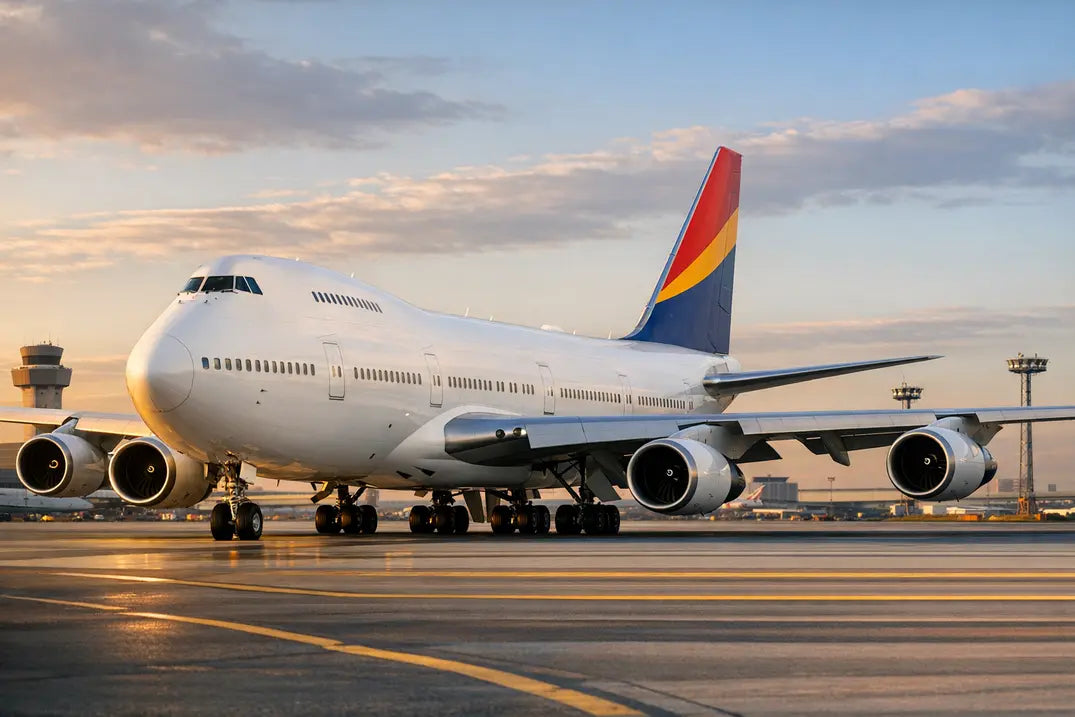
Compared with the closest predecessor sub variants in everyday airline service, the Boeing 747-300’s defining feature is that it standardised the stretched upper deck as the baseline configuration, rather than leaving it as an airline specific modification. In practical cabin planning terms, this meant more usable premium floor area upstairs and a different balance of galley and seating space on the main deck, because the upper deck could take a larger share of high yield seating. Relative to the later 747-400, the 747-300 remains a “Classic” aircraft: it does not incorporate the 747-400’s winglets, additional fuel tanking concept, or two crew glass cockpit automation package, even though it influenced the external shape that the 747-400 retained.
In certification and fleet engineering terms, the 747-300 is also easier to place: it is explicitly defined by the FAA as a 747-200 series baseline with a stretched upper deck, and it keeps classic 747 operating limitations such as VMO and MMO values set within the established family framework. Ongoing airworthiness oversight for the 747 line, including the 747-300, continues through the airworthiness directive process. EASA’s Safety Publications Tool lists the 747-300 among affected models for certain FAA issued directives, underscoring that the variant remains part of the regulated continuing airworthiness ecosystem (EASA Safety Publications Tool entry US-2023-12-14).
Variant identifiers for quick recognition and specification checks include:
- FAA model definition: described as a 747-200 series airplane with a stretched upper deck
- FAA approval milestone: 1 March 1983 (747-300 series approval under TCDS A20WE)
- Engine families approved for the variant: Pratt and Whitney JT9D-7R4G2; General Electric CF6-50E2 and CF6-80C2B1; Rolls Royce RB211-524B2-19, RB211-524C2-19, RB211-524D4-19, RB211-524D4-39
- Operational identity: four engine transport category 747 Classic, retaining the classic systems and crew concept rather than the later two crew automation of the 747-400
- Certification driven cabin limits: FAA passenger capacity limitations are tied to installed exit configuration and compliance status
- Family relationship: the later 747-400 is defined by the FAA as a 747-300 series baseline with wing extension, winglets, added fuel tanking and a two man crew cockpit

A Boeing 747 aircraft operated by Iberia is seen flying over a mountainous landscape, showcasing the airline's classic red, orange, and yellow livery.
Boeing 747-300 technical specifications, systems highlights and engines
The Boeing 747-300 sits in the “Classic” 747 lineage and is defined, from a certification standpoint, as essentially a 747-200 series aeroplane with a stretched upper deck. That change targets a clear mission: carry more people (or more premium seating and galleys) without redesigning the core airframe, wing, landing gear, and systems architecture that made earlier 747s viable on long range trunk routes.
Technically, the variant is best understood as a capacity and layout optimisation rather than a clean sheet performance leap. The design trade off is straightforward: the upper deck stretch improves cabin flexibility and revenue potential, while operators still plan runway performance, fuel burn, and payload around classic 747 constraints (available thrust rating, structural weight limits, and airport compatibility). In passenger service, the same airframe can feel very different depending on airline cabin density, seat pitch, service philosophy, and maintenance culture; for a passenger facing comparison framework, see this airline experience guide.
- Certification basis (variant definition): The FAA type certificate describes the 747-300 as basically a 747-200 series aeroplane with a stretched upper deck (FAA Type Certificate Data Sheet A20WE, PDF).
- Approved engine options (as installed on the 747-300 series): Pratt and Whitney JT9D-7R4G2; General Electric CF6-50E2 and CF6-80C2B1; Rolls-Royce RB211-524B2-19, RB211-524C2-19, RB211-524D4-19, RB211-524D4-39 (FAA TCDS A20WE, PDF).
- Airspeed operating limit: VMO/MMO 375/0.92 (KEAS) listed for the 747-300 series (FAA TCDS A20WE, PDF).
- Certified passenger capacity note (exit limited): The type certificate includes a 747-300 and 747-100B SUD passenger capacity limitation of 660 passengers with 5 pairs of Type A exits on the main deck plus one pair of Type A exits on the upper deck, with the main deck limited to 550 and the upper deck limited to 110 under the referenced configuration (FAA TCDS A20WE, PDF).
- Thrust class context (engine family level): JT9D later models cover 48,000 to 56,000 pounds thrust (Pratt and Whitney, JT9D product page).
- Thrust class context (engine family level): CF6-50 is described by GE Aerospace as a 46,000 to 54,000 pound thrust derivative (GE Aerospace, CF6 engine family; and CF6-50 rating range in GE documentation, commercial engine status report).
Systems and handling relevant technology
For flight crews and engineers, the headline “747-200 with a stretched upper deck” matters because it implies operational continuity: much of what drives dispatch and day-to-day handling (engine choice, weight management, and airport infrastructure compatibility) sits on a mature classic 747 baseline rather than a new generation flight deck and systems suite. The stretched upper deck primarily changes cabin arrangement and emergency egress configuration considerations, which in turn affects certified seating limits under specific exit layouts (as captured in the type certificate).
On the ground, one of the most distinctive handling features across the 747 family is the combination of a multi-bogie main gear layout with steering support. Boeing documentation for the 747 describes a steering system that incorporates steering of the main body landing gear in addition to nose gear steering, with the body gear steering centred, mechanically locked, and depressurised for takeoff and landing. The stated benefits include improved manoeuvrability, reduced need for differential braking in turns (and therefore reduced brake wear), lower thrust requirements, and reduced tyre scrubbing during tight ground manoeuvres (Boeing airport planning material reproduced at 747 airport planning document).
In flight, “numbers” such as cruise Mach, climb capability, and range are strongly governed by weight, engine rating, and drag configuration rather than the upper deck stretch alone. Practically, that means a 747-300’s handling and performance planning often comes down to: selecting an engine programme aligned with route structure and maintenance strategy, keeping within airspeed limits (VMO/MMO), and managing centre of gravity and structural limits through fuel and payload distribution, especially on long sectors.
Published performance figures for the 747-300 can vary widely between sources and operators. The reasons are usually operational rather than contradictory data: different cabin densities (and therefore payload), differing operating empty weight and configuration, engine variant and thrust rating, assumed atmospheric conditions (ISA deviation), runway slope and surface condition, use of anti ice or packs settings, and whether the performance basis is still air range, still air distance with reserves, or a dispatch range with operator policies. For serious planning and engineering work, the authoritative baseline is the operator’s approved flight manual and performance programme, with the type certificate and manufacturer documentation defining the boundaries and approved configurations.
Engines on the Boeing 747-300: JT9D, CF6, and RB211 options
The 747-300 is approved with three major engine families, each with its own industrial history and operational logic. The FAA type certificate lists Pratt and Whitney JT9D-7R4G2, General Electric CF6-50E2 and CF6-80C2B1, and Rolls-Royce RB211-524 variants as approved installations on the 747-300 series (FAA TCDS A20WE).
Pratt and Whitney JT9D is historically central to the early widebody era. Pratt and Whitney describes the JT9D as the high bypass ratio engine that opened a new era in commercial aviation and notes entry into service on the Boeing 747 in 1970. The same manufacturer page lists other aircraft families powered by JT9D variants, including Boeing 767, Airbus A300, Airbus A310, and McDonnell Douglas DC-10, and it also provides thrust range context for later JT9D models (Pratt and Whitney, JT9D engine overview).
GE Aerospace CF6 is one of the longest running commercial widebody engine programmes. GE states that the CF6 engine family entered service in 1971 and that the CF6-80C2 continues in production today, reflecting a long evolutionary path within the family. For the 747-300 context, the key point is that the type certificate includes CF6-50E2 as well as CF6-80C2B1 as approved installations, depending on the specific aircraft build and certification. GE describes the CF6-50 as a 46,000 to 54,000 pound thrust derivative and notes its selection to power, among others, the Boeing 747 (GE Aerospace, CF6 engine family; additional CF6 family background in GE Aerospace communications, CF6 50 years of revenue service).
Rolls-Royce RB211-524 brings the distinctive Rolls-Royce triple spool architecture into the classic 747 era. Academic propulsion references summarise the RB211-524 family applications as including the 747 and 767, which aligns with the 747-300 type certificate listing of RB211-524 variants as approved engines (Purdue University propulsion reference, RB211 family overview; and FAA TCDS A20WE, PDF).
Comparison of Boeing 747 Variants
Scroll horizontally to see more →
| Parameter | Boeing 747-300 | Boeing 747-400 | Boeing 747-200 | Boeing 747-8 |
|---|---|---|---|---|
| Entry into service | 1983 | 1989 | 1970 | 2011 |
| Engines | 4 × GE CF6-50E2 / PW JT9D-7R4G2 / RR RB211-524 | 4 × GE CF6-90 / PW PW4000 / RR RB211-524G | 4 × PW JT9D / GE CF6-50 / RR RB211-524 | 4 × GE GEnx-2B67 |
| Length | 70.6 m | 70.6 m | 70.3 m | 76.3 m |
| Wingspan | 59.6 m | 64.4 m | 59.6 m | 68.4 m |
| Height | 19.3 m | 19.4 m | 19.3 m | 19.4 m |
| Typical seating and layout | 3-class: 400–496 passengers | 3-class: 416–524 passengers | 3-class: 366–440 passengers | 3-class: 410–467 passengers |
| MTOW | 340 t | 396 t | 366 t | 447 t |
| Range | 6,700 nm | 7,260 nm | 6,850 nm | 8,000 nm |
| Cruise speed | 0.85 Mach | 0.85 Mach | 0.85 Mach | 0.85 Mach |
| Service ceiling | 45,100 ft | 45,100 ft | 45,100 ft | 43,100 ft |
| Program note | Partial double-deck with stretched upper deck, improved engines over -200 | Same fuselage length as -300 but with winglets, glass cockpit, more efficient | Original production 747 baseline, shorter upper deck introduced Queen of the Skies | Modern stretched 747 with new wing, GEnx engines, longest-range 747 variant |
Scroll horizontally to see more →
This table compares key specifications of the Boeing 747-200, 747-300, 747-400, and 747-8 variants. It highlights the evolution in range, size, and performance, with the 747-8 offering the longest range and highest MTOW. The 747-400 introduced major efficiency upgrades over the 747-300, while the 747-8 stands out for its stretched fuselage and modern engines. All versions maintain similar cruise speeds and seating in a 3-class layout.
Boeing 747-300 operations, routes, missions and airlines worldwide
The Boeing 747-300 was built for airlines that needed classic 747 capacity on slot constrained trunk routes, but wanted more usable cabin and premium space than earlier 747 Classics. In day to day airline planning, this meant using the aircraft where demand peaks were predictable, connection banks were strong, and the commercial case favoured very high seat and belly cargo volume on a single departure: intercontinental hub routes, high season leisure flows, and (in specific domestic markets) very high frequency, very high density shuttle style flying.
In typical passenger service, the Boeing 747-300 was rostered to make the most of its large fixed costs: a long sector paired with another long or medium sector, or a single long out and back rotation designed to keep the aircraft productive while still fitting into overnight maintenance windows. For a sense of widebody utilisation benchmarks used by large carriers in published operating statistics, US DOT Form 41 derived datasets commonly show widebody fleets clustering around roughly 10 to 12 block hours per aircraft per day in normal operations, with seasonal and network driven variation (MIT Airline Data Project, carrier operating statistics). The same scheduling logic applied to the Boeing 747-300 in its mainline era: operators tried to avoid long ground times, while protecting turnarounds with extra catering, cleaning, and baggage time due to cabin size and lower deck loading.
Beyond passenger networks, the Boeing 747-300 also built an operational reputation through conversions. In a Boeing passenger to freighter programme, Boeing described the converted 747 300 Special Freighter as capable of carrying approximately 235,000 lb of revenue payload with approximately 4,200 nautical miles of range, and a total volume of 26,600 cubic feet (Boeing newsroom: first 747 300 Special Freighter to Atlas Air). Operationally, that puts the variant into the long haul cargo bracket where hubs, night time slots, and fast main deck loading drive the economics, and where a small number of weekly frequencies can still move significant tonnage.
The Boeing 747-300 worked best in hub and spoke systems with strong long haul banks, because its size rewards high load factors and good onward connectivity. It also suited point to point leisure flying when tour operators could reliably fill several hundred seats on the same departure day after day. The main constraints were operational rather than aerodynamic: many airports needed Code E stands, compatible jet bridges, high capacity baggage systems, and sufficient tug power and towbar procedures. Dispatch reliability planning also had to account for four engine maintenance exposure and (for classic 747 cockpits) the flight engineer role, which affects crew planning, training pipelines, and duty time management. Crew standardisation and recurrent training are central to safe, consistent widebody operations, and these topics are part of the wider professional ecosystem around airline flying (Ready for Takeoff, the team).
Where the aircraft operates around the world
Historically, the Boeing 747-300 saw its most visible passenger missions on high demand intercontinental links between major hubs in Europe, across the North Atlantic and into the Middle East, and on dense long haul corridors in Asia including Japan’s very high capacity domestic flying (in the short range 747 300SR sub variant). In North and South America, the type appeared more often through charter, cargo, and later conversion driven roles, supporting long haul freight networks and ad hoc passenger demand rather than large scale scheduled flag carrier deployment. In Africa, the aircraft was used by a smaller set of operators, but it played a major role on long range trunk links from southern Africa and on combi operations where passenger demand and cargo yields needed to be balanced in a single airframe.
Across all regions, the missions were consistent with what the 747 Classic family enabled at the time: consolidating demand into fewer departures, carrying large belly cargo volumes alongside passengers, and providing premium cabin space on the upper deck for network airlines. As the industry shifted to more fuel efficient twin engine widebodies, the Boeing 747-300 increasingly migrated toward high density leisure, ACMI style deployment, and cargo conversions where airframe availability and payload volume remained commercially useful.
- Europe: Swissair used the Boeing 747-300 family from Zurich on long haul hub routes with strong premium demand and significant belly cargo; KLM deployed Boeing 747-300 aircraft within Amsterdam Schiphol bank structures on intercontinental services where capacity and slots were key constraints; Sabena operated Boeing 747-300 aircraft from Brussels on long haul markets where a single departure could carry both local and connecting demand; Union de Transports Aériens operated Boeing 747-300 aircraft on long haul services that often reflected multi stop, lower frequency network patterns; Iberia operated Boeing 747-300 aircraft as a high capacity solution on selected long haul services during a period of fleet transition; Corsair used Boeing 747-300 aircraft in leisure high density roles out of France, where seat mile economics mattered more than premium cabin breadth; Air Atlanta Icelandic became known for operating classic 747 variants, including Boeing 747-300, in wet lease style deployments when operators needed additional widebody lift.
- North & South America: Atlas Air operated converted Boeing 747-300 Special Freighters as part of long haul cargo networks where main deck volume, payload, and overnight connectivity are central to the business case (see Boeing programme description in the linked Boeing release); Focus Air Cargo used Boeing 747-300 freighter capacity in all cargo operations, supporting long range freight links between the Americas and overseas markets; Emtrasur Cargo operated a Boeing 747-300M freighter within a cargo context, illustrating how late life 747 300 airframes could still be economically deployed for niche freight missions when available lift was constrained.
- Asia: Japan Airlines operated Boeing 747-300 variants including very high density domestic missions in Japan (notably with the short range domestic approach used for high frequency, high volume city pairs); Singapore Airlines operated Boeing 747-300 family aircraft on long haul routes where premium capacity and network connectivity supported the economics; Cathay Pacific used Boeing 747-300 aircraft within a Hong Kong hub context during the classic 747 era; Qantas operated Boeing 747-300 aircraft on long haul sectors linking Australia with major international gateways; Pakistan International Airlines used Boeing 747-300 aircraft on long haul routes to Europe and North America during periods when very large capacity was required; Saudi Arabian Airlines used Boeing 747-300 family aircraft on high demand services, including travel peaks associated with pilgrimage flows; Mahan Air operated Boeing 747-300 aircraft in later life service, showing the type’s persistence in markets where older widebodies can remain viable.
- Africa: South African Airways used Boeing 747-300 aircraft on long range trunk routes from Johannesburg where capacity and payload were critical to route economics; TAAG Angola Airlines operated Boeing 747-300 aircraft, including combi use, linking Luanda with major international destinations during the classic 747 era; EgyptAir operated Boeing 747-300 aircraft through the 1980s into the 2000s on high demand international services, aligning with the type’s role as a flagship high capacity widebody for network airlines.
Typical seating and cabin trends
Cabin capacity on the Boeing 747-300 varied widely by operator strategy. A widely cited reference set for classic widebody seating illustrates the scale: approximately 412 seats in a three class layout, approximately 496 seats in a two class layout, and up to 660 seats in a maximum density single class arrangement (Civil Jet Aircraft Design, aircraft data tables (Elsevier)). In practice, network carriers typically stayed closer to the lower end of that range to protect premium cabin revenue and galley and lavatory ratios, while leisure and charter operators pushed higher seat counts to reduce unit costs on dense holiday routes.
The Boeing 747-300 cabin structure encouraged a familiar split between the main deck and the stretched upper deck. Main deck economy was commonly arranged at ten abreast (3 4 3), which maximised seat count but required careful aisle management during service and boarding. The upper deck was often configured as premium seating for network airlines, because it is quieter, has a distinct boarding flow, and supports a clear product separation. In high density operations, the upper deck could also be used to add additional economy or premium economy type seating, depending on the operator’s commercial model and galley placement.
For readers looking for operator facing planning references, Boeing publishes airport and servicing characteristics documents for the 747 Classic family that inform how cabin and ground handling constraints translate into real turn times and gate planning (Boeing airport planning manuals). Those planning assumptions matter directly for cabin strategy: a higher seat count does not only change revenue potential, it also changes turnaround staffing, catering uplift, potable water and waste service demand, and boarding and deplaning time, all of which feed back into achievable daily utilisation for a Boeing 747-300 operator.
This video explores the reasons behind the commercial failure of the Boeing 747-300, examining its design, market timing, and competition to understand why it fell short compared to other models in the iconic 747 series.
Boeing 747-300 safety record and how safe the aircraft is overall
The Boeing 747-300 safety record needs to be read in context: it is a mature widebody design that operated for decades in high utilisation, long haul airline service, where exposure is measured in vast numbers of departures, landings, flight hours and operational cycles. In that environment, even a small number of serious events can appear prominent, especially when a single accident receives major investigative attention and drives industry wide learning. As with most transport aircraft, the pattern of events involving the Boeing 747-300 and closely related 747 Classics is dominated by operational and human factors on approach, landing and ground handling, rather than by a single defining airframe weakness.
At the industry level, the risk backdrop is exceptionally low: in 2024 airlines carried about 5 billion passengers on over 40 million flights, with an all accident rate of 1.13 per million flights, as reported in the IATA Annual Safety Report. IATA Annual Safety Report 2024 executive summary
For the Boeing 747-300 specifically, its safety outcome is best understood as the sum of four layers of defence: the aircraft’s redundant systems and performance margins, disciplined standard operating procedures, strong crew resource management and monitoring, and robust oversight by regulators and operators. When a layer is weakened, for example through fatigue, incomplete training, degraded situational awareness, unclear ground rules or gaps in airport safety nets, the remaining defences are forced to carry more load.
Notable accidents and serious incidents linked to the Boeing 747-300
- Korean Air Flight 801, 1997 (Boeing 747-300) During the approach into Guam, the aircraft impacted terrain after being cleared to land. The NTSB identified the central issue as flight crew performance on a non precision approach, specifically the captain’s failure to adequately brief and execute the approach and the other flight deck crewmembers’ failure to effectively monitor and cross check. Contributing factors included the captain’s fatigue, inadequate flight crew training, and the FAA’s intentional inhibition of the minimum safe altitude warning system (MSAW) at Guam and its inadequate management of that system. The lasting safety impact is not limited to one airline: the investigation reinforced best practice around stabilised approaches, assertive monitoring and callouts, clear go around decision making, fatigue risk management, and reliable terrain safety nets around airports. NTSB investigation DCA97MA058
- Ansett Australia flight 881, 1994 (Boeing 747-312, 747-300 series) After departure the crew shut down an engine due to an oil leak, returned to Sydney, then continued the approach while warning indications persisted and landed with the nose landing gear retracted. The investigation discussed the technical chain (including the original oil leak) and also highlighted the operational side: interpretation of flight deck indications, crew coordination and decision making under time and organisational pressure. The broader learning is classic high capacity transport aviation: abnormal situations require disciplined troubleshooting, unambiguous cross checks, and a strict bias towards a go around when configuration status is uncertain. BASI investigation report 9403038 (ATSB archive)
- Korean Airlines ground accident at Chicago O’Hare, 1992 (Boeing 747-300) While the aircraft was taxiing, a ground vehicle entered the jet blast area and was overturned, resulting in a fatal ground injury. The NTSB pointed to the hazardous condition not being identified by the vehicle driver and inadequate separation distance. Although not an airworthiness issue, it is directly relevant to day to day safety: a Boeing 747-300’s high thrust settings at low speed can produce powerful jet blast, so airports and operators rely on strict ramp rules, vehicle routing discipline, and training that treats jet blast as a predictable hazard rather than an unusual one. NTSB final report CHI92LA250 (PDF)
How safe is the Boeing 747-300?
In general terms, the Boeing 747-300 is a safe aircraft when operated within its certified envelope and under a modern safety management framework. The design itself was built for airline reliability and tolerance of failures through redundancy and clear abnormal procedures, and its three person flight deck architecture was intended to support workload management through division of tasks. The events that matter most in its history are strongly tied to execution: approach briefings, monitoring discipline, stabilised approach criteria, clear go around triggers, and the integrity of external safety nets such as terrain warning logic and airport alerting systems. The Korean Air 801 investigation is a direct example of how these layers interact, including the role of fatigue and training in eroding monitoring performance. NTSB investigation summary
It is also important to separate aircraft type risk from operator risk. A well maintained Boeing 747-300 flying for an operator with strong SOP compliance, robust line training, effective crew pairing and proactive fatigue management is not comparable to the same airframe flown with weak standardisation or poor oversight. Fitness to fly is part of that chain, which is why pilots and cabin crew are subject to medical standards, periodic examinations and human performance controls. Related background is covered in aeronautical medicine, medical examinations and emerging aviation health technologies.
From a passenger perspective, the practical answer to how safe it is can be stated simply: the Boeing 747-300 operates in a regulatory environment where procedures, training standards, maintenance requirements and accident investigation are designed to make catastrophic outcomes exceptionally rare. The overall trend in commercial aviation is continuous improvement, and global safety statistics compiled by organisations such as IATA support the conclusion that commercial flying remains one of the safest modes of transport. IATA Annual Safety Report 2024
01 What is the typical range of the Boeing 747-300?
The Boeing 747-300 has a range of about 10,360 km with maximum payload, extending to around 10,967 km in a typical two-class configuration with 486 passengers. This makes it suitable for long-haul routes like transatlantic or transpacific flights. Fuel capacity supports up to 198,380 liters, enabling efficient operation over these distances.
02 How many passengers can the Boeing 747-300 carry?
In a high-density one-class setup, it accommodates up to 580 passengers, while a three-class layout holds 412. Typical two-class arrangements seat around 496 passengers across its wide 6.13-meter cabin. The upper deck, accessed via a straight stairway, adds significant capacity compared to earlier models.
03 What engines power the Boeing 747-300?
It uses four turbofan engines such as GE CF6-50E2 (235 kN thrust), P&W JT9D-7R4G2 (243 kN), or R-R RB211-524D4 (236 kN). These provide a cruise speed of Mach 0.85 (around 900-910 km/h) and support a service ceiling of 13,715-13,750 meters. Engine options contribute to its reliable performance on extended routes.
04 What distinguishes the Boeing 747-300 cabin from earlier 747 models?
The Boeing 747-300 features a straight stairway to the upper deck instead of a spiral one, freeing space for additional seats above and below. This design improves passenger flow and capacity, with the upper deck holding up to 69-85 economy seats. The overall cabin offers a spacious ten-abreast economy layout for comfort on long flights.
05 How does the Boeing 747-300 perform compared to other 747 variants?
The 747-300 cruises at Mach 0.85, slightly faster than the Mach 0.84 of the -100 and -200, thanks to minor aerodynamic tweaks while keeping the same takeoff weight. Its range exceeds the -100's 9,800 km but falls short of the -400's 14,800 km due to lacking winglets. Fuel efficiency stands at about 22.4 g/passenger-km, suitable for high-capacity long-haul missions.
06 What are good seat choices on a Boeing 747-300 for passengers?
Upper deck seats offer quieter rides with less engine noise and better views, ideal for window lovers despite fewer total seats. Main deck forward sections provide more legroom near galleys, while avoiding rear rows minimizes turbulence feel. The wide cabin reduces crowding, but check airline layouts as configurations vary from 412 to 580 seats.