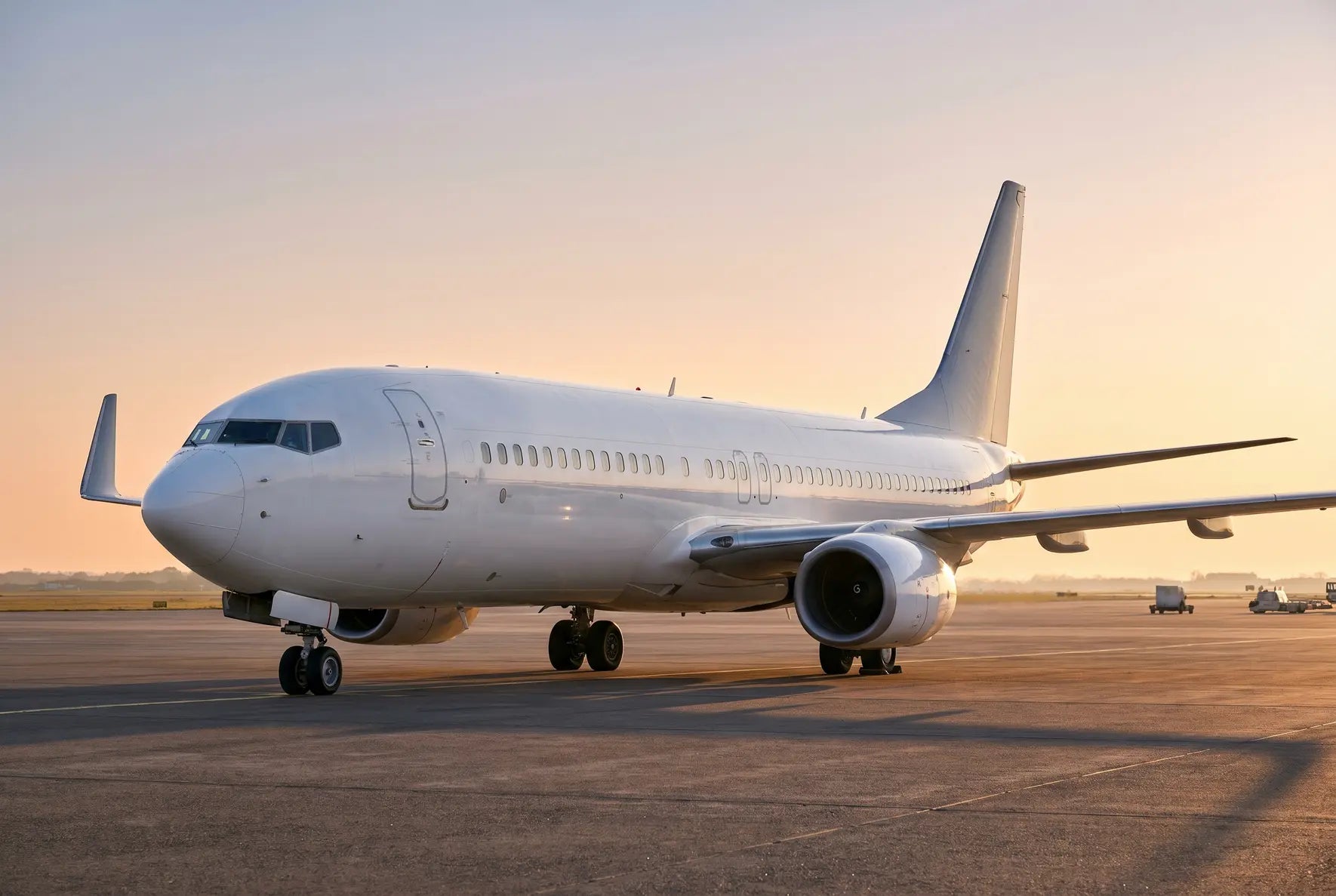
Boeing 737-900: Program Launch, Development History and Variant Evolution
The Boeing 737-900 emerged as the largest member of the 737 Next Generation (NG) family, a third-generation evolution of the world's best-selling single-aisle jet. Boeing launched the 737NG programme in November 1993 to replace the ageing 737 Classic series (-300/-400/-500) with a modernised airframe featuring a redesigned, higher-span wing, upgraded CFM56-7B engines from CFM International, a digital glass cockpit and updated cabin interiors. While the -600, -700 and -800 variants were the first to enter development, Boeing formally announced the 737-900 in 1997 as a stretched derivative intended to capture the higher-capacity end of the short- to medium-haul market.
Alaska Airlines was named the launch customer for the 737-900 programme, placing the order that officially triggered the variant's go-ahead. By mid-2000, the first prototype was ready for flight testing. The aircraft completed its maiden flight on 3 August 2000 from Boeing's Renton, Washington facility. A rigorous 381-hour flight-test campaign followed, covering the full certification envelope for both the airframe and the CFM56-7B powerplant. On 17 April 2001, the Boeing 737-900 received FAA type certification, clearing it for commercial operations. First delivery to Alaska Airlines took place shortly after, in April 2001, marking the variant's entry into revenue service.
Boeing Commercial Airplanes manufactured all 737-900 airframes at its Renton plant in Washington State. Production of the baseline 737-900 was modest: a total of approximately 52 aircraft were built and delivered between 2001 and 2003. The core customer base consisted of just four airlines: Alaska Airlines, Continental Airlines (whose fleet later transferred to United Airlines following their 2010 merger), KLM Royal Dutch Airlines and Korean Air. This limited uptake reflected a fundamental commercial constraint: although the 737-900 offered roughly 2.6 metres of additional fuselage length over the 737-800, Boeing retained the same emergency exit configuration as the shorter variant. This restricted maximum certified seating to 189 passengers, the same limit as the 737-800, effectively negating much of the stretch advantage for high-density operators.
That limitation became the primary catalyst for the 737-900ER (Extended Range), which Boeing officially launched in July 2005 with Lion Air as the launch customer. The 737-900ER first flew on 1 September 2006 and entered service in April 2007. It addressed the baseline model's shortcomings with structural reinforcements, a higher maximum take-off weight of approximately 85,130 kg versus 79,000 kg, auxiliary fuel tanks for extended range, an additional pair of overwing emergency exits, and a flat rear pressure bulkhead that freed extra cabin space for up to 220 seats in single-class configuration. The ER variant also incorporated a short-field performance package as standard. These upgrades transformed the 737-900 concept into a far more competitive product against the Airbus A321. For readers seeking a broader understanding of how different aircraft types compare and connect to everyday flying, Ready for Take-Off provides an accessible and richly illustrated reference.
Boeing ended commercial production of all 737 Next Generation variants in 2019, with final NG deliveries completed in January 2020, as the 737 MAX family took over as Boeing's current-production single-aisle line.
What Sets the Boeing 737-900 Apart from Related Variants
The baseline Boeing 737-900 occupies a narrow niche between the highly successful 737-800 and the later 737-900ER. Compared with the 737-800, it offers a longer fuselage (42.1 m versus 39.5 m) and more cabin volume, yet shares an identical maximum take-off weight of 79,000 kg and the same CFM56-7B engine options, resulting in no meaningful payload-range advantage. Against its own successor, the 737-900ER, the baseline model lacks the structural upgrades, higher weight limits, additional exits and auxiliary fuel capacity that made the ER variant commercially viable for a wider range of operators.
Key variant identifiers for the Boeing 737-900 (non-ER) include:
- Engines: two CFM International CFM56-7B turbofans (typically CFM56-7B24 or CFM56-7B26, rated at approximately 24,200 to 26,300 lbf thrust each)
- Wingtip devices: blended winglets (optional); wingspan of 35.8 m with winglets, 34.3 m without
- Maximum take-off weight: 79,000 kg (174,200 lb), identical to the 737-800
- Maximum certified seating: 189 passengers (exit-limited, same as the 737-800)
- Typical two-class seating: approximately 177-178 passengers
- Fuselage length: 42.1 m (138 ft 2 in), approximately 2.6 m longer than the 737-800
- Total production: approximately 52 aircraft delivered (2001-2003)
- No auxiliary fuel tanks or flat rear pressure bulkhead (features reserved for the 737-900ER)

A Delta Air Lines Boeing 737-800 aircraft is seen in flight with a clear blue sky in the background. The airplane features the airline's signature livery and is captured mid-flight, showcasing its sleek design.
Boeing 737-900 Technical Specifications, Systems, and Engine Overview
The Boeing 737-900 is the longest fuselage variant in the 737 Next Generation (NG) family, designed to compete directly with the Airbus A321 in the high-capacity, short-to-medium-range segment. Stretching the proven 737-800 airframe by an additional 2.6 m (8 ft 6 in), the 737-900 trades some range capability for higher passenger capacity while retaining the same wing, landing gear, and systems architecture shared across all NG variants. The result is an airframe optimised for dense domestic and regional routes where seat-mile cost matters most.
From an engineering perspective, the 737-900 inherits the redesigned NG wing with greater area and span compared to the 737 Classic generation, along with improved aerodynamics, higher fuel capacity, and a modernised cockpit. It is powered exclusively by CFM International CFM56-7B series engines, and its maximum takeoff weight of approximately 79,000 kg (174,000 lb) positions it between the lighter 737-800 and the later, structurally reinforced 737-900ER. While Boeing also builds large freighter variants like the Boeing 747-400ERF for dedicated cargo operations, the 737-900 remains firmly focused on the passenger market.
- Length: 42.1 m (138 ft 2 in)
- Wingspan: 35.8 m (117 ft 5 in), with blended winglets available
- Height: 12.5 m (41 ft 3 in)
- Typical seating: 177-178 passengers (two-class); up to 189 (single-class); maximum certified 220 seats
- Maximum Takeoff Weight (MTOW): approximately 79,000 kg (174,000 lb)
- Maximum Landing Weight (MLW): 66,360 kg (146,300 lb)
- Operating Empty Weight (OEW): approximately 42,490 kg (93,670 lb)
- Maximum Zero Fuel Weight (MZFW): 62,730 kg (138,270 lb)
- Fuel capacity: approximately 26,030 litres (6,875 US gallons)
- Engines: 2x CFM International CFM56-7B24, -7B26, or -7B27 (24,000 to 27,300 lbf thrust per engine)
- Range: approximately 2,745 NM (5,080 km) with maximum payload
- Long-range cruise speed: approximately Mach 0.79 (460 KTAS / 850 km/h)
- Maximum operating speed: Mach 0.82 (Mmo)
- Service ceiling: 41,000 ft (12,500 m)
- Takeoff field length (typical at MTOW): approximately 2,300 m (7,550 ft)
- Landing field length (typical): approximately 1,700 m (5,580 ft)
- Avionics baseline: 737NG EFIS with dual FMC, PFD/ND displays, optional HGS (Head-Up Guidance System)
- Flight crew: 2 (pilot and co-pilot)
Systems Architecture and Handling Technology
Unlike fly-by-wire aircraft such as the Airbus A320 family or the Boeing 787, the 737-900 retains a conventional mechanical flight control system. Primary flight controls (ailerons, elevators, and rudder) are connected to the cockpit via cables, pulleys, and quadrants, and are actuated by hydraulic Power Control Units (PCUs) fed by dual independent hydraulic systems (A and B). In the event of a dual hydraulic failure, ailerons and elevators can revert to manual operation through aerodynamic tab assistance, a design feature that traces back to the original 737 architecture.
The secondary flight controls include hydraulically powered flight spoilers for roll augmentation and speedbrake function, ground spoilers for post-landing deceleration, and double-slotted trailing-edge flaps paired with leading-edge slats and flaps for low-speed performance. The braking system features multi-disc wheel brakes on the main landing gear with a fully automatic anti-skid system and an autobrake selector offering multiple deceleration settings plus a dedicated Rejected Takeoff (RTO) mode for high-speed aborts.
Automation on the 737-900 is built around the Automatic Flight Director System (AFDS), which integrates dual autopilot channels, an autothrottle, and the Flight Management Computer (FMC). The FMC provides LNAV/VNAV capability, performance-optimised profiles for all flight phases, and supports RNAV/RNP procedures. Engine control is managed by Full Authority Digital Engine Control (FADEC), which optimises fuel scheduling, monitors engine parameters, and enables precise thrust management including assumed-temperature and derated takeoff procedures.
Published performance figures for the 737-900 should always be interpreted in context. Values for range, takeoff field length, and payload capacity vary significantly depending on operator-selected options such as cabin density, optional auxiliary fuel tanks, blended winglet installation, specific engine thrust rating, and certified weight variants. Atmospheric assumptions (temperature, pressure altitude, wind) and runway conditions further affect real-world performance. The figures listed above are representative manufacturer or reference values and should not be treated as absolute for any specific airframe or operation.
CFM56-7B Engines: History, Variants, and Applications
The Boeing 737-900 is powered exclusively by the CFM International CFM56-7B engine family, a high-bypass turbofan produced by the joint venture between GE Aerospace and Safran Aircraft Engines. The CFM56-7B was developed specifically for the 737 Next Generation programme as a successor to the CFM56-3 that powered the 737 Classic series (-300/-400/-500). First certified in 1996 by the FAA and French DGAC, the engine entered airline service on the 737-700 with Southwest Airlines in 1997.
Key technical features of the CFM56-7B include a 61-inch diameter solid titanium wide-chord fan, single-crystal high-pressure turbine blade materials, and FADEC. Compared to the earlier CFM56-3, the -7B delivers approximately 8% lower fuel burn and around 15% reduced maintenance costs. The engine family spans nominal takeoff thrust ratings from 19,500 to 27,300 lbf, with the 737-900 typically fitted with the CFM56-7B24 (24,000 lbf), CFM56-7B26 (26,000 lbf), or CFM56-7B27 (27,300 lbf). The specific variant depends on the airline's selected maximum takeoff weight and operational requirements; different thrust ratings are often achieved via FADEC software limits rather than fundamental hardware changes.
In 2007, CFM introduced the Tech Insertion upgrade for the CFM56-7B, incorporating improvements to the high-pressure compressor, combustor, and turbine sections. This delivered roughly 1% lower fuel burn, 15-20% lower NOx emissions, and approximately 5% reduced maintenance costs. A further evolution, the CFM56-7BE, was certified in July 2010 and began deliveries in mid-2011, adding redesigned turbine blading and nozzle components derived from LEAP technology research for additional efficiency gains. The CFM56-7B is the exclusive powerplant for the entire 737NG family, including the 737-600, 737-700, 737-800, 737-900/900ER, and Boeing Business Jet (BBJ) derivatives. Its successor, the CFM LEAP-1B, powers the Boeing 737 MAX family and is not interchangeable with NG airframes.
Boeing 737-900 vs 737-800 vs 737-900ER vs Airbus A321-200 Specifications
Scroll horizontally to see more →
| Parameter | Boeing 737-900 | Boeing 737-800 | Boeing 737-900ER | Airbus A321-200 |
|---|---|---|---|---|
| Entry into service | 2001 | 1998 | 2007 | 1994 |
| Engines | 2 × CFM International CFM56-7B24/26 turbofans | 2 × CFM International CFM56-7B24/26 turbofans | 2 × CFM International CFM56-7B27 turbofans | 2 × CFM International CFM56-5B turbofans |
| Length | 42.1 m | 39.5 m | 42.1 m | 44.5 m |
| Wingspan | 35.8 m | 35.8 m | 35.8 m | 34.1 m |
| Height | 12.5 m | 12.5 m | 12.5 m | 11.8 m |
| Typical seating and layout (short description + approximate passengers) | 2-class: 170–180 passengers | 2-class: 160–175 passengers | 2-class: 180–189 passengers | 2-class: 185–200 passengers |
| MTOW | 79 t | 79 t | 85.1 t | 93.5 t |
| Range | 2,740 nm | 2,935 nm | 3,185 nm | 3,200 nm |
| Cruise speed | 0.79 Mach | 0.79 Mach | 0.79 Mach | 0.78 Mach |
| Service ceiling | 41,000 ft | 41,000 ft | 41,000 ft | 39,000 ft |
| Program note | Longest standard-fuselage member of the 737NG family, optimized for high-density short- to medium-haul routes. | Core workhorse of the 737NG family, balancing capacity, range and operating economics for global short- to medium-haul networks. | Extended-range, higher-MTOW evolution of the 737-900, aimed at transcontinental and longer medium-haul missions with more seats. | Stretch of the A320 family and direct competitor to larger 737NG variants, widely used on dense short- and medium-haul routes. |
Scroll horizontally to see more →
The table compares key specs of the Boeing 737-900, 737-800, 737-900ER and Airbus A321-200, highlighting how capacity and range trade off. The 737-800 is shorter with slightly less seating but offers more range than the 737-900. The 737-900ER raises MTOW and range beyond both, while the A321-200 is longest with the highest seating and MTOW, and similar range to the 737-900ER.
Boeing 737-900 Operations: Airlines, Typical Routes and Missions Worldwide
The Boeing 737-900 was designed for high-density domestic and medium-range international routes, sitting at the top of the 737 Next Generation family in terms of fuselage length. Only 52 airframes of the original non-ER variant were built before Boeing shifted production to the improved 737-900ER, which means the baseline 737-900 is comparatively rare. Its primary mission is to connect major hubs with large secondary cities and popular leisure destinations on sectors typically ranging from 700 to 2,300 nautical miles (approximately 1,300 to 4,300 km), translating to block times of roughly 1.5 to 5 hours.
In daily operations, airlines commonly schedule the Boeing 737-900 for 4 to 5 sectors per day, achieving around 8 to 12 block hours of daily utilisation. Annualised, that translates to approximately 3,000 flight hours per year, a figure consistent with broader 737NG family utilisation data published by CFM International, the engine manufacturer. The aircraft cruises at about Mach 0.78 to 0.79 (around 850 km/h) and is well suited to both hub-and-spoke networks, where it feeds traffic from secondary cities into a carrier's main hub, and point-to-point services linking high-demand city pairs directly. To learn more about how the 737 family fits into modern narrow-body fleets, Ready for Takeoff offers detailed comparisons across variants.
Operationally, the longer fuselage introduces certain challenges. Ground crews must pay close attention to gate compatibility and jet-bridge positioning, especially at congested terminals. Pilots follow tailored rotation-rate procedures to manage tail-strike risk during takeoff at high weights. On short or hot-and-high runways, the Boeing 737-900 may face payload restrictions, requiring operators to reduce passenger or cargo loads to meet performance requirements. Despite these considerations, the aircraft retains full 737 family systems commonality, which keeps crew training costs low and simplifies maintenance logistics.
Where the Boeing 737-900 Operates Around the World
Globally, the Boeing 737-900 fleet is concentrated in North America and Asia, with a smaller footprint in Europe. Africa and South America show little to no documented operations of the baseline 737-900 variant. In North America, the type serves busy domestic trunk routes, transcontinental services and near-international flights to Canada, Mexico and the Caribbean. In Europe, a single major operator deploys it across intra-European and North African short-haul sectors. In Asia, it covers regional international routes and select high-density domestic corridors.
- Europe: KLM Royal Dutch Airlines is the principal European operator of the Boeing 737-900, flying it from Amsterdam Schiphol on intra-European routes to destinations across Spain, Italy, Greece, Scandinavia and North Africa. KLM uses it as the highest-capacity member of its 737NG sub-fleet, deploying it on both business trunk routes and seasonal leisure sectors. No other major European carrier is reliably documented as operating the non-ER baseline variant in significant numbers.
- North & South America: Continental Airlines was the launch customer for the Boeing 737-900, operating it on medium-haul domestic routes from hubs in Houston, Newark and Cleveland, as well as near-international services to Mexico, Central America and the Caribbean. After the 2012 merger, all airframes transferred to United Airlines, which continues to deploy them on similar high-density U.S. domestic trunk routes and cross-border services. Alaska Airlines also operates the 737-900 (ER variant) on West Coast transcontinental and Alaska-to-Lower 48 routes. In South America, no airline is clearly documented as an operator of the baseline 737-900.
- Asia: Korean Air operates a small fleet of Boeing 737-900 aircraft on regional routes from Seoul to destinations in Japan, China and Southeast Asia, as well as on high-demand domestic services within South Korea. The type fits between smaller narrow-bodies and wide-bodies, covering short-to-medium-haul sectors where demand justifies additional capacity. Other large Asian 737-900-family operators, such as Lion Air in Indonesia and Jin Air in South Korea, fly the ER variant rather than the baseline model.
- Africa: No African airline is clearly documented as operating the baseline Boeing 737-900 in significant numbers. Major African 737 operators, including FlySafair, Ethiopian Airlines and Royal Air Maroc, rely primarily on 737-700, 737-800 or 737 MAX variants for their narrow-body operations.
Typical Seating Configurations on the Boeing 737-900
Seating layouts on the Boeing 737-900 vary significantly between network carriers and leisure or low-cost operators. The aircraft is certified for a maximum of 189 passengers in a single-class, high-density arrangement. In practice, full-service airlines typically configure it with 170 to 180 seats across two classes, while low-cost operators push closer to 185 to 189 seats in an all-economy cabin. All configurations use a standard 3-3 abreast layout in economy.
Among network carriers, Alaska Airlines fits 178 seats divided into 16 First Class seats (2-2 abreast), 24 Premium Class seats with extra legroom, and 138 Main Cabin seats at standard pitch. United Airlines configures its Boeing 737-900 with approximately 167 to 179 seats, including around 20 First Class seats and a generous Economy Plus section of 40 to 51 extra-legroom seats, with the remainder in standard economy. Details of the United Airlines 737-900 seat map are available on the carrier's website.
In Europe, KLM configures its Boeing 737-900 with up to 188 seats. Europe Business Class uses the same 3-3 hardware but blocks the middle seat and adds pitch (approximately 84 cm / 33 inches), while Economy Comfort offers slightly more legroom than the standard Economy Class rows at about 76 cm (30 inches) pitch. The number of Business Class rows flexes by route demand using a moveable curtain divider.
Low-cost and charter operators tend to install a single-class cabin with 185 to 189 seats at a tighter pitch of 28 to 30 inches, maximising revenue potential per flight. Whether used by a full-service carrier with a premium cabin or a budget airline in all-economy layout, the Boeing 737-900 offers a versatile platform that operators can tailor to their specific market requirements.
In this video, discover how the Boeing 737-900ER differs from the standard 737-900, including what the ER designation means and the key changes that set the extended range variant apart.
Boeing 737-900 Safety Record: How Safe Is This Aircraft?
The Boeing 737-900 and its extended-range sibling, the 737-900ER, hold one of the strongest safety records among commercial narrowbody jets. With approximately 505 units of the 737-900ER delivered and over 90 percent of the fleet still in active service worldwide, the type has accumulated millions of flight hours since entering revenue service in 2007. To date, no passenger has ever lost their life aboard a Boeing 737-900 or 737-900ER, and the variant has recorded zero hull-loss accidents in airline operations. That distinction is notable given the aircraft has been flying for nearly two decades across demanding route networks in North America, Southeast Asia and Europe. Operators such as Delta Air Lines, United Airlines, Alaska Airlines, Lion Air and other carriers within the 737 Next Generation programme have logged extensive service with the type.
Notable Incidents Involving the Boeing 737-900
Although the 737-900 family has avoided fatal crashes, a small number of serious incidents have been documented by aviation safety databases.
- Lion Air runway excursion, Surabaya, Indonesia (2013) - On 1 February 2013, a Lion Air 737-900ER (registration PK-LFO) operating flight JT-904 overran the runway at Surabaya-Juanda Airport after landing long and fast in wet conditions. The aircraft suffered substantial damage to its landing gear and lower fuselage, but all occupants evacuated without serious injury. Indonesia's National Transportation Safety Committee (KNKT) attributed the event primarily to an unstabilised approach that was not discontinued with a go-around, compounded by inadequate crew resource management. The investigation reinforced industry-wide emphasis on stabilised-approach criteria and go-around decision-making.
- Lion Air runway excursion, Gorontalo, Indonesia (2014) - On 6 August 2014, another Lion Air 737-900ER (PK-LFG) veered off the runway at Jalaluddin Airport in Gorontalo during landing in crosswind conditions. Landing gear and engine nacelles sustained damage, yet no fatalities or serious injuries occurred. Contributing factors included inadequate crosswind technique and reduced runway friction. The event highlighted the importance of performance calculations and pilot training for operations into shorter or more challenging airfields.
- FAA door-plug inspections following the Alaska Airlines 737 MAX 9 event (2024) - After a mid-cabin door plug separated in flight on an Alaska Airlines 737-9 MAX on 5 January 2024, the FAA issued safety alerts that extended precautionary inspections to certain 737-900ER aircraft configured with similar plug-type door assemblies. No 737-900ER experienced a comparable failure, and the inspections were preventive rather than reactive. The broader investigation uncovered manufacturing quality-assurance gaps at Boeing's Renton facility, prompting stricter oversight of production processes across multiple 737 variants.
In each of these cases, the root causes were linked to operational decisions or manufacturing quality processes rather than to inherent structural or aerodynamic shortcomings of the 737-900 design itself. Lessons learned from each event fed directly into updated standard operating procedures, enhanced pilot training programmes and tighter regulatory surveillance.
How Safe Is the Boeing 737-900?
When accident data is measured against traffic volume, the Boeing 737-900 family stands out favourably. According to Aviation Safety Network records, the type has recorded zero fatal accidents and zero hull losses throughout its operational history, a record few narrowbody programmes of comparable fleet size and longevity can match. The broader 737 Next Generation series, of which the 737-900 is the largest member, benefits from a mature design philosophy refined across more than 7,100 deliveries, featuring redundant flight-control systems, enhanced ground-proximity warning systems, and windshear detection as standard.
Global aviation safety has improved dramatically over the past two decades. Industry data compiled by IATA and ICAO show the fatal accident rate for commercial jet operations has fallen to approximately 0.1 to 0.2 fatal accidents per million departures, meaning a passenger would need to fly daily for thousands of years before statistically encountering a fatal event. Rigorous regulatory oversight from bodies such as the FAA and EASA, continuous airworthiness directives, and mandatory crew training standards all contribute to keeping risk exceptionally low. For airlines operating across varied environments, the 737-900 remains a dependable workhorse. Aviation continues to be one of the safest modes of transport available, and the Boeing 737-900's clean safety record reinforces that broader trend.
01 What typical routes and range does the Boeing 737-900 usually fly?
The Boeing 737-900 is designed mainly for short- to medium-haul flights, typically between 1 and 5 hours. Its maximum range is around 3,200 nautical miles (about 5,900 km) depending on airline configuration and payload. Airlines often use it on busy domestic routes and shorter international services, such as New York–Denver, London–Canary Islands, or intra-Asia flights. It is well suited to high-frequency routes where demand is too big for smaller narrowbodies but does not justify a widebody jet.
02 How is the cabin of a Boeing 737-900 usually configured for passengers?
Most Boeing 737-900 aircraft seat roughly 170–190 passengers in a two-class layout with business (or first) at the front and economy in a 3-3 configuration. Seat pitch in economy is typically 30–32 inches, similar to other modern narrowbody jets, though this varies by airline. Overhead bins are larger on many 737-900s compared with earlier 737 generations, helping with carry-on storage. Some airlines install newer LED lighting and updated sidewalls, which give the cabin a brighter and more spacious feel.
03 Which airlines commonly operate the Boeing 737-900 and on what kinds of routes?
The Boeing 737-900 is widely used by airlines such as United Airlines, Alaska Airlines, Korean Air, and several carriers in the Middle East and Asia. In North America, it often serves dense domestic routes and transcontinental flights, including hubs to popular leisure destinations. In Asia, it is used on regional routes between major cities and holiday islands. Because of its capacity and range, airlines typically deploy it where demand is strong but does not require a widebody like the Boeing 787 or Airbus A330.
04 How does the Boeing 737-900 compare in performance and fuel efficiency to similar aircraft?
The Boeing 737-900 is the largest member of the 737 Next Generation family and offers more seats than the 737-800, which lowers per-seat operating costs when well filled. Its fuel burn per flight is higher than smaller 737 variants, but fuel use per passenger can be competitive or better due to the extra seats. Compared with similar aircraft like the Airbus A321ceo, performance is broadly comparable, though exact efficiency depends on engine options, seating density, and airline operating practices. For newer routes, many airlines now favor the 737-9 MAX or A321neo, which offer improved fuel efficiency over the 737-900.
05 What is the safety record of the Boeing 737-900 and are there any notable design features?
The Boeing 737-900 is part of the 737 Next Generation series, which has a strong safety record in commercial service when maintained and operated according to regulations. It features updated avionics, improved wing design, and more powerful CFM56-7B engines compared with older 737 classics. Many aircraft are equipped with modern safety and navigation systems such as advanced terrain awareness and enhanced autopilot capabilities. As with any transport-category aircraft, safety performance reflects global regulatory oversight, airline maintenance standards, and crew training as much as the underlying design.
06 What should passengers know about comfort, noise, and seat choice on a Boeing 737-900?
Noise levels on a Boeing 737-900 are generally moderate, with the quietest experience usually in the front half of the cabin and away from the engines and galleys. Over the wing, the ride can feel slightly smoother in turbulence, while seats near the rear may experience more engine and airflow noise. Exit row and some bulkhead seats may offer extra legroom, but window alignment can vary, so not every seat has a perfectly positioned window. For travelers sensitive to noise or movement, selecting a seat forward of the wing and avoiding the last few rows often provides a more comfortable experience.