

ATR 42-200: Program Origins, Development Milestones and Variant History
The ATR 42-200 holds a unique place in regional aviation history as the original variant of the ATR 42 programme, serving as the foundation upon which an entire family of turboprop airliners was built. The aircraft emerged from a European ambition to create a modern, fuel-efficient regional airliner capable of replacing ageing types such as the Fokker F27 and Hawker Siddeley HS 748 on short-haul routes.
The programme traces its roots to the late 1970s, when French manufacturer Aerospatiale and Italian firm Aeritalia (now Leonardo S.p.A.) each pursued independent regional aircraft studies. Aerospatiale developed the AS 35 concept while Aeritalia worked on the AIT 230. Recognising the benefits of pooling resources, the two companies signed a cooperation agreement and on 4 November 1981 formally established ATR (Avions de Transport Regional), a 50/50 joint venture structured as a Groupement d'Interet Economique (GIE) under French law. The ATR consortium, headquartered in Toulouse, France, combined Aerospatiale's expertise in fuselage design and final assembly with Aeritalia's strength in wing and empennage manufacturing. Final assembly of all ATR 42 aircraft takes place at the Toulouse-Blagnac facility.
Development moved quickly once the programme was launched. Two ATR 42-200 prototypes were constructed. The first, registered F-WEGA (MSN 001), completed its maiden flight on 16 August 1984 from Toulouse-Blagnac Airport. The second prototype, F-WEGB (MSN 002), followed with its first flight on 31 October 1984. The two airframes were used extensively for flight testing and certification trials. According to an EASA certification presentation, both the ATR 42-200 and ATR 42-300 received their type certification on 24 September 1985 from the French Direction Generale de l'Aviation Civile (DGAC). The type is covered under EASA Type Certificate EASA.A.084 and FAA Type Certificate A53EU.
The first production aircraft was designated the ATR 42-300 and was delivered to French regional carrier Air Littoral on 3 December 1985. Air Littoral operated the first revenue service on 23 December 1985. Only the two prototype airframes were built as ATR 42-200s; neither entered commercial airline service. MSN 001 (F-WEGA) was later written off, while MSN 002 (F-WEGB) was scrapped. The ATR 42-200 designation therefore represents the pre-production configuration that validated the design before series manufacturing began. The success of the ATR 42 programme also led to the development of the stretched ATR 72 family, launched in January 1986.
What Distinguishes the ATR 42-200 from Other Variants
The ATR 42-200 was powered by two Pratt & Whitney Canada PW120 turboprop engines, each rated at approximately 1,800 shp, driving four-blade Hamilton Standard 14SF-5 propellers. This combination established the baseline powerplant configuration for the entire ATR 42 series. The subsequent ATR 42-300, which became the first true production model, retained the same PW120 engines and propeller arrangement but incorporated refinements for series production and airline operations. The ATR 42-320, certified on 4 March 1988, introduced the more powerful PW121 engines rated at 2,100 shp, offering improved performance in hot-and-high conditions. Later variants brought more significant changes: the ATR 42-500 adopted PW127E engines paired with six-blade propellers, while the current ATR 42-600 features the PW127M and a modern glass cockpit.
Key identifiers that distinguish the ATR 42-200 from the rest of the ATR 42 family include:
- Engines: Pratt & Whitney Canada PW120 (approximately 1,800 shp per engine)
- Propellers: Four-blade Hamilton Standard 14SF-5
- Role: Pre-production prototype and certification airframe (2 built: MSN 001 and MSN 002)
- Type certificates: Covered under EASA.A.084 and FAA A53EU, certified 24 September 1985
- Status: Neither airframe entered revenue airline service; both retired from the fleet
While the ATR 42-200 never carried fare-paying passengers, its contribution to the programme was essential. The flight test data gathered from the two prototypes directly enabled the rapid certification and commercial launch of the ATR 42-300, which went on to sell in significant numbers before production ended in 1996. The broader ATR 42 family has since accumulated over 480 deliveries across all variants, serving more than 200 operators in over 100 countries worldwide.

The image shows a HOP! ATR 42-500 aircraft in mid-flight against a clear blue sky. The plane, with its distinctive red and blue livery, is part of the HOP! airline fleet, a regional branch of Air France.
ATR 42-200 Technical Specifications, Systems and Engine Overview
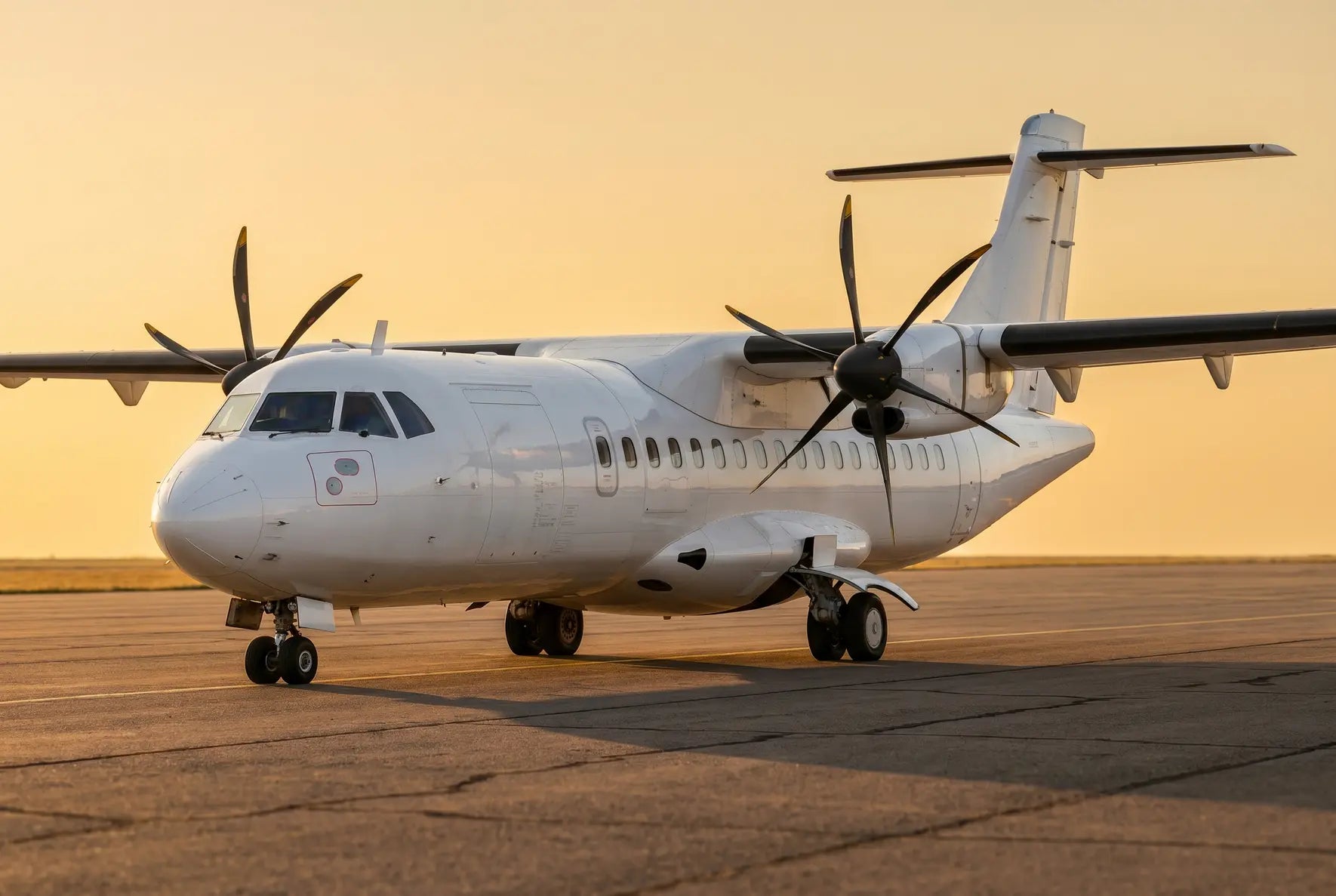
The ATR 42-200 was the original production variant of the ATR 42 family, a high-wing, twin-turboprop regional airliner jointly developed by Aerospatiale (France) and Aeritalia (Italy). Designed from the outset for short-haul, low-density routes, the aircraft prioritised fuel efficiency, short-field capability, and low operating costs over speed. Its high-wing configuration kept the engines and propellers clear of FOD on unprepared strips, while the fixed trailing-link main landing gear simplified maintenance. The -200 established the baseline airframe geometry shared by every subsequent ATR 42 variant: identical fuselage cross-section, wingspan, and empennage. The trade-off accepted at this stage was a relatively modest maximum take-off weight and engine power, which limited payload-range performance compared to later marks.
With a standard cabin seating up to 48 passengers at 30-inch (760 mm) pitch, the ATR 42-200 offered regional operators a compelling seat-mile cost on stages of around 200 to 500 nautical miles. Its design drew heavily on the fuel economy advantages inherent in turboprop propulsion, consuming significantly less fuel than comparable regional jets of the era. According to Aircraft Commerce's ATR 42 & 72 guide, the ATR 42-200 achieved a cruise speed of 265 KTAS and a take-off field length of 3,575 feet (1,090 m) at MTOW under ISA sea-level conditions. Those numbers made it well suited to the secondary airports and thinner routes where turboprops thrive.
- Overall length: 22.67 m (74 ft 5 in)
- Wingspan: 24.57 m (80 ft 7 in)
- Height: 7.59 m (24 ft 11 in)
- Wing area: 54.5 m2
- Typical MTOW: 16,700 kg (36,817 lb)
- Engines: 2 x Pratt & Whitney Canada PW120 turboprops, rated at 1,800 SHP for take-off
- Propellers: Hamilton Standard 14SF-5 four-blade, approximately 13 ft (3.96 m) diameter, variable-pitch and reversible
- Cruise speed: 265 KTAS (at optimum flight level, ISA conditions)
- Take-off field length: 3,575 ft (1,090 m) at MTOW, ISA, sea level
- Service ceiling: 25,000 ft (7,620 m)
- Range (max passengers): approximately 459 NM (850 km)
- Standard seating: up to 48 passengers (single-class, 30 in pitch)
- Certification: EASA Type Certificate EASA.A.084
Flight Controls, Avionics and Systems
The ATR 42-200 uses manual primary flight controls with mechanical linkages for ailerons, elevator, and rudder. Spring tabs on the ailerons compensate for aerodynamic loads, keeping control forces manageable without hydraulic power assistance on the primary surfaces. Electrical trim is provided for pitch and rudder. Secondary flight controls, including flaps and ground spoilers, are hydraulically powered. This architecture gives pilots a direct, tactile feel of the aircraft throughout the flight envelope, an approach sometimes preferred by crews operating into challenging short strips. Should the hydraulic system fail, the primary controls remain fully functional.
In the cockpit, the -200 featured conventional analog (electromechanical) instrumentation as its baseline avionics fit. Later ATR 42 variants (-500, -600) introduced glass cockpits and advanced flight management systems, but the -200 relied on traditional instruments typical of the mid-1980s regional fleet. Operators exploring career paths with airlines operating turboprop fleets can learn more about pilot conditions at carriers such as BA CityFlyer. The braking system on the main landing gear uses multi-disc hydraulic brakes with anti-skid protection.
Published performance figures for the ATR 42-200 should be interpreted with care. Values such as range, take-off field length, and payload depend heavily on operator-specific factors: cabin configuration and seat count, chosen MTOW option, atmospheric conditions (temperature and altitude), runway surface and slope, and reserve-fuel policy. Manufacturer brochure numbers typically assume ISA conditions at sea level with a standard passenger load. Real-world operations at hot-and-high airports or with non-standard configurations will differ. Always refer to the approved Airplane Flight Manual for operational planning.
Pratt & Whitney Canada PW120: The Powerplant Behind the ATR 42-200
The ATR 42-200 is powered by two Pratt & Whitney Canada PW120 turboprop engines, each rated at 1,800 SHP for take-off. The PW120 belongs to the PW100/150 engine family, a series of free-turbine turboprops produced by P&WC (now part of RTX Corporation) that spans from 1,800 to over 5,000 SHP. Development of the PW100 series began in the late 1970s, with the first PW120 prototype flight engine built in 1981-1982. The engine entered revenue service alongside the ATR 42 when the aircraft was certified in 1985.
The PW120 uses a three-shaft, free-turbine architecture with separate low-pressure and high-pressure compressor spools and an independent power turbine driving the propeller through a reduction gearbox. It achieves an overall pressure ratio of 12.14:1. On the ATR 42-200, the engines are paired with Hamilton Standard 14SF-5 four-blade reversible-pitch propellers with a diameter of approximately 13 feet (3.96 m), providing efficient thrust conversion at typical turboprop operating speeds and enabling effective reverse thrust for short-field operations.
The PW100 family proved exceptionally versatile. Beyond the ATR 42-200 and -300, close derivatives power a wide range of regional turboprops. The PW120A is fitted to the de Havilland Canada DHC-8-100 (Dash 8). The PW118 powers the Embraer EMB 120 Brasilia. Uprated variants such as the PW121 (1,900-2,100 SHP) went into the ATR 42-320 and improved hot-and-high performance, while the PW127 series (up to 2,750 SHP) powers the ATR 42-500, -600 and ATR 72 family. The PW150A, the most powerful member, delivers over 5,000 SHP for the Bombardier Q400. With more than 10,000 engines delivered and tens of millions of flight hours accumulated, the PW100 family remains the dominant turboprop engine series in regional aviation.
ATR 42-200 vs ATR 42-300 vs ATR 72-200 vs ATR 72-210 Specifications Comparison
Scroll horizontally to see more
| Parameter | ATR 42-200 | ATR 42-300 | ATR 72-200 | ATR 72-210 |
|---|---|---|---|---|
| Entry into service | 1985 | 1985 | 1989 | 1993 |
| Engines | 2 × Pratt & Whitney PW120 | 2 × Pratt & Whitney PW121 | 2 × Pratt & Whitney PW124B | 2 × Pratt & Whitney PW127 |
| Length | 17.7 m | 17.7 m | 27.2 m | 27.2 m |
| Wingspan | 24.6 m | 24.6 m | 27.0 m | 27.0 m |
| Height | 7.1 m | 7.1 m | 7.7 m | 7.7 m |
| Typical seating and layout | Single-class: 48–50 passengers | Single-class: 48–50 passengers | Single-class: 66–70 passengers | Single-class: 66–70 passengers |
| MTOW | 16.9 t | 18.6 t | 21.4 t | 22.8 t |
| Range | 1,500 nm | 1,800 nm | 1,500 nm | 1,650 nm |
| Cruise speed | 0.52 Mach | 0.52 Mach | 0.52 Mach | 0.52 Mach |
| Service ceiling | 25,000 ft | 25,000 ft | 25,000 ft | 25,000 ft |
| Program note | Original short-haul regional turboprop, baseline ATR 42 model for 48 pax | Higher power engines for improved hot/high performance | Stretched fuselage version doubling capacity to 70 pax | Enhanced power PW127 engines for better climb and field performance |
Scroll horizontally to see more
The table compares early ATR 42 and ATR 72 variants across dimensions, engines, capacity, and performance. ATR 72 models are longer (27.2 m vs 17.7 m) and seat more (66–70 vs 48–50), with higher MTOW (21.4–22.8 t vs 16.9–18.6 t). Range varies: ATR 42-300 leads at 1,800 nm, while ATR 72-210 improves to 1,650 nm. All cruise at 0.52 Mach and share a 25,000 ft ceiling.
ATR 42-200 Operations: Typical Routes, Missions and Airlines Worldwide
The ATR 42-200 was the original variant of the ATR 42 family, powered by two Pratt & Whitney Canada PW120 engines rated at 1,800 shp each. It completed its maiden flight on 16 August 1984 from Toulouse and received its type certificate in September 1985. Only a small number of airframes carried the -200 designation (notably MSN 001 and 002), as production quickly transitioned to the improved ATR 42-300 from late 1985 onward. Despite its brief production run, the ATR 42-200 established the operational template that would define the entire ATR 42 lineage for decades: short-haul regional flying on routes where larger jet aircraft are uneconomical.
Designed for sectors of approximately 200 to 300 nautical miles, the ATR 42-200 was optimised for flights lasting between 40 and 80 minutes. ATR 42 family aircraft in regional airline service typically achieve between 5 and 10 block hours per day, completing 4 to 6 revenue sectors with turnaround times of around 25 to 35 minutes. This high-frequency, short-sector profile made the type well suited to hub-and-spoke feeder services, connecting secondary and regional airports to major hubs. It also performed effectively in point-to-point networks serving thin routes, island-hopping operations and remote communities where runway lengths are limited. The ATR 42-300 official factsheet from ATR lists a basic takeoff distance of 1,090 m (3,576 ft) at sea level, underscoring the type's short-field capability.
Operators of early ATR 42 variants faced several challenges. The most significant was sensitivity to icing conditions: ice could accumulate beyond the de-icing boots on the wing leading edges, particularly in supercooled large droplet (SLD) environments. Following incidents in the 1990s, aviation authorities introduced stricter operational limitations in icing conditions, enhanced crew training requirements and mandated aircraft modifications. Hot-and-high performance was another consideration, as the PW120 engines of the -200 offered less margin than the uprated powerplants fitted to later variants. Maintenance scheduling around the high-cycle operations typical of regional turboprop service also required careful fleet management. Many carriers that began with the -200 subsequently upgraded to the ATR 42-300 or ATR 42-320, which addressed several of these limitations with improved engines and increased maximum takeoff weight.
Where the ATR 42-200 Operated Around the World
The ATR 42-200 and its direct successor, the ATR 42-300, saw service across four broad regions. In Europe, the type anchored domestic and intra-regional feeder networks, particularly in France and the Mediterranean, connecting secondary cities to major hubs. In North America, early ATR 42 variants served as commuter feeders under major airline brands, linking small communities to hub airports. Across Asia and the Pacific, the aircraft proved effective on inter-island and mountainous routes where short runways and challenging terrain limited alternatives. In Africa, operators relied on the ATR 42 for domestic and intra-regional connectivity, taking advantage of its ability to operate from unpaved or short airstrips. For context on the working conditions of pilots at European carriers that operated regional turboprops in these networks, some airlines developed specific crew rostering patterns to accommodate the high-cycle nature of short-haul operations.
- Europe: Air Littoral (France) was among the earliest ATR 42 customers, using the type on domestic French regional routes. Aero Trasporti Italiani (Italy) operated ATR 42s on Italian domestic services. Olympic Airlines (Greece) deployed the type on island-hopping routes in the Aegean. Air Lithuania flew three ATR 42-300s on Baltic regional connections. These airlines typically used the aircraft as feeder services linking smaller cities to national hubs such as Paris-Orly, Rome-Fiumicino and Athens.
- North & South America: In the United States, Simmons Airlines and Trans States Airlines operated ATR 42-300s under the American Eagle and TWA Express brands respectively, feeding passengers into major hubs like Chicago O'Hare and St. Louis. In Central and South America, SATENA (Colombia) and Islena Airlines (Honduras) used the ATR 42 for domestic routes through mountainous and tropical terrain where its short-field performance was essential.
- Asia: Air Tahiti (French Polynesia) operated ATR 42s extensively for inter-island flights across the Pacific archipelagos. In Nepal, Buddha Air and Yeti Airlines used the type for short mountain routes connecting Kathmandu to regional airports. Wings Air (Indonesia) became one of the largest ATR operators in the region, using ATR 42 and ATR 72 variants across its domestic island network.
- Africa: Overland Airways (Nigeria), Solenta Aviation (Mozambique) and AfriJet (Gabon) have operated ATR 42 variants on regional and domestic routes. Air Mauritius used ATR 42s for short-haul services from Mauritius. Across the continent, operators valued the type for its ability to serve airports with limited infrastructure and shorter runways.
Typical Seating Configurations and Cabin Layout
The ATR 42-200 cabin features a circular cross-section with an inside width of 2.57 m (8 ft 5 in), accommodating four-abreast seating in a 2-2 layout separated by a single aisle. The original design capacity was 42 passengers, which gave the aircraft its name, though most operators configured the cabin for 46 to 48 seats at a standard pitch of 30 inches (76 cm). All configurations were single-class economy, as the short sector lengths typical of ATR 42 operations did not justify premium cabin products. Cape Air, for example, configured its ATR 42 with 46 seats at 30-inch pitch and 17-inch seat width. Loganair's ATR 42-500 seats 48 passengers in a similar layout with 18-inch wide seats and rear-facing seats in the first row. Some cargo-combi configurations reduced passenger seating to accommodate freight in the forward cabin, a layout favoured by operators serving remote communities where mixed passenger-cargo loads are common. Across the ATR 42 family, network carriers and leisure operators alike have maintained broadly consistent cabin layouts, with the main variable being seat count (ranging from 40 to 50) depending on pitch and whether space is allocated for additional baggage or cargo compartments.
In this video, watch a Danish Air Transport ATR-42 start up, taxi, and depart Stord Airport, then return for approach and landing in January 2021, highlighting key moments of regional turboprop operations.
ATR 42-200 Safety Record: Accident History and How Safe Is This Turboprop?
The ATR 42-200 was the original prototype variant of the ATR 42 family, with only a handful of airframes built for development and certification testing before production shifted to the more powerful ATR 42-300. Because so few ATR 42-200 units flew, and most were eventually upgraded or retired early, no hull-loss accidents or fatal incidents specific to this sub-variant appear in the Aviation Safety Network database. Any meaningful safety assessment therefore needs to consider the broader ATR 42 programme, which shares the same airframe architecture, wing design and core systems across all series.
Across every variant, the ATR 42 family has accumulated roughly 450 deliveries since the type entered airline service in 1985. According to an independent safety study published by Austrian Wings, the ATR 42 has been involved in 47 recorded accidents and incidents, of which 34 resulted in hull losses and 276 fatalities. Those numbers span four decades and a wide range of operating environments, from well-resourced carriers in Europe to airlines flying into remote tropical and mountainous airstrips. Context matters: the majority of fatal events cluster in the 1990s and early 2000s, and the rate has improved markedly since then thanks to design modifications, better training and stronger regulatory oversight.
Notable ATR 42 Accidents and Their Lessons
Although the ATR 42-200 itself has no recorded accidents, three events involving later ATR 42 variants illustrate the safety challenges the type has faced and the improvements that followed.
- Conviasa Flight 2350 (13 September 2010) - An ATR 42-320 (YV1010) operating from Porlamar to Ciudad Guayana, Venezuela, struck power lines approximately 10 km short of the runway and crashed into an industrial area. Of the 51 people on board, 17 lost their lives. The Venezuelan investigation concluded that a malfunction in the centralised crew alerting system triggered an erroneous stall warning, and the crew's improper response, combined with poor situational awareness, led to the loss of altitude. The accident reinforced the importance of crew resource management (CRM) training and prompted calls for upgraded avionics in older ATR 42 fleets.
- Empire Airlines Flight 8284 (27 January 2009) - An ATR 42-320 (N218FE) operating a FedEx feeder cargo service crashed on approach to Lubbock, Texas, killing both crew members. The NTSB determined that the crew continued an unstabilised approach in icing conditions, resulting in ice contamination of the horizontal stabiliser and a subsequent tailplane stall. The investigation led to updated FAA Airworthiness Directives requiring enhanced anti-ice procedures and improved ice-detection displays on ATR 42 and ATR 72 aircraft.
- Precision Air Flight PW 494 (6 November 2022) - An ATR 42-500 (5H-PWT) crashed into Lake Victoria shortly after departing Bukoba Airport, Tanzania. Of the 43 occupants, 19 did not survive. Tanzania's Aircraft Accident Investigation Bureau attributed the crash to dual engine failure following bird ingestion during the initial climb. The accident highlighted the need for improved bird-hazard management at regional airports and led to recommendations for wildlife mitigation programmes at airfields served by turboprop fleets.
A fourth event worth noting involved the ATR 72-212 operating as American Eagle Flight 4184, which crashed near Roselawn, Indiana in October 1994 after encountering supercooled large-droplet icing. Although it was an ATR 72 rather than an ATR 42, the findings directly affected the entire ATR family. The NTSB investigation triggered sweeping changes: extended de-icing boots, mandatory ice-detection upgrades and revised icing-certification standards that applied to all ATR 42 variants still in service at the time.
How Safe Is the ATR 42-200 Today?
Evaluating the ATR 42-200 in isolation is difficult given its limited production run. Within the wider ATR 42 family, the hull-loss rate has fallen steadily since the late 1990s. ATR's own safety statistics for 1985 to 2024 show an improving trend in both overall hull losses and fatal accident rates. Much of this improvement stems from a combination of design refinements, stricter EASA and FAA certification requirements, enhanced pilot training programmes and mandatory adoption of terrain awareness and warning systems (TAWS).
Regional turboprops, by the nature of their operations, face higher exposure to challenging conditions such as short runways, mountainous terrain and less-developed airport infrastructure. Operators that invest in thorough training, robust standard operating procedures and proactive maintenance consistently achieve safety records in line with jet fleets. For travellers curious about the safety culture of specific airlines, resources such as this overview of regional carrier operations provide useful context on how airlines manage these challenges day to day.
Despite the headline figures, aviation remains statistically one of the safest forms of transport. Continuous feedback loops between manufacturers, regulators and operators mean that each incident generates tangible improvements in design, procedures and oversight, making every subsequent flight safer than the last.
01 What is the typical range and mission profile of the ATR 42-200?
The ATR 42-200 has a maximum range of about 1,500 kilometers with full passenger load, suited for short to medium regional routes. It excels on missions connecting smaller airports to hubs, often flying 300-800 km sectors. Operators favor it for its ability to serve thin routes with low passenger volumes profitably.
02 How is the cabin laid out on the ATR 42-200, and what is the passenger experience like?
The ATR 42-200 typically seats 42-50 passengers in a single-class layout with two seats per side and an aisle. Noise levels are higher than jets due to the turboprop engines, but the cabin feels spacious with larger windows for better views. Passengers often note a smooth ride on regional hops, though propeller vibration is noticeable.
03 Which airlines operate the ATR 42-200 and on what routes?
Airlines like Air New Zealand, Volaris, and Wings Air use the ATR 42-200 for regional networks in areas like Oceania, Latin America, and Southeast Asia. Common routes include island hops, remote city connections, and feeder services to major airports under 1,000 km. It supports operations in hot-and-high or short-runway environments.
04 How does the ATR 42-200 perform in terms of fuel efficiency compared to similar aircraft?
The ATR 42-200 offers excellent fuel efficiency for regional ops, burning about 30% less fuel per passenger than comparable jets on short routes. Compared to the Dash 8-100, it has similar capacity but better economics on low-demand sectors due to lower acquisition costs. Its turboprop design shines below 10,000 feet where jets are less efficient.
05 What is the safety record of the ATR 42-200?
The ATR 42-200 has a strong safety record, with hull-loss accidents occurring at a rate below industry averages for regional turboprops, thanks to robust design and rigorous maintenance. Key safety features include a high-wing configuration for better propeller clearance and stall protection systems. Most incidents link to external factors like weather rather than airframe flaws.
06 What should passengers know about seating, windows, and turbulence on the ATR 42-200?
Rows 1-3 offer quicker boarding and slightly more legroom; window seats from row 5 provide the best views without wing obstruction. The aircraft handles turbulence well due to its low-altitude flight profile and flexible wings, often feeling less bumpy than jets. Over-wing exits are at rows 10-11, so avoid those seats if preferring aisle access.