

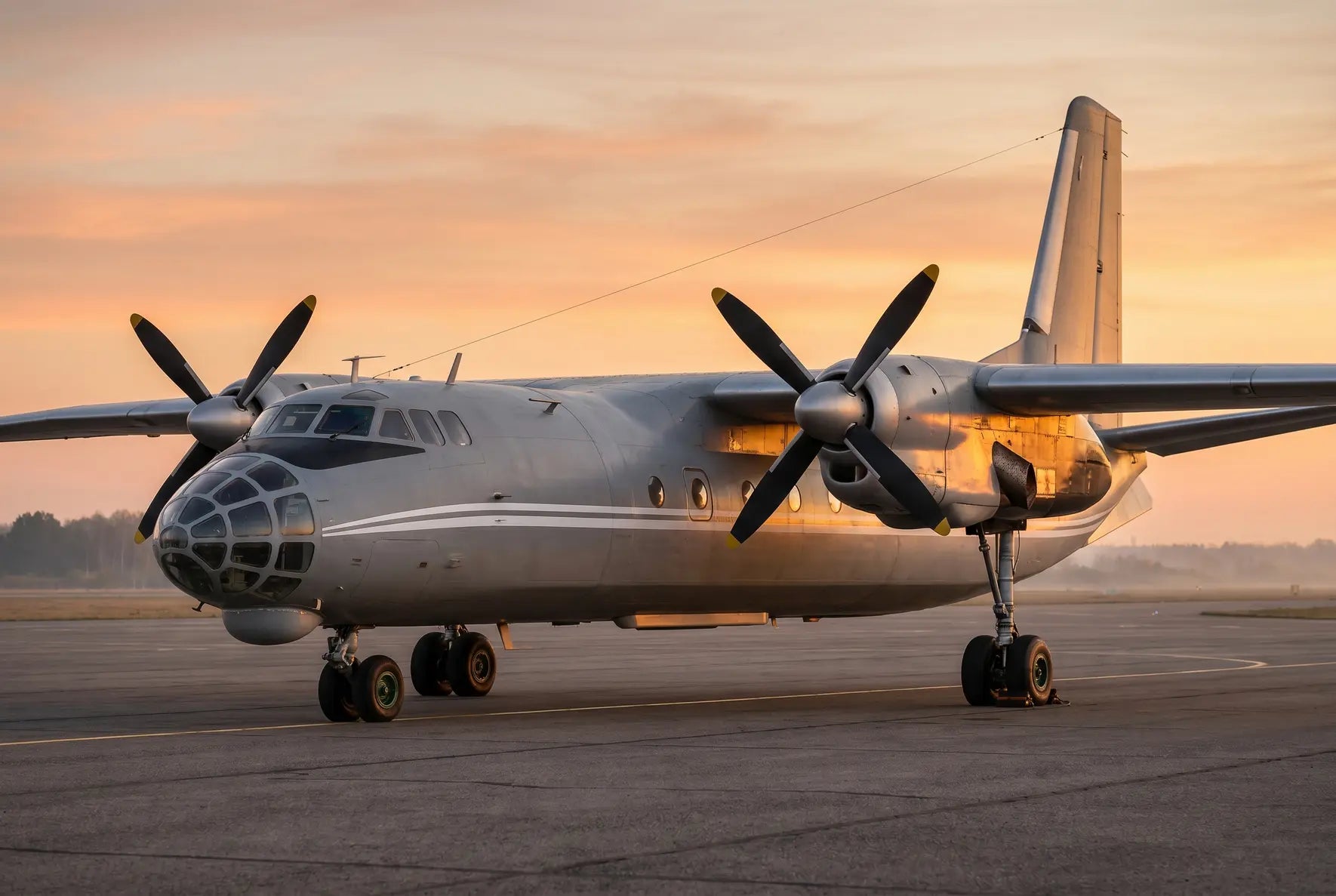
Antonov An-30 History and Development: From An-24 Survey Variant to Open Skies
The Antonov An-30 (NATO reporting name Clank) is a specialised aerial survey and cartography aircraft derived from the Antonov An-24 twin-turboprop. It was created to give the Soviet Union a dedicated platform for photogrammetry, topographic mapping, resource and border survey, and reconnaissance over very large areas. Where the An-24 family was conceived as a regional transport and airliner, the An-30 reworked that proven airframe into a flying survey laboratory, with the navigator and camera operators placed in a heavily glazed nose beneath a raised flight deck.
The programme was launched by the OKB Antonov design bureau in Kyiv under the internal designation An-24FK (fotokartograficheskiy, meaning photo-mapping). According to Antonov's own history, a USSR Council of Ministers decree of 6 July 1964 authorised construction of the An-24FK aerial survey aircraft. A production An-24A was converted into the An-24FK prototype, with first flight of the survey prototype taking place in August 1967. Antonov records the first flight of the An-30 proper on 25 August 1967, with a test crew led by Ivan Davydov; open sources show minor date discrepancies, but the manufacturer's record is the most authoritative.
Series production was assigned to the Kiev Aviation Plant in Ukraine. The first production An-30 flew on 12 March 1973, and the type was formally introduced into Soviet civil aviation service by ministerial order on 20 April 1974. Antonov cites roughly 124 aircraft built at Kyiv between 1973 and 1979; other technical databases give around 123 units produced between 1971 and 1980, with about 23 exported to operators including Afghanistan, Bulgaria, China, Cuba, Czechoslovakia, Mongolia and Vietnam. The figures are close and all point to a production run of a little over 120 airframes.
Mechanically, the An-30 is powered by two Ivchenko AI-24VT turboprops driving four-blade propellers, supplemented by an auxiliary RU-19A-300 turbojet in the starboard nacelle for additional take-off thrust and systems power, a feature shared with the wider An-24/An-26 family. The survey fit included vertical and oblique aerial cameras and dedicated sensors, with camera mounts in the lower fuselage for continuous mapping strips. The same airframe could be reconfigured for An-26-type transport duties when survey work was not required.
What sets the An-30 apart from related variants
Compared with its An-24 parent and the cargo-oriented An-26, the An-30 is defined by its glazed, stepped nose, raised cockpit and built-in photo-mapping systems rather than by changes to engines or wing. Within the An-30 family itself, the differences are largely a matter of mission equipment rather than airframe or powerplant. The baseline An-30 and civil-oriented An-30A handled standard cartography, while the An-30B served as the principal military survey and reconnaissance configuration with updated navigation and communication systems. In 1977, one airframe was converted into the An-30RR for radiation survey, carrying specialised detection and sampling equipment. Further designations such as the An-30D Sibiryak (extended-range, winterised for Siberian operations), An-30M, An-30R and An-30FG denote operator and mission-specific sensor or avionics packages built on the same basic structure.
The An-30B in particular became the backbone of Open Skies Treaty observation fleets. Antonov notes the first training observation flights on the An-30 took place on 25-30 April 1994, and that on 13 April 1997 an An-30 of the Ukrainian "Blakytna Stezha" squadron flew an Open Skies mission to the United States covering 26,000 km. Operators including Bulgaria, the Czech Republic, Romania, Russia and Ukraine have used the type for unarmed reconnaissance flights under the treaty. Readers interested in long-haul survey and transport contrasts may also compare this turboprop with a long-range widebody such as the Airbus A340-300.
Key variant identifiers for the An-30/An-30B are summarised below, based on manufacturer and technical sources:
- Engines: two Ivchenko AI-24VT turboprops with four-blade propellers, plus an auxiliary RU-19A-300 turbojet.
- Nose and cockpit: multi-faceted glazed nose for the navigator/photographer, with a raised flight deck above it.
- Mission systems: vertical and oblique aerial survey cameras and sensors for photogrammetry and cartography.
- Maximum take-off weight: about 23,000 kg.
- Performance: maximum speed near 540 km/h, range about 2,600 km, service ceiling around 8,300 m.
- Crew: typically seven, including navigator and camera operators.

A white and blue Antonov An-30 aircraft is captured in flight against a clear sky. The plane features dual engines and distinctive nose design, with markings indicating its registration number, RA-26226.
Antonov An-30: Technical Specifications and Systems Highlights
The Antonov An-30 (NATO reporting name Clank) is a specialised aerial survey and cartography aircraft derived from the Antonov An-24 regional turboprop. Its design priorities differ from a conventional transport: rather than maximising passenger payload, the airframe was reshaped around a heavily glazed navigator's nose, multiple camera hatches and dedicated sensor-operator stations, making stable, long-endurance flight at survey altitudes the dominant requirement. The aircraft inherits the An-24/An-26 family's high-wing layout, rugged landing gear and ability to operate from less developed airfields, while trading some cabin volume for photogrammetric equipment.
The central engineering trade-off is between endurance over survey areas and operating weight. The An-30 carries specialised mission systems instead of bulk cargo, so its useful load is largely consumed by fuel, crew and cameras. This emphasis on patient, methodical coverage rather than point-to-point speed shapes nearly every published performance figure.
- Role: aerial cartography and topographic photography
- Crew: typically 5 to 7 (pilots, navigator, radio operator and photo/sensor operators)
- Length: approximately 24.3 m
- Wingspan: 29.2 m
- Height: approximately 8.3 m
- Wing area: 75.0 m²
- Empty weight: approximately 15,600 to 15,990 kg, depending on equipment fit
- Maximum take-off weight (MTOW): 23,000 kg
- Maximum speed: approximately 540 km/h
- Typical survey cruise: around 430 km/h
- Range: approximately 2,600 km (about 1,400 NM)
- Service ceiling: approximately 8,300 to 8,400 m
- Powerplant: two Ivchenko AI-24 series turboprops, around 2,800 shp each, plus one RU-19A-300 auxiliary turbojet (about 8.8 kN thrust)
- Distinguishing features: glazed nose, five sealed camera hatches and dedicated cartography consoles
Systems and handling-relevant technology
As a member of the An-24/An-26 lineage, the An-30 uses conventional mechanically and hydraulically actuated flight controls rather than fly-by-wire, reflecting the era and mission for which it was designed. Mission stability matters more than agility: long, straight photographic runs at constant altitude and heading favour an aircraft with predictable handling and modest control forces. Navigation and survey work historically relied on a Soviet-standard radio-navigation suite, with the navigator's glazed compartment providing the wide field of view needed for positioning camera lines, while later operators have integrated digital sensors, recording and, in some cases, satellite-based navigation depending on the upgrade path. Because avionics fits are highly operator- and variant-specific, no single fixed configuration applies across the fleet.
The auxiliary RU-19A-300 turbojet is an important systems element: beyond providing extra thrust for take-off and climb, this class of small engine can supply electrical power and assist engine starting, improving independence from ground equipment at remote sites.
Published performance figures should be read with care. Reported values for cruise speed, range and ceiling vary between sources because they depend on weights, atmospheric assumptions, equipment fit, fuel state and runway condition. A figure quoted as a maximum or as an indicative cruise may not be achievable simultaneously with maximum payload, so the numbers above are best treated as representative ranges rather than absolute guarantees. These considerations matter increasingly as operators weigh fuel burn and emissions; the future of aviation in the face of climate challenges is reshaping how ageing turboprop fleets are operated and replaced.
Engines: the Ivchenko AI-24 and RU-19A-300
The An-30 is powered by two Ivchenko AI-24 turboprops, typically cited as AI-24T, AI-24VT or AI-24WT depending on the source, each producing roughly 2,075 to 2,103 kW (about 2,800 shp). The AI-24 was developed by the Ivchenko design bureau in the USSR, now Ivchenko-Progress of Zaporizhzhia, Ukraine, and series-produced largely by Motor Sich. It emerged at the turn of the 1960s as a medium-power turboprop for regional transports, with the AI-24T installed on the An-30 reported to have an assigned life of around 18,000 hours and a dry weight near 600 kg. The same engine family powers the closely related Antonov An-26 and the An-24 from which the An-30 descends, making it one of the more widely fielded Soviet turboprops of its generation.
Mounted alongside the turboprops is a single RU-19A-300 auxiliary turbojet, attributed to the Tumansky design bureau and rated at roughly 8.8 kN of thrust. On the An-24/An-26/An-30 family it is commonly installed in the right nacelle to boost take-off and climb performance, particularly from short or hot-and-high airfields, while also serving as a source of bleed air and electrical power. Although it does not turn the An-30 into a jet in cruise, it meaningfully improves field performance and operational independence, a practical solution well suited to the survey missions the aircraft was built to perform.
Antonov An-30 vs An-24RV vs An-26 vs An-32 Specifications Comparison
Scroll horizontally to see more →
| Parameter | Antonov An-30 | Antonov An-24RV | Antonov An-26 | Antonov An-32 |
|---|---|---|---|---|
| Entry into service | 1973 | 1967 | 1970 | 1984 |
| Engines | 2 × Ivchenko AI-24T turboprops + 1 × Tumansky RU-19A-300 turbojet | 2 × Ivchenko AI-24RV turboprops | 2 × Ivchenko AI-24VT turboprops | 2 × Ivchenko AI-20DM turboprops |
| Length | 24.3 m | 23.5 m | 23.8 m | 23.8 m |
| Wingspan | 29.2 m | 29.2 m | 29.2 m | 29.2 m |
| Height | 8.3 m | 8.3 m | 8.6 m | 8.75 m |
| Typical seating and layout (short description + approximate passengers) | Special mission survey: 7–12 crew and observers | Single-class regional: 44–52 passengers | Cargo combi: up to 40 passengers on side benches | Cargo combi: up to 50 passengers on side benches |
| MTOW | 23 t | 21 t | 24 t | 27 t |
| Range | 1,400 nm | 1,600 nm | 1,100 nm | 1,550 nm |
| Cruise speed | 0.35 Mach | 0.40 Mach | 0.40 Mach | 0.41 Mach |
| Service ceiling | 27,200 ft | 27,900 ft | 24,600 ft | 28,200 ft |
| Program note | Specialised aerial survey and cartography derivative of the An-24 with glazed nose and camera bays for military and civil mapping roles. | Baseline An-24 regional airliner providing the foundation platform for multiple utility and special-mission variants. | Ramp-equipped tactical transport variant of the An-24 family, optimised for short-field cargo and military logistics. | Hot-and-high performance transport development of the An-26 with more powerful engines for challenging environments. |
Scroll horizontally to see more →
The table compares key specs across four Antonov An-24 family variants. The An-30 is a 1973 special-mission survey aircraft with a turboprop pair plus an auxiliary turbojet, small crew capacity, and 1,400 nm range. The An-24RV is the baseline regional airliner, offering the longest range (1,600 nm) and 44–52 seats. The An-26 adds a ramp for tactical cargo but has the shortest range (1,100 nm) and lower ceiling. The An-32 is the heaviest (27 t MTOW) and highest ceiling (28,200 ft), optimized for hot-and-high operations.
Antonov An-30 Operations: Survey Missions, Routes and Operators Worldwide
The Antonov An-30 is not a conventional airliner but a specialised aerial survey and cartography platform derived from the An-24. Its missions revolve around aerial photography and mapping rather than scheduled passenger service, which shapes its routes, sortie lengths and daily utilisation. A glazed nose, raised cockpit and five camera bays in the cabin floor let crews capture vertical and oblique imagery, producing topographic maps at scales from 1:3,000 to 1:200,000.
Typical survey sorties are flown at photographic altitudes between 2,000 and 7,000 m, with routine national mapping often conducted around 3,000 to 4,000 m. With a practical range of roughly 2,500 to 2,600 km and a cruise speed near 430 to 530 km/h, mission endurance is approximately 5 to 6 hours. Operations are mission-based rather than network-based: there is no hub-and-spoke or point-to-point airline pattern. Instead, aircraft launch from a home base, fly programmed photographic lines over a target area, then return, so daily utilisation depends on weather windows, sunlight and cloud cover. Clear-sky requirements for imagery are a key operational challenge, alongside the demands of maintaining ageing Soviet-era airframes and AI-24 turboprops.
Where the Antonov An-30 operates
The type has served across four broad regions. In Europe, it remains best known for national mapping and for unarmed reconnaissance under the Treaty on Open Skies, where its stable survey design suited certified observation work. In North & South America, documented use is limited and tied mainly to Cuba as an export recipient rather than to commercial airline service. In Asia, export deliveries supported government survey and air-force roles, while in Africa the aircraft appears chiefly with cargo and utility operators that reconfigure it like an An-26.
- Europe: Aeroflot was the largest civil user, taking 65 An-30A aircraft for Soviet aerial survey work, with a further six delivered to other Soviet civil organisations. In the post-Soviet era, Russia, Ukraine, Romania and Bulgaria operated the type mainly in military and Open Skies roles. Antonov records the first training observation flights under the treaty on 25 to 30 April 1994, and the Romanian Air Force has used upgraded examples for both treaty missions and domestic mapping.
- North & South America: Cuba is the documented operator in the region, listed among export recipients of the An-30 family; no widely documented commercial airline use exists elsewhere in the Americas.
- Asia: China received exported An-30A aircraft (reported at seven of the eighteen exported airframes) for survey duties, while further export users included Afghanistan, Mongolia and Vietnam.
- Africa: Aero-Fret in the Republic of the Congo is identified as a civil operator, typically using the aircraft in a transport-style configuration; Sudan has also been reported as a user.
Typical seating and cabin layout
Because the An-30 is a working survey aircraft, it does not follow airline seat-map conventions. Published references list a flight crew of five to seven, including pilots, a navigator in the glazed nose, a flight engineer, a radio operator and one or two camera operators. The cabin centres on mission equipment rather than passengers: two camera operator workstations, a crew rest area and a food locker sit alongside the five floor camera windows, which carry up to three vertical and two oblique cameras as described by Airforce Technology. Specialised variants alter this layout: the An-30D Sibiryak adds fuel for long-range ice and fisheries monitoring and transport, the An-30M serves meteorological research, and a small number were converted to An-30-100 VIP transports after 1991. For readers comparing crew-based survey operations with the demands of large network airlines and their pilot rosters, see this overview of airline pilot conditions. Further airframe and performance details are catalogued by SKYbrary.
In this video, watch a Romanian Air Force Antonov An-30 Open Skies aircraft, tail number 1105, depart Manching Air Base on 27 July 2018, captured in clear detail from the airfield.
Antonov An-30 Safety Record: How Safe Is This Survey Aircraft?
The Antonov An-30 is a niche aircraft, and its safety record must be read in that light. Around 123 to 124 examples were built at the Kyiv Aviation Plant between roughly 1971 and 1980, derived from the proven An-24 airframe. Compared with mainline jetliners that operate millions of flights a year, the An-30 fleet has always been small, flying limited cartography, survey and observation missions rather than dense commercial schedules. As a result the total number of cycles accumulated by the type is modest, and the absolute number of accidents is correspondingly low. Several of the most serious losses were not the result of technical failure at all, but of hostile action during military operations. According to the Aviation Safety Network type record, documented hull losses number in the low dozens across more than five decades of service, a figure that reflects both the small fleet and its specialised, often state-operated use.
Notable accidents and serious incidents
A small number of events illustrate the main risk factors associated with the type and its operating environment.
- Soviet Air Force, 1985 (Afghanistan): an An-30B on an aerial photography mission was shot down by a man-portable surface-to-air missile near the Kabul area. The primary factor was hostile action, not airworthiness. The event reinforced military doctrine on mission altitude, routing and the vulnerability of slow turboprops in contested airspace.
- Russian Open Skies unit, 2012 (Caslav, Czech Republic): an aircraft flying an Open Skies Treaty observation mission made an emergency landing, reportedly following a landing-gear extension problem, and caught fire after touchdown; seven of the 23 occupants were injured. The case prompted operator-level review of emergency procedures, maintenance practices and crew response to gear malfunctions.
- Ukrainian Air Force, 2014 (near Sloviansk): an An-30B conducting surveillance was shot down by ground-launched fire during conflict in eastern Ukraine. As with the 1985 loss, the cause was hostile action, underlining the limits of using unarmed survey aircraft over hostile territory.
- Russian cargo flight, 2022 (near Olenyok, Sakha): an An-30M suffered a double engine failure attributed to probable fuel exhaustion and made an off-airfield forced landing; all seven crew survived with minor injuries, but the aircraft was written off. The Bureau of Aircraft Accidents Archives records the event, which highlights the importance of disciplined fuel planning and in-flight monitoring.
How safe is the Antonov An-30?
Judged against its traffic volume, the An-30 has an acceptable record for an older Soviet-era turboprop operated mainly by state and military users. Its design philosophy is conservative: it shares the rugged AI-24 turboprops and structural lineage of the widely used An-24 and An-26 family, types valued for their tolerance of rough conditions. Most fatal events stem from hostile action or operational factors such as fuel management, rather than systemic design flaws, which points to the decisive role of standard operating procedures, training and oversight. Crews who follow disciplined fuel, weather and emergency procedures, supported by sound regulatory frameworks, materially reduce risk, and modern pilot pathways such as the Multi-Crew Pilot License place strong emphasis on these competencies. For broader context, statistics published by the International Civil Aviation Organization consistently show long-term improvement in global safety. Even allowing for the An-30's age and specialised role, aviation as a whole remains one of the safest modes of transport.
01 What is the Antonov An-30 mainly used for today?
The Antonov An-30 is primarily used as an aerial cartography and surveillance aircraft, derived from the Antonov An-24 airliner and adapted with a glazed nose and multiple camera bays for mapping missions. It is still employed by several air forces, including those of Romania, Bulgaria, Russia and Ukraine, for aerial survey, Open Skies observation flights, ice and fisheries monitoring, mineral prospecting and general reconnaissance. On some occasions it can also be reconfigured to carry light cargo or personnel, similar to an An-26-style transport layout. Travellers are most likely to encounter the Antonov An-30 on special missions rather than on regular commercial passenger routes.
02 What is the typical range and flight profile of the Antonov An-30?
The Antonov An-30 has a typical maximum range of around 2,600 km or about 1,400 nautical miles, allowing it to cover large survey areas without refuelling. Cruise speed is roughly 430 km/h, with a maximum speed near 540 km/h and a service ceiling around 8,300 m, although survey flights are often conducted at lower altitudes between about 3,000 and 4,000 m to achieve the required ground image resolution. Open Skies and mapping missions usually involve long, straight tracks flown at steady speed and altitude to ensure consistent photographic or sensor coverage. Compared with jet airliners, these missions feel slower and more methodical, with frequent turns to align for new survey runs.
03 What is the cabin layout and comfort like on the Antonov An-30?
The Antonov An-30 cabin is optimized for aerial survey work rather than passenger comfort, with workstations, camera hatches and equipment racks instead of a typical airline-style seating cabin. Depending on configuration, it may have a small number of basic seats for crew and observers, often arranged around the mission equipment rather than in neat rows. Noise levels inside are relatively high due to the two turboprop engines and the large glazed nose, so headsets or ear protection are standard for those on board. Amenities such as modern in-flight entertainment, galleys and dedicated passenger service areas are minimal or absent, as the aircraft is essentially a flying work platform.
04 Which operators still use the Antonov An-30 and on what kinds of routes?
The Antonov An-30 is no longer widespread, but it remains in service with a small number of operators, mainly air forces and government agencies. Countries such as Romania, Bulgaria, Russia and Ukraine have used the type for Open Skies treaty flights and domestic aerial mapping missions, while civil operators have been reported in regions such as Central Africa. Typical routes are not point-to-point passenger services but predetermined survey tracks over national territory or neighbouring states participating in observation agreements. When the aircraft is used for cargo or personnel transport, flights are usually short to medium range, linking military or regional airfields rather than major international hubs.
05 How does the Antonov An-30 perform compared with similar turboprops?
The Antonov An-30 shares its basic airframe and engines with the An-24 family, giving it a similar turboprop performance profile with a cruise speed of about 430 km/h and a range around 2,600 km. Its distinctive features are the raised cockpit, glazed nose and camera bays, which slightly reduce aerodynamic efficiency but greatly improve downward and forward visibility for survey work. Compared with modern regional turboprops designed for passengers, the Antonov An-30 is less fuel-efficient and noisier, but it offers excellent low-speed handling and stability at survey altitudes. Its rugged design and ability to operate from relatively basic airfields make it well suited to remote mapping, environmental monitoring and military observation missions.
06 What should a traveller or observer expect if flying on an Antonov An-30?
A flight on an Antonov An-30 is more of a mission experience than a typical passenger trip, with crew focused on cameras and sensors rather than cabin service. The aircraft’s turboprops, older insulation and utilitarian interior mean it is louder and more vibratory than modern turbofan jets, so wearing provided headsets or earplugs is advisable. Large glazed areas in the nose and observation windows can offer impressive views of the terrain below, but seating is limited and often tied to mission roles rather than free seat selection. Turbulence behaviour is generally similar to other medium turboprops, with the aircraft capable of flying lower than jets to avoid some weather, though survey work may require staying at specific altitudes even when conditions are slightly bumpy.