

Antonov An-24 programme history, launch decisions and variant evolution
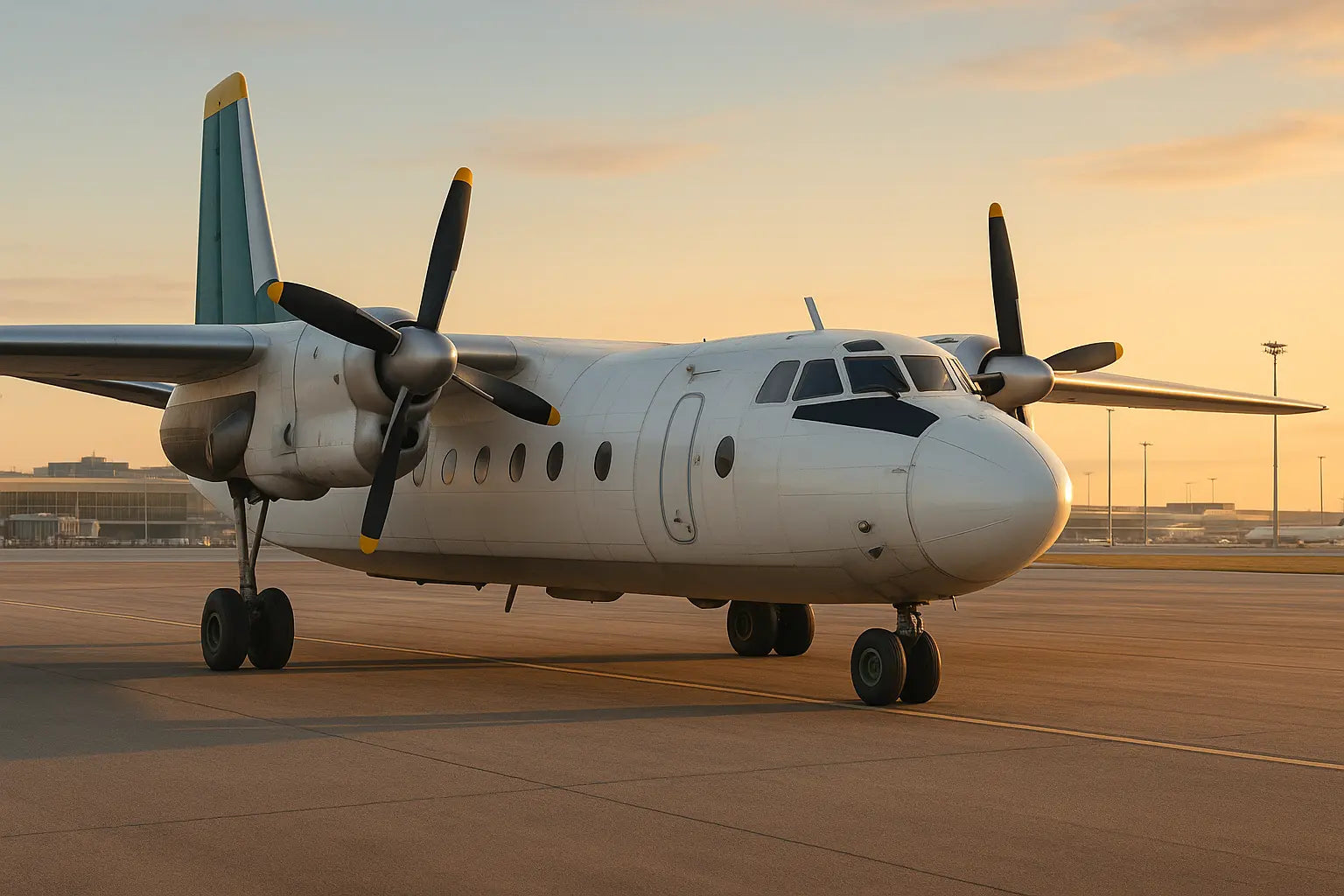
The Antonov An-24 was conceived in the late 1950s to meet a Soviet requirement for a robust short to medium haul regional airliner able to serve smaller cities and remote communities, including operations from unpaved or imperfect airfields. In that context, the design priorities were reliability, ease of maintenance, and good field performance rather than outright speed. The high wing configuration kept propellers and engines farther from debris ingestion, while the rugged structure was intended for dispersed operations with limited ground support.
Authoritative programme chronology published by Antonov ties the formal start of the aircraft to a government decision: on 18 December 1957, the USSR Council of Ministers issued a decree initiating development of a new aircraft in the class that would become the Antonov An-24. The same Antonov source records the first flight on 20 October 1959, and states that serial production was authorised on 19 August 1961 at the Kyiv aircraft manufacturing facility. Antonov further notes that in September 1962 the An-24 conducted its first technical passenger flight on the route Kyiv to Kherson, a useful marker for early operational introduction in the Aeroflot system.
While the An-24 family later became very broad, the baseline Antonov An-24 established the core configuration: a twin turboprop, pressurised regional transport with a rugged undercarriage and systems designed for high utilisation. Antonov highlights a manufacturing technology point that is unusual in civil airliner narratives: the use of adhesive bonded and welded joints in portions of the airframe structure as a replacement for traditional riveting in some applications, aimed at improving durability and manufacturing efficiency. This is one of the programme’s distinctive production engineering features, and it also helps explain why the aircraft gained a reputation for structural toughness in rough field service.
Manufacturing was distributed across several Soviet plants. Antonov’s published programme history lists serial construction at Kyiv (1961 to 1979, 1,028 aircraft), Ulan Ude (1965 to 1971, 174 aircraft), and Irkutsk (1965 to 1971, 165 An-24T aircraft). That split production footprint mattered: it enabled high output for Aeroflot and state operators, and it also contributed to the large number of sub variants and conversions that appeared over time, as airframes were adapted to different roles and local requirements.
In terms of incremental development, Antonov’s own timeline records major steps that anchor the mid programme evolution. The company notes that in 1965 series production of the An-24B began in Ulan Ude, and that the dedicated transport derivative An-24T first flew on 16 November 1965, with the first production An-24T from Irkutsk making its first flight in January 1966. Even though those are formally separate sub variants, they are important for understanding what changed around the baseline Antonov An-24 concept: increasing emphasis on freight and mixed cargo passenger missions, and the broadening of roles beyond pure regional passenger service.
A parallel strand of development is the emergence of the An-24 family into specialised military and survey derivatives. The An-24 lineage underpinned later Antonov types including the An-26 and An-30, and the design’s adaptability was central to its longevity. For readers interested in how airlines and training organisations manage standard operating procedures across multi crew aircraft types, the discipline is similar even though the technology era differs: the Multi Crew Pilot License MPL overview is a useful internal reference for how modern structured multi crew training concepts map to the operational reality of transport aircraft.
What makes the Antonov An-24 distinct among its closest sub variants
In most operator usage, the name Antonov An-24 is used as a family label, but it is also a meaningful baseline configuration against which later sub variants are defined. The closest sub variants are typically the passenger improved An-24B and the cargo oriented An-24T, with numerous special mission conversions in between. The baseline An-24 sits at the centre: it is the reference configuration that established the airframe, high wing layout, and core systems architecture, and it became the production foundation on which the later passenger cabin refinements and freight focused structural changes were built.
From a development history standpoint, the best way to differentiate the baseline Antonov An-24 is to focus on what is fixed early in the programme versus what is explicitly introduced later in Antonov’s own chronology. The airframe and operational concept were set by the 1957 decree and validated by the 1959 first flight, while later changes such as the explicit production start of the An-24B in 1965 and the first flight of the An-24T in November 1965 represent branching points rather than characteristics of the baseline. Antonov also records that by 25 December 1970 a Chinese replica, the Y 7, achieved its first flight, underlining how the baseline An-24 configuration had stabilised sufficiently to be reproduced and further evolved abroad.
Variant identifiers that can be verified from Antonov’s published programme history and specifications include the following.
- Programme launch basis: USSR Council of Ministers decree dated 18 December 1957 initiating development of the aircraft that became the Antonov An-24.
- First flight date: 20 October 1959 in Antonov’s published chronology.
- Serial production authorisation: 19 August 1961 for Kyiv plant No. 473 in Antonov’s chronology.
- Early operational milestone: first technical passenger flight recorded by Antonov in September 1962 on Kyiv to Kherson.
- Core airframe feature highlighted by Antonov: adhesive bonded and welded joints used in the airframe structure as a notable manufacturing approach.
For readers who want a primary programme narrative from the manufacturer, Antonov’s own An 24 history page is the most direct reference and is worth consulting alongside any secondary database summaries: Antonov AN 24 programme history and chronology.

A Volga-Avia Antonov An-24B aircraft is captured mid-flight with its landing gear extended, flying against a gray sky above a forested landscape.
Antonov An-24 technical characteristics, systems overview and performance
Technically, the Antonov An-24 is best understood as a rugged regional transport designed to trade ultimate cruise efficiency for field capability, maintainability, and dispatch reliability in austere conditions. Its high wing and sturdy landing gear geometry support operations from imperfect surfaces, while a relatively conservative systems philosophy reflects the era: robust, inspectable solutions that can be supported with limited infrastructure.
As part of a wider family, the Antonov An-24 also serves as the baseline from which multiple derivatives were developed, including freight and special mission types. That matters for performance interpretation: published numbers often describe the family in general or a specific sub variant, and operators may use aircraft that differ in equipment, weights, and auxiliary power configurations even when the aircraft is labelled simply as an An 24.
Specs that matter for the Antonov An-24, as published by Antonov, include the following.
- Length: 23.53 m (Antonov published characteristics).
- Wingspan: 29.20 m (Antonov published characteristics).
- Height: 8.32 m (Antonov published characteristics).
- Wing area: 74.98 m2 (Antonov published characteristics).
- Cruise speed: 420 km/h (Antonov published flight characteristics).
- Operational range: 990 km (Antonov published flight characteristics, definition as stated by the manufacturer).
- Operational ceiling: 9,100 m (Antonov published flight characteristics).
Systems and handling relevant technology
In cockpit and systems terms, the Antonov An-24 reflects a mid twentieth century transport design approach: direct and robust rather than highly automated. From a handling perspective, the high wing configuration helps protect the propellers and engines from debris in rough field operations, and it supports stable low speed characteristics useful in regional sectors with frequent takeoffs and landings. Antonov explicitly positions the aircraft for operation from or to unpaved airfields and highlights ease of maintenance as a programme attribute, which aligns with the aircraft’s reputation as a practical workhorse in demanding environments.
The propulsion architecture for the core family is based on Ivchenko AI 24 series turboprops. The AI 24 family was designed specifically to power the An 24 series, with later improvements introduced over time and broad application across An 24 derivatives. For an accessible background on the engine family, including the manufacturer attribution to Ivchenko Progress and later production by Motor Sich, a starting point is Ivchenko AI 24 engine overview, which can then be cross checked against engine maker publications and operator manuals where available.
Published performance numbers for the Antonov An-24 vary because the aircraft is often described at a family level rather than a narrowly defined configuration. Variations can come from sub variant differences, installed equipment, cabin density, operator specific weight limits, atmospheric assumptions, and runway surface condition. When comparing sources, it is important to confirm whether the figures refer to the baseline Antonov An-24, a later passenger or cargo derivative, or an auxiliary thrust equipped variant.
Engines on the Antonov An-24 and auxiliary power variants
The baseline Antonov An-24 uses two Ivchenko AI 24 series turboprop engines. A commonly cited takeoff shaft power rating for the AI 24A is around 2,550 hp, and it is associated with the An 24, An 26 and An 30 families in published engine listings. A consolidated reference for the engine family application and ratings can be found via AI 24A turboprop technical specifications.
Some An 24 sub variants, often referred to as An 24RV in secondary sources, add a small auxiliary turbojet to provide additional thrust for takeoff and climb performance in hot conditions and to support other functions such as onboard starting and electrical supply in certain scenarios. A technical description of the RU 19A 300 auxiliary turbojet and its stated purposes, including additional thrust at takeoff and improved climb under hot climate conditions, is available here: RU 19A 300 auxiliary turbojet description and specifications.
Because the An 24 family is frequently discussed in terms of career pathways and operator expectations for pilots transitioning between aircraft classes, it can be helpful to connect technical competence to professional documentation standards. A relevant internal resource on that theme is 10 tips to write a pilot’s cover letter, which supports clear communication of aircraft and operational experience without overstating capability.
Comparison of Antonov An-24 and Similar Regional Turboprop Aircraft
Scroll horizontally to see more →
| Parameter | Antonov An-24 | Antonov An-26 | Fokker F27-500 Friendship | Hawker Siddeley HS 748 Series 2 |
|---|---|---|---|---|
| Entry into service | 1962 | 1969 | 1958 | 1961 |
| Engines | 2 × Ivchenko AI-24A turboprop | 2 × Ivchenko AI-24VT turboprop | 2 × Rolls-Royce Dart turboprop | 2 × Rolls-Royce Dart 532/536 turboprop |
| Length | 23.53 m | 23.80 m | 25.07 m | 20.40 m |
| Wingspan | 29.20 m | 29.20 m | 29.00 m | 30.10 m |
| Height | 8.32 m | 8.58 m | 8.36 m | 7.57 m |
| Typical seating and layout (short description + approximate passengers) | Single-class: 44–52 passengers | Single-class: 40–50 passengers | Single-class: 44–52 passengers | Single-class: 40–58 passengers |
| MTOW | 21 t | 24 t | 20.4 t | 21.3 t |
| Range | 1,300 nm | 1,050 nm | 1,300 nm | 1,400 nm |
| Cruise speed | 0.36 Mach | 0.36 Mach | 0.39 Mach | 0.38 Mach |
| Service ceiling | 27,600 ft | 28,000 ft | 25,000 ft | 25,000 ft |
| Program note | Baseline Soviet short-haul turboprop airliner optimized for rough-field regional routes. | Derivative tactical transport and combi version of the An-24 with rear cargo ramp for military and cargo use. | Western contemporary turboprop regional airliner competing in similar capacity and range segment. | British rugged regional turboprop designed for short and rough airfields, broadly comparable in role and era. |
Scroll horizontally to see more →
This table compares the Antonov An-24 with its direct military derivative An-26 and Western counterparts like the Fokker F27 and Hawker Siddeley HS 748. While seating and range are broadly similar, the An-26 stands out with higher MTOW and military versatility, whereas the F27 and HS 748 offer slightly faster cruise speeds. The An-24 balances regional robustness with operational simplicity.
Antonov An-24 operations: typical routes, missions, and airlines worldwide
The Antonov An-24 is a Soviet designed twin turboprop built for short to medium regional flying, where simple infrastructure and rough weather can make jet operations impractical. In airline service, the An-24 family has been used primarily as a regional feeder and lifeline aircraft, linking provincial airports to larger administrative centres, and connecting remote communities where runway length, surface condition, and limited ground equipment constrain aircraft choice.
Across most operators, typical missions are short haul passenger sectors, mixed passenger and mail carriage, and occasional charter work. Because the aircraft’s performance is optimised for regional stages, published range figures point to a profile built around shorter routes: around 750 km with maximum payload and up to 2,400 km with maximum fuel. Cruise is commonly quoted around 450 km/h, with a maximum speed around 500 km/h, which aligns with the An-24’s role as a time efficient turboprop on sectors that would be inefficient to cover by ground transport. This translates into typical airline stage lengths in the 200 km to 800 km band, with occasional longer repositioning legs when payload is light.
In daily utilisation, the An-24 is generally scheduled for multiple short cycles per day rather than a small number of long flights. In remote networks, a practical pattern is a morning outbound to a regional field, a return to a hub, and one or two additional rotations later in the day, depending on daylight constraints, de icing needs, and the availability of alternates. In larger Soviet era networks, it also supported high frequency spokes between regional capitals and major hubs, effectively acting as a turboprop equivalent to a modern regional jet feeder.
Operationally, the Antonov An-24 tends to appear in environments where reliability in harsh conditions matters as much as passenger comfort: secondary and regional airports, limited ground support, and routes that must operate through winter weather. Typical network structures include hub and spoke systems based on regional capitals (for example, Siberian hubs feeding smaller settlements) and point to point links between remote towns where a connection through a major airport would be impractical.
Challenges for operators are largely tied to the aircraft’s age and the realities of sustaining classic turboprop fleets. These challenges can include sourcing compliant parts and avionics support, managing corrosion and fatigue on aging airframes, ensuring consistent maintenance standards across remote outstations, and meeting evolving regulatory and operational requirements. In practice, the strongest An-24 operators have tended to be those with robust in house engineering capability and tight control of maintenance processes, rather than ad hoc charter structures.
Where the Antonov An-24 operates today and how that has changed
Historically, the Antonov An-24 was a workhorse across Eastern Europe and the wider Soviet aligned aviation ecosystem, where it served dense domestic networks and international regional links. Over time, as newer regional aircraft and jets replaced classic turboprops, An-24 operations contracted toward niches: remote connectivity, lower infrastructure routes, and state supported regional transport. In recent years, the centre of gravity has been northern and eastern Eurasia, where the aircraft’s economics and rugged operational profile have remained relevant for certain missions, even as many carriers retired the type.
Globally, the An-24’s footprint has differed by region. In Europe, it was once common among state airlines and later disappeared from most scheduled passenger markets as fleets modernised. In North and South America, use has been limited and often tied to state or specialist operators, with notable historical examples in the Caribbean. In Asia, it has supported domestic and governmental flying in parts of the former Soviet sphere and certain isolated markets. In Africa, the type has seen substantial historical use, often in challenging operating environments, but scheduled passenger visibility has generally declined as fleets and oversight frameworks evolved.
- Europe: TAROM operated the Antonov An-24 on domestic services in Romania during the type’s early regional era, reflecting classic hub feeding from Bucharest to provincial airports. LOT Polish Airlines and Interflug are notable historical European operators in the former Eastern Bloc, using the aircraft for short haul scheduled networks where runway performance and regional demand matched turboprop economics.
- North & South America: Cubana historically operated multiple An-24 sub variants, using them on domestic and regional sectors typical of Caribbean stage lengths, where frequency and short runway capability matter more than high cruise speed. Aero Caribbean is also recorded as an operator, reflecting a narrower, specialist footprint rather than continent wide adoption.
- Asia: Air Koryo is a documented operator, reflecting the An-24’s continued relevance where fleet choices are constrained and regional turboprops remain practical. Across the broader region, historical use has also included major state systems such as CAAC Airlines and later China Southern Airlines, where An-24s supported early domestic route development before large scale jet and modern turboprop expansion.
- Africa: Air Mali is a prominent historical example, using An-24s for domestic and regional connectivity in an era where air transport bridged long overland journeys. Other recorded operators include Egyptair and Misrair, illustrating the aircraft’s past role in building scheduled networks and supporting regional sectors under hot and high and infrastructure limited conditions.
Typical Antonov An-24 seating and cabin layouts
Cabin capacity on the Antonov An-24 depends on the sub variant and operator choice. Widely cited figures include 44 seats for the An-24A and up to 52 seats for later passenger variants such as the An-24B, matching the aircraft’s role as a regional turboprop for thin to medium demand routes. These numbers matter operationally because they define both the revenue ceiling on short sectors and the boarding and turnaround rhythm at small airports.
Although individual seat maps vary by airline and era, typical passenger cabins follow straightforward regional turboprop patterns, prioritising density and fast boarding over premium product segmentation. In many networks, the An-24 effectively functioned as a single cabin utility aircraft, with limited differentiation between business and economy, particularly in domestic and remote operations.
- Common seating ranges: approximately 44 to 52 passengers, depending on variant and interior configuration.
- Operator driven differences: state or network carriers historically tended to adopt standardised layouts aligned with published capacities, while charter or mixed mission operators sometimes traded seating for payload flexibility.
- Practical comfort features: documentation emphasises functional regional transport rather than modern cabin amenities, with the passenger experience shaped more by route profile and airport facilities than by onboard product.
For reference on published capacities and baseline specifications, see the consolidated An-24 data on Antonov An-24 overview and variants and the compiled specification summary including passenger capacity and performance on Airports Worldwide An-24 specifications. For a comparative perspective on how modern short haul families are explained for readers, the Airbus narrowbody family breakdown at the A320 family explained provides useful context on how capacity and mission drive variant choice even in today’s fleets.
This video explores why the Antonov An-24 has earned a reputation as one of the most dangerous planes, examining its design, safety record, and the factors contributing to its high accident rate.
Antonov An-24 safety record: accident history and how safe it is today
The Antonov An-24 has been in airline and state service since the early 1960s, and its safety record must be interpreted in that context: a long operational life, extensive use across diverse regulatory environments, and heavy utilisation on short haul sectors that inherently generate many takeoffs and landings. Like other high cycle regional aircraft, risk exposure is concentrated in the approach and landing phases, often at airports with limited ground aids, challenging weather, and demanding runway environments.
Over decades of service, the An-24 family has experienced a significant number of accidents and serious incidents. The contributing factors seen across the historical record are familiar to regional operations worldwide: weather and low visibility approaches, crew decision making and stabilised approach discipline, maintenance quality and corrosion control on aging airframes, and the operational pressures that arise in remote networks. In other words, the type’s accident history reflects not only aircraft design and systems, but also how and where it has been flown, and the standard of oversight applied by operators.
Because many An-24s still flying are older airframes, modern safety depends heavily on continuing airworthiness practices: rigorous structural inspection and corrosion prevention, engine and propeller health monitoring, reliable avionics and navigation capability appropriate to the route structure, and conservative operational policies around alternates, minima, and runway condition. These factors can vary widely by country and operator, which is why general statements about the aircraft alone are less useful than understanding the operator’s maintenance system and flight operations standards.
Major Antonov An-24 accidents and what changed afterwards
The events below illustrate recurring safety themes relevant to the Antonov An-24 and close sub variants, with links to recognised investigation sources or safety databases for further reading.
- Stavropolskaya Aktsionernaya Avia Flight 1023 (1997): A chartered Antonov An-24 suffered an in flight structural failure attributed in the final conclusions to corrosion and improper maintenance, alongside insufficient oversight. This accident reinforced the critical importance of corrosion control, detailed structural inspections, and maintenance governance, especially for aircraft operating in harsh climates and in multi region service history. Reference: incident summary and investigation references.
- Angara Airlines Flight 200, Nizhneangarsk (2019): An Antonov An-24RV experienced an engine failure, continued to landing, and then had a runway excursion with fatalities among crew. The Interstate Aviation Committee investigation page documents the case and its completion date, and the interim findings and recommendations highlighted the need for focused checks and training related to systems such as braking and single engine approach and landing handling. Reference: Interstate Aviation Committee investigation page.
- TAROM Flight 35 (1970): A TAROM Antonov An-24 accident associated with controlled flight into terrain during approach, where situational awareness, navigation, and procedural discipline under poor visibility were central safety issues. This kind of event is one reason modern regional operations place strong emphasis on instrument procedure compliance, approach stabilisation gates, and crew cross checking. Reference: event overview and sources.
- Angara An-24 crash near Tynda (2025): A fatal accident involving an An-24 in Russia’s Far East renewed scrutiny of operating aging aircraft in remote regions, particularly under constraints on parts availability and fleet renewal. Investigations were reported as ongoing in the immediate aftermath, with preliminary indications reported by industry media. Reference: FlightGlobal reporting on network impact and preliminary indications.
How safe is the Antonov An-24 today
How safe the Antonov An-24 is today depends less on the original design and more on the realities of operating a high cycle, older turboprop in modern air transport. In well controlled operations, safety is driven by strict standard operating procedures, conservative weather decision making, robust crew training, and high quality continuing airworthiness management, including corrosion prevention and structural inspection discipline. Where oversight is weaker or maintenance supply chains are stressed, risk can increase, particularly because the aircraft is most often used on demanding regional routes with frequent takeoffs and landings.
It is also important to separate global commercial aviation safety rates from the experience of specific legacy fleets. Across commercial aviation as a whole, accidents are rare at the scale of tens of millions of flights per year. For example, IATA’s published safety reporting for global operations provides context on modern accident rates across jets and turboprops, illustrating that the baseline level of commercial aviation safety is very high even when year to year results fluctuate. Reference: IATA 2024 Safety Report release.
In practical terms, an An-24 flight operated under strong regulatory oversight and modern operational discipline can be conducted safely, but the type’s age means there is less margin for weak maintenance, poor crew resource management, or marginal weather decision making. For readers interested in how aircraft families evolve through variants and upgrades, the approach used to explain modern sub variants in A320 ceo vs A320 neo differences is a helpful contrast to legacy fleets where major redesign and re engining programmes are not the primary safety lever. Regardless of aircraft type, commercial aviation remains one of the safest ways to travel.
01 What kind of routes and range is the Antonov An-24 typically used for?
The Antonov An-24 is a regional turboprop designed for short- to medium-haul routes, typically up to about 500–800 km with a full payload and up to around 2,000–2,400 km with lighter loads and maximum fuel. It is commonly used on domestic and regional flights linking major cities with smaller towns, especially where airport infrastructure is basic. Its ability to operate from rough or semi-prepared runways makes it well suited to remote areas with limited ground support. Many operators use it for lifeline services such as commuter, cargo, and mixed passenger-freight missions in challenging environments.
02 What is the passenger experience like on an Antonov An-24 (cabin, comfort, and noise)?
The Antonov An-24 typically seats around 44–52 passengers in a narrow single-aisle cabin with a 2–2 seating layout in most airline configurations. The cabin height is modest and overhead space is limited compared with newer regional aircraft, so larger carry-on bags may need to be checked. As with many older turboprops, cabin noise near the propellers can be noticeable, especially around the wing area, so seats toward the front or rear may be slightly quieter. Basic onboard service is common, and modern amenities such as individual entertainment or in-seat power are rare unless the aircraft has been refurbished.
03 Which airlines still operate the Antonov An-24 and on what types of routes?
The Antonov An-24 is now mainly operated by smaller regional airlines, government organizations, and charter or cargo operators, rather than large international carriers. It is most often found in parts of Eastern Europe, Russia, Central Asia, Africa, and some areas of China under local variants. Typical routes include domestic links between regional centers and remote communities, supply flights to mining or oil regions, and mixed passenger-cargo services. Fleet composition and operators can change frequently due to age, regulations, and replacement by newer regional aircraft, so availability varies by country and year.
04 How does the Antonov An-24 compare with similar regional turboprops?
The Antonov An-24 was designed as a rugged workhorse with strong short-field performance rather than as a highly refined passenger airliner. It typically cruises at around 440–450 km/h, which is comparable to many classic regional turboprops, but it is generally less fuel-efficient and less quiet than modern aircraft such as the ATR 42 or Dash 8 family. Its main advantage is the ability to handle rough, unpaved, or partially prepared runways and operate with minimal ground equipment. For passengers, the trade-off is a more basic and noisier cabin but access to destinations that may not be reachable with newer jets or turboprops.
05 What is the safety record of the Antonov An-24 and what design features affect it?
The Antonov An-24 has been in service since the 1960s, and over such a long period it has been involved in various accidents, many linked to factors such as harsh operating environments, weather, and operator standards rather than design alone. The aircraft has a strong, high-wing airframe that keeps engines and propellers further from debris on rough strips, and its turboprop engines provide good performance in hot-and-high and short-field conditions. However, many An-24s are now older airframes, and safety depends heavily on maintenance quality, regulatory oversight, and whether modern avionics and systems upgrades have been implemented. Travelers flying on an An-24 should pay attention to the reputation of the operator and local safety oversight rather than focusing only on the aircraft type.
06 What should a passenger know about choosing a seat on an Antonov An-24?
On an Antonov An-24, seats roughly aligned with the propellers and wing area tend to experience higher noise and more vibration, so passengers sensitive to noise may prefer seats farther forward or aft when possible. Windows may not line up perfectly with every row, and views can be partially blocked by the wing in the middle of the cabin, so choosing seats forward of the wing can improve outside visibility. The aircraft’s robust wing and turboprop design generally handle turbulence in a solid, stable way, though low-level flights over mountains or rough terrain can still feel bumpy. As cabins are relatively compact, boarding early can help ensure overhead space for small bags and time to settle into a preferred seat if free seating is used.