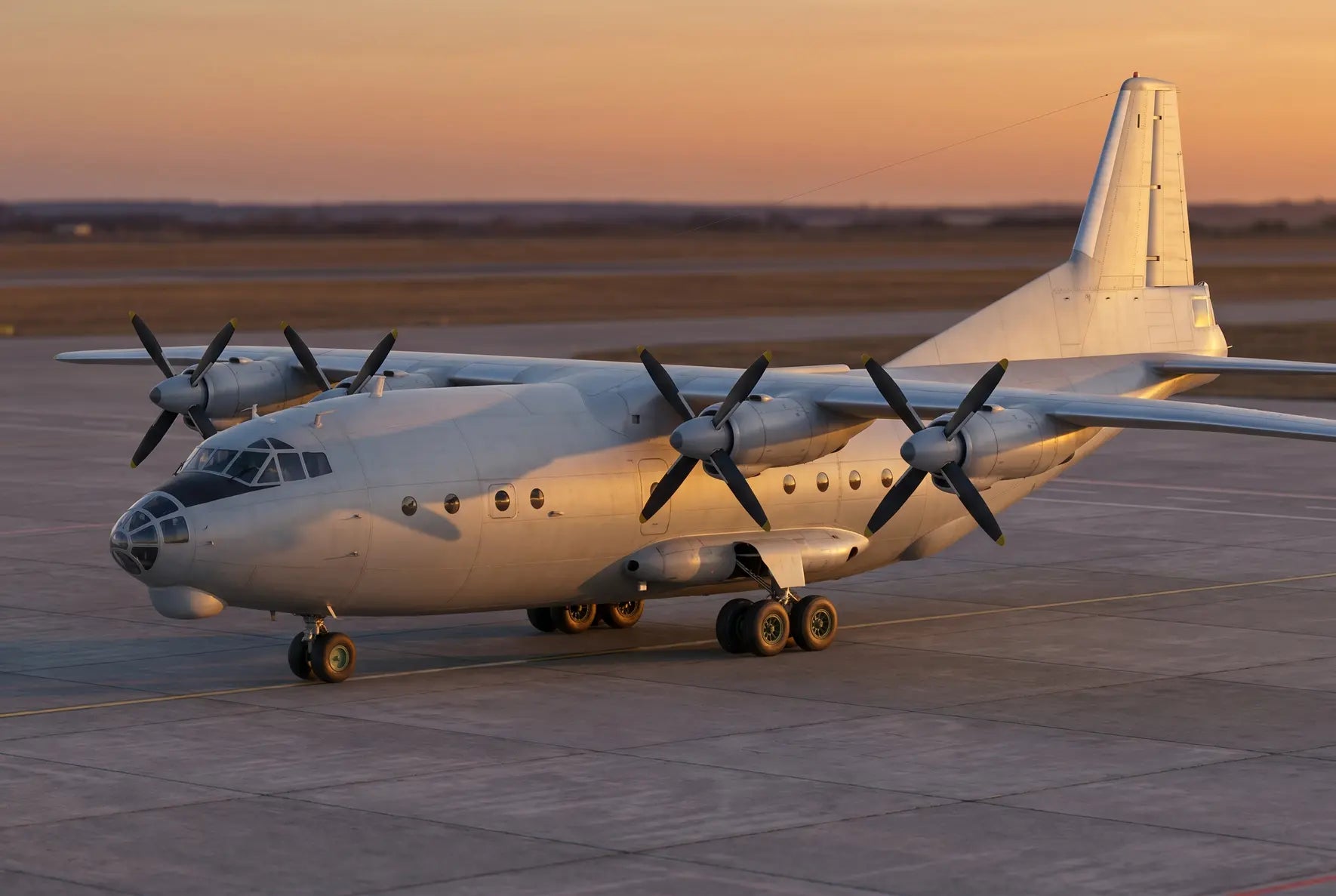
Antonov An-12: History, Development Path and Program Milestones
The Antonov An-12, known by the NATO reporting name Cub, is a four-engine turboprop military transport aircraft designed by the Antonov Design Bureau in Kyiv, Ukraine (then part of the Soviet Union). Often described as the Soviet counterpart to the Lockheed C-130 Hercules, the An-12 served as the standard medium-range cargo and paratroop transport of the Soviet Air Forces for more than three decades. Its origins, development timeline and technical evolution reflect a deliberate effort to modernise Soviet military airlift capabilities during the Cold War era.
The Antonov An-12 emerged from a lineage of turboprop transports developed under the leadership of chief designer Oleg K. Antonov. In the mid-1950s, the bureau had already produced the twin-engine An-8, the first purpose-built Soviet turboprop transport, and was developing the four-engine An-10 "Ukraina" passenger airliner. The Soviet government sought a larger, modern military transport capable of carrying heavy equipment, vehicles and paratroopers to unprepared airfields across vast distances. This requirement led to the An-12, which was conceived as the military cargo derivative of the An-10, sharing its wing, powerplant layout and much of its systems architecture while featuring a completely redesigned rear fuselage with a large cargo ramp and clamshell doors.
On 30 November 1955, the Council of Ministers of the USSR issued Directive No. 1956-1055, formally authorising the development and construction of the An-12 prototype, internally designated "Product T". This directive marks the official program launch date. The design team adapted the An-10 airframe for its new role: a reinforced cargo floor with tie-down points, provisions for airdrop operations, paratroop doors and a pressurised forward crew section paired with an essentially unpressurised main cargo hold. The aircraft was powered by four Ivchenko AI-20A turboprop engines, each producing approximately 4,000 horsepower.
On 16 December 1957, the first An-12 prototype completed its maiden flight from the Irkutsk-2 airfield at State Aviation Factory No. 39 in Irkutsk, Siberia. The test crew was led by pilot Yakov Vernikov. Factory testing and state trials followed throughout 1958 and 1959, evaluating performance on unprepared and high-altitude airfields, cargo and airdrop operations, and harsh-weather resilience. In 1959, the An-12 completed state acceptance trials and entered operational service with the Soviet Air Forces (VVS), rapidly becoming the core medium-range airlifter of Soviet military transport aviation.
Series production began at the Irkutsk factory in the late 1950s. In 1961, the main production line was transferred to the Tashkent Aviation Production Association (TAPO) in the Uzbek SSR, which ultimately built approximately 830 aircraft between 1961 and 1972. Additional production took place at factories in Voronezh and Kazan. By the time production ended around 1972-1973, a total of approximately 1,243 aircraft (per Antonov's official records) had been manufactured across all variants. The design was also licensed to China, where it was further developed as the Shaanxi Y-8 medium transport, which spawned its own extensive family of derivatives. Crew requirements typically involved five to six members: two pilots, a navigator, a flight engineer, a radio operator and, on armed military variants, a tail gunner operating two 23 mm NR-23 cannons in a rear turret. The physical demands placed on these crews, particularly during long missions at altitude in a partially unpressurised aircraft, underscore the importance of aeronautical medicine and rigorous medical examinations for military aviators.
Key Variants and What Sets Them Apart
Over its production life, the An-12 was built in numerous sub-variants, each introducing incremental improvements in engines, range, avionics and mission equipment. The initial production An-12 used the AI-20A engine and served as the baseline military transport. The An-12A, introduced in the early 1960s, upgraded to the more powerful AI-20K engine (approximately 4,250 hp), increasing climb performance and hot-and-high capability while adding fuel capacity for greater range. The An-12B became one of the principal production standards of the 1960s, incorporating structural refinements in the wing and landing gear, a higher allowable take-off weight and incremental avionics modernisation. The An-12BP further increased fuel capacity and maximum take-off weight to around 61,000 kg, establishing itself as the de facto standard tactical transport variant of the Soviet Air Forces by the late production period. The An-12BK, widely exported to Warsaw Pact allies and other nations, refined maintainability and updated navigation and communication systems for international operations.
Beyond the transport family, the An-12 airframe was adapted for specialised missions. The An-12B-I (approximately seven aircraft built) served as a dedicated electronic countermeasures (ECM) platform, fitted with jamming transmitters, receivers and additional antenna fairings. The An-12PP was a later, more capable electronic warfare conversion used for radar and communications jamming. The An-12PS was configured for search and rescue operations, carrying direction-finding equipment, survival stores and pararescue teams, and was notably used in support of the Soviet space programme. Up to 60 distinct variants were developed over the aircraft's lifetime, each tailored to specific operational requirements.
The following list summarises the key identifiers that distinguish the major Antonov An-12 variants:
- Engines: AI-20A (baseline, ~4,000 hp), AI-20K (~4,250 hp on An-12A/B), AI-20M (~4,250 hp on An-12BP/BK)
- Maximum take-off weight: approximately 61,000 kg on later variants (An-12BP, An-12BK)
- Maximum payload: up to 20,000 kg across all major transport variants
- Cargo hold volume: approximately 85-90 m3, with rear loading ramp and clamshell doors
- Defensive armament: two 23 mm NR-23 cannons in a tail turret (military variants); removed on civil freighters
- Pressurisation: pressurised forward crew section; main cargo bay essentially unpressurised
- Specialised mission systems: ECM suites (An-12B-I, An-12PP), SAR equipment (An-12PS), ELINT/ISR configurations (An-12BK-IS)
The Antonov An-12 saw extensive operational deployment across decades, from Cold War logistics and the 1968 Warsaw Pact intervention in Czechoslovakia to the 1971 Indo-Pakistani War (where India valued its rugged high-altitude performance) and the Soviet-Afghan War (1979-1989), where it earned the sobriquet Black Tulip for its role in repatriating fallen soldiers. Its robust design, short-field capability and versatile cargo hold ensured that many airframes remained in both military and commercial freight service well into the 21st century.

The image shows an Antonov An-12BK, a Soviet-era military transport aircraft, in flight. The plane is painted in gray with red star insignias on the wings and tail.
Antonov An-12 Technical Specifications, Systems and Engine Overview
The Antonov An-12 was designed as a rugged four-engine turboprop military transport, built to carry heavy loads into austere and semi-prepared airstrips across the Soviet Union and beyond. Its high-wing configuration, rear loading ramp, and robust landing gear reflect a clear design priority: maximise payload flexibility and short-field performance, even at the expense of pressurisation in the cargo hold and aerodynamic refinement. The aircraft is the military derivative of the Antonov An-10 passenger transport, sharing the same wing, empennage, and powerplant family while adding a redesigned rear fuselage with an integrated cargo ramp and tail gun position.
With a maximum payload of 20,000 kg and a ferry range exceeding 5,700 km, the An-12 occupies a similar operational niche to the Lockheed C-130 Hercules. The trade-off between range and payload is significant: at full 20-tonne load, range drops to approximately 3,600 km, while lighter loads allow considerably longer sectors. Unlike many Western counterparts, the main cargo hold is unpressurised, which limits operations with personnel or pressure-sensitive cargo at higher altitudes, even though the aircraft can reach a service ceiling above 10,000 m.
- Length: 33.1 m (108 ft 7 in)
- Wingspan: 38.0 m (124 ft 8 in)
- Height: 10.53 m (34 ft 7 in)
- Wing area: 121.7 m2
- Maximum takeoff weight (MTOW): 61,000 kg (134,482 lb)
- Operating empty weight (OEW): approximately 28,000 kg (baseline variants; up to 30,500 kg for later or fully equipped configurations)
- Maximum payload: 20,000 kg (44,000 lb)
- Engines: 4 x Ivchenko AI-20M or AI-20K turboprops, each producing approximately 4,000 to 4,250 shp
- Propellers: 4-blade AV-68I constant-speed, variable-pitch, reversible propellers
- Maximum speed: 660 km/h (360 kt)
- Typical cruise speed: 570 km/h (310 kt)
- Range with maximum payload (20 t): approximately 3,600 km (1,940 nmi)
- Ferry range (maximum fuel, reduced payload): approximately 5,700 km (3,080 nmi)
- Service ceiling: 10,200 m (33,500 ft)
- Rate of climb: 10.2 m/s (approximately 2,010 ft/min)
- Cargo hold dimensions: approximately 13.8 m long x 3.25 m wide x 2.50 m high
- Crew: 5 (two pilots, flight engineer, navigator, radio operator)
- Pressurisation: cockpit and forward crew cabin pressurised; main cargo hold unpressurised
- Defensive armament (military variants): 2 x 23 mm NR-23 cannons in a manned tail turret
Systems, Flight Controls and Handling Technology
The An-12 uses a conventional mechanically-actuated flight control system with hydraulic power boost on all primary surfaces (ailerons, elevators, rudder). Control inputs travel from the cockpit via cables and rods to hydraulic actuators at each surface, with an artificial feel system providing feedback to the pilots. In the event of a hydraulic system failure, limited manual reversion is available, though control forces increase substantially. Large double-slotted flaps, hydraulically actuated, provide the lift augmentation necessary for short-field operations.
The avionics baseline reflects the aircraft's late-1950s origins: a two-axis analog autopilot (pitch and roll, with heading hold and basic coupled approaches on later variants), ADF for NDB navigation, a Doppler navigation radar for ground speed and drift measurement, a radio altimeter, and nose-mounted weather radar. Many civil cargo operators have retrofitted surviving An-12s with GPS navigation, Mode-S transponders, and TCAS to comply with modern airspace requirements. The standard crew of five, including a dedicated navigator and radio operator, reflects the low level of cockpit automation. This contrasts sharply with modern aircraft such as the Embraer E190-E2, which use fully integrated digital avionics suites and fly-by-wire controls with two-crew operations.
The landing gear is a tricycle arrangement with main units retracting into external fuselage blisters, keeping the cargo floor unobstructed. This design enables the aircraft to operate from unpaved or semi-prepared runways. Braking is assisted by propeller reverse thrust from the four-blade constant-speed propellers. The cargo handling system includes a roller-track floor for palletised loads, a built-in electric overhead crane running the length of the cargo bay, and twin winches for pulling heavy items up the rear ramp.
Published performance figures for the An-12 vary depending on the specific variant (An-12B, An-12BK, An-12BP), operator modifications, actual loaded weight, atmospheric conditions, and runway surface type. Operators planning real-world flights typically work with longer takeoff and landing distances than manufacturer-published minimums, particularly at high weights or on unprepared strips. Range figures are similarly dependent on payload, altitude, and reserve fuel policies. All numbers cited above should be understood as representative of typical configurations rather than absolute guarantees.
Ivchenko AI-20 Turboprop Engines: History, Variants and Applications
The An-12 is powered by four Ivchenko AI-20 turboprop engines, one of the most widely produced and long-serving turboprop designs in aviation history. The AI-20 was developed by the OKB-478 design bureau (later known as Ivchenko-Progress) in Zaporizhzhia, Ukraine, under the direction of Aleksandr Ivchenko. Serial production was carried out primarily by Motor Sich in Zaporizhzhia and the Perm Engine Plant in Russia. Total production exceeded 14,000 units.
The AI-20 is a single-shaft turboprop featuring a 10-stage axial compressor, an annular combustion chamber with 10 burner injectors, and a three-stage axial turbine. The engine drives the propeller through a front-mounted reduction gearbox at constant RPM, with power modulated through fuel flow and propeller blade pitch. Key performance figures include a takeoff power of approximately 3,170 kW (4,250 shp) and a cruise specific fuel consumption of around 0.264 kg/kWh. The engine measures approximately 3,096 mm in length and has a dry weight of around 1,040 kg.
Several AI-20 variants were produced over the engine's long service life. Early An-12s used the AI-20A, while later production and retrofit programmes introduced the AI-20M (with improved power and reliability, rated at approximately 4,190 shp) and the AI-20K, which achieved a time between overhauls (TBO) of approximately 2,000 hours. The Chinese-manufactured derivative, designated WJ-6, powers the Shaanxi Y-8 and Y-9 transport aircraft derived from the An-12 airframe.
Beyond the An-12, the AI-20 family powered a broad range of Soviet-era aircraft, including the Ilyushin Il-18 four-engine airliner, the Ilyushin Il-38 maritime patrol aircraft, the Antonov An-10 passenger transport, the Antonov An-32 tactical transport (which uses an uprated AI-20D variant for hot-and-high operations), and the Beriev Be-12 amphibious patrol aircraft. This wide adoption across civil and military platforms speaks to the engine's fundamental reliability and adaptability, even though its fuel efficiency and overhaul intervals trail those of modern Western turboprops by a considerable margin.
Antonov An-12 vs C-130E vs Shaanxi Y-8 vs Transall C-160: Key Specifications Comparison
Scroll horizontally to see more →
| Parameter | Antonov An-12 | Lockheed C-130E Hercules | Shaanxi Y-8 | Transall C-160 |
|---|---|---|---|---|
| Entry into service | 1959 | 1962 | 1981 | 1967 |
| Engines | 4 × Ivchenko AI-20K turboprop | 4 × Allison T56-A-7 turboprop | 4 × WJ-6 turboprop | 2 × Rolls-Royce Tyne RTy.20 Mk 22 turboprop |
| Length | 33.1 m | 29.8 m | 34.0 m | 32.4 m |
| Wingspan | 38.0 m | 40.4 m | 38.0 m | 40.0 m |
| Height | 10.5 m | 11.6 m | 11.6 m | 11.3 m |
| Typical seating and layout (short description + approximate passengers) | Troop/cargo: up to 100 paratroopers or mixed cargo | Tactical transport: around 90 paratroopers or mixed cargo | Tactical transport: around 96 troops or mixed cargo | Tactical transport: around 93 troops or mixed cargo |
| MTOW | 61 t | 70.3 t | 61 t | 51 t |
| Range | 3,200 nm | 2,050 nm | 3,200 nm | 1,700 nm |
| Cruise speed | 0.48 Mach | 0.54 Mach | 0.48 Mach | 0.52 Mach |
| Service ceiling | 36,000 ft | 33,000 ft | 34,400 ft | 27,900 ft |
| Program note | Soviet medium-range military freighter and paratroop transport, widely exported and used as a rugged workhorse. | U.S. tactical airlifter benchmark of the Cold War era, direct Western counterpart to the An-12 in mission and size. | Chinese development of the An-12 with local systems and variants, extending the basic design into later decades. | Franco-German tactical transport optimized for short and rough-field operations, slightly smaller alternative to the An-12/C-130 class. |
Scroll horizontally to see more →
The table compares four Cold War–era tactical transports across size, engines, performance, and roles. The C-130E has the highest MTOW (70.3 t) and slightly faster cruise (0.54 Mach), while the An-12 and Y-8 share similar range (3,200 nm) and specs, reflecting the Y-8’s An-12 lineage. The C-160 is lighter (51 t) with the shortest range (1,700 nm) and lowest ceiling (27,900 ft).
Antonov An-12 Operations: Typical Missions, Routes and Airlines Around the World
The Antonov An-12 is a four-engined turboprop freighter designed for medium-range cargo transport. With a maximum payload of approximately 20,000 kg (44,000 lb) and a range of about 3,600 km (1,900 nmi) at full load, this aircraft typically flies sectors between 500 and 2,000 km. Its cruise speed sits around 520 to 570 km/h (280 to 310 kt), allowing it to complete one to three sectors per day depending on route length and ground-handling conditions. Average daily utilisation for most operators falls in the range of 3 to 6 block hours, well below the 8 to 10 hours common on modern jet freighters. The lower figure reflects the ad-hoc charter nature of most remaining An-12 operations and the additional maintenance time required by ageing airframes.
The aircraft excels in point-to-point operations rather than traditional hub-and-spoke networks. Its high-wing design, robust landing gear and rear loading ramp allow it to operate from unpaved, gravel and short runways that would be inaccessible to jet freighters. This makes it a workhorse for delivering industrial equipment to remote oilfields, mining sites and humanitarian relief zones. Operators also use the An-12 as a feeder freighter linking secondary or regional airports to larger cargo hubs, though this role has diminished as newer turboprops and small jet freighters have entered the market.
Operating the An-12 today presents significant challenges. The type requires a flight crew of five (two pilots, a flight engineer, a navigator and a radio operator), raising staffing costs compared with two-pilot glass-cockpit freighters. Spare parts depend on legacy Soviet-era supply chains, and structural fatigue on older airframes demands intensive inspection programmes. Noise and emissions restrictions in Europe and North America further limit where the aircraft can operate commercially.
Where the Antonov An-12 Operates
The An-12 has seen service on every inhabited continent, though it is most active today across Africa, parts of Asia and the former Soviet states in Europe. In Africa, it fills a vital niche carrying freight into remote or conflict-affected areas with minimal runway infrastructure. Across Asia and the CIS region, it supports energy-sector logistics and government transport. In Europe, Ukrainian cargo carriers have been the principal civil operators, running charters to the Middle East and Africa. Presence in North and South America has always been limited, restricted mainly to occasional charter work for project cargo and relief missions.
- Europe: Ukrainian carriers have dominated European An-12 operations. Ukraine Air Alliance flew ad-hoc cargo charters from Kyiv to destinations across Western Europe, the Middle East and Africa, handling oil and gas spares, automotive parts and relief cargo. Cavok Air provided ACMI and charter cargo services, including humanitarian flights contracted by NGOs. Motor Sich Airlines used the type for industrial cargo linked to its engine-manufacturing operations, while Antonov Airlines employed it as a lighter support freighter alongside its fleet of heavy-lift aircraft. Historically, Aeroflot and several Soviet-bloc state airlines operated large An-12 fleets across domestic and international routes. In Russia, carriers such as Avial Aviation ran cargo services to remote Siberian and Far Eastern destinations.
- North and South America: The An-12 was never widely adopted on this continent. Occasional appearances have involved specialised cargo operators and short-term charters for project freight, particularly in the mining and energy sectors. Eastern European and CIS-based operators have periodically flown An-12 charters into Brazil, Chile and Mexico carrying heavy machinery, though the aircraft usually retains its foreign registration.
- Asia: Silk Way Airlines of Azerbaijan operated several An-12s from Baku for heavy and outsized cargo, including UN and humanitarian contracts to Central Asia and Afghanistan. In China, the state civil aviation authority (CAAC) flew the An-12 and its locally built derivative, the Shaanxi Y-8, on domestic freight routes before modern jets replaced them. Iraqi Airways and EgyptAir also used the type for cargo and state logistics across the Middle East. In South and Southeast Asia, smaller cargo firms in countries such as Indonesia and Bangladesh have operated An-12s for freight to islands and remote communities with limited infrastructure.
- Africa: The continent remains one of the last strongholds of An-12 operations. In 2025, Batot Air of Burkina Faso put a 63-year-old An-12 into service, reportedly the oldest active commercial aircraft in Africa. Sudanese operators such as Azza Transport and Badr Airlines have used the type to deliver relief supplies, food aid and fuel to remote airstrips in Sudan and South Sudan. Across West and Central Africa, small cargo carriers frequently rely on An-12s for general freight between capitals and secondary cities. Foreign-registered An-12s also operate extensively within Africa under wet-lease arrangements, including flights into Algeria, a country whose own national carrier flies a very different fleet, as detailed in this overview of Air Algerie.
Cargo Hold Configuration and Cabin Layout
The Antonov An-12 was designed from the outset as a freighter and military transport, not a passenger airliner. Its cargo hold measures approximately 13.5 m in length, 3.0 m in width and 2.4 m in height, providing a usable volume of around 80 to 97 m³ depending on the variant. The hold is generally unpressurised, while the cockpit and the small crew rest area immediately behind the flight deck are pressurised. An overhead electric travelling crane runs most of the length of the bay, and twin winches near the rear ramp assist with loading heavy pallets and vehicles.
In military configuration, the cargo bay can accommodate up to 60 paratroopers on fold-down canvas and metal seats along the sidewalls, or palletised seating rows down the centreline for up to approximately 90 to 100 troops. Civil freighter variants strip out all seating and maximise cargo floor space, retaining only a few jumpseats in the pressurised forward section for supernumerary crew, loadmasters or accompanying personnel. There is no standard airline-style cabin configuration. When passengers are carried in the unpressurised hold, operations are typically conducted at lower cruising altitudes. The rear loading ramp, with an opening approximately 2.8 to 3.0 m wide and 2.4 m high, permits roll-on and roll-off of light vehicles, machinery and oversized pallets, a feature that remains central to the aircraft's operational value in austere environments.
In this video, discover why Russian soldiers avoid flying on a specific aircraft, exploring its design, operational risks, and the factors that make it feared and unpopular in service.
Antonov An-12 Safety Record: Accident History and How Safe Is This Aircraft?
The Antonov An-12 entered service in 1959, and approximately 1,243 airframes were produced between 1957 and 1972 at factories across the Soviet Union. Over more than six decades of continuous operation, the type has accumulated millions of flight hours in military airlift, humanitarian relief and commercial cargo roles. According to the Wikipedia listing derived from Aviation Safety Network data, more than 190 hull-loss accidents and incidents have been recorded for the An-12 family. That figure must be weighed against the fleet size, the era in which many of these airframes were designed, and the demanding environments in which they have routinely operated, including unpaved runways, conflict zones and regions with limited navigational infrastructure. Today, fewer than 100 An-12s remain active worldwide, split between civil cargo operators in the CIS, Africa and parts of Asia, and a handful of military air forces.
Notable Accidents and Their Aftermath
Several high-profile accidents illustrate the operational risks associated with this ageing turboprop freighter and the lessons drawn from each event.
- Allied Air, Accra, Ghana (2 June 2012) - An An-12BK operating a cargo flight from Lagos overran runway 21 at Kotoka International Airport at night in wet conditions. The aircraft broke through the perimeter fence and struck a minivan on a public road, killing 10 people on the ground; all four crew members survived. The Aviation Safety Network record and the Ghanaian accident investigation report identified an unstabilised approach, excessive touchdown speed and inadequate use of braking and reverse thrust as principal causes, compounded by rain-reduced friction. The investigation prompted a review of runway-end safety areas at Kotoka and reinforced stabilised-approach procedures among regional cargo operators.
- Silk Way Airlines, Dwyer Airbase, Afghanistan (18 May 2016) - A Silk Way Airlines An-12BK (4K-AZ25) on a cargo run from Baku overran the runway at Dwyer Airbase, broke apart and caught fire, killing all seven crew. Investigators concluded that the crew attempted to take off with engine number three inoperative and its propeller unfeathered, producing significant negative thrust. The findings underscored the critical importance of engine-out dispatch rules and propeller-feathering checks before any takeoff attempt.
- Grodno Avia, Irkutsk, Russia (3 November 2021) - An An-12BK (EW-518TI) on a cargo flight from Yakutsk descended prematurely during a night instrument approach in snowfall and low visibility. The aircraft struck trees roughly three kilometres short of runway 30 and was destroyed; all nine occupants perished. The accident was classified as controlled flight into terrain (CFIT) following deviation below the correct glide path. It renewed attention on approach monitoring discipline and minimum-descent-altitude compliance for operators of legacy freighter types.
A recurring pattern in these events, and across the wider An-12 accident record, is the central role of human and operational factors: unstabilised approaches, incorrect configuration management, inadequate crew resource management and, in several African and CIS cases, weak regulatory oversight. Structural or design-origin failures account for a far smaller share of the total. Nonetheless, the advancing age of the remaining fleet means that corrosion, metal fatigue and diminishing spare-part availability remain ongoing airworthiness concerns for operators that still fly Soviet-era freighters.
How Safe Is the Antonov An-12 Today?
Comparing the An-12 directly with modern jet freighters is not straightforward. The type was designed in the 1950s to a robust military specification, featuring a high-wing layout, rugged landing gear and a rear cargo ramp suited to austere strips. That design philosophy prioritised operational flexibility over the advanced redundancy and avionics now standard on newer aircraft. Many of the recorded accidents occurred in operating environments with minimal ground-based navigation aids, limited maintenance infrastructure and regulatory frameworks that fell well short of current ICAO safety standards. When An-12s are flown by operators with rigorous standard operating procedures, regular maintenance programmes and well-trained crews, the type has demonstrated the ability to operate reliably over long periods.
It is also worth noting that several countries and regional bodies have imposed restrictions. The UAE, for instance, permanently banned the An-12 from its airspace in 2010, and EASA-regulated airports rarely see the type. These measures reflect broad concerns about fleet age and operator standards rather than a single catastrophic design flaw. As global aviation safety continues to improve, with hull-loss rates at historic lows for the industry as a whole, commercial aviation remains one of the safest forms of transport. For the An-12 specifically, safety outcomes depend heavily on the standard of oversight and operational discipline applied by each individual operator.
01 What kind of missions is the Antonov An-12 typically used for today?
The Antonov An-12 is primarily used as a military and civilian cargo aircraft, often flying freight, humanitarian supplies, and outsized loads to remote or rugged airfields. Many operators use it on short- to medium-haul routes in Africa, Asia, and Eastern Europe where infrastructure is limited. It is valued for its rear cargo ramp and ability to operate from unpaved or semi‑prepared runways. Passenger operations are now rare and usually limited to ad‑hoc troop or charter flights with basic seating installed in the cargo hold.
02 What is the range and typical cruise profile of the Antonov An-12?
Depending on variant, payload, and fuel configuration, the Antonov An-12 has a maximum range of roughly 3,600 to 5,700 km, with practical commercial legs often kept under 3,000 km for payload flexibility. It usually cruises around 640–660 km/h at altitudes near 7,000–9,000 meters. Operators often plan conservative cruise settings to reduce fuel burn and engine wear on its four turboprop engines. These characteristics make it suitable for medium-range regional cargo links rather than long‑haul flights.
03 What is the cabin like for passengers on an Antonov An-12 flight?
When configured for passengers, the Antonov An-12 uses removable, often military‑style seats in the cargo compartment, which feels more like a freight bay than an airliner cabin. Noise levels are high due to the four turboprop engines and minimal acoustic insulation, so ear protection is usually recommended. Climate control can be basic, and amenities such as modern inflight entertainment, overhead bins, or advanced lighting are generally absent. The experience is functional and spartan, intended for personnel transport rather than comfort travel.
04 Which airlines or operators still fly the Antonov An-12 and on what routes?
The Antonov An-12 is now mainly flown by cargo airlines, military air arms, and specialized charter operators in regions such as Russia and the CIS, parts of Asia, and some African countries. Typical routes include freight runs between secondary cities, relief flights into conflict or disaster zones, and supply missions to remote mining or energy sites. Many aircraft are operated under local or regional brands rather than large global airlines. In some jurisdictions, older An-12s face restrictions or bans from commercial passenger use due to noise and safety regulations.
05 How does the Antonov An-12 compare with similar cargo aircraft?
The Antonov An-12 is often compared to aircraft like the Lockheed C-130 Hercules, as both are four‑engine turboprop tactical transports with rear ramps. The An-12 generally offers a spacious cargo hold and strong rough‑field performance but tends to lag behind newer designs in avionics, noise levels, fuel efficiency, and systems reliability. Many An-12s still in service are older airframes with modernized components rather than fully new‑build aircraft. For operators, its main advantages are low acquisition cost and rugged versatility, balanced against higher maintenance and operating demands.
06 What should a traveller know about safety and flight characteristics on the Antonov An-12?
The Antonov An-12 was designed in the late 1950s, and its safety profile depends heavily on how each individual aircraft is maintained, upgraded, and operated. Accidents over the decades have often involved aging airframes, challenging operating conditions, or overloaded flights, which is why some regions have imposed limitations on the type. In flight, the aircraft is stable and robust, with a high wing and strong landing gear that handle turbulence and rough runways well, though passengers may perceive a louder and more vibration‑prone ride than on modern jets. Anyone flying on an An-12 should be aware that standards can vary widely by operator and regulator, making the choice of carrier particularly important.