
S7 Airlines Overview & Company Profile
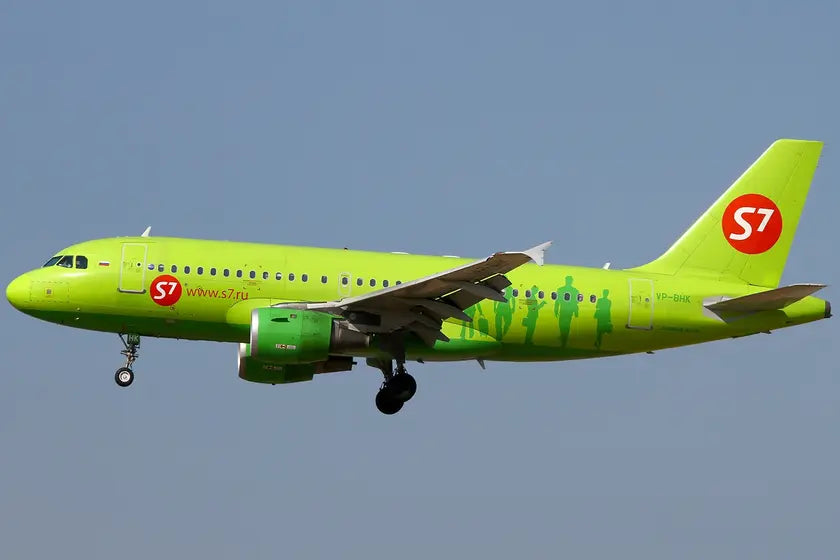
S7 Airlines (legally JSC Siberia Airlines) is Russia's largest privately-owned airline and the country's second-largest carrier by passenger volume, behind state-owned Aeroflot. Founded in 1957 as the Tolmachevo United Aviation Squadron and rebranded as S7 Airlines in 2006, the airline is headquartered in Ob, a city adjacent to Novosibirsk in western Siberia. It operates from dual hubs at Novosibirsk Tolmachevo Airport (OVB) and Moscow Domodedovo Airport (DME), with additional focus cities at Irkutsk, St. Petersburg, Vladivostok, and Khabarovsk.
S7 Airlines is a subsidiary of the S7 Group (formerly S7 AirSpace Corporation), a holding company that also encompasses S7 Technics (aircraft maintenance), S7 Training (pilot and crew training), S7 Tour, and Globe Airlines (charter operations). In 2023, S7 Group posted a record net profit of 37 billion rubles (approximately $400 million), though industry analysts note this figure was partly inflated by the suspension of Western aircraft lease payments following international sanctions. In 2025, S7 Airlines carried approximately 12.8 million passengers and operated around 100,000 flights across a network of roughly 100 destinations.
S7 was a member of the Oneworld airline alliance from 2010 until its membership was suspended in April 2022, following Russia's invasion of Ukraine. The airline is currently banned from European Union airspace and subject to comprehensive Western sanctions that restrict access to Boeing and Airbus spare parts, technical support, and new aircraft deliveries. These sanctions have fundamentally reshaped S7's operational environment, fleet strategy, and, by extension, pilot working conditions.
Fleet Composition & Aircraft Types
S7 Airlines operates a mixed fleet of approximately 105 aircraft, comprising Airbus narrowbodies, Boeing 737-800s, and Embraer E170 regional jets. The fleet is heavily impacted by Western sanctions: a significant number of A320neo and A321neo aircraft are parked due to engine maintenance issues with Pratt & Whitney PW1100G powerplants, for which spare parts and technical support are no longer available from Western suppliers. In July 2024, S7 began formally decommissioning some of these newer aircraft, reducing the operational fleet to substantially fewer airframes than the total inventory suggests.
| Aircraft Type | Role | Total | Status / Notes |
|---|---|---|---|
| Airbus A320neo | Narrowbody | 31 | ~21 parked due to PW1100G engine issues. Only ~10 operational. |
| Airbus A321neo | Narrowbody | 8 | All parked / designated for retirement. Sanctions prevent engine maintenance. |
| Airbus A320-200 | Narrowbody | 16 | Operational. CFM56 engines easier to maintain under sanctions. |
| Airbus A321-200 | Narrowbody | 11 | Operational. High-capacity domestic routes (up to 220 pax, all-economy). |
| Airbus A319-100 | Narrowbody | 3 | Operational. Smaller capacity for thinner routes. |
| Boeing 737-800 | Narrowbody | 18 | Operational workhorse. Domestic and select international routes. |
| Embraer E170 | Regional Jet | 17 | ~4 parked. Regional and feeder routes across Siberia. |
| Boeing 737-800BCF | Freighter | 2 | Cargo operations for S7 Cargo. |
Fleet data as of early 2026 via Flightradar24 and Airfleets. Operational numbers fluctuate as sanctions constrain maintenance cycles.
The most critical fleet development is S7's commitment to acquire 100 Tupolev Tu-214 medium-range aircraft, manufactured at the Kazan Aircraft Plant in Russia. A letter of intent has been signed, with contract finalization expected by the end of 2026 and first deliveries targeted for 2029. The Tu-214 is a twin-engine narrowbody seating up to 213 passengers, offering full independence from Western supply chains. While less fuel-efficient than modern Airbus or Boeing equivalents, the Tu-214 represents S7's long-term fleet strategy in a sanctions-constrained environment. This transition will require substantial pilot retraining as the Tu-214 features different flight systems and cockpit philosophy compared to Airbus fly-by-wire or Boeing conventional designs.
In December 2023, S7 also reached an agreement with lessors AerCap, ALC, and SMBC Aviation Capital to purchase 45 existing aircraft from their fleet for approximately 45 to 50 billion rubles, supported by Russia's National Wealth Fund. This move regularized the ownership status of previously leased aircraft that had been effectively stranded in Russia following sanctions.
By late 2023, only approximately 20% of S7's Airbus fleet was fully operational due to spare parts shortages and maintenance limitations imposed by Western sanctions. The airline has responded by extending aircraft operational lives, developing domestic maintenance capabilities through S7 Technics, and shifting operations toward Boeing 737-800 and older A320ceo airframes whose CFM56 engines are easier to maintain with available resources. Pilots should be aware that fleet availability constraints may lead to higher utilization rates and more intensive scheduling on operational aircraft.
Pilot Salary & Compensation
S7 Airlines does not publicly disclose specific pilot salary figures. However, compensation can be estimated based on publicly available Aeroflot benchmarks (Russia's largest carrier and primary salary reference point), industry reporting, and job posting analysis. Russian airline pilot salaries are structured around a base monthly component plus variable flight-hour-based pay, creating a system where total compensation depends heavily on monthly block hours flown.
According to a 2024 Aeroflot salary announcement (which sets the baseline for the Russian market), narrowbody pilots flying 70 hours per month earn approximately 543,000 rubles/month for captains and 283,000 rubles/month for first officers. At 85 hours monthly, these figures rise to 707,000 RUB and 357,000 RUB respectively. S7 Airlines, as a privately-owned carrier competing for the same pilot pool, is understood to offer compensation broadly in line with Aeroflot levels, though precise S7 figures remain undisclosed.
Estimated First Officer Pay Scale
| Experience Level | Monthly Gross (est.) | Annual Gross (est.) | USD Equivalent (approx.) |
|---|---|---|---|
| Entry F/O (70 hrs/month) | 250,000 - 300,000 RUB | 3.0 - 3.6 million RUB | ~$30,000 - $36,000 |
| Mid-Level F/O (80 hrs) | 300,000 - 400,000 RUB | 3.6 - 4.8 million RUB | ~$36,000 - $48,000 |
| Senior F/O (85 hrs) | 350,000 - 450,000 RUB | 4.2 - 5.4 million RUB | ~$42,000 - $54,000 |
Estimated Captain Pay Scale
| Experience Level | Monthly Gross (est.) | Annual Gross (est.) | USD Equivalent (approx.) |
|---|---|---|---|
| New Captain (70 hrs/month) | 500,000 - 580,000 RUB | 6.0 - 7.0 million RUB | ~$60,000 - $70,000 |
| Experienced Captain (80 hrs) | 580,000 - 700,000 RUB | 7.0 - 8.4 million RUB | ~$70,000 - $84,000 |
| Senior Captain (85+ hrs) | 700,000 - 820,000 RUB | 8.4 - 9.8 million RUB | ~$84,000 - $98,000 |
Figures are estimates based on Aeroflot benchmarks and Russian aviation industry data. USD conversion at ~100 RUB/USD. Actual S7 figures may vary. Flight-hour variable pay represents a significant portion of total compensation.
Russian pilot salaries are significantly below international benchmarks. According to industry analysis from RFE/RL, Russian commercial pilot pay has declined to approximately 40% of global average levels, down from ~70% before the pandemic. A senior captain at S7 earning 800,000 RUB/month (~$8,000 USD) would earn roughly one-third to one-quarter of what a comparable captain earns at a major US or European carrier. This disparity has driven documented pilot emigration toward Gulf carriers (Emirates, FlyDubai, Air Arabia) and Asian airlines in Uzbekistan, Kazakhstan, and Vietnam, creating retention challenges across Russian aviation. Pilots considering S7 should evaluate compensation in the context of Russia's lower cost of living, particularly outside Moscow.
Roster Pattern & Quality of Life
S7 Airlines pilots operate under Russian Federal Air Transport Agency (Rosaviatsia) regulations, which currently set maximum flight time at 80 hours per month and 800 hours per year. These limits can be temporarily increased to 90 hours monthly and 900 hours annually with pilot and trade union consent under exceptional circumstances. In 2025, the Russian Ministry of Transport proposed making 90/900 the new permanent standard, a change strongly opposed by the Russian Flight Crew Union (PLC) on fatigue safety grounds.
📅 Sample Month: Narrowbody First Officer (Novosibirsk Base)
Russia's vast geography means S7 pilots regularly operate long domestic sectors that can exceed 5 to 7 hours (for example, Moscow to Vladivostok at roughly 9 hours). These ultra-long domestic flights create fatigue management challenges comparable to international long-haul operations at Western carriers. Russian regulations mandate minimum 10-hour rest opportunities between duty periods, with 8 hours of uninterrupted sleep. Duty periods are capped at 14 hours under standard conditions.
S7 Airlines maintains pilot bases at Novosibirsk (primary hub), Moscow Domodedovo, and Irkutsk, with smaller operational presences at Vladivostok, Khabarovsk, and St. Petersburg. In 2024, S7 reduced its Moscow-based crew by approximately 15%, redirecting capacity toward Siberian bases. Pilots offered relocation to Novosibirsk or Irkutsk received retraining and relocation assistance. Novosibirsk offers significantly lower living costs than Moscow (housing costs can be 3 to 5 times lower), which partially offsets the salary differential with Western carriers. However, Siberian winters are severe, with temperatures regularly dropping below -30°C, and the geographic isolation from European Russia is a genuine quality-of-life consideration for pilots and their families.
Benefits, Travel Perks & Social Package
S7 Airlines offers what it describes as a "decent social package" in its recruitment materials, though specific benefit details are not publicly disclosed and form part of individual employment contracts. Based on standard Russian aviation industry practice and available information, the following benefits are typical for pilots at major Russian carriers including S7.
The S7 benefits package should be evaluated against Russia's broader social safety net, which provides universal healthcare (though quality varies), state pensions, and generous maternity protections by global standards. However, compared to Western European carriers, specific pilot-oriented benefits such as dedicated aviation pension schemes (like France's CRPN), comprehensive loss-of-license insurance, and extensive staff travel on global alliance networks are either absent or significantly reduced. The suspension of Oneworld membership means S7 pilots no longer benefit from alliance-wide interline travel privileges, a tangible quality-of-life reduction compared to the pre-2022 era.
Career Progression & Seniority
Career progression at S7 Airlines follows a seniority-based system standard across the global airline industry. Upgrade from First Officer to Captain, fleet transition opportunities, and schedule preferences are all determined primarily by seniority number. S7 does recruit experienced captains from other airlines (direct entry is available for type-rated pilots), distinguishing it from carriers like Air France that promote exclusively from within.
The current aviation environment in Russia creates an unusual dynamic for career progression. The combined effects of pilot emigration to foreign carriers, workforce reductions, and fleet constraints have compressed seniority lists at some Russian airlines, potentially accelerating upgrade timelines for pilots who remain. However, the reduced fleet size and limited international network also constrain the total number of captain positions available.
| Career Milestone | Estimated Timeline | Notes |
|---|---|---|
| Join as First Officer (A320 or B737) | Day 1 post-training | Most common entry fleet. Type rating provided by S7 Training. |
| Line check / consolidation | 3 - 6 months | Supervised line flying followed by line check to full F/O status. |
| Fleet transition (if applicable) | 2 - 5 years | Seniority-based. Transition between A320, B737, or E170 fleets. |
| Captain upgrade | 5 - 12 years (est.) | Depends on fleet growth, retirements, and pilot attrition. Command assessment required. |
| Training Captain / TRI / TRE | Variable | Separate selection and instructor qualification through S7 Training. |
| Tu-214 transition (future) | 2029+ | New type rating required. S7 Training to develop Tu-214 training programme. |
The post-2022 sanctions environment has created contradictory pressures on pilot careers at S7. On one hand, documented pilot emigration (particularly to Gulf and Asian carriers offering 2 to 3 times Russian salaries) has thinned seniority lists, potentially accelerating upgrades. On the other hand, fleet shrinkage due to maintenance constraints reduces the total number of command positions. Industry observers warn that Russia may face a systemic pilot shortage by 2026 to 2027, which could create urgent upgrade opportunities but also raise concerns about adequate training and experience levels for newly promoted captains. The planned Tu-214 introduction from 2029 will create an entirely new fleet transition pathway, potentially opening additional captain positions for pilots willing to retrain on Russian-manufactured aircraft.
Recruitment Process & Requirements
S7 Airlines actively recruits both First Officers and Captains for its Airbus A320 family fleet. Recruitment is conducted on a rolling basis, with positions advertised through the airline's careers portal and aviation job boards such as PilotsGlobal. The airline provides type rating training for selected candidates who do not already hold A320 family qualifications, reducing the entry barrier for pilots transitioning from other aircraft types.
First Officer Requirements
Captain Requirements
Selection Process
Online Application
Submit CV, license copies, medical certificate, and flight hour records through S7's careers portal or PilotsGlobal. Applications reviewed on a rolling basis throughout the year.
Document Verification & Screening
HR team verifies license validity, medical status, and minimum qualifications. Candidates may be asked to provide additional documentation or references at this stage.
Technical Assessment & Interview
Technical knowledge assessment covering aircraft systems, aviation regulations, and operational procedures. Interview component evaluates CRM skills, decision-making, and cultural fit. Conducted at S7 facilities (typically Novosibirsk or Moscow).
Simulator Assessment (if applicable)
For captain candidates and some experienced F/O applicants, a simulator session on A320 or B737 evaluates handling skills, standard operating procedures, and non-normal management.
Medical & Contract
Successful candidates undergo Class 1 medical validation (if not already current with Russian FATA). Employment contract offered with base assignment. F/O candidates without A320 type rating enter S7 Training for company-funded type rating course, receiving an apprenticeship scholarship of 16,000 RUB/month during training.
Russian language fluency is an absolute requirement. All cockpit communications on domestic flights, company procedures, technical manuals, and union interactions are conducted in Russian. While ICAO English Level 4 is required for international operations, the working language at S7 is Russian. For non-Russian pilots, license validation through the Russian Federal Air Transport Agency (FATA) is required before commencing line operations. This process can be lengthy and bureaucratic. The 150-hour minimum for F/O candidates is notably low by international standards, reflecting Russia's pilot shortage and S7's willingness to invest in training less-experienced recruits.
International Destinations & Layovers
S7 Airlines' international network has been drastically reduced since 2022 due to EU airspace bans and Western sanctions. The airline's pre-sanctions route map covered destinations across Europe, the Middle East, and Asia. Today, international operations are limited to "friendly nations" not participating in sanctions, plus select CIS destinations. In December 2025, S7 resumed international service on the Vladivostok to Bangkok route using Boeing 737-800 aircraft. The majority of S7's flying is now domestic within Russia's vast territory.
Pilots considering S7 should understand that the international layover experience is significantly reduced compared to pre-2022 operations and compared to Western carriers. The vast majority of S7 flying (over 90%) is now domestic within Russia. Domestic layovers occur at cities across Russia's 11 time zones, from Kaliningrad on the Baltic to Vladivostok on the Pacific. While Russia's geographic diversity offers unique travel experiences, the loss of European, East Asian, and other major international destinations represents a tangible quality-of-life reduction compared to the airline's Oneworld-era operations.
How S7 Airlines Compares: Airline Radar Chart
How does S7 Airlines stack up against Russia's other major carriers, Aeroflot (state-owned flag carrier) and Ural Airlines (private competitor based in Yekaterinburg)? Below is a comparative analysis across five key pilot employment metrics. Scores are editorial estimates based on publicly available data, industry reporting, and pilot community feedback.
Key Takeaways from the Comparison
Aeroflot leads on salary and benefits. As Russia's state-owned flag carrier with government backing, Aeroflot offers the highest publicly disclosed pilot salaries in Russian aviation (captains up to 820,000 RUB/month on narrowbody at maximum hours). Aeroflot also provides the most comprehensive benefits including 70 days annual leave, signing bonuses (650,000 RUB for captains, 350,000 RUB for F/Os), and a private pension scheme. S7 is believed to compete on salary but lacks the same government-backed financial resilience.
S7 offers more geographic flexibility than Ural Airlines. With bases in Novosibirsk, Moscow, and Irkutsk, S7 provides more base options than Ural Airlines (primarily Yekaterinburg and Moscow). S7's broader domestic network also offers more route variety. However, Ural Airlines has invested more aggressively in extending aircraft operational life, with dedicated programs to push Airbus A320 family airframes beyond 96,000 flight hours.
Job security is the weakest metric for all Russian carriers. Western sanctions, fleet constraints, geopolitical isolation, and uncertain domestic aircraft manufacturing timelines create genuine employment risk across the sector. S7's private ownership means it lacks the implicit government guarantee that supports Aeroflot. Ural Airlines, also privately held, faces similar vulnerability. All three carriers depend on successfully maintaining aging Western aircraft until Russian-manufactured replacements arrive.
Fleet condition is a differentiator. Aeroflot operates Russia's largest and most diverse fleet, including widebody aircraft. S7's mixed fleet (Airbus, Boeing, Embraer) offers more variety than Ural's all-Airbus operation, but S7 has a significant portion of its newer aircraft (A320neo/A321neo) grounded. Ural Airlines' focused single-type fleet provides maintenance efficiency advantages.
Scores are editorial estimates based on publicly available salary data, industry reporting (RFE/RL, Russian Aviation Insider, Flightglobal), airline press releases, and pilot community feedback. They represent a general assessment for a pilot evaluating long-term career options within Russian aviation. Individual experiences will vary based on seniority, base assignment, fleet type, and personal circumstances. All Russian carriers face unprecedented uncertainty due to the sanctions environment.
Union & Industrial Relations
Pilot representation in Russian aviation is primarily handled by the PLC (Profsoiuz Letnogo Sostava, or Russian Flight Crew Union), which advocates for flight crew interests across Russian airlines including working conditions, safety standards, and compensation levels. The PLC's leadership, including President Miroslav Boychuk and Vice President Oleg Prikhodko, has been vocal on issues affecting pilot welfare, particularly regarding proposed changes to flight time limitations.
Key Labor Disputes & Regulatory Battles
The Russian aviation labor relations landscape is markedly different from Western systems. Formal strike action by pilots is extremely rare in Russia, and the PLC's influence operates primarily through regulatory advocacy and public commentary rather than collective bargaining power comparable to ALPA (US) or SNPL (France). Pilot protections depend heavily on Russian labor code provisions and the airline's internal policies. S7's specific union representation arrangements are not publicly documented, and prospective pilots should inquire directly about collective agreement terms, grievance procedures, and worker representation structures during the recruitment process.
Verdict: Who Is S7 Airlines For?
🎯 Our Take
S7 Airlines occupies a unique position in Russian aviation as the country's largest privately-owned carrier, operating from Siberian bases that offer a genuinely different lifestyle compared to Moscow-centric Aeroflot. The airline provides a complete pilot career path from entry-level First Officer to Captain, with company-funded type rating training, a mixed fleet across three manufacturers, and bases in some of Russia's most distinctive cities.
The trade-offs are substantial and cannot be understated. Salaries are well below international benchmarks (roughly one-third to one-quarter of Western equivalents), the fleet is under severe pressure from sanctions-induced maintenance constraints, the international network has been drastically reduced, and the airline's long-term trajectory depends on factors largely outside its control: sanctions resolution, domestic aircraft manufacturing timelines, and the broader geopolitical situation. Job security carries meaningful risk given S7's private ownership and the absence of government backing that supports Aeroflot.
For Russian-speaking pilots committed to building a career within Russia's domestic aviation market, S7 offers competitive conditions within the Russian context, a strong regional brand, and the prospect of fleet renewal through the Tu-214 programme. For international pilots, the barriers are high: Russian language fluency, license validation, geographic isolation, and compensation that is difficult to justify by global standards.
1 Do I need to speak Russian to fly for S7 Airlines?
Yes, fluent Russian is mandatory for all pilot positions at S7 Airlines. All internal communications, operational procedures, cockpit coordination on domestic flights, and company culture are in Russian. While ICAO English Level 4 is required for international operations, Russian is the working language. There is no English-only pathway at S7.
2 Does S7 Airlines pay for the type rating?
Yes. S7 provides company-funded A320 family type rating through S7 Training for pilots recruited without an existing type qualification. During the training period, candidates receive an apprenticeship scholarship of 16,000 RUB per month. This substantially lowers the financial barrier to entry compared to self-funded type rating courses, which can cost $30,000 or more internationally.
3 How does S7 pilot pay compare to Aeroflot?
S7 does not publicly disclose pilot salaries, but industry consensus is that compensation is broadly competitive with Aeroflot levels, though Aeroflot's 2024 salary increase set a high benchmark (captains up to 820,000 RUB/month at maximum hours on narrowbody). Aeroflot also offers signing bonuses and 70 days annual leave. S7's private ownership means salary adjustments are driven by market competition rather than government-backed financial resources. Prospective candidates should negotiate specific terms during the hiring process.
4 Can non-Russian citizens apply?
Russian aviation regulations do not explicitly prohibit non-Russian pilots, but practical barriers are substantial. Foreign pilots must validate their licenses through the Russian Federal Air Transport Agency (FATA), demonstrate fluent Russian proficiency, and navigate a complex regulatory framework significantly different from EASA or FAA systems. Work permits and residency requirements add additional administrative hurdles. In practice, the vast majority of S7 pilots are Russian nationals.
5 What happens when the Tu-214 arrives?
S7's order for 100 Tu-214 aircraft represents the airline's long-term fleet strategy. First deliveries are expected from 2029. Current pilots will need to complete type rating conversion, likely managed through S7 Training. The Tu-214 uses Russian-manufactured engines (PS-90A) and avionics, representing a fundamentally different cockpit environment than Airbus or Boeing. This transition creates both opportunity (new captain positions on a growing fleet) and challenge (retraining on an aircraft type with different handling characteristics and reduced efficiency compared to Western equivalents).
6 Is S7 Airlines safe to fly for?
S7 Airlines is listed on the EU's air safety list (banned from EU airspace) due to concerns about oversight and sanctions-related maintenance challenges rather than specific safety incidents. Within Russia, S7 maintains operational safety standards overseen by Rosaviatsia. However, the broader Russian aviation environment faces documented challenges including fleet maintenance constraints, proposed flight hour increases opposed by pilot unions, and systematic pilot fatigue concerns. Prospective pilots should evaluate safety culture, maintenance standards, and fatigue management practices carefully during the interview process.
7 What are the base options at S7?
S7 operates pilot bases at Novosibirsk Tolmachevo (primary hub), Moscow Domodedovo, and Irkutsk, with smaller operational presences at Vladivostok, Khabarovsk, and St. Petersburg. In 2024, S7 reduced Moscow-based crew by approximately 15%, shifting capacity toward Siberian bases. Base assignment is determined by operational requirements, and pilots should be prepared for the possibility of being based in Siberia. Novosibirsk offers significantly lower living costs than Moscow but comes with harsh winters and geographic isolation.
8 How long to upgrade to Captain at S7?
Upgrade timelines at S7 are not publicly disclosed, but based on industry standards and the current Russian aviation environment, an estimated 5 to 12 years from First Officer to Captain is realistic. The accelerating factors (pilot emigration reducing seniority lists) and decelerating factors (fleet contraction reducing captain positions) are both at play. S7 does accept direct-entry captains from other carriers, meaning type-rated experienced captains can join at command level rather than starting as F/Os. A command assessment including simulator evaluation is required for all captain candidates.
Official Links & Resources
Before applying or making any career decisions, always verify information directly with official sources. These are the key websites and organisations relevant to S7 Airlines pilot careers:
Bookmark Russian Aviation Insider for English-language updates on Russian aviation developments, including fleet changes, regulatory updates, and market analysis. For Russian-language resources, the Rosaviatsia website publishes official regulations, advisory materials, and licensing information. When evaluating S7 specifically, monitor the PilotsGlobal S7 page for the latest job postings and requirement updates.