

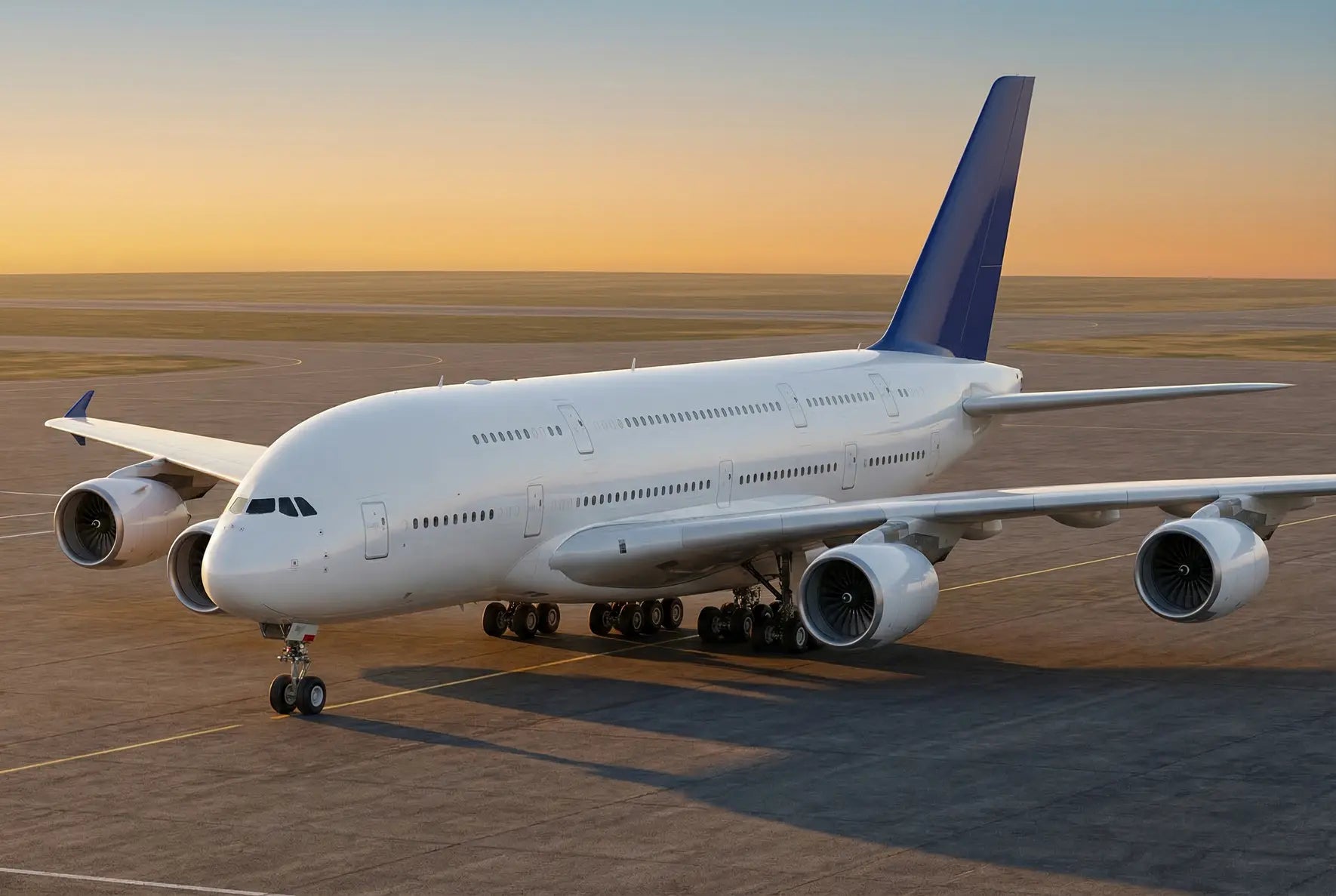
Airbus A380-800: History, Program Launch, and Development of the Superjumbo
The Airbus A380-800 emerged from a long ambition to challenge the dominance of the Boeing 747 in the very large aircraft segment. During the early 1990s, Airbus began studying market demand for a high capacity, long range, double deck widebody. In June 1994, the project took shape under the working title A3XX, a twin deck concept designed to carry more than 500 passengers on hub to hub routes where airport congestion and slot limitations made fewer, larger flights commercially attractive.
Airbus formally established its Large Aircraft Division in 1996 to coordinate the multinational effort, drawing on manufacturing centres in Toulouse (France), Hamburg (Germany), Broughton (United Kingdom), and Getafe (Spain). The airframe design was frozen in 1998, and by July 2000 Airbus had secured more than 50 firm orders from launch customers including Emirates, Singapore Airlines, Air France, and Qantas. In December 2000, the programme was officially launched under the designation A380, with an initial development budget estimated at around €8.8 billion.
Component production began in January 2002. The first centre wing box was unveiled in July 2003, and the first complete wing left the Broughton facility in November 2003. Final assembly started in the purpose built Jean Luc Lagardère plant in Toulouse in May 2004. The completed prototype, registered F-WWOW, was publicly unveiled on 18 January 2005, and the maiden flight took place on 27 April 2005 from Toulouse Blagnac Airport.
Type certification from EASA (Type Certificate EASA.A.110) and the FAA was granted in December 2006, following an extensive test campaign that included an emergency evacuation trial with 853 passengers and 20 crew members completed in 78 seconds. The first production aircraft was delivered to Singapore Airlines on 15 October 2007, and the inaugural commercial service operated on 25 October 2007 between Singapore and Sydney.
The programme faced significant delays and cost overruns. Incompatible design software between German and French production sites caused wiring problems affecting approximately 100,000 wires and 40,000 connectors per aircraft. These issues triggered successive delay announcements in 2005 and 2006, pushing entry into service roughly two years beyond the original early 2006 target. Total development costs escalated to an estimated €18 billion or more, and the difficulties prompted management changes within the EADS group. The planned freighter variant, the A380-800F, was ultimately shelved after customers including FedEx and UPS cancelled their orders.
Once in service, Airbus introduced incremental performance upgrades. A 2010 build standard added a strengthened airframe, a 1.5 degree wing twist increase, and optimised fly by wire control laws, enabling a maximum takeoff weight (MTOW) option of 573 tonnes. A further 2012 upgrade raised MTOW to 575 tonnes, adding approximately 150 nautical miles of range. In June 2017, Airbus presented the A380plus concept at the Paris Air Show, featuring proposed split tip winglets, Airspace cabin improvements, and an additional 80 seat capacity, but it was never launched as a production programme. Production peaked at 30 aircraft per year in both 2012 and 2014. Airbus announced the end of A380 production in February 2019, citing insufficient orders, and the final aircraft was delivered in December 2021, bringing the total to 251 deliveries across 14 operators. Many airlines, particularly Emirates, which operates the largest A380 fleet, continue to fly the type extensively.
What Distinguishes the A380-800 from Other A380 Variants
The A380-800 is the only variant of the A380 family that entered series production and commercial service. It is a full length, double deck, quad engine widebody with a typical three class layout seating around 525 passengers and a maximum certified capacity of 853. Two other variants were studied but never built. The A380-900 was a proposed stretched version with roughly 10 additional fuselage frames, targeting around 650 passengers in three class configuration. The A380-800F freighter was designed to carry 150 tonnes of payload over 5,600 nautical miles but was cancelled due to programme delays. Pilots interested in the operational environment around the A380 and how airlines structure their pilot career paths can explore how different fleet operators manage training and type ratings.
Within the A380-800 designation, three certified sub variants exist under EASA Type Certificate EASA.A.110, each defined by its powerplant:
- A380-841 and A380-861: powered by Engine Alliance GP7200 series turbofans (models GP7270 and GP7277), each rated at approximately 70,000 to 81,500 lbf of thrust.
- A380-842: powered by Rolls Royce Trent 900 series turbofans (models Trent 970, 972, 970B, 972B), with thrust ratings from approximately 70,000 lbf up to 84,000 lbf in growth versions.
- Maximum takeoff weight: ranging from 560 tonnes at the original baseline to 575 tonnes on later build standards.
- Range: approximately 8,000 nautical miles (14,800 km) in standard configuration, extending to around 8,350 nm with later MTOW upgrades.
- Wingspan: 79.75 metres, constrained by the 80 x 80 metre airport compatibility box, with wingtip fences rather than winglets on the production model.

The image features an Emirates Airbus A380 aircraft in flight against a clear blue sky. The plane displays the Emirates logo prominently and is equipped with four engines.
Airbus A380-800 Technical Specifications, Systems Architecture and Engine Options
The Airbus A380-800 was conceived as an ultra high capacity, long range widebody designed to connect major international hubs on routes where demand exceeds the capacity of single deck aircraft. Its double deck fuselage accommodates between 525 passengers in a typical three class layout and up to 853 in a maximum density configuration. The design prioritises range and payload over runway performance: with a maximum takeoff weight of up to 575 tonnes and fuel capacity exceeding 320,000 litres, the A380-800 covers sectors of up to 8,000 nautical miles (14,800 km) at a long range cruise speed of Mach 0.85. Its 845 m² wing, the largest ever fitted to a commercial airliner, enables a slower approach speed, roughly 20 knots below comparable widebodies, which benefits landing performance and ride comfort.
The A380-800 shares Airbus fly by wire philosophy and cockpit commonality with the A330 and A340 families, allowing mixed fleet flying with reduced transition training. However, it introduced several firsts for commercial aviation: a 5,000 psi (350 bar) hydraulic system, Integrated Modular Avionics (IMA), and Avionics Full Duplex Switched Ethernet (AFDX, based on ARINC 664), setting the foundation for avionics architecture later refined in the A350 XWB.
- Overall length: 72.72 m (238 ft 7 in)
- Wingspan: 79.75 m (261 ft 8 in), ICAO Aerodrome Reference Code F
- Height: 24.09 m (79 ft 0 in)
- Wing area: 845 m²
- Typical MTOW: 560,000 kg to 575,000 kg depending on operator option
- Maximum landing weight (MLW): approximately 394,000 kg
- Maximum zero fuel weight (MZFW): approximately 369,000 kg
- Fuel capacity: approximately 320,000 litres (usable ~253,983 kg at standard density)
- Cruise speed: Mach 0.85 (approximately 903 km/h), maximum Mach 0.89
- Service ceiling: 43,100 ft (13,136 m)
- Cockpit crew: two pilots, eight interchangeable LCD displays
- Engines: four Rolls-Royce Trent 900 or four Engine Alliance GP7200 turbofans
- Seating: 525 typical (three class) up to 853 maximum certified
Flight Controls, Avionics and Systems Highlights
The A380-800 flight control system relies on six computers: three Primary Flight Control Computers (PRIMs) and three Secondary Flight Control Computers (SECs). A single PRIM is sufficient to maintain safe control through landing. Control surfaces are driven by a mix of conventional hydraulic actuators, Electro Hydrostatic Actuators (EHAs) on elevators and ailerons, and Electrical Backup Hydraulic Actuators (EBHAs) on rudders and spoilers. The 5,000 psi hydraulic system, a step up from the 3,000 psi standard on earlier jets, reduces component size and saves over 1,000 kg in system weight. Braking uses carbon brakes on a 22 wheel main landing gear arrangement (four leg configuration), managed through a Local Electro Hydraulic Generation System (LEHGS).
Avionics are built on Integrated Modular Avionics (IMA) using Core Processing Input/Output Modules (CPIOMs) networked via AFDX. This architecture replaces many dedicated avionics boxes with shared processing modules, reducing wiring and improving maintainability. The glass cockpit features eight large interchangeable LCD screens, two Head Up Displays (HUD capable), and the familiar Airbus sidestick interface with flight envelope protection, including alpha floor, load factor limiting and bank angle protection. Many pilots transitioning from the A330 or A340, including those at airlines across a range of operators in the aviation industry, benefit from significant cockpit commonality.
Published performance figures for the A380-800 vary depending on operator selected MTOW option, cabin density, atmospheric conditions, runway elevation and slope, and engine variant. Manufacturer range is typically quoted with a full three class payload and standard reserves. Takeoff field length, fuel burn per seat and payload range curves are all sensitive to these variables, so absolute values should always be interpreted in context rather than taken as fixed guarantees.
Engine Options: Rolls-Royce Trent 900 and Engine Alliance GP7200
Airlines ordering the A380-800 could choose between two powerplant families. The Rolls-Royce Trent 900 is a three spool, high bypass turbofan derived from the Trent 800 (Boeing 777) and Trent 500 (Airbus A340-500/600). It features a 116 inch (2.95 m) fan with 24 swept hollow titanium blades, a bypass ratio of 8.5 to 8.7:1, overall pressure ratio of up to 39:1, and a dry weight of 6,246 kg (13,770 lb). Thrust ratings across Trent 970, 972 and 977 variants span 334 to 374 kN (75,100 to 84,100 lbf). Two thirds of A380 operators, including Singapore Airlines, Qantas, British Airways, Lufthansa and ANA, selected the Trent 900.
The alternative is the Engine Alliance GP7200, a joint venture engine between GE Aviation and Pratt & Whitney. It draws its high pressure core from the GE90 and its low pressure sections from PW4000 heritage. The GP7200 features a 116 inch (296 cm) fan, a bypass ratio of 8.8:1, and a thrust range of 311 to 363 kN (70,000 to 81,500 lbf) across the GP7270 and GP7277 variants. The GP7200 is exclusive to the A380 and was chosen by Emirates (the largest A380 operator by fleet size), Etihad Airways, Korean Air and Qatar Airways. Both engine families are certified to similar overall thrust levels and meet stringent noise and emissions standards, with the choice often driven by airline maintenance agreements, fleet commonality and long term support considerations.
Airbus A380-800 vs A380-800F vs Boeing 747-8I vs Airbus A350-1000 Specifications
Scroll horizontally to see more →
| Parameter | Airbus A380-800 | Airbus A380-800F | Boeing 747-8I | Airbus A350-1000 |
|---|---|---|---|---|
| Entry into service | 2007 | Cancelled | 2011 | 2018 |
| Engines | 4 × Rolls-Royce Trent 900 | 4 × Rolls-Royce Trent 900 | 4 × GE GEnx-2B67 | 2 × Rolls-Royce Trent XWB-97 |
| Length | 72.7 m | 72.7 m | 76.3 m | 73.8 m |
| Wingspan | 79.8 m | 79.8 m | 68.4 m | 64.8 m |
| Height | 24.1 m | 24.1 m | 19.4 m | 17.8 m |
| Typical seating and layout | 3-class: 525 passengers | N/A (freighter) | 3-class: 410–467 passengers | 3-class: 350–410 passengers |
| MTOW | 575 t | 575 t | 447 t | 322 t |
| Range | 8,200 nm | 5,600 nm | 8,000 nm | 8,100 nm |
| Cruise speed | 0.85 Mach | 0.85 Mach | 0.85 Mach | 0.85 Mach |
| Service ceiling | 43,000 ft | 43,000 ft | 43,100 ft | 43,000 ft |
| Program note | World's largest passenger airliner, full double-deck design for high-capacity hub-to-hub ultra-long-haul | Planned freighter variant with three cargo decks, development cancelled in 2008 | Latest 747 passenger model, partial double-deck, advanced engines for long-range operations | Modern efficient widebody, all-new design with composites, longest-range twin-engine for point-to-point |
Scroll horizontally to see more →
The table compares key dimensions and performance across the A380-800, cancelled A380-800F, 747-8I, and A350-1000. The A380 leads in wingspan (79.8 m), height (24.1 m), MTOW (575 t) and typical capacity (525). The 747-8I is longest (76.3 m) and nearly matches A380 range (8,000 vs 8,200 nm). The A350-1000 uses two engines, is much lighter (322 t), yet offers similar long range (8,100 nm).
Airbus A380-800 Operations: Airlines, Routes and Typical Missions Worldwide
The Airbus A380-800 was designed for high-capacity, long-haul operations connecting the world's busiest aviation hubs. With a maximum range of approximately 15,200 km (8,200 nmi), this double-deck widebody typically serves routes lasting between 6 and 18 hours, covering distances from medium-haul intercontinental segments to ultra-long-haul sectors such as Dubai to Auckland, which stretches over 14,200 km. Airlines operating the type commonly achieve daily utilisation rates in the range of 12 to 16 block hours per aircraft, reflecting the long sectors and quick turnarounds that justify deploying such a large airframe.
The Airbus A380-800 thrives in hub-and-spoke networks where passenger volumes on trunk routes are consistently high. It is most commonly found at major international hubs such as Dubai International (DXB), London Heathrow (LHR), Singapore Changi (SIN), Sydney Kingsford Smith (SYD), and Munich (MUC). Point-to-point deployment is rare because filling more than 400 seats on a single frequency requires the feed traffic that only large hubs can generate. Airports serving the A380 must meet specific infrastructure requirements, including runways of at least 2,950 m at maximum takeoff weight, reinforced taxiways rated for the aircraft's 575-tonne MTOW, widebody gates with dual boarding bridges, and hangars tall enough to accommodate its 24-metre height. These constraints limit the number of airports capable of handling regular A380 operations and represent a key challenge for operators looking to expand the type's network. The shift towards more efficient twinjets such as the Boeing 777X and Airbus A350 has also prompted several carriers to retire or reduce their A380 fleets, particularly after the pandemic-driven demand slump of 2020.
Where the Airbus A380-800 Operates by Region
As of 2025, approximately 10 airlines actively operate the Airbus A380-800 worldwide. The fleet is concentrated in the Middle East, Europe, and Asia-Pacific, with limited but significant presence on routes to North America, Africa, and Oceania. The aircraft predominantly serves premium international corridors where demand justifies its capacity, linking major cities across continents on daily or multi-daily frequencies. Retired operators include Air France (retired in 2020), Malaysia Airlines, Thai Airways, and China Southern Airlines, all of which withdrew the type due to financial pressures or fleet rationalisation.
- Europe: British Airways operates 12 Airbus A380-800 aircraft from London Heathrow on routes to destinations including Los Angeles, Miami, San Francisco, Boston, Johannesburg, and Dubai. Lufthansa returned 8 A380s to active service post-pandemic, deploying them from Munich to cities such as New York JFK, Los Angeles, Bangkok, New Delhi, Denver, and Boston. Both carriers use the type to consolidate high-yield long-haul demand through their primary hubs.
- North & South America: No North or South American airline has ever operated the Airbus A380-800. However, the type is a frequent visitor to major U.S. gateways. Los Angeles (LAX) receives the highest number of daily A380 movements in the Western Hemisphere, served by Emirates, Qantas, Lufthansa, British Airways, Korean Air, and Singapore Airlines. Other U.S. destinations include New York JFK, San Francisco, Miami, Dallas/Fort Worth, and Washington Dulles.
- Asia & Oceania: Emirates is the world's largest Airbus A380-800 operator with approximately 116 aircraft, serving over 40 destinations from Dubai, including multiple daily frequencies to London, Bangkok, Sydney, and Hong Kong. Singapore Airlines flies around 12 A380s from Changi Airport on premium routes to London, Sydney, and other key cities. Korean Air (7 aircraft) and Asiana Airlines (6 aircraft) deploy the type from Seoul Incheon on transpacific and regional routes. All Nippon Airways (ANA) operates 3 A380s exclusively on its Tokyo Narita to Honolulu route, branded as the "Flying Honu." Qantas maintains 10 active A380s connecting Sydney and Melbourne with Los Angeles, Singapore, London (via Singapore), Dallas/Fort Worth, and Johannesburg. Qatar Airways flies approximately 8 A380s from Doha to London, Bangkok, Perth, and Paris. Etihad Airways operates 9 A380s from Abu Dhabi on select high-demand routes including London Heathrow. For comparison, the operational philosophy of matching aircraft size to route demand is a core principle across the industry, applicable even to smaller regional types such as the Antonov An-148.
- Africa: No African airline operates the Airbus A380-800. The continent is served by foreign carriers using the type on routes into major gateways. British Airways connects London Heathrow with Johannesburg, while Emirates deploys A380s to Johannesburg, Cairo, and Casablanca from Dubai. Qantas also serves Johannesburg from Sydney using the type.
Typical Seating Configurations of the Airbus A380-800
The Airbus A380-800 offers extraordinary flexibility in cabin layout thanks to its two full passenger decks, with real-world configurations ranging from 379 seats to 615 seats depending on the operator and route strategy. The manufacturer originally marketed the type with a typical three-class capacity of 525 seats.
Network carriers focused on premium service tend to install four-class cabins with first class, business class, premium economy, and economy. Qantas configures its A380 with 485 seats across four classes: 14 first class, 70 business class, 60 premium economy, and 341 economy. Singapore Airlines offers one of the lowest-density layouts at 471 seats across four classes, reflecting its emphasis on spacious premium cabins including its signature Suites product on the upper deck. Emirates operates no fewer than eight different A380 configurations, ranging from a low-density four-class layout of 487 seats (14 first, 76 business, 56 premium economy, 341 economy) to a high-density two-class variant seating 615 passengers (58 business, 557 economy) used on shorter, high-demand routes. ANA seats 520 passengers in a three-class configuration that includes 8 first class, 56 business, 73 premium economy, and 383 economy seats. On the upper deck, premium cabins typically feature 1-2-1 or 2-2-2 abreast business class seating with lie-flat beds, while economy class on the main deck is usually arranged in a 3-4-3 layout with a seat pitch of around 31 to 32 inches. The variety of configurations underscores how operators tailor the Airbus A380-800 to balance revenue potential with passenger comfort on different route segments.
In this video, discover why the Airbus A380 is making an unlikely comeback, from its 2007 first commercial flight and record-breaking debut to the shifts reshaping its role in modern airline fleets.
Airbus A380-800 Safety Record: How Safe Is the Superjumbo?
The Airbus A380-800 holds one of the most impressive safety records of any commercial airliner in aviation history. Since entering service with Singapore Airlines in October 2007, the superjumbo has accumulated over 800,000 flights and 7.3 million block hours (as of December 2021) with zero fatalities and zero hull losses. A total of 251 A380-800 aircraft were delivered to 14 operators before production ended. As of early 2026, approximately 159 remain in active service worldwide, with Emirates operating the largest fleet. Despite a number of serious incidents over nearly two decades, no passenger or crew member has ever lost their life aboard the double decker.
Notable Incidents and What Changed
Qantas Flight 32 (November 2010) remains the most significant safety event in A380 history. Shortly after departure from Singapore Changi, the Rolls Royce Trent 900 powering the No. 2 engine on A380-842 VH-OQA suffered an uncontained intermediate pressure turbine disc failure at approximately 7,000 feet. Shrapnel punctured the left wing, severing wiring, hydraulic lines and fuel system components. Despite cascading system failures, the crew of five pilots managed to land the aircraft safely with all 469 occupants unharmed. The Australian Transport Safety Bureau (ATSB) investigation determined that a manufacturing defect in an internal oil feed stub pipe led to oil leakage, fire and eventual disc rupture. In the aftermath, Rolls Royce replaced 55 Trent 900 engines across the global fleet and revised manufacturing quality controls. The incident also prompted enhanced crew resource management training for multi failure scenarios.
Air France Flight 66 (September 2017) involved A380-800 F-HPJE, powered by Engine Alliance GP7200 engines, en route from Paris to Los Angeles. At cruise altitude over Greenland, the No. 4 engine suffered an uncontained fan hub fracture, scattering debris and damaging the nacelle and wing surfaces. The crew shut down the engine and diverted safely to Goose Bay, Canada, with all 521 occupants uninjured. The BEA technical report identified cold dwell fatigue in the titanium fan hub alloy as the root cause, a phenomenon not fully understood at the time of certification. The findings led to updated inspection protocols and improved understanding of macro zone behaviour in titanium alloys used in large turbofan engines.
Wing rib feet cracking (2012) was a structural concern discovered during routine maintenance. Hairline cracks were found in aluminium brackets inside the wings of several early build A380s. Although Airbus confirmed the cracks did not pose an immediate flight safety risk due to the wing's load redistribution capability, the European Union Aviation Safety Agency (EASA) issued an airworthiness directive mandating fleet wide inspections. Airbus responded with a permanent fix that involved switching to an improved aluminium alloy and reinforcing affected areas, restoring the full structural life of the wing.
How Safe Is the Airbus A380-800?
By every measurable standard, the A380-800 ranks among the safest large commercial aircraft ever built. Its fatal accident rate stands at zero, a distinction shared by very few widebody types with comparable service histories. This record reflects a design philosophy built around structural redundancy: four engines, triple or quadruple redundant flight control systems, and extensive use of composite materials and advanced aluminium alloys. Rigorous standard operating procedures, continuous airworthiness monitoring and strict regulatory oversight by agencies such as EASA and the FAA further underpin the aircraft's operational safety. Operators including Emirates, Singapore Airlines, Qantas and British Airways maintain the type under manufacturer recommended maintenance programmes and crew training standards.
When measured against the billions of passenger kilometres flown each year, the A380's record reinforces a well established fact: commercial aviation remains one of the safest modes of transport available. Each incident involving the superjumbo has led to tangible improvements in engine design, materials science, inspection techniques and crew procedures, demonstrating the industry's commitment to learning from every event. For passengers boarding this iconic double decker, the data speaks clearly: the Airbus A380-800 offers an outstanding level of safety backed by nearly two decades of proven service.
01 What is the range and typical mission profile of the Airbus A380-800?
The Airbus A380-800 has a maximum range of about 15,200 km (8,200 nautical miles), suitable for ultra-long-haul flights like Dubai to Auckland or Hong Kong to New York. It excels on high-demand routes between major hubs, carrying 525-853 passengers non-stop. Airlines use it for missions up to 15 hours, optimizing fuel efficiency at Mach 0.85 cruise speed.
02 What are common cabin layouts and passenger comfort features on the Airbus A380-800?
Typical layouts seat 525 passengers in three or four classes, with British Airways configuring 469 seats across four classes on their A380-800 fleet. The double-deck design offers wider seats, more personal space, and advanced air circulation that refreshes cabin air every two to three minutes. Passengers experience a smoother ride and one of the quietest cabins among wide-body aircraft due to engine and aerodynamic optimizations.
03 Which airlines operate the Airbus A380-800 and on what routes?
Major operators include Emirates, British Airways, Singapore Airlines, and Qantas, with Emirates flying the most on high-volume routes from Dubai to London, Sydney, and New York. British Airways uses it for transatlantic and intra-Asia flights from London Heathrow. These airlines deploy it on busy long-haul corridors where high capacity justifies its size.
04 How does the fuel efficiency and performance of the Airbus A380-800 compare to similar aircraft?
Powered by four Rolls-Royce Trent 900 or Engine Alliance GP7200 engines, the A380-800 cruises at Mach 0.85 (903 km/h) with a fuel consumption of about 3.1 litres per 100 passenger-kilometers. It achieves better fuel burn per seat than smaller twinjets on dense routes due to its capacity, though less efficient per trip than modern Boeing 787s. Its maximum takeoff weight of 575 tonnes supports heavy payloads over 15,000 km.
05 What is the safety record and key design features of the Airbus A380-800?
The Airbus A380-800 has an exemplary safety record with no fatal accidents in passenger service since entering operations in 2007. Design features include thrust reversers only on inner engines to save weight, a high service ceiling of 13,000 meters, and robust landing gear for paved runways only. Its size enhances stability, contributing to smooth flights and low noise levels.
06 What practical tips should travelers know about flying on the Airbus A380-800?
Upper deck seats near the front offer quicker boarding and quieter rides away from engines, while lower deck provides easier access to economy galleys. Large windows and high stability make it handle turbulence smoothly compared to narrower fuselages. Approach speed is around 255 km/h, ensuring stable landings, and the spacious cabin reduces claustrophobia on long flights.