

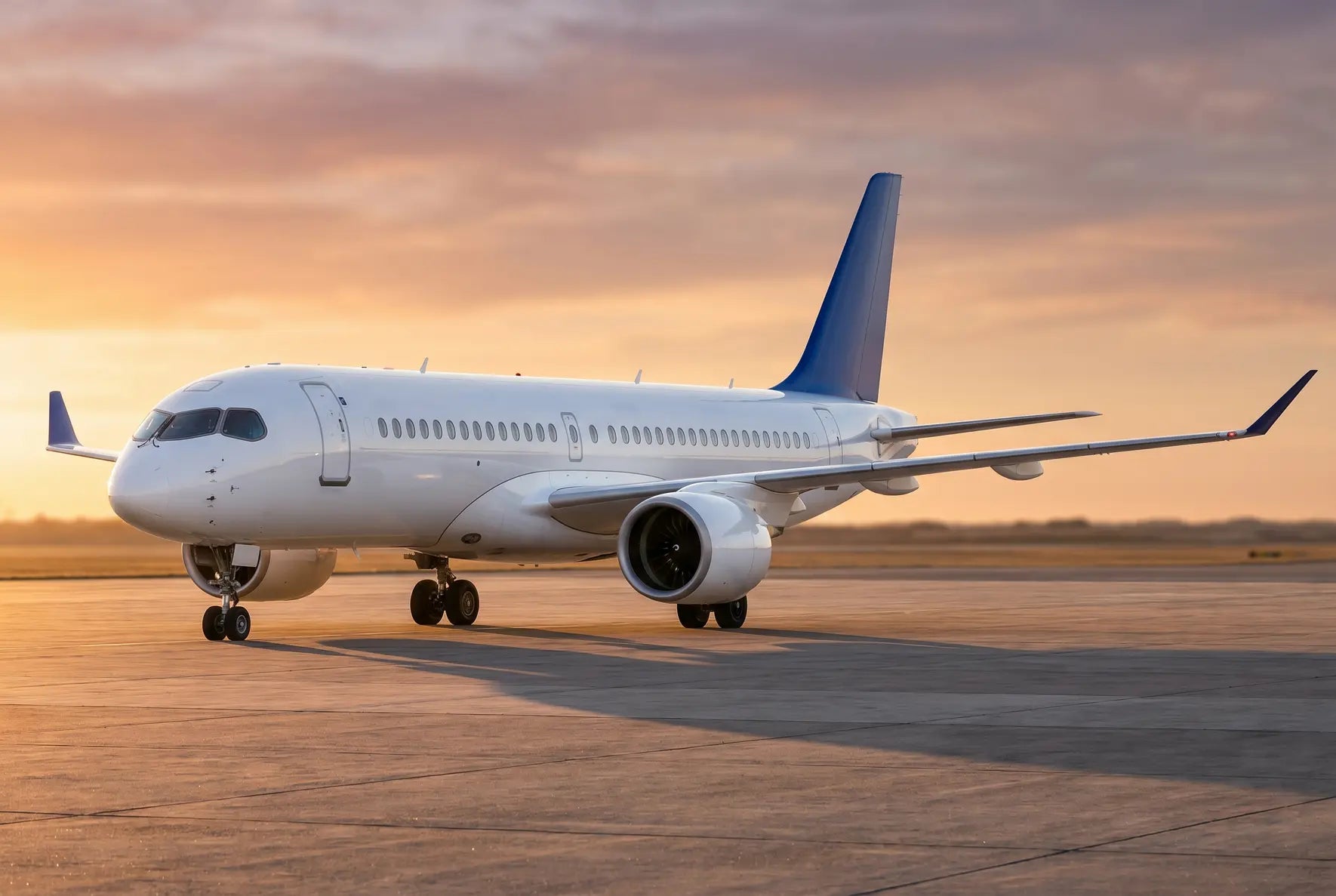
Airbus A220-300 History and Development: From Bombardier CS300 to Airbus
The Airbus A220-300 is the larger member of the A220 family, a clean-sheet, five-abreast narrow-body twinjet designed to serve the 100-to-150-seat market segment. It was not born under the Airbus name. The aircraft originated as the Bombardier CS300, part of the Canadian manufacturer's ambitious CSeries programme, before a dramatic change of ownership reshaped its commercial trajectory and turned it into one of the most in-demand single-aisle jets in modern aviation.
Origins: the Bombardier CSeries Programme
Bombardier had explored a large regional jet concept since the mid-1990s, initially under the BRJ-X study aimed at competing with the McDonnell Douglas MD-80 family and the Boeing 717. The project was shelved and revived several times before Bombardier granted authority to offer the CSeries on 15 March 2005. Formal sales proposals followed on 22 February 2008, and the programme was officially launched on 13 July 2008 at the Farnborough International Airshow. Two variants were announced: the smaller CS100 (now A220-100) and the stretched CS300 (now A220-300).
Bombardier selected the Pratt & Whitney PW1500G geared turbofan engine family to power both variants, promising fuel-burn reductions of approximately 20% compared with previous-generation competitors. The CS300 was paired with higher-thrust variants of that engine, the PW1521G and PW1524G/PW1525G, rated between 21,000 and 23,000 lbf, to accommodate its greater maximum take-off weight.
Key Milestones of the CS300/A220-300
The smaller CS100 completed its maiden flight on 16 September 2013, validating the shared platform. The CS300 followed with its own first flight on 27 February 2015 from Mirabel, Quebec. Transport Canada issued the initial type certificate for the CS300 on 11 July 2016, and the European Union Aviation Safety Agency (EASA) validated the type certificate on 15 June 2016. Entry into commercial service took place on 14 December 2016 with Latvian carrier airBaltic, which became the global launch operator for the type. Early service reports confirmed better-than-expected fuel efficiency and dispatch reliability.
Financial Pressures and the Boeing Trade Dispute
The CSeries programme faced significant cost overruns and schedule delays during development, placing heavy financial strain on Bombardier. The Quebec provincial government invested approximately CAD 1 billion in the programme in 2016, and the Canadian federal government contributed CAD 372.5 million in interest-free loans. In April 2017, Boeing filed a dumping petition with the U.S. Department of Commerce, alleging that Bombardier had sold 75 CS100 aircraft to Delta Air Lines below production cost with the aid of government subsidies. The U.S. Department of Commerce imposed preliminary duties of 292%, but the U.S. International Trade Commission unanimously ruled in Bombardier's favour on 26 January 2018, finding that Boeing had suffered no material injury. Boeing declined to appeal the decision in March 2018.
Transition to Airbus
Even before the trade dispute was resolved, Bombardier and Airbus announced a partnership on 16 October 2017. The deal formally closed on 1 July 2018, when Airbus acquired a 50.01% majority stake in the programme through the newly created Airbus Canada Limited Partnership (ACLP). On 10 July 2018, the CSeries family was officially rebranded: the CS300 became the Airbus A220-300. Airbus brought its global sales network, supply-chain expertise, and after-sales support to the programme, rapidly accelerating order intake. On 13 February 2020, Bombardier transferred its remaining 33.58% interest in ACLP to Airbus and the Government of Quebec, exiting commercial aviation entirely. Airbus increased its stake to 75%, with Quebec holding 25%.
In January 2019, Airbus broke ground on a second A220 final assembly line in Mobile, Alabama. Production began there in August 2019, and the first Mobile-built A220-300 completed its maiden flight on 2 June 2020 before being delivered to Delta Air Lines on 22 October 2020. The Mobile facility supplements the original Mirabel, Quebec line and supports growing demand from North American operators. Airlines considering the A220-300 for fleet renewal include carriers across Europe; pilots interested in operator-specific conditions can explore resources such as airline pilot career insights for further reading.
What Distinguishes the A220-300 from the A220-100
The A220-300 shares over 95% parts commonality with the A220-100, including identical wingspan (35.1 m), wing area, cockpit systems, and fuselage cross-section. The principal difference is the fuselage stretch: the A220-300 measures 38.7 m in overall length compared with 35.1 m for the A220-100, achieved through additional fuselage plugs forward and aft of the wing. This added length increases typical seating from around 108 passengers in the A220-100 to approximately 130-150 in the A220-300, with a maximum single-class capacity of up to 160 seats. To handle the higher operating weight, the A220-300 uses uprated PW1500G engine variants delivering greater thrust (up to approximately 23,300 lbf per engine versus around 18,900 lbf on the A220-100) and carries a higher maximum take-off weight of roughly 70,900 kg (versus about 63,050 kg). Despite the increased size, the A220-300 maintains a range of up to 3,400 nm (6,300 km), and the type holds ETOPS-180 certification, enabling extended overwater operations.
Key variant identifiers for the Airbus A220-300 include:
- ICAO/manufacturer type designation: BD-500-1A11
- Engines: 2x Pratt & Whitney PW1521G / PW1524G / PW1525G geared turbofans
- Fuselage length: 38.7 m (127 ft 0 in), stretched versus 35.1 m for the A220-100
- Typical seating: 130-150 passengers (two-class); up to 160 (high-density)
- MTOW: approximately 67,585-70,900 kg
- Range: up to 3,400 nm (6,300 km)
- ETOPS: 180-minute approval
- Wingtip type: integrated raked wingtips (shared with A220-100)

The image shows an Airbus A220-300 aircraft in flight against a clear blue sky. This modern passenger jet is part of Airbus's family of fuel-efficient planes.
Airbus A220-300 Technical Specifications, Systems and Engine Overview
The Airbus A220-300 was purpose-built to fill the gap between regional jets and traditional narrowbodies, targeting the 100-to-160-seat segment with an emphasis on fuel efficiency, low operating costs and strong runway performance. It is the stretched variant of the A220 family, with a fuselage 3.7 metres longer than the A220-100, allowing higher passenger capacity while sharing the same wing, systems and engine type. The design philosophy centres on a lightweight composite wing, a modern geared turbofan powerplant and a wide single-aisle cabin that offers more comfort per seat than many competitors in its class.
Compared to legacy types that once served this segment, such as the Boeing 717-200, the A220-300 offers substantially greater range, lower fuel burn per seat and a next-generation cockpit. Its carbon-fibre reinforced polymer (CFRP) wing, aluminium-lithium fuselage panels and fly-by-wire controls represent a clean-sheet approach that avoids the compromises inherent in re-engined older platforms.
- Overall length: 38.7 m (127 ft 0 in)
- Wingspan: 35.1 m (115 ft 2 in)
- Height: 11.5 m (37 ft 9 in)
- Wing area: 112.3 m² (1,209 sq ft), aspect ratio 10.97
- Fuselage max external diameter: 3.5 m (11 ft 6 in); max cabin width 3.28 m (10 ft 9 in) in a five-abreast layout
- Seating capacity: up to 160 in high-density; typically 120 to 150 in a two-class arrangement
- Maximum take-off weight (MTOW): up to 70.9 tonnes (156,300 lb), with a lower 67.6 t option available
- Maximum landing weight (MLW): 61.0 tonnes (134,500 lb)
- Maximum zero-fuel weight (MZFW): 58.0 tonnes (128,000 lb)
- Max ramp weight: 71.2 tonnes (157,000 lb)
- Fuel capacity: 21,508 litres (5,681 US gal)
- Range: 3,400 NM (6,300 km) as published by Airbus at MTOW with a typical two-class cabin load
- Cruise speed: Mach 0.82 (Mmo)
- Typical cruise altitude: 34,000 to 41,000 ft
- Engines: two Pratt & Whitney PW1500G geared turbofans (up to approximately 23,300 lbf per engine)
- Cargo volume: 31.1 m³ (1,100 cu ft) in the lower hold
- Avionics: Collins Aerospace Pro Line Fusion integrated avionics suite
Flight Controls, Avionics and Systems Architecture
The A220-300 employs a full fly-by-wire (FBW) flight control system with sidestick controllers, making it one of a small number of single-aisle types to combine FBW with a sidestick interface. The system uses a C*U control law, which blends pitch-rate command with speed stability cues, an approach conceptually similar to the logic found on the Boeing 777 and 787 rather than the pure C* law of the Airbus A320 family. Triplex flight control computers provide redundancy, and the system includes flight envelope protections that guard against excessive angles of attack, bank angles and structural loads.
The cockpit is built around the Collins Aerospace Pro Line Fusion avionics suite, featuring large-format displays, a synthetic vision system, optional head-up displays (HUD) and an integrated flight management system. The automatic flight control system (AFCS) encompasses autopilot, flight director and autothrust functions, all tightly coupled with the FBW architecture. Engine control is managed by full-authority digital engine control (FADEC) units on each PW1500G, enabling precise thrust management and contributing to efficient fuel scheduling across all flight phases.
Published performance figures for the A220-300 should be interpreted with care. Range, payload and field-length numbers vary depending on the selected MTOW option (67.6 t or 70.9 t), cabin configuration, passenger count, cargo load and atmospheric conditions. Airbus publishes range at standard assumptions; operators in hot-and-high environments or with denser cabin layouts will see different real-world numbers. Runway performance is likewise sensitive to airport elevation, temperature, slope and runway condition, so no single figure can represent all scenarios.
Pratt & Whitney PW1500G Geared Turbofan Engines
The A220-300 is exclusively powered by the Pratt & Whitney PW1500G, a member of the PW1000G Geared Turbofan (GTF) family. The PW1500G was the first engine in that family to achieve type certification, awarded by Transport Canada in February 2013. The defining innovation is a planetary reduction gearbox positioned between the fan and the low-pressure turbine, allowing the fan to spin at an optimal lower speed (around 4,000 to 5,000 RPM) while the low-pressure spool operates at a much higher speed. This decoupling lets each component run at peak aerodynamic efficiency.
The PW1500G features a 73-inch (185 cm) fan diameter and achieves a bypass ratio of 12:1, among the highest in its thrust class. Variants within the PW1500G series include the PW1519G and PW1521G (powering the A220-100) and the PW1524G and PW1525G (certified for the A220-300), with thrust ratings in the 19,000 to 25,000 lbf range depending on the model. Pratt & Whitney reports that the GTF architecture delivers fuel-burn reductions of up to 16% and noise reductions of up to 75% compared with prior-generation engines in this thrust class.
The broader PW1000G GTF family shares the same geared-turbofan principle across several applications: the PW1100G-JM powers the Airbus A320neo family, the PW1900G is fitted to the Embraer E190-E2 and E195-E2, and the PW1400G was selected for the Irkut MC-21. Pratt & Whitney invested an estimated 10 billion US dollars in developing the GTF platform, a programme rooted in demonstrator work that began in the late 1990s and early 2000s. The PW1500G completed its first ground-test runs in 2010 and flew on a Boeing 747SP flying testbed in 2011 before achieving certification in 2013. These engines remain the sole powerplant option for the A220 family, meaning operators do not face an engine-selection decision as they would on some other single-aisle programmes.
Airbus A220-300 vs A220-100 vs Embraer E195-E2 vs Airbus A319neo Specifications
Scroll horizontally to see more →
| Parameter | Airbus A220-300 | Airbus A220-100 | Embraer E195-E2 | Airbus A319neo |
|---|---|---|---|---|
| Entry into service | 2016 | 2016 | 2019 | 2017 |
| Engines | 2 × Pratt & Whitney PW1500G | 2 × Pratt & Whitney PW1500G | 2 × Pratt & Whitney PW1900G | 2 × CFM LEAP-1A |
| Length | 38.7 m | 35.0 m | 38.4 m | 33.8 m |
| Wingspan | 35.1 m | 35.1 m | 35.0 m | 35.8 m |
| Height | 11.8 m | 11.5 m | 12.0 m | 11.8 m |
| Typical seating and layout | 2-class: 120–150 passengers | 2-class: 100–135 passengers | 2-class: 120–146 passengers | 2-class: 140–160 passengers |
| MTOW | 70.9 t | 63.7 t | 63.9 t | 75.5 t |
| Range | 3,400 nm | 3,600 nm | 2,850 nm | 3,700 nm |
| Cruise speed | 0.78 Mach | 0.78 Mach | 0.82 Mach | 0.78 Mach |
| Service ceiling | 41,000 ft | 41,000 ft | 41,000 ft | 41,000 ft |
| Program note | Stretched variant offering higher capacity for regional to short-haul routes | Baseline shorter variant for lower-density regional operations | Direct regional jet competitor with similar capacity and efficiency | New generation A320 family member for higher-capacity short-haul missions |
Scroll horizontally to see more →
The table compares key specs of the A220-300, A220-100, Embraer E195-E2 and A319neo, covering dimensions, engines, seating, MTOW, range and performance. The A319neo seats the most and has the highest MTOW and range, while the A220-100 offers strong range in a smaller airframe. The A220-300 and E195-E2 are similar in size, but the E195-E2 cruises faster and has shorter range.
Airbus A220-300 Operations: Airlines, Typical Routes and Missions Worldwide
The Airbus A220-300 is designed for missions ranging from short regional hops to medium-haul routes of up to 3,400 nautical miles (6,300 km). In practice, operators fly the type on sectors lasting anywhere from one hour to over seven hours, with airBaltic pushing the envelope on its Riga to Dubai route at approximately 7 hours 30 minutes of block time. Typical daily utilisation for A220-300 operators sits between 10 and 14 block hours per aircraft, with airBaltic reporting figures toward the upper end of that range. The aircraft achieves a three-month rolling dispatch reliability of approximately 98.9%, according to Airbus fleet data, making it a dependable workhorse for high-frequency schedules.
Operationally, the A220-300 thrives in both hub-and-spoke networks and point-to-point models. Full-service carriers deploy it from major hubs to feed connecting traffic, while low-cost and leisure airlines use it to open direct routes between secondary or underserved airports. Its ability to operate from short runways, steep approaches and hot-and-high airports broadens its reach to airfields that larger narrowbodies cannot serve efficiently. The type also holds 180-minute ETOPS approval, enabling overwater routing and opening up transatlantic thin-route possibilities.
However, operators have faced notable challenges. The Pratt & Whitney PW1500G engines that power the A220-300 have been affected by a metal powder contamination issue leading to accelerated combustor corrosion. By late 2025, roughly 17% of the global A220 fleet was grounded while engines were removed for inspection or repair, with airlines such as Air Canada, Air France, airBaltic, Delta Air Lines and SWISS all reporting aircraft temporarily out of service. SWISS took the step of grounding its entire A220-100 sub-fleet to prioritise engine availability for its A220-300 aircraft. Supply-chain constraints have also slowed A220 production, with Airbus delivering 75 aircraft in 2024, below initial targets.
Where the Airbus A220-300 Operates Around the World
As of early 2026, over 500 A220-family aircraft have been delivered to more than 20 operators across four continents. Europe hosts the densest concentration of A220-300 activity, where full-service and hybrid carriers use the type on intra-European networks of two to four hours. In North America, the aircraft anchors domestic networks and selected cross-border routes between the United States and Canada. Asia and the Middle East see growing adoption on domestic trunk routes and short international sectors. In Africa, the A220-300 supports a mix of domestic services and regional connections, though fleet sizes remain smaller.
- Europe: airBaltic is the world's most prolific A220-300 operator by weekly departures, running over 1,600 flights from its Riga base across the continent and to destinations as far as Dubai and Abu Dhabi. SWISS deploys 31 A220-300s on intra-European routes from Zurich and Geneva to cities including Porto, Dublin and Dubrovnik. Air France operates 36 aircraft on high-frequency short-haul routes from Paris-Charles de Gaulle and Paris-Orly. ITA Airways uses the type on domestic Italian routes and short European sectors, while Bulgaria Air and Cyprus Airways round out the regional operator base with smaller fleets. Several European carriers, including DAT Danish Air Transport, continue to operate older narrowbody and turboprop types on similar short-haul missions, illustrating the market segment the A220-300 is designed to capture.
- North & South America: Delta Air Lines is the largest A220 customer worldwide, with over 80 aircraft serving domestic routes from hubs such as Atlanta, New York-LaGuardia and Salt Lake City. Air Canada operates 33 A220-300s on transcontinental Canadian routes and cross-border services to the United States. JetBlue flies 33 aircraft from the US East Coast, including routes to Europe, while Breeze Airways uses 25 A220-300s in a pure point-to-point model connecting underserved US city pairs. No South American airline currently operates the type.
- Asia: Korean Air operates 10 A220-300s primarily on high-frequency domestic routes such as Seoul to Jeju and Seoul to Busan, with some short international services to Japan. Air Manas in Kyrgyzstan has introduced a single aircraft for short-haul regional services from Bishkek.
- Africa: EgyptAir fields around 12 A220-300s on domestic services from Cairo to Luxor and Hurghada, as well as short international flights to Athens, Rome and Istanbul. Air Tanzania operates four aircraft on domestic trunk routes alongside its widebody fleet. Air Senegal uses a single A220-300 for West African regional services.
Typical Seating Configurations on the Airbus A220-300
The A220-300 cabin uses a 2-3 abreast layout across all operators, meaning only one middle seat per row rather than the two found on most competing single-aisle jets. The maximum certified exit limit currently stands at 149 passengers, although Airbus is working toward certification of a 160-seat variant expected around 2027 with additional overwing exits. In practice, seat counts range from around 120 in premium-heavy layouts to 149 in high-density configurations.
Network carriers tend to install two-class cabins. Delta Air Lines offers 130 seats split across First Class (12 seats at 37-inch pitch), Delta Comfort+ (43 seats at 33 to 34-inch pitch) and Main Cabin (75 seats at 31 to 32-inch pitch). Air Canada configures 137 seats with 12 in Business (37-inch pitch, 21-inch width) and 125 in Economy. SWISS seats 145 passengers in 15 Business and 130 Economy seats, while Air France opts for 148 seats with 12 in Business and 136 in Economy. Korean Air fits 140 seats in a two-class layout.
Leisure and hybrid operators favour denser single-class arrangements. airBaltic typically seats 148 to 149 passengers in all-economy, with a flexible business-class curtain on selected flights. Breeze Airways installs up to 150 seats across its "Nice" and "Nicest" fare brands. Across all configurations, Economy seats on the A220-300 generally measure 18 to 19 inches wide with pitch between 29 and 32 inches, while Business or First Class seats range from 20 to 21 inches wide with pitch of 36 to 38 inches.
In this video, discover why the Airbus A220 is considered a winner, exploring the key features and advantages that set it apart in commercial aviation and make it a compelling choice for airlines.
Airbus A220-300 Safety Record: How Safe Is This Single-Aisle Jet?
The Airbus A220-300 holds one of the strongest safety records among modern commercial aircraft. Originally developed by Bombardier as the CS300 and entering service with Swiss International Air Lines in 2016, the type has accumulated close to two million flights and over 3.5 million block hours across more than 25 operators worldwide. With approximately 500 aircraft delivered by early 2026, the A220-300 has experienced only one fatal accident and one hull loss in nearly a decade of operations. These figures, set against the volume of daily flights performed by the global fleet, place the aircraft well within the safety standards expected of a latest-generation narrowbody. The Aviation Safety Network database for the A220-300 provides a comprehensive log of all recorded events involving the type.
Notable Incidents and Safety Lessons
On 23 December 2024, Swiss International Air Lines Flight LX1885, operated by an Airbus A220-300 (registration HB-JCD), suffered an uncontained failure of its Pratt & Whitney PW1500G engine at FL400 while en route from Bucharest to Zurich. Smoke entered the cockpit and cabin, prompting the crew to shut down the affected engine and divert to Graz Airport in Austria. All 74 passengers and five crew members were evacuated via emergency slides. One cabin crew member lost consciousness due to oxygen deprivation and was airlifted to hospital, where she died on 30 December 2024 from hypoxic brain damage. The Austrian Safety Investigation Authority preliminary report identified engine failure mechanics and the effectiveness of Protective Breathing Equipment (PBE) as key areas under examination. This event marked the first fatality involving the A220 family and prompted renewed scrutiny of PBE standards and smoke management procedures across several operators.
On 14 June 2025, an airBaltic Airbus A220-300 (registration YL-AAO) sustained a ground fire during routine maintenance at Riga International Airport. The fire originated from the environmental control system. No crew or maintenance personnel were injured, but Airbus assessed the airframe as beyond economic repair in December 2025, making it the first hull loss for the A220 family. The airline confirmed the write-off in its March 2026 annual report. Because the event occurred on the ground with no passengers aboard, it did not involve operational flight risk, though it contributed to ongoing reviews of maintenance protocols and ground handling safety.
Several other incidents have been recorded without fatalities or hull losses. In June 2025, a JetBlue Airways A220-300 experienced a runway excursion on landing at Boston Logan International Airport with no injuries reported. Multiple smoke or fume events have also been documented across various operators, including Air Tanzania, Delta Air Lines, and Air Canada, most linked to engine or environmental control system anomalies. In each case, crews followed standard operating procedures, and the aircraft landed safely. These events have informed airworthiness directives and prompted Pratt & Whitney to accelerate inspection intervals for the PW1500G engine family.
How Safe Is the Airbus A220-300?
When measured against its total flight volume, the Airbus A220-300 demonstrates an accident rate that compares favourably with other modern single-aisle types such as the Airbus A320neo and Boeing 737 MAX families. The aircraft benefits from a clean-sheet design philosophy that integrates a full fly-by-wire control system, advanced composite materials making up roughly 40 percent of the airframe, and the latest-generation avionics suite. These elements work together to reduce pilot workload, provide flight envelope protection, and improve structural resilience. Airbus has also announced plans to introduce a Runway Overrun Awareness and Alerting System (ROAAS) on all future A220 production aircraft by 2027, adding another layer of preventive safety technology.
The A220-300 holds full type certification from EASA, the FAA, and Transport Canada, including ETOPS-180 approval granted in January 2019. Regulatory oversight from these three major authorities ensures that every airworthiness directive, inspection bulletin, and design modification is subject to rigorous independent review. Operators also follow standardised procedures for crew training, including increasingly sophisticated simulation methods. Innovations such as virtual reality-based pilot training are expanding the tools available to prepare flight crews for abnormal and emergency scenarios.
Taken as a whole, the safety record of the A220-300 reflects the strengths of modern aerospace engineering, multilayered regulatory frameworks, and continuous operational learning. While no aircraft type is immune to incidents, the data consistently shows that commercial aviation remains one of the safest modes of transport. The Airbus A220 family page provides further details on the design and safety philosophy behind this aircraft.
01 What is the range and typical mission profile of the Airbus A220-300?
The Airbus A220-300 has a maximum range of about 3,600 nautical miles, making it suitable for medium-haul routes like transcontinental flights within North America or Europe to the Middle East. Airlines often use it for missions from 500 to 3,000 nautical miles, balancing efficiency on shorter hops with capability for longer sectors. This versatility allows it to replace older jets on routes up to 6 hours.
02 How is the cabin laid out on the Airbus A220-300, and what is the passenger experience like?
The A220-300 typically seats 130 to 160 passengers in a single-aisle configuration with 2-3 abreast seating, offering more personal space than similar aircraft. Larger windows and a quieter cabin due to advanced engine technology enhance comfort, with noise levels around 50-60 decibels. Passengers report a smooth ride and good overhead bin space for carry-ons.
03 Which airlines operate the Airbus A220-300 and on what routes?
Major operators include Delta Air Lines, Air Canada, Swiss International Air Lines, and Breeze Airways. They deploy it on regional to medium-haul routes, such as Delta's U.S. domestic flights from New York to Los Angeles or Air Canada's services between Toronto and western Canada. In Europe, Swiss uses it for routes to Scandinavia and the Mediterranean.
04 How does the Airbus A220-300 perform in fuel efficiency compared to similar aircraft?
The A220-300 achieves 25% better fuel efficiency per seat than previous-generation jets like the Boeing 737-700 or A319, thanks to its Pratt & Whitney geared turbofan engines and lightweight composite materials. It burns about 20% less fuel per trip than competitors in its class. This efficiency lowers operating costs and emissions on high-frequency routes.
05 What is the safety record of the Airbus A220-300?
The Airbus A220-300 has an exemplary safety record with no fatal accidents since entering service in 2016. Key design features include reinforced composite wings for better fatigue resistance, advanced fly-by-wire controls, and redundant systems for enhanced reliability. It meets or exceeds all modern certification standards from aviation authorities.
06 What should travelers know about seats, windows, and turbulence on the Airbus A220-300?
Opt for window seats in rows 1-10 or 25-30 for the best views through the extra-large windows that dim electronically. The aircraft's low wing loading contributes to a stable ride in turbulence, feeling less bumpy than heavier jets. Economy seats offer good legroom at around 31-32 inches pitch in most configurations.