
SWISS Overview & Company Profile
Swiss International Air Lines (commonly known as SWISS) is the flag carrier of Switzerland, headquartered in Kloten near Zurich Airport. The airline was established on March 31, 2002, following the bankruptcy of Swissair, built around the former regional subsidiary Crossair. SWISS initially retained Crossair's IATA code LX while adopting Swissair's ICAO code SWR, preserving critical international traffic rights during the transition.
In 2005, Lufthansa Group began acquiring shares in the airline, and the full takeover was completed on July 1, 2007. Since then, SWISS has operated as a wholly owned subsidiary of the Lufthansa Group, one of Europe's largest aviation conglomerates. The airline joined the Star Alliance on April 1, 2006, and is a full member of the Miles & More frequent flyer programme.
SWISS operates from two primary hubs: Zurich Airport (ZRH) as the main hub and Geneva Airport (GVA) as a secondary hub. The airline serves over 110 destinations in more than 40 countries, carrying approximately 21.1 million passengers in 2024 on around 163,000 flights. Revenue for 2024 reached CHF 6.5 billion (approximately EUR 6.5 billion), with an Adjusted EBIT of CHF 801 million, representing 12.4% of revenue. As of the end of 2024, SWISS employed approximately 10,870 staff, a 10% increase over the previous year. The airline operates sister carrier Edelweiss Air as a leisure-focused subsidiary, and Swiss WorldCargo provides airfreight services using the belly capacity of passenger aircraft.
Fleet Composition & Type Ratings
SWISS operates one of Europe's most modern and diversified fleets, with a mix of Airbus narrowbodies for European services and Airbus/Boeing widebodies for intercontinental operations. The airline is currently in the midst of a significant fleet renewal programme centred on the Airbus A350-900 (replacing the ageing A340-300 fleet) and the continued integration of A320neo family aircraft. The fleet totals approximately 95 aircraft, with further deliveries scheduled through 2027.
The A350-900 represents the centrepiece of the modernisation effort. SWISS has ordered 10 aircraft, with the first delivered in October 2025. Configured with the new SWISS Senses cabin (four First Class suites, 45 Business, 38 Premium Economy, and 156 Economy seats), the A350 offers around 22% better fuel efficiency per passenger than the A340 it replaces. The first long-haul A350 service launched on the Zurich to Boston route in November 2025, with Montreal following in early 2026.
| Aircraft Type | Role | In Service | Routes / Notes |
|---|---|---|---|
| Airbus A220-100 | Narrowbody | 9 (grounded) | Grounded since Oct 2025 due to Pratt & Whitney engine issues. Engines redistributed to A220-300 fleet. |
| Airbus A220-300 | Narrowbody | 21 | European short/medium-haul. Most fuel-efficient narrowbody in the fleet. |
| Airbus A320-200 | Narrowbody | 9 | European network. Being gradually supplemented by A320neo. |
| Airbus A320neo | Narrowbody | 11 | 15-20% more fuel-efficient than A320ceo. Deliveries ongoing through 2026. |
| Airbus A321-100/200 | Narrowbody | 6 | Higher-capacity European routes. Mix of -100 and -200 variants. |
| Airbus A321neo | Narrowbody | 6 | Latest generation narrowbody. Extended range capability for thinner long routes. |
| Airbus A330-300 | Widebody | 14 | Long-haul workhorse. 236 passengers in three classes. Major North American and Asian routes. |
| Airbus A340-300 | Widebody | 4 | Ultra-long-haul. Average age ~22 years. Being replaced by A350-900. |
| Airbus A350-900 | Widebody | 1+ | New flagship. 10 on order. SWISS Senses cabin with First Class suites. Boston, Montreal first routes. |
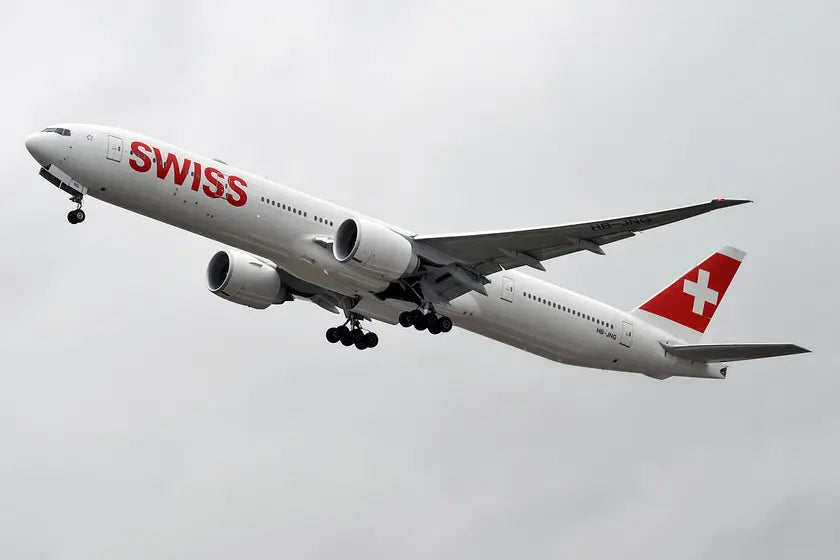
| Boeing 777-300ER | Widebody | 12 | Largest capacity widebody. Up to 320 passengers. Flagship long-haul routes to NYC, Asia, Middle East. |
Fleet data as of late 2025. Numbers are approximate and subject to ongoing deliveries, retirements, and operational adjustments.
In October 2025, SWISS announced the grounding of its entire nine-aircraft A220-100 fleet for up to 18 months due to persistent Pratt & Whitney geared turbofan engine reliability issues affecting approximately 15% of A220 operators worldwide. Serviceable engines from the grounded A220-100s have been redistributed to support the larger A220-300 fleet, which provides superior cost efficiency. Routes previously served by the A220-100 (including London City) have been transferred to partner airline Helvetic Airways.
SWISS covers the cost of type rating for pilots recruited through official selection. New First Officers are typically assigned to A220 or A320 family aircraft for short and medium-haul operations. Transition to widebody types (A330, A350, 777) is seniority-based. The SWISS pilot careers page provides full details on fleet assignment and training pathways.
Pilot Salary & Compensation
SWISS pilot salaries are among the highest in Europe, reflecting both the airline's premium positioning and Switzerland's high cost of living. Compensation is governed by the Collective Labour Agreement (GAV) negotiated between SWISS management and Aeropers, the pilots' union. Total remuneration includes a monthly base salary, block-hour pay, per diem layover allowances, night/weekend premiums, and variable bonuses. All figures below are in Swiss Francs (CHF), which trades close to parity with the Euro.
First Officer (F/O) Pay Scale
| Seniority | Annual Gross (est.) | Notes |
|---|---|---|
| Year 1 (entry) | CHF 70,000 - CHF 90,000 | Entry-level on narrowbody (A220/A320). Excludes allowances. |
| Year 3-5 | CHF 95,000 - CHF 115,000 | Incremental seniority steps. Includes standard per diems. |
| Year 7-10 | CHF 115,000 - CHF 135,000 | Mid-career F/O. Some may transition to widebody at this stage. |
| Senior F/O (10+ yrs) | CHF 130,000 - CHF 150,000+ | Widebody F/O (A330/777) at top of F/O scale. Including all allowances. |
Figures are annual gross estimates compiled from multiple industry sources, pilot reports, and salary databases. Average F/O pay is approximately CHF 127,000 per year.
Captain Pay Scale
| Seniority | Annual Gross (est.) | Notes |
|---|---|---|
| Entry Captain (narrowbody) | CHF 190,000 - CHF 220,000 | A220/A320 command. Substantial salary jump upon upgrade. |
| Captain, 5+ yrs (widebody) | CHF 230,000 - CHF 280,000 | A330/A350/777. Long-haul routes with premium per diems. |
| Senior Captain (777/A350 LH) | CHF 280,000 - CHF 320,000 | Top of scale. Including all allowances, bonuses, and premiums. |
Captain compensation ranges from CHF 190,000 to over CHF 320,000 depending on aircraft type, seniority step, and route assignment.
These figures are estimates compiled from multiple public sources including industry salary databases, pilot community reports, and aviation media. Actual compensation depends on the latest GAV collective agreement, individual seniority steps, aircraft type, block hours flown, and per diem rates. Switzerland has one of the highest costs of living in Europe: federal, cantonal, and municipal income tax rates vary considerably by canton (Zurich vs. Geneva), and mandatory social security contributions (AHV/IV, pension fund) further reduce take-home pay. Always verify current figures with the latest Aeropers publications or SWISS HR directly.
Roster Pattern & Quality of Life
SWISS pilots operate under EASA Flight Time Limitation (FTL) rules, supplemented by the Aeropers collective labour agreement. The regulatory framework sets maximum duty periods of 13 hours for up to two-sector days, with reductions for additional sectors. Night operations (duty starting between 22:00 and 04:59) are capped at 11 hours 45 minutes. Cumulative limits include 190 duty hours per 28 days, 100 block hours per 28 days, and 900 block hours per calendar year.
In practice, SWISS pilots average approximately 580 to 650 block hours per year, well below the regulatory maximum. This figure has declined by roughly 8% since 2019 (from approximately 630 hours) as a result of both pilot preference shifts toward better work-life balance and post-pandemic capacity management. Around 40% of SWISS pilots now work part-time (between 40% and 95% of full-time), a trend accelerating in recent years and further tightening crew availability.
📅 Sample Month: Short/Medium-Haul First Officer (ZRH)
Long-haul crews operate on multi-day trip patterns: a typical rotation involves 2 to 4 days of flying (with layovers at destination) followed by 3 to 5 recovery days. Augmented crews (3 to 4 pilots) are used on ultra-long-haul sectors exceeding 10 hours, enabling in-flight rest. Long-haul pilots generally log fewer flying days per month but accumulate higher block hours per trip, with layovers of 18 to 48 hours at destination.
SWISS pilots are based at either Zurich (ZRH) or Geneva (GVA), with base assignments determined through seniority-based bidding. Zurich is the primary hub with substantially greater flight frequency, and therefore typically requires higher seniority to secure. Both cities rank among Europe's most expensive for housing, but offer excellent public transport, healthcare, and quality of life. SWISS provides subsidised public transport passes and direct bus services to the airports. Living costs in the Zurich metropolitan area are among the highest in the world, a factor pilots should carefully weigh against the premium compensation.
SWISS is experiencing a pilot shortage driven by a post-pandemic training backlog. Despite the European Flight Academy in Solothurn running at full capacity with approximately 100 trainees per intake, courses were halted during COVID and only resumed in mid-2022. In May 2025, the airline scrapped approximately 1,400 flights (around 1.5% of its schedule). Aeropers president Clemens Kopetz told Swiss media that "schedules are full, we are flying at 100%, but many colleagues tell us it's too much." The high rate of part-time work (40% of pilots) further compounds the supply constraint.
Benefits, Travel Perks & Retirement
SWISS offers one of the most comprehensive benefits packages among European airlines, combining Switzerland's robust social protection framework with airline-specific perks. The Swiss three-pillar pension system, universal healthcare, and generous statutory leave provisions create a safety net that few other countries in Europe can match.
Switzerland's pension system is widely regarded as one of the most comprehensive in the world. For pilots earning CHF 150,000 or more, the combined Pillar 1 (state) and Pillar 2 (occupational) contributions create substantial retirement capital. Unlike many European countries where state pensions are the primary retirement income, the Swiss system spreads risk across three independent pillars. The mandatory Pillar 2 occupational pension builds a personal pension pot invested in diversified portfolios, with both employer and employee contributing. This means SWISS pilots accumulate significant retirement wealth throughout their career, with the added option to make tax-advantaged Pillar 3a voluntary contributions.
Additional perks for SWISS employees include fleet discounts with automobile manufacturers, subsidised airport parking, American Express and MasterCard crew credit cards with Miles & More rewards, discounted fitness memberships, and workplace wellness services. According to the SWISS employee benefits page, the airline also provides reduced-price public transport passes and various corporate discount programmes.
Career Progression & Seniority
Career progression at SWISS follows a strictly seniority-based model. Upgrade from First Officer to Captain, fleet transitions to widebody aircraft, and preferred route assignments are all determined by your position on the seniority list. SWISS does not accept direct-entry Captains: all externally hired pilots must start as First Officers regardless of their previous command experience at other airlines. While this protects seniority interests of existing F/Os, it means experienced Captains transitioning from other carriers will restart at the bottom of the command queue.
The estimated upgrade timeline from F/O to Captain at SWISS is approximately 4 to 7 years, though this varies significantly depending on hiring cycles, retirement waves, and fleet expansion. Pilots hired during growth phases may achieve captaincy faster, while those hired during contraction periods could wait longer. Once Captains reach command status, further career advancement focuses on seniority-driven bidding for preferred aircraft types (particularly the 777-300ER and A350-900), routes, and base assignments.
| Career Milestone | Typical Timeline | Notes |
|---|---|---|
| Cadet training (ab initio) | ~24 months | Theory in Zurich, practical in Phoenix (USA) & Grenchen (CH). Cost ~CHF 140,000, pre-financed by SWISS. |
| Join as F/O (A220 or A320) | Day 1 post-training | Most common entry fleet. Type rating funded by SWISS. |
| Widebody F/O transition | 5-10 years | A330, A350, or 777. Seniority-dependent bid. 4-6 weeks type rating training. |
| Captain upgrade (narrowbody) | ~4-7 years | Command assessment required. Not guaranteed. Depends on seniority position. |
| Captain on widebody | 10-18+ years | 777 or A350 command. Top of seniority list. Premium compensation. |
| Training Captain / TRE / TRI | Variable | Requires separate selection and instructor qualification. Additional pay premiums. |
SWISS is actively recruiting, with the European Flight Academy running at capacity with approximately 100 trainees per intake. The introduction of 10 A350-900 aircraft, ongoing A320neo deliveries, and the retirement of older fleet types should create significant transition opportunities and potentially accelerate both widebody F/O positions and Captain upgrades in the coming years. However, the post-pandemic training backlog means it will take several years before the pilot pipeline fully recovers. For pilots entering now, the fleet renewal programme represents a genuine career acceleration opportunity.
Recruitment Process & Requirements
SWISS recruits pilots through two distinct pathways: the Ab Initio Cadet Programme (for candidates with little or no flight experience) and the Direct/Ready Entry stream (for experienced First Officers with valid type ratings). Both pathways lead to the same seniority list and career progression. The selection process is conducted in partnership with the European Flight Academy (EFA), the Lufthansa Group's pilot training organisation.
Ab Initio Cadet Programme: Requirements
Direct/Ready Entry F/O: Requirements
Selection Stages
DLR / SPHAIR Aptitude Assessment
For ab initio cadets: pass the DLR psycho-technical aptitude test (cognitive ability, spatial reasoning, multitasking, coordination). Swiss citizens aged 17-23 can alternatively complete the SPHAIR screening programme and apply directly with a SPHAIR Certificate. This is a mandatory prerequisite before application.
Application & Documentation
Apply to the European Flight Academy and select SWISS as preferred airline. For direct entry: apply via the Lufthansa Group jobs portal. All documentation is verified at this stage, including nationality, language certificates, and medical fitness.
Assessment Day (Opfikon, Switzerland)
A full-day assessment at the Lufthansa Group facility in Opfikon, near Zurich. Includes AON aptitude and personality tests, a group exercise assessing CRM and teamwork skills, and an individual psychological/HR interview. For direct entry candidates, a simulator assessment may also be included. Focus areas: leadership, cultural fit, stress management, and decision-making under pressure.
Medical & Board Decision
Final EASA Class 1 medical verification. The recruitment board reviews all assessment results and makes a decision: pass, deferral, or elimination. Successful cadets receive a training start date. Direct entry pilots proceed to type rating and line training.
Training & Contract
Cadets sign a framework and loan agreement (SWISS pre-finances the full ~CHF 140,000 training cost). From June 2025, no advance financial contribution is required. Training includes 12 months of theory in Zurich, practical phases in Phoenix (Arizona, USA) and Grenchen (Switzerland), followed by type rating. Swiss citizens receive a CHF 60,000 government subsidy; EU/EFTA citizens receive CHF 36,000.
German fluency is essential. While English proficiency is required, German is the primary working language at SWISS. All internal communications, briefings, and company culture operate predominantly in German. Candidates who do not yet meet C1 German level can develop their language skills during the cadet training programme, but demonstrating strong German ability at selection significantly improves your chances. For the DLR test, thorough preparation in multitasking, spatial reasoning, and psychomotor skills is critical, as this is where most candidates are eliminated.
Top 5 Layover Destinations
SWISS operates an extensive long-haul network from Zurich, with daily or near-daily services to major cities across North America, Asia, the Middle East, and Africa. Layovers for long-haul crews typically last 18 to 48 hours, with hotel accommodation contracted by the airline (generally 4-star properties near city centres or airports). Layover destinations are determined by roster bid and seniority, with senior pilots getting priority on the most popular routes.
All crew hotels are contracted by the airline. Pilots do not choose or book their own accommodation. Transport between hotel and airport is provided. Under EASA FTL regulations, pilots must have a minimum 10-hour rest opportunity before the next duty period, with 8 hours of uninterrupted sleep. Long-haul flights exceeding 10-11 hours require augmented crews (3-4 pilots), and layovers are typically 24 hours minimum. Layover destinations are determined by your roster bid and seniority: more senior pilots get first pick of the most popular routes. SWISS also serves Washington D.C., San Francisco, Los Angeles, Montreal, Seoul, Mumbai, Johannesburg, Dubai, and many other long-haul destinations.
How SWISS Compares: Airline Radar Chart
How does SWISS stack up against its two closest Lufthansa Group siblings: Lufthansa (Germany) and Austrian Airlines (Austria)? All three airlines belong to the same corporate group but maintain separate pilot contracts, compensation structures, and working conditions. Below is a comparative analysis across five key metrics.
Key Takeaways from the Comparison
SWISS wins decisively on salary. With First Officers earning CHF 70,000 to 150,000 and Captains CHF 190,000 to 320,000, SWISS pays substantially more than both Lufthansa (F/O EUR 60,000-100,000, Captain EUR 85,000-250,000) and Austrian Airlines (F/O EUR 42,000-70,000, Captain EUR 80,000-135,000 narrowbody). This reflects Switzerland's higher cost of living but also the airline's premium positioning. Even after adjusting for Swiss living costs, SWISS pilots generally enjoy higher purchasing power.
Benefits are strongest at SWISS. The Swiss three-pillar pension system provides superior retirement security compared to German or Austrian state pension equivalents. Loss of license coverage, generous staff travel across the Lufthansa Group and Star Alliance, and Switzerland's exceptional healthcare system give SWISS a clear edge. All three airlines offer Lufthansa Group staff travel, but SWISS pilots benefit additionally from Swiss-specific social protections.
Fleet quality is comparable between SWISS and Lufthansa. Both airlines are undergoing major fleet renewals with the A350, but Lufthansa operates a much larger and more diverse fleet including the Boeing 747-8. SWISS's fleet is more focused and modern on average, with the A220 and A320neo forming a strong narrowbody backbone. Austrian's fleet is smaller and less diverse, centred on the A320 family and Boeing 767/777.
Work-life balance is a pressure point for all three. SWISS pilots currently face scheduling pressures due to pilot shortages, with 40% opting for part-time work. Lufthansa pilots have experienced similar tensions, with the Vereinigung Cockpit (VC) union negotiating aggressively on roster improvements. Austrian pilots recently secured a 19% pay increase. All three airlines are grappling with post-pandemic staffing challenges.
Scores are editorial estimates based on publicly available salary data, pilot community reports, union publications, airline press releases, and industry benchmarks from sources including ECA, Eurocockpit, and aviation salary databases. They represent a general assessment for an experienced pilot considering a long-term career. Individual experiences will vary based on seniority, fleet, base, and personal priorities.
Union & Industrial Relations
SWISS pilots are represented by Aeropers (Airline Pilots Association), founded in 1945 and headquartered in Kloten, adjacent to Zurich Airport. Aeropers represents approximately 1,500 active members and 900 non-active members, making it Switzerland's largest professional pilots' association and the legitimate collective bargaining partner for both SWISS and Edelweiss Air. Aeropers is a member of SwissALPA (Swiss Airline Pilots Association), which also includes ESPA (easyJet Switzerland pilots) and SIPA (independent pilots).
Aeropers Structure & Governance
Recent CBA History & Key Disputes
The current CBA landscape at SWISS is in flux. The overwhelming support for CBA termination (85% of members) signals significant pilot dissatisfaction with roster management and work-life balance implementation. With renegotiations expected in 2026, incoming pilots can likely expect improvements in scheduling predictability and deployment planning. Precedents within the Lufthansa Group are encouraging: Eurowings pilots recently secured 17% total wage increases, Austrian Airlines pilots obtained 19%, and Brussels Airlines pilots achieved 3% average increases. Union membership at SWISS is optional but strongly recommended: the vast majority of SWISS pilots are Aeropers members, and the union negotiates aggressively on salary, roster protections, and career safeguards.
Verdict: Who Is SWISS For?
🎯 Our Take
Swiss International Air Lines is one of Europe's premier pilot employers. The combination of some of the continent's highest pilot salaries (CHF 70,000-320,000 range), Switzerland's exceptional three-pillar pension system, a modern fleet undergoing active renewal with the A350, Star Alliance membership, and the prestige of Switzerland's flag carrier make it an outstanding long-term career choice.
The trade-offs are real: German language fluency is mandatory, Switzerland's cost of living is among the highest in the world, the current pilot shortage means heavy scheduling pressure, and the CBA is under renegotiation following significant pilot dissatisfaction with work-life balance implementation. Captain upgrade at 4-7 years is competitive by European standards, but no direct-entry Captain pathway exists.
For German-speaking pilots with a long-term vision, SWISS offers a career that is hard to match: premium compensation, world-class benefits, fleet diversity from the A220 to the 777, and a base in one of Europe's most liveable countries. The upcoming CBA renegotiation and fleet expansion with A350 deliveries represent genuine catalysts for improved conditions in the years ahead.
1 Do I need to speak German to fly for SWISS?
Yes. German at C1 level is required for all pilot positions at SWISS. While the cadet programme allows candidates to develop their German during training, it is the primary working language for internal communications, briefings, and company operations. English at ICAO Level 4 or higher is also mandatory. There is no German-free pathway.
2 Does SWISS pay for the type rating?
Yes. For pilots recruited through the official selection process, SWISS covers the type rating cost. For cadets, the full training programme (approximately CHF 140,000) is pre-financed by SWISS as an interest-bearing loan, repaid gradually from salary after employment begins. From June 2025, no advance financial contribution is required. Swiss citizens receive a CHF 60,000 government subsidy, and EU/EFTA citizens receive CHF 36,000.
3 How long does it take to upgrade to Captain at SWISS?
The estimated upgrade timeline is approximately 4 to 7 years, though this varies significantly depending on hiring cycles, pilot retirements, and fleet growth. SWISS does not accept direct-entry Captains. All upgrades come from within through a seniority-based system. The ongoing fleet renewal (10 A350s, continued A320neo deliveries) should create upgrade opportunities, but the pace depends on many variables beyond individual control.
4 Can non-EU citizens apply to SWISS?
No. SWISS requires applicants to be Swiss, EFTA, or EU-26 citizens. Croatian nationals must hold a Swiss residence permit. There is no work permit sponsorship pathway for non-EU citizens. This restriction applies to both the cadet programme and direct entry positions.
5 What is the DLR test, and how hard is it?
The DLR (Deutsches Zentrum fur Luft- und Raumfahrt) test is a comprehensive psycho-technical aptitude assessment used by Lufthansa Group airlines. It evaluates cognitive ability, spatial reasoning, multitasking, psychomotor coordination, and decision-making speed. The DLR test is widely considered one of the most challenging airline aptitude assessments in Europe. Swiss citizens aged 17-23 can alternatively complete the SPHAIR screening programme instead. Thorough preparation is strongly recommended.
6 How does SWISS pilot pay compare to other European airlines?
SWISS pays among the highest pilot salaries in Europe. First Officers earn CHF 70,000-150,000 and Captains CHF 190,000-320,000, substantially above Lufthansa (F/O EUR 60,000-100,000), Austrian Airlines (F/O EUR 42,000-70,000), and most other European carriers. Even after adjusting for Switzerland's higher cost of living and tax burden, SWISS pilots generally enjoy strong purchasing power. The Swiss three-pillar pension system adds further long-term financial value that is difficult to replicate elsewhere in Europe.
7 What bases are available for SWISS pilots?
SWISS pilots are based at either Zurich (ZRH) or Geneva (GVA). Base assignments are determined through seniority-based bidding. Zurich is the main hub with the majority of flights and typically requires higher seniority to secure. Both cities offer excellent quality of life but are among Europe's most expensive for housing. There are no other base options currently available.
8 Is there a relationship between SWISS and Edelweiss Air for pilots?
Yes. Edelweiss Air is SWISS's leisure-focused sister carrier, also represented by Aeropers. While the two airlines maintain separate operations, there are connections within the Lufthansa Group pilot framework. Edelweiss pilots have their own seniority list but benefit from the same union representation and similar working conditions. Some career flexibility between the two airlines may exist, though specifics depend on current agreements.
Official Links & Resources
Before applying or making any career decisions, always verify information directly with official sources. These are the key websites and organisations relevant to SWISS pilot careers:
Bookmark the Aeropers website for the latest pilot-specific developments at SWISS, including CBA renegotiation updates, salary adjustments, and roster management changes. For training programme details and upcoming application windows, check the European Flight Academy Switzerland page regularly.