
SunExpress Overview & Company Profile
SunExpress is a Turkish-German leisure airline founded in 1989 as a joint venture between Turkish Airlines (50%) and Lufthansa (50%). Headquartered in Antalya, Turkey, with a secondary office in Frankfurt, Germany, SunExpress has grown from a small regional carrier into Europe's leading leisure airline. The airline was named Best Leisure Airline in Europe by Skytrax three consecutive years (2022, 2023, 2024) and is certified as a Great Place to Work.
In 2024, SunExpress carried approximately 15 million passengers and generated €2.2 billion in revenue (a 23% increase year-over-year), with a net profit of $164 million and an 86% load factor. For 2025, the airline targets 16.8 million passengers across 237 routes to 35 countries. With approximately 4,200 employees and an all-Boeing narrowbody fleet of 85+ aircraft, SunExpress occupies a unique position in the market: a high-growth leisure carrier backed by two of Europe's most established aviation groups. The airline's primary bases are Antalya (AYT), Izmir (ADB), and Ankara (ESB), connecting Turkey's tourist hubs with destinations across Europe, North Africa, and the Middle East.
The strategic importance of SunExpress to its parent companies cannot be overstated. For Turkish Airlines, it provides dedicated capacity to Turkey's leisure tourism market without diluting the flag carrier's premium brand. For Lufthansa, it secures access to one of Europe's fastest-growing aviation markets and tourist destinations. This dual parentage provides SunExpress with financial stability, access to both companies' procurement power (particularly for fleet orders), and a staff travel network that few leisure carriers can match. The airline operates under Turkish Air Operator Certificate (AOC) and is regulated by the Turkish DGCA (SHGM).
Turkey's tourism sector, which welcomed over 60 million visitors in 2024, is the primary demand driver for SunExpress. The airline's route network is designed around seasonal leisure flows: European holidaymakers flying to Turkey's Mediterranean and Aegean coasts in summer, and Turkish diaspora communities in Germany, Austria, Switzerland, and the Netherlands visiting family year-round. This hybrid demand model provides more resilience than a pure charter operation, though it still creates significant seasonal variation in pilot workload and earnings.
The route network spans primarily short and medium-haul sectors, with the longest flights reaching approximately 5-6 hours (destinations in Scandinavia, the UK, and North Africa). Typical sectors include Antalya to German cities (Dusseldorf, Munich, Frankfurt, Berlin, Hamburg), Austrian gateways (Vienna, Graz, Salzburg), Scandinavian capitals (Copenhagen, Stockholm, Oslo), and Eastern European hubs (Bucharest, Warsaw, Prague). The domestic Turkish network connects Antalya and Izmir with Istanbul, Ankara, Trabzon, and other internal cities. From a pilot's perspective, the route network means short duty periods with frequent returns to base during standard operations, though summer charter blocks can include multi-day trip patterns with layovers at European outstations. The absence of ultra-long-haul flying eliminates circadian rhythm disruption common at widebody operators, and most pilots sleep in their own beds the majority of nights, particularly during the quieter winter season.
Fleet Composition & Orders
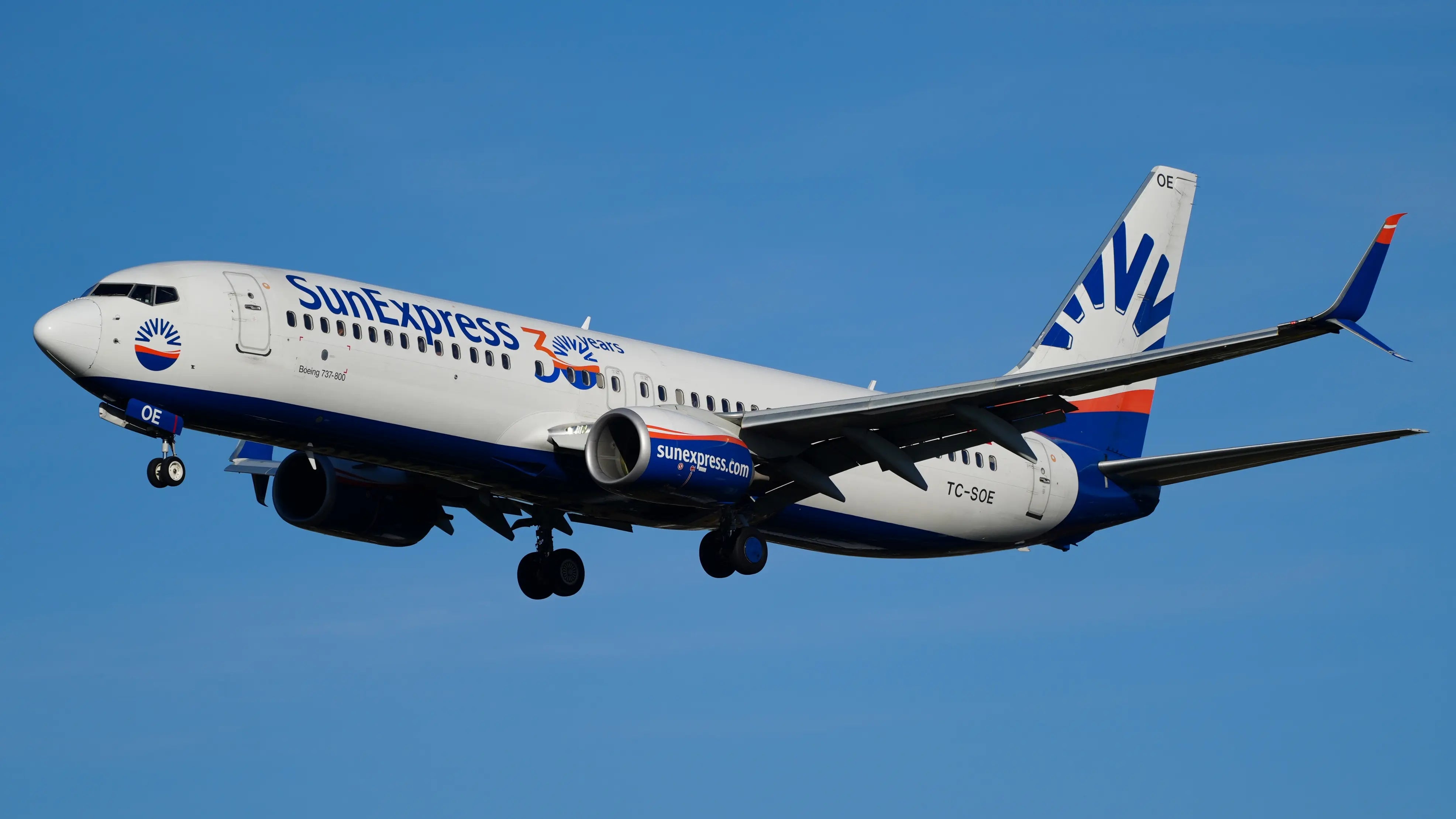
SunExpress operates an all-Boeing 737 fleet, making it one of the largest single-type operators in Europe. As of early 2026, the fleet consists of approximately 85 aircraft: a mix of the proven Boeing 737-800NG and the newer Boeing 737-8 MAX. The airline is in the middle of an aggressive fleet modernization and expansion program, with firm orders for 87 Boeing 737 MAX aircraft plus 45 options and purchase rights, totalling 132 aircraft. This order includes 28 x 737-8 (189 seats) and 17 x 737-10, the larger variant seating up to 230 passengers, which will be the first of its kind for SunExpress.
| Aircraft Type | Role | In Service | Notes |
|---|---|---|---|
| Boeing 737-800NG | Narrowbody | ~50 | Workhorse fleet. 189 seats. Being gradually replaced by 737-8 MAX. |
| Boeing 737-8 MAX | Narrowbody | ~35 | New-generation replacement. 189 seats. 14% lower fuel burn vs 737-800NG. +4 delivered Jan 2026. |
| Boeing 737-10 MAX | Narrowbody | On order | 17 on order. 230 seats. First delivery expected 2027+. Largest 737 variant. |
Fleet data as of early 2026 based on SunExpress corporate disclosures. Exact split between NG and MAX evolves with ongoing deliveries.
The fleet growth trajectory is ambitious. SunExpress aims to operate 100 aircraft by 2028, 150 by 2033, and up to 166 by 2035. This near-doubling of the fleet over the next decade represents one of the fastest growth rates among European carriers. The introduction of the 737-10 will also open new possibilities for higher-density routes, particularly on peak-season leisure destinations. For pilots, the single-type fleet means only one type rating is required (Boeing 737), simplifying training and creating a large, flexible pilot pool.
The transition from the 737-800NG to the 737 MAX family is well underway. The MAX variants offer approximately 14% lower fuel burn compared to the NG, reduced noise footprint, and improved cockpit displays. From a pilot perspective, the 737 MAX retains the same type rating as the 737NG, with only a differences training course required for conversion. This means pilots can seamlessly operate both NG and MAX aircraft, and the airline can roster crews across the entire fleet without type-rating constraints. In January 2026 alone, SunExpress took delivery of 4 additional Boeing 737-8 aircraft, illustrating the pace of the fleet renewal.
The 737-10, once delivered (expected from 2027 onwards), will be SunExpress's largest aircraft at 230 seats compared to 189 on the 737-8 and 737-800. While the 737-10 shares the same type certificate as the 737-8, pilots may need a short familiarization course on the slightly different handling characteristics of the stretched fuselage. The introduction of this variant signals SunExpress's ambition to compete more effectively on high-density European routes where per-seat costs are critical.
From an operational standpoint, the transition from the 737-800NG to the 737-8 MAX brings meaningful improvements in fuel efficiency (approximately 14% lower fuel burn per seat), reduced noise footprint (40% smaller noise area), and enhanced cockpit technology including a larger display format and improved flight management system. For pilots, the MAX series introduces MCAS (Maneuvering Characteristics Augmentation System), which has been updated and is now required training content following the 2019 certification changes. The differences training from 737-800NG to 737-8 MAX is relatively short (typically 2-3 days of ground school plus simulator sessions), reflecting the common type certificate. This means SunExpress pilots can operate any aircraft in the fleet without separate type ratings, and the airline's crew scheduling department can assign pilots to either NG or MAX aircraft interchangeably, which is a significant advantage for both operational flexibility and pilot utilization.
Operating a single aircraft family (Boeing 737) means SunExpress pilots only need one type rating for their entire career at the airline. This streamlines training, enables flexible crew rostering across the entire fleet, and avoids the complexity of multi-fleet seniority bidding seen at carriers with diverse fleets. The transition from 737-800NG to 737-8 MAX requires only a short differences course, not a full type rating conversion. The 737-10, while larger, shares the same 737 MAX type certificate.
Pilot Salary & Compensation Breakdown
One of SunExpress's most distinctive features is that all pilot salaries are quoted and paid net (after tax), in either euros or Turkish lira at the pilot's preference. This is unusual among European carriers, where salaries are typically stated as gross figures. According to the official 2025 SunExpress pilot brochure, compensation consists of a monthly net base salary, duty-hour pay, night duty premiums, and cycle compensation for multi-sector days. There is no profit-sharing scheme or traditional annual bonus, but retention bonuses are paid at specific career milestones.
First Officer (F/O) Pay Scale
| Seniority | Monthly Net Base | Duty Pay (0-100 hrs) | Duty Pay (101+ hrs) | Night Duty |
|---|---|---|---|---|
| Year 0-1 | €2,990/mo | €15.40/hr | €27.50/hr | €50.00/hr |
| Year 2-3 | €3,210/mo | €15.40/hr | €27.50/hr | €50.00/hr |
| Year 3-4 | €3,440/mo | €15.40/hr | €27.50/hr | €50.00/hr |
| Year 4-5 | €3,660/mo | €15.40/hr | €27.50/hr | €50.00/hr |
| Year 5+ | €3,880/mo | €15.40/hr | €27.50/hr | €50.00/hr |
All figures are net monthly amounts per the 2025 official brochure. Duty pay is calculated on duty hours (not block hours). Night duty pay applies between 00:00 and 06:00 local time.
In addition to the base and duty pay, First Officers receive cycle compensation for multi-sector days: €11.90 for the 3rd cycle, €23.80 for the 4th cycle, and €35.70 for the 5th cycle in a single duty period. During peak summer months with high duty hours (up to 150 duty hours/month), a First Officer at mid-seniority can realistically earn between €4,500 and €5,500 net per month. Winter months are considerably quieter (25-40 flight hours, 60-70 duty hours), bringing total monthly earnings closer to €3,500-€4,000 net.
Captain Pay Scale
| Seniority | Monthly Net Base | Duty Pay (0-100 hrs) | Duty Pay (101+ hrs) | Night Duty |
|---|---|---|---|---|
| Year 0-3 | €5,970/mo | €28.60/hr | €52.80/hr | €71.30/hr |
| Year 4-6 | €6,490/mo | €28.60/hr | €52.80/hr | €71.30/hr |
| Year 7-10 | €6,720/mo | €28.60/hr | €52.80/hr | €71.30/hr |
| Year 11-14 | €7,020/mo | €28.60/hr | €52.80/hr | €71.30/hr |
| Year 15+ | €7,170/mo | €28.60/hr | €52.80/hr | €71.30/hr |
Captain figures are also net. Cycle compensation for Captains: €17.90 (3rd cycle), €35.80 (4th cycle), €53.70 (5th cycle). These amounts are per the 2025 brochure.
A mid-seniority Captain flying a busy summer schedule can take home approximately €9,000-€10,000 net per month, while winter earnings are closer to €7,000-€8,000 net. Senior Captains (15+ years) at peak utilization may see monthly net earnings approach €11,000. These figures are considerably lower than what Turkish Airlines or major European flag carriers pay in gross terms, but the net payment structure means the comparison is not straightforward. Living costs in Antalya or Izmir are significantly lower than in Istanbul, Frankfurt, or Paris.
Estimated Annual Net Earnings
Given the significant seasonality of SunExpress operations, it is more meaningful to look at annualized earnings estimates than monthly snapshots. The table below provides conservative, mid-range, and high estimates for annual net take-home pay at different career stages, accounting for the summer/winter fluctuation described above.
| Rank & Seniority | Conservative (Low Summer) | Mid-Range Estimate | High Estimate (Peak Utilization) |
|---|---|---|---|
| F/O Year 0-1 | €42,000 | €48,000 | €54,000 |
| F/O Year 3-4 | €48,000 | €55,000 | €62,000 |
| F/O Year 5+ | €52,000 | €60,000 | €68,000 |
| Captain Year 0-3 | €82,000 | €96,000 | €110,000 |
| Captain Year 7-10 | €90,000 | €105,000 | €118,000 |
| Captain Year 15+ | €95,000 | €112,000 | €126,000 |
Estimates include base salary, duty-hour pay (assuming average monthly duty hours across summer and winter), night duty premiums, and cycle compensation. They do not include per diems, retention bonuses, or any future pay increases. These are net (after-tax) figures. All estimates are based on the 2025 brochure rates and should be considered approximate.
To put these figures in context, a mid-career First Officer earning approximately €55,000 net in Antalya has a purchasing power roughly equivalent to a gross salary of €80,000-€90,000 in Germany or the Netherlands, once you factor in the net payment structure and the significantly lower cost of living in southern Turkey. A senior Captain at €112,000 net is living very comfortably by any standard, particularly in a city like Antalya where a modern apartment rents for €500-€700/month and daily expenses are a fraction of Western European norms. This purchasing power advantage is one of the key financial arguments in favor of SunExpress, particularly for pilots who are content to make Turkey their primary residence.
It is worth breaking down the cost of living advantage more specifically. A family of four in Antalya can expect monthly expenses of roughly €2,000-€2,500 for rent (a spacious modern apartment), groceries, utilities, transport, dining out, and entertainment. The same lifestyle in Frankfurt or Amsterdam would cost €4,500-€6,000, and in London or Zurich considerably more. Private schooling for children in Antalya, if desired, ranges from €2,000-€5,000 per year at international schools, compared to €15,000-€30,000 at equivalent institutions in Western Europe. Domestic staff (cleaning, childcare) is widely available at a fraction of European rates. This means a SunExpress First Officer earning €55,000 net can save a higher proportion of their income than a counterpart earning €80,000 gross at a German carrier, after accounting for tax, social contributions, and living costs. For pilots focused on building long-term savings or paying off flight training debt, this financial arbitrage is a compelling reason to consider Turkey-based flying.
Type Rating Cost & Retention Bonuses
SunExpress requires pilots who are not already type-rated on the Boeing 737 to pay a €30,000 type rating contribution. This can be deducted from the monthly salary over 36 months (totalling €32,500 with the deduction plan fee). Pilots who self-fund the type rating upfront receive higher retention bonuses: €2,500 at year 3, €5,000 at year 5, and €10,000 at year 7. Those who use the salary deduction plan receive smaller milestones: €5,000 at year 5 and €7,500 at year 7. This structure effectively creates a minimum commitment period of 5-7 years.
All salary figures come from the official 2025 SunExpress pilot recruitment brochure. Because salaries are stated net (after Turkish income tax), direct comparison with European carriers quoting gross salaries requires careful adjustment. Turkish income tax rates for this income bracket are approximately 15-27%, meaning the gross equivalent is roughly 20-35% higher than the net figures shown. Additionally, the strong seasonality of SunExpress operations means summer and winter monthly earnings can differ by 30-40%. Currency fluctuations between the euro and Turkish lira also affect the real purchasing power for pilots paid in TRY. Always verify with the latest official brochure at hr.sunexpress.com.
Roster Pattern & Quality of Life
SunExpress operates under Turkish DGCA (SHGM) flight time limitation rules, with a planned transition to EASA FTL regulations expected in 2026. The airline is required by the Turkish DGCA to increase crew numbers by approximately 10% to comply with the new EASA standards, which is expected to improve rest periods and reduce maximum duty times. Rosters are published on a weekly basis, which gives pilots less long-term planning visibility compared to airlines that publish monthly schedules. Pilots must reside in Turkey at their assigned base (Antalya, Izmir, or Ankara), as commuting from abroad is not permitted.
The seasonal nature of SunExpress operations is one of the most important factors affecting quality of life. Summer (May through October) is extremely busy, with duty hours reaching up to 150 hours per month and typical flying of 80-100+ block hours. Winter is dramatically quieter, with just 25-40 flight hours per month (60-70 duty hours). This creates a "feast or famine" pattern that some pilots appreciate (more free time in winter) while others find challenging (intense workload in summer with less rest flexibility).
📅 Sample Month: Summer F/O Schedule (Antalya Base)
SunExpress also offers part-time contracts on a "20 days on / 10 days off" pattern, which is relatively unusual in the industry and particularly attractive for pilots with families or those who want extended blocks of free time. This contract type is available for both F/Os and Captains, though availability may vary by base and season.
❄️ Sample Month: Winter F/O Schedule (Antalya Base)
The contrast between the two rosters is stark. Winter flying at SunExpress is remarkably light, with many pilots flying just 8-12 days per month and enjoying extended blocks of days off. This is when the airline schedules most recurrent training, simulator checks, and CRM sessions. Many pilots use the quieter winter months to pursue hobbies, spend time with family, or travel using their staff travel benefits. However, the trade-off is that summer flying is intense, and the transition from the relaxed winter pace to peak-season operations can be demanding. The weekly roster publication means pilots may have limited ability to plan personal commitments more than a week ahead during the busy season.
A typical summer duty day at SunExpress might involve 2-3 sectors, starting with an early morning departure from Antalya to a German or Austrian city, a quick turnaround at the European outstation, and a return flight arriving back at base in the late afternoon or evening. Multi-sector days with 4-5 short domestic or regional flights also occur, particularly from Izmir which has a denser short-haul network. The average sector length is approximately 2.5-3.5 hours, meaning pilots accumulate block hours relatively quickly during peak season. Night operations are common, especially during late-summer charter peaks when flights to and from European holiday destinations extend into the early morning hours. The combination of early starts, late finishes, and multi-sector days during summer is the primary driver of pilot fatigue complaints, and is precisely the area where the EASA FTL transition should bring the most meaningful improvements in 2026.
The transition from Turkish DGCA flight time limitations to EASA FTL regulations, expected to take full effect in 2026, represents a significant change for SunExpress operations. EASA FTL rules are generally more restrictive than the current Turkish regulations, particularly regarding maximum duty periods, disruptive schedules (early starts and late finishes), and cumulative fatigue management. The airline has already begun increasing crew numbers by approximately 10% to accommodate the new requirements. For pilots, this transition should result in slightly reduced maximum duty times, better rest provisions, and potentially more days off during the busy summer months. It may also slightly reduce total duty hours available for earning duty-hour pay, but the overall impact on quality of life is expected to be positive.
Special leave provisions are generous by Turkish standards. Pilots receive 1 birthday leave day per year, plus excuse leave for major life events: 5 days for a wedding, 7 days for birth of a child, 10 days for death of a spouse, 5 days for death of a parent, child, or sibling, and 2 days for moving house. These are in addition to the annual leave entitlement and do not count against it.
SunExpress requires all pilots to live in Turkey at their assigned base. Antalya is the largest base and the airline's headquarters, offering a Mediterranean lifestyle with low living costs, excellent weather, and a large expat community. Izmir, Turkey's third-largest city, provides a more urban environment with a vibrant cultural scene. Both cities offer a high quality of life at a fraction of the cost of Western European capitals. However, pilots who prefer to live in their home country and commute to work will find this arrangement restrictive. The residency requirement is non-negotiable and is verified by the airline.
Benefits, Travel Perks & Insurance
As a joint venture between Turkish Airlines and Lufthansa, SunExpress pilots benefit from access to one of the widest staff travel networks in the industry. The benefits package also includes private health insurance, per diem allowances, ground transportation, and loss of license coverage for Captains. While not as comprehensive as what legacy flag carriers offer under strong European labor law frameworks, the package is competitive for a leisure carrier operating from Turkey.
The staff travel benefit deserves special attention. Through the Turkish Airlines and Lufthansa parent networks, SunExpress pilots can access discounted fares on Star Alliance carriers, Lufthansa Group airlines (including Swiss, Austrian, Brussels Airlines, Eurowings), all Turkish Airlines destinations (340+ globally), and dozens of additional airlines through the myIDTravel interline system. This is a significant perk for pilots who value personal travel, particularly given Turkey's strategic location as a bridge between Europe, the Middle East, and Central Asia.
The myIDTravel platform, which SunExpress participates in through its Lufthansa Group connection, provides access to discounted standby and confirmed ID tickets on over 50 partner airlines worldwide. Turkish Airlines' network alone covers more than 130 countries and 340 destinations, including extensive coverage of Africa, Central Asia, and the Far East that many European LCCs do not reach. Combined with Lufthansa Group's European and transatlantic network, the travel benefits available to SunExpress pilots are genuinely world-class and would cost thousands of euros to replicate at retail prices. Staff travel eligibility extends to immediate family members (spouse and children) after six months of employment, and eligible relatives can be added for a nominal annual fee.
Regarding retirement provisions, SunExpress pilots are enrolled in the Turkish Social Security Institution (SGK), which provides a state pension based on years of contribution and average earnings. The standard retirement age in Turkey is 60 for men and 58 for women, with 7,200 days of premium payments required for full eligibility. There is no supplementary company pension scheme, which is a notable gap compared to European carriers that typically offer employer-funded pension contributions ranging from 10-20% of salary. Pilots considering SunExpress as a long-term career should factor in the need for personal retirement savings to supplement the SGK pension, particularly if they plan to retire in a country with higher living costs than Turkey.
The health insurance provision covers medical consultations, hospital stays, surgical procedures, dental care, and specialist referrals at private hospitals throughout Turkey. Turkish private healthcare is widely regarded as high quality and significantly more affordable than equivalent care in Western Europe. Pilots stationed in Antalya or Izmir will find modern, well-equipped private hospitals nearby. The 80/20 employer-employee cost split for premium payments is standard for the Turkish private sector. Coverage for family members (spouse and dependent children) is included in the same plan at no additional premium.
Several benefits common at Western European carriers are notably absent or limited at SunExpress. There is no dedicated pilot pension scheme beyond the Turkish state social security system (SGK). Loss of license insurance is only available for Captains, not First Officers, which is a significant gap for younger pilots. There is no formal profit-sharing or annual bonus scheme. Maternity and paternity leave follows Turkish statutory minimums, which are less generous than EU-mandated entitlements. Pilots evaluating SunExpress against EU-based carriers should factor these differences into the total compensation picture.
Career Progression & Upgrade Path
Career progression at SunExpress follows a structured upgrade pathway from First Officer to Captain, with clearly defined eligibility requirements. Unlike some legacy carriers with decade-long seniority queues, SunExpress's rapid growth creates relatively faster upgrade opportunities. The airline also accepts direct-entry Captains with significant command experience, which is a notable advantage for experienced pilots seeking a command position without starting from the bottom of a new seniority list.
| Career Milestone | Requirements / Timeline | Notes |
|---|---|---|
| Join as First Officer | Day 1 (post type rating) | Entry on Boeing 737. Type rating required (self-funded or salary deduction). |
| Captain Upgrade Eligibility | Min. 700 hrs F/O on type at SXS | Max age 59y+364d. No check failures in last 12 months. Max 3 upgrade attempts. |
| Direct Entry Captain | 4,000+ total hours, 500+ PIC | Min 3 years airline experience. Seniority credit: 1 year SXS per 3 years CPT elsewhere. |
| Training Captain / TRI / TRE | Variable | Internal selection. SunExpress has trained 160+ pilots through its in-house program as of 2025. |
The upgrade requirements are straightforward: a minimum of 700 hours as a First Officer on the Boeing 737 type at SunExpress, no check ride failures in the preceding 12 months, and a maximum age of 59 years and 364 days. Pilots are limited to three upgrade attempts. The fast-growing fleet (targeting 100 aircraft by 2028 and 150 by 2033) should create consistent demand for new Captains, potentially making upgrade timelines shorter than at more established carriers where growth has plateaued.
For direct-entry Captains, SunExpress offers an interesting seniority credit system: for every 3 years of Captain experience at a previous airline, pilots receive 1 year of SunExpress seniority. This helps experienced Captains who join SunExpress avoid starting at the very bottom of the seniority list for bidding purposes, particularly for leave and base preferences.
Beyond the traditional F/O-to-Captain progression, SunExpress offers a range of instructor and management roles for pilots interested in non-flying or mixed careers. The airline's in-house training department employs Type Rating Instructors (TRIs), Type Rating Examiners (TREs), and Line Training Captains. With over 160 pilots trained in-house as of 2025 and a pipeline of hundreds more needed for the fleet expansion, training roles are expected to be in strong demand. These positions typically carry additional pay premiums and are considered prestigious within the airline's pilot community.
SunExpress also has a ground-based training facility in Antalya, though full flight simulator sessions are currently conducted at partner facilities. The airline has announced plans to expand its training infrastructure to support the growing fleet, which may include dedicated simulator facilities in Turkey. For pilots interested in safety, standards, or fleet management roles, SunExpress's growth phase means that new positions are being created regularly, offering career paths that would take much longer to access at a mature airline with a static organizational structure.
An important consideration for First Officers planning their career at SunExpress is the type rating bond. If a pilot leaves before completing their retention bonus milestones, they effectively forfeit any remaining bonuses and must have fully paid off the type rating cost. This creates a soft "golden handcuffs" effect for the first 5-7 years of employment, but also ensures that pilots who stay for the long term are rewarded with meaningful retention bonuses. Once the type rating is fully paid and retention bonuses are received, pilots have full flexibility to remain or explore opportunities elsewhere, though the rapid growth at SunExpress means internal opportunities are likely to be more attractive than they would be at a stagnating airline.
It is also worth noting that SunExpress pilots hold a Turkish ATPL or validated foreign license, not an EASA ATPL. While the airline is transitioning to EASA FTL rules for operational purposes, the pilot licensing framework remains under the Turkish DGCA (SHGM). Pilots who later wish to transfer to an EASA-regulated carrier in Europe may need to convert their license, which involves administrative processes and potentially additional examinations depending on the target state. This is an important consideration for pilots who view SunExpress as a stepping stone to a European flag carrier rather than a long-term career destination. Turkish Airlines, however, operates under the same Turkish licensing framework, meaning a move from SunExpress to the parent carrier would be seamless from a regulatory perspective. The SHGM is working toward increased harmonization with EASA standards, and the regulatory gap is expected to narrow over the coming years as Turkey continues its EU accession-related aviation reforms.
With 132 Boeing 737 MAX aircraft on order and a target to nearly double the fleet by 2033, SunExpress will need to recruit and train hundreds of new pilots over the coming decade. This growth trajectory is one of the airline's strongest selling points for career progression. More aircraft means more Captain positions, more training roles, and more opportunities for seniority advancement. The introduction of the 737-10 (230 seats) will also create new route possibilities and potentially new base openings, further expanding career options. Pilots who join during this growth phase may benefit from significantly faster progression than those at airlines with stable or shrinking fleets.
Recruitment Process & Requirements
SunExpress recruits both experienced Captains and First Officers (including low-hour pilots) through a structured selection process managed via the airline's dedicated recruitment portal at hr.sunexpress.com. Unlike some European carriers, SunExpress is open to non-EU nationals and actively recruits internationally, though a Turkish work permit is required for foreign pilots (processed within approximately 30 days by the airline). The selection process is thorough, consisting of seven distinct stages, and places significant emphasis on psychometric testing and simulator performance.
Captain Requirements
First Officer Requirements
Selection Process (7 Stages)
Document & License Verification
Initial screening of all submitted documents, licenses, certificates, and flight hours. Applications are submitted through the hr.sunexpress.com portal. Incomplete applications are automatically rejected.
English Proficiency Test
Company-administered English language assessment. This goes beyond ICAO Level 4 verification and tests practical aviation English, comprehension, and communication skills. Conducted online or at a SunExpress facility.
Mollymawk Psychometric Assessment
A comprehensive 3-hour computer-based psychometric test covering physics, mathematics, spatial reasoning, memory, and multitasking. This is the most technically demanding stage and where the majority of candidates are eliminated. Thorough preparation in cognitive aptitude testing is strongly recommended.
Simulator Assessment
Full-motion Boeing 737NG simulator check. Evaluates technical flying skills, standard operating procedures, CRM, and handling of non-normal situations. Candidates are assessed on precision, workload management, and decision-making under pressure.
Panel Interview (1.5 hours)
Face-to-face interview with a panel consisting of an HR representative, a line Captain, and a psychologist. Conducted entirely in English. Covers motivation, CRM scenarios, career goals, situational judgment, and cultural fit. Expect competency-based and behavioral questions.
Final Document Check
Verification of all original documents, medical certificate validity, and background checks. Any discrepancies between submitted copies and originals result in immediate disqualification.
Work Permit & Contract
For foreign nationals, SunExpress arranges the Turkish work permit (approximately 30 days processing). Once approved, the employment contract is signed and a start date for type rating or line training is assigned. Turkish nationals proceed directly to contract signing.
Preparing for the Assessment
The Mollymawk psychometric assessment is widely considered the most challenging element of the SunExpress selection and deserves dedicated preparation. Unlike the DLR test battery used by Lufthansa Group or the COMPASS test used by some British carriers, Mollymawk tests are less standardized in publicly available preparation materials, which adds to the difficulty. The assessment evaluates cognitive processing speed, numerical reasoning, spatial orientation, short-term and working memory, multitasking capability under time pressure, and basic physics comprehension. The test is administered on a computer with strict time limits for each section. Scores are benchmarked against a pilot-specific norm group, and candidates who fall below threshold in any key area are eliminated regardless of their performance in other areas.
The best preparation strategy involves practicing with general aviation aptitude testing platforms such as SkyTest, CUT-E, or Symbiotics, which train the same cognitive skills even if the exact test format differs. Candidates should focus particularly on spatial reasoning under time pressure, mental arithmetic, and divided attention tasks. Many successful applicants report that the multitasking sections, where candidates must simultaneously track instruments, respond to audio cues, and perform mathematical calculations, are the most challenging. Practice sessions of 2-3 hours at a time help build the stamina needed for the actual 3-hour assessment.
For the simulator assessment, candidates are evaluated on a Boeing 737NG full-flight simulator at one of SunExpress's partner training facilities. The assessment typically includes standard instrument flying (ILS approaches, holding patterns, NDB tracking), abnormal and emergency handling (engine failure at various phases of flight, system malfunctions), and crew resource management (CRM) under workload. The assessors are less interested in perfect flight path management and more focused on decision-making, workload prioritization, communication, and how candidates handle unexpected situations. Prior experience on Boeing aircraft is an advantage but not essential, as the assessment accounts for differences in type experience. Candidates with Airbus backgrounds are expected to demonstrate adaptability rather than Boeing-specific expertise.
The panel interview (approximately 90 minutes) is conducted by a senior Captain, a training Captain, and typically an HR representative. Questions cover behavioral and competency-based scenarios (threat and error management, conflict resolution, decision-making under pressure), motivation for joining SunExpress, understanding of the airline's operations and culture, and willingness to relocate to Turkey. Candidates who demonstrate genuine research into SunExpress's operations, fleet plans, and Turkish aviation market tend to perform better than those who approach it as just another airline interview. The panel particularly values honesty about limitations and a constructive learning attitude over rehearsed "perfect" answers.
The Mollymawk psychometric test is widely regarded as the most challenging element of the SunExpress selection. It tests raw cognitive ability rather than aviation knowledge, so standard airline interview preparation books will not be sufficient. Practice with computer-based aptitude testing platforms (such as those offered by SkyTest or similar providers) is strongly recommended. For the simulator assessment, familiarity with Boeing 737NG procedures is essential, even for candidates who will eventually fly the MAX. The interview panel values honest, structured answers over rehearsed responses. SunExpress does not require Turkish language skills for pilots, as all operational communications are conducted in English.
How SunExpress Compares: Airline Radar Chart
How does SunExpress stack up against its two closest competitors in the Turkish aviation market: Turkish Airlines (the national flag carrier and 50% parent) and Pegasus Airlines (Turkey's largest low-cost carrier)? Below is a comparative analysis across five key metrics. Scores are editorial estimates based on publicly available data, official brochures, and industry benchmarks.
Key Takeaways from the Comparison
Turkish Airlines dominates on salary and fleet diversity. As a full-service flag carrier operating widebody aircraft (A350, 777, 787) on intercontinental routes, Turkish Airlines offers significantly higher absolute pay: Captains reportedly earn between $14,500 and $16,500 USD per month, with First Officers in the $7,000-$11,000 range. The fleet spans over 400 aircraft across multiple Airbus and Boeing types, giving pilots access to long-haul widebody flying that SunExpress simply cannot offer with its narrowbody-only operation.
SunExpress wins on lifestyle and growth potential. Pilots based in Antalya or Izmir enjoy a Mediterranean lifestyle with dramatically lower living costs than Istanbul (Turkish Airlines' base). The part-time contract option (20/10 pattern) is not available at Turkish Airlines. And the growth trajectory (doubling the fleet by 2033) suggests faster upgrade timelines and more career opportunities in the near term. The dual parentage also provides unique staff travel benefits spanning both Star Alliance and the broader Turkish Airlines network.
Pegasus offers less overall. As a pure low-cost carrier, Pegasus typically offers lower compensation, fewer benefits, and higher pilot turnover. The airline has historically used pay-for-training models and reportedly experiences significant pilot attrition to Turkish Airlines. SunExpress sits above Pegasus on most metrics, benefiting from its premium leisure positioning and stronger ownership backing.
Job security is SunExpress's hidden strength. Backed by two of Europe's most established aviation groups (Turkish Airlines and Lufthansa), with 132 aircraft on order and strong financial performance ($164M profit in 2024), SunExpress offers a level of job security that few leisure carriers can match. The airline has never furloughed pilots, even during the COVID-19 pandemic, when many competitors reduced their pilot workforce significantly.
| Metric | SunExpress | Turkish Airlines | Pegasus Airlines |
|---|---|---|---|
| Fleet Size | 85+ (737 only) | 400+ (mixed A/B) | 100+ (A320neo family) |
| Captain Net Pay (est.) | €8,000-€10,000/mo | $14,500-$16,500/mo | $6,000-$8,000/mo |
| F/O Net Pay (est.) | €4,000-€5,500/mo | $7,000-$11,000/mo | $3,500-$5,500/mo |
| Base City | Antalya / Izmir | Istanbul (IST) | Istanbul (SAW) |
| Widebody Flying | No | Yes (A350, 777, 787) | No |
| Part-Time Option | Yes (20/10) | No | Limited |
| Staff Travel Network | TK + LH + myIDTravel | Star Alliance + TK | Limited interline |
| Loss of License | Captains only | All pilots | Limited |
| Type Rating Bond | €30,000 | Company-funded | Self-funded |
| Growth Outlook | 132 aircraft on order | Expanding widebody | Moderate growth |
This comparison uses estimated figures from official sources where available and industry benchmarks otherwise. Turkish Airlines figures are approximate based on publicly reported compensation ranges for foreign contract pilots. Pegasus figures are estimated from industry surveys and pilot forums. Currency conversions at approximate market rates. Always verify with official sources.
Scores are editorial estimates based on publicly available salary data, official pilot brochures, airline press releases, and industry benchmarks. They represent a general assessment for an experienced pilot considering a long-term career. Individual experiences will vary based on seniority, fleet, base assignment, and personal priorities. Turkish Airlines salary data is estimated from pilot forums and industry sources, as the airline does not publish an equivalent of the SunExpress brochure. Pegasus data is limited. Scores for all airlines will be updated as we publish dedicated guides.
Verdict: Who Is SunExpress For?
🎯 Our Take
SunExpress occupies a unique niche in the European pilot job market. It is neither a full-service flag carrier nor a pure low-cost airline, but a high-growth leisure carrier with the financial backing and operational standards of two major aviation groups. For the right pilot profile, this can be an excellent career choice.
The strengths are clear: an all-Boeing 737 fleet that simplifies training and career management, net salary payments that avoid the confusion of gross-to-net calculations, one of the most ambitious fleet growth plans in Europe (132 aircraft on order), direct-entry Captain positions with seniority credit, a Mediterranean lifestyle at Antalya or Izmir bases with low living costs, and unrivalled staff travel access through both Turkish Airlines and Lufthansa networks.
The trade-offs are equally real: salaries are lower than Turkish Airlines and most Western European carriers in absolute terms, the seasonal workload creates extreme summer intensity, weekly roster publication limits planning, the mandatory Turkey residency requirement eliminates commuting, loss of license insurance is only for Captains, there is no dedicated pilot pension, and the type rating cost (€30,000) is a significant upfront commitment. The transition to EASA FTL rules in 2026 should improve working conditions but is not yet finalized.
For pilots who value lifestyle, growth potential, and the security of strong ownership over maximum absolute salary, SunExpress deserves serious consideration. The next decade of fleet expansion (from 85 to 150+ aircraft) will create hundreds of new Captain positions and career opportunities.
Looking ahead to 2026 and beyond, several developments could meaningfully improve the SunExpress proposition. The anticipated transition to EASA Flight Time Limitation rules would bring the airline in line with Western European fatigue management standards, potentially reducing maximum duty hours and improving rest requirements. The introduction of the 737-10 (expected from 2027) will add a new dimension to route planning and crew scheduling. And Turkey's continued growth as a tourism destination, with the government targeting 75 million visitors by 2030, provides a strong demand backdrop for the airline's expansion plans. For pilots who join during this growth phase, the combination of rapid fleet expansion, new aircraft variants, and increasing route diversification creates a dynamic and opportunity-rich environment that more established carriers simply cannot match.
1 Do I need to speak Turkish to fly for SunExpress?
No. All operational communications at SunExpress are conducted in English. Turkish language skills are not required for pilots. ICAO English Level 4 is the minimum, with an additional company English proficiency test during selection. Many SunExpress pilots are non-Turkish nationals from across Europe and beyond.
2 Does SunExpress pay for the type rating?
Partially. The Boeing 737 type rating costs €30,000, which the pilot must fund. SunExpress offers a salary deduction plan over 36 months (totalling €32,500), spreading the cost across paychecks. Pilots who already hold a valid 737 type rating do not pay this fee. There is no fully employer-funded type rating option as seen at some flag carriers.
3 How long does it take to upgrade to Captain at SunExpress?
There is no fixed timeline, but eligibility requires a minimum of 700 hours as a First Officer on the Boeing 737 type at SunExpress. Given the airline's rapid growth (targeting 100 aircraft by 2028, up from 85), upgrade opportunities are expected to be more frequent than at established carriers with slower growth. The airline also accepts direct-entry Captains with 4,000+ total hours and 500+ PIC hours.
4 Can I live outside Turkey and commute to my base?
No. SunExpress requires all pilots to reside in Turkey at their assigned base (Antalya, Izmir, or Ankara). This is a strict requirement that is verified by the airline. Commuting from abroad is not permitted. For foreign pilots, the airline assists with the Turkish work permit process, which typically takes about 30 days.
5 Are SunExpress salaries really paid net (after tax)?
Yes. All salary figures in the official SunExpress pilot brochure are stated as net amounts after Turkish income tax deductions. This is unusual in the European aviation industry, where salaries are typically quoted as gross figures. Pilots can choose to receive their salary in euros or Turkish lira. The net payment structure simplifies take-home pay calculations but makes direct comparison with other airlines more complex.
6 What is the Mollymawk test and how should I prepare?
The Mollymawk psychometric assessment is a 3-hour computer-based test that evaluates cognitive aptitude through sections on physics, mathematics, spatial reasoning, memory, and multitasking. It is used by several airlines beyond SunExpress. Preparation should focus on computer-based aptitude testing platforms such as SkyTest or equivalent services. Standard airline interview preparation books are not sufficient for this test. The Mollymawk is widely considered the most challenging stage of the SunExpress selection process.
7 Is there a part-time contract option?
Yes. SunExpress offers a "20 days on / 10 days off" part-time contract pattern, available to both First Officers and Captains. This is relatively uncommon in the industry and can be attractive for pilots with families or those seeking extended blocks of free time. Availability may vary by base, season, and operational requirements.
8 Can non-EU citizens apply to SunExpress?
Yes. Unlike many European carriers that restrict recruitment to EU/EEA nationals, SunExpress is open to pilots of all nationalities. The airline arranges the Turkish work permit for foreign nationals, with processing taking approximately 30 days. A valid JAA or EASA pilot license is accepted. This makes SunExpress one of the more accessible European-quality carriers for pilots from outside the EU.
9 What is the cost of living like at SunExpress bases?
Living costs in Antalya and Izmir are significantly lower than Western European cities. A modern apartment in a good area of Antalya rents for approximately €500-€700/month, while groceries, dining out, and entertainment are 40-60% cheaper than in Germany or the UK. Ankara is slightly cheaper still. Turkey offers an excellent quality of life for the salary levels offered, particularly for pilots paid in euros. Many expat pilots report that their purchasing power in Turkey is substantially higher than colleagues earning more in absolute terms at Western European carriers. Healthcare is affordable and high-quality at private hospitals.
10 Does SunExpress offer long-haul or widebody flying?
No. SunExpress operates exclusively narrowbody Boeing 737 aircraft on short and medium-haul routes (maximum sector lengths of approximately 5-6 hours). There are no plans to introduce widebody aircraft. Pilots seeking long-haul intercontinental flying would need to apply to Turkish Airlines (the parent carrier) or other airlines. However, SunExpress's single-type operation is a deliberate strategy that simplifies fleet management, training, and pilot rostering. Some pilots prefer narrowbody flying for the frequency of home returns and the avoidance of jet lag associated with long-haul operations.
Official Links & Resources
Before applying or making any career decisions, always verify information directly with official sources. These are the key websites and organisations relevant to SunExpress pilot careers:
Download the latest SunExpress pilot brochure from hr.sunexpress.com before applying. This document contains the most current salary tables, benefit details, and contract terms. The brochure is updated annually and is the single most authoritative source for pilot compensation data. Also check the SunExpress LinkedIn page for the latest recruitment campaigns and open positions.