

Etihad Airways Overview & Company Profile
Etihad Airways is the national airline of the United Arab Emirates, founded by Royal Decree on 11 July 2003 and launching commercial operations on 5 November 2003. Headquartered in Khalifa City, Abu Dhabi, the airline operates from its sole hub at Abu Dhabi International Airport (AUH), a modern facility whose Terminal A opened in November 2023 as one of the largest airport terminals in the world. Unlike most of its global peers, Etihad is not a member of any major airline alliance and instead relies on a network of bilateral partnerships and codeshares.
The airline is wholly owned by the Government of Abu Dhabi through ADQ (Abu Dhabi Developmental Holding Company), the emirate's sovereign wealth fund, which took over majority ownership in October 2022. This state backing translates into long-term financial stability and an aggressive growth mandate tied to Abu Dhabi's Journey 2030 strategy, a plan that aims to more than double passenger numbers and nearly double the fleet by the end of the decade.
Etihad delivered record financial results in 2025, posting profit of AED 1.7 billion (USD 463 million) for the first nine months of the year and reporting full-year revenue of AED 30.7 billion (approximately USD 8.4 billion), up 21% year-on-year. The airline carried 22.4 million passengers and added 29 new aircraft during the year, making 2025 its largest fleet expansion in company history. Etihad hired roughly 400 pilots in 2025 alone, which reflects both the organic growth of the fleet and retirements at senior levels. For aspiring airline pilots, this kind of state-driven hiring momentum is rare among legacy carriers and creates meaningful opportunities on widebody equipment.
Etihad positions itself as a premium Gulf carrier with a strong focus on business and long-haul traffic. Its route map covers North America, Europe, Africa, the Indian subcontinent, Southeast Asia, and Oceania, with ultra-long-haul flagship routes to New York, Chicago, Toronto, and Sydney. Operationally, the airline is pursuing a dual strategy: scaling long-haul premium with the A350-1000 and reactivated A380, while pushing narrowbody reach with the A321LR and newly ordered A321XLR. That positioning shapes what flying for Etihad actually looks like from the flight deck, and is the foundation for everything that follows in this article.
Fleet Composition & Type Ratings
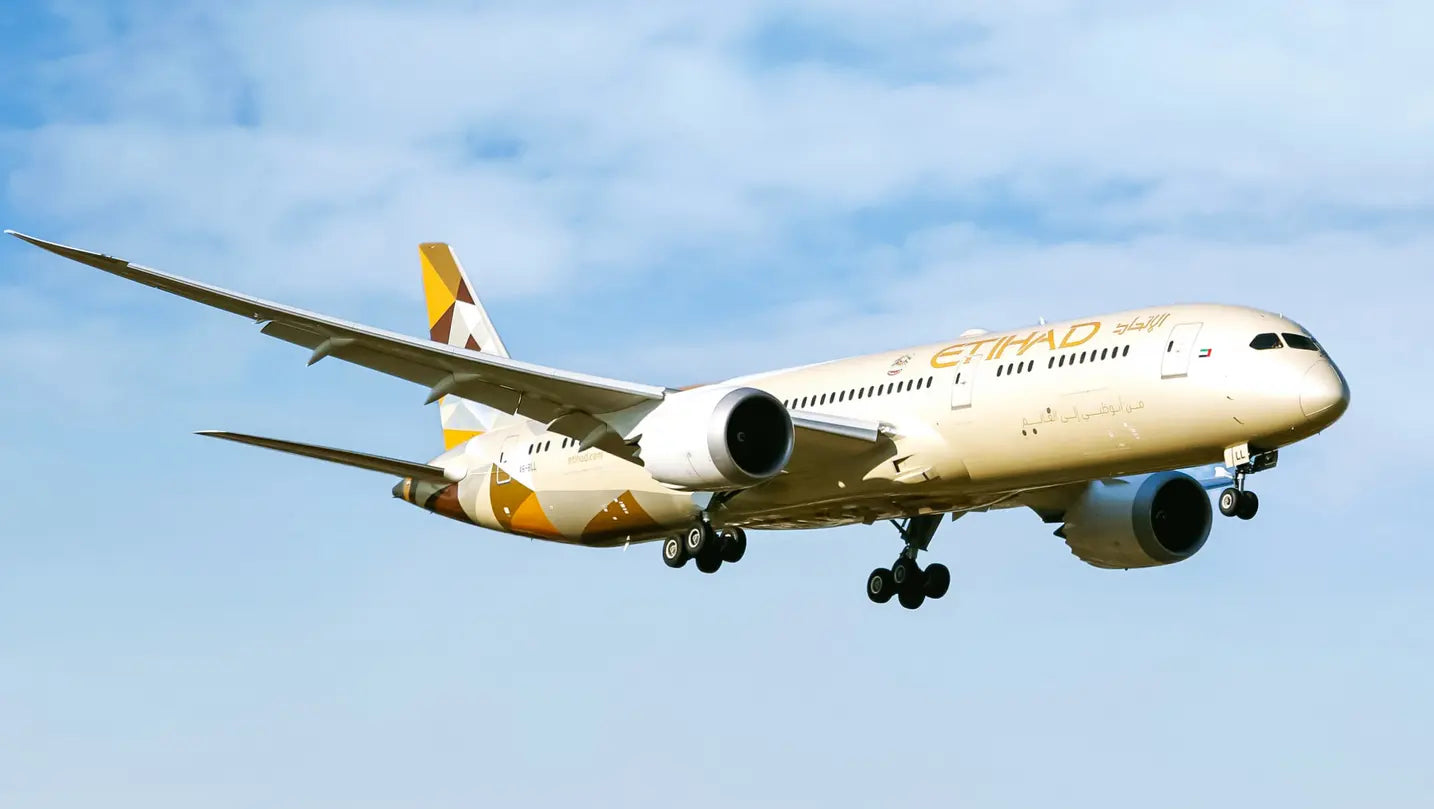
Etihad operates one of the most varied widebody fleets in the Middle East, combining Boeing long-haul workhorses with an expanding Airbus widebody lineup. As of February 2026, the airline's fleet stands at approximately 128 aircraft, the largest in its history. The active fleet is built around three long-haul pillars: the Boeing 787 family (the backbone, with 47 aircraft across the 787-9 and 787-10), the Airbus A350-1000 (growing rapidly from 10 aircraft in March 2026 toward a target of 20+), and the reactivated Airbus A380 (7 active, with 2 more returning to service by 2027). Narrowbody operations revolve around the A320/A321 family and the new A321LR, which unlocks thinner long-haul routes such as Hanoi or European secondary cities.
| Aircraft Type | Role | In Service | Routes / Notes |
|---|---|---|---|
| Airbus A320-200 / A320neo | Narrowbody | ~16 | Regional and short-haul. First A320neo delivered 2025. |
| Airbus A321-200 / A321neo | Narrowbody | ~24 | Short/medium-haul. A321neo deliveries continuing through 2026. |
| Airbus A321LR | Narrowbody, extended range | 4+ | First delivered July 2025. Long thin routes, partial business class. |
| Airbus A321XLR | Narrowbody, ultra-extended range | On order | Will open up new thin long-haul city pairs. |
| Airbus A350-1000 | Widebody | 10 (Mar 2026) | Flagship long-haul. New York, Chicago, Sydney, Atlanta, Milan. |
| Airbus A380-800 | Widebody flagship | 7 active (9 by 2027) | LHR, CDG, SIN, YYZ, plus NRT from June 2026. Reactivation ongoing. |
| Boeing 787-9 Dreamliner | Widebody | 37 | Long-haul workhorse. Network backbone across all regions. |
| Boeing 787-10 Dreamliner | Widebody | 10 | High-density long-haul. Strong on Gulf to Asia trunk routes. |
| Boeing 777-300ER | Widebody | 9 | Mature long-haul workhorse. Flagship prior to A350 arrival. |
| Boeing 777-200LR Freighter | Freighter | 5 | Etihad Cargo operations, global network. |
| Airbus A330-900neo | Widebody (new) | Up to 6 (mix wet-lease and order) | Fresh A330neo order announced late 2025 to support expansion. |
| Airbus A350F | Freighter (on order) | 3 on order | Next-gen cargo capacity for Etihad Cargo. |
Fleet data compiled from Etihad's February 2026 traffic statistics and public tracking via Flightradar24 and airfleets.net. Numbers are approximate and subject to deliveries, retirements, and reactivations.
Etihad pays for type rating training for recruits hired through the official selection process. Most Direct Entry First Officers without a current type rating are placed on the A320 family or Boeing 787, depending on operational need. Direct Entry Captains typically join on widebody types (A350, 777, 787, and the reactivated A380). Transition between fleets is possible but is tied to seniority and operational demand rather than a fixed bidding schedule. Etihad has also published vacancies for the A380 fleet as reactivation ramps up through 2027, which creates one of the few routes in global aviation today to live the superjumbo experience in the left or right seat.
From a career perspective, the fleet composition matters for two reasons. First, Etihad's order book (A350-1000, A330neo, A321LR/XLR, A350F) signals sustained hiring into the late 2020s. Second, a pilot joining today can realistically expect to fly several types over a long career given the airline's active refleeting. Compared with airlines like Emirates, which operates an almost exclusively widebody fleet, Etihad offers a more gradual path from narrowbody to widebody flying for pilots who prefer to build experience progressively. Further detail on the current fleet is available on Etihad's official fleet page.
Pilot Salary & Compensation Breakdown
Etihad pilot compensation is structured as a total tax-free package that combines a monthly basic salary, flying pay tied to block hours, a housing allowance or company accommodation, education support, layover per diems, and end-of-service benefits under UAE labour law. Unlike most Western legacy carriers, there is no collective agreement and no union framework, which means published salary figures come from official job postings, industry tracking sites, and pilot forum reports. The two most reliable public anchors are Etihad's own careers page, which advertises total annual packages based on 75 flying hours per month, and the Pilot Career Center profile maintained by the pilot community.
First Officer Pay Scale
| Seniority & Fleet | Monthly Basic (est.) | Total Annual Package | Notes |
|---|---|---|---|
| F/O A320 family (entry) | AED 35,000 to 42,000 | Up to AED 513,732 | Based on 75 block hrs/month. Tax-free. |
| F/O A320, experienced | AED 42,000 to 48,000 | AED 530,000 to 580,000 | Increments tied to service years. |
| F/O widebody (787, 777, A350) | AED 45,000 to 55,000 | ~AED 600,000 (~USD 163,000) | Higher block-hour rates on long-haul. |
| Senior F/O widebody | AED 55,000 to 62,000 | AED 620,000 to 700,000 | Pre-command stage. Enhanced flying pay. |
Figures are total annual estimates including basic salary, flying pay, and housing/transport allowances, based on public job postings and pilot community data. All amounts are tax-free in the UAE.
Captain Pay Scale
| Seniority & Fleet | Monthly Basic (est.) | Total Annual Package | Notes |
|---|---|---|---|
| Captain A320 family | AED 55,000 to 65,000 | Up to AED 637,304 | Per official Etihad A320 Captain posting. |
| Captain B787 / B777 | AED 65,000 to 75,000 | AED 680,000 to 760,000 | Widebody command. |
| Captain A350-1000 | AED 70,000 to 80,000 | AED 720,000 to 800,000 | Flagship long-haul. Premium block pay. |
| Captain A380 (senior) | AED 75,000 to 85,000 | Up to ~AED 800,000+ | Top of scale as A380 returns to service. |
Widebody Captains with 5+ years seniority typically cross the AED 700,000 total package mark when layover per diems, overtime, and productivity pay are included.
Allowances & Other Pay Components
These figures are estimates compiled from Etihad's official job postings on careers.etihad.com, community-sourced data on pilot career forums (including PPRuNe Middle East), and industry sites such as Pilot Career Center. Actual compensation depends on individual contract negotiation, fleet assignment, seniority, block hours flown, and ongoing policy updates. Etihad does not publish a full transparent salary matrix. Always verify the latest official job posting for the specific aircraft and role you are applying for before making a decision.
Roster Pattern & Quality of Life
Roster design at Etihad is governed by the UAE General Civil Aviation Authority (GCAA) Flight Time Limitations framework, which caps total flight time at 100 hours in any 28-day rolling window and 900 hours in any 12-month period. Duty limits are similarly regulated, with weekly and 28-day caps comparable to EASA standards. Etihad typically targets around 75 block hours per month for both First Officers and Captains, leaving a healthy buffer below the regulatory maximum.
Pilots typically receive 8 to 9 days off per month, giving roughly 100 to 110 days off per year before annual leave is added. Combined with 42 days of annual leave (standard across Gulf carriers under Etihad contracts), total time off is materially higher than at most European short-haul airlines, though slightly below the French legacy benchmark of 45+ days of annual leave. The roster is a flexible line system: pilots receive their monthly schedule in advance, can bid for preferences, and may be called in on standby days. Long-haul pilots often operate 2 to 4 trips per month with 24 to 48 hour layovers between sectors, while narrowbody crews fly more frequent, shorter rotations around the Middle East and Indian subcontinent.
📅 Sample Month: Widebody First Officer (B787 or A350 out of AUH)
Ultra-long-haul sectors (AUH to Sydney, Chicago, Toronto, or São Paulo) are operated with augmented crews (three or four pilots) to allow in-flight rest. Under GCAA FTL rules, layovers on such pairings are typically a minimum of 24 hours and often extend to 36 or 48 hours on the longer patterns. A typical long-haul month might include only 4 to 6 total flying days, but each trip is longer and includes extended destination rest.
All Etihad pilots are based in Abu Dhabi. There are no secondary or satellite crew bases, which means living in or very close to the UAE capital is effectively mandatory. Abu Dhabi offers a high standard of living, modern infrastructure, international schools, and year-round sunshine, but also searing summer temperatures (45°C+) and distinctive cultural expectations. Many pilots choose villa communities such as Al Raha, Al Reef, or Khalifa City, which sit within a 15 to 25 minute drive of the airport. Commuting from outside the UAE is not practical, and pilots are expected to relocate.
Benefits, Travel Perks & End of Service
Etihad's benefits package is built around the classic Gulf-carrier expatriate model: a tax-free salary, housing support, healthcare, education for children, annual home leave tickets, and end-of-service gratuity under UAE labour law. What makes the UAE distinctive compared with European or North American carriers is that these benefits substitute for the social security and pension infrastructure that pilots receive by default in their home countries. Pilots need to actively plan their own long-term savings and retirement, as the UAE does not provide a public pension to expatriates.
The UAE's end-of-service gratuity is the closest equivalent to a pension for expatriates. It is calculated on the basic salary only, not the total package, which is a critical detail. For a pilot on AED 60,000 monthly basic with 10 years service, the gratuity works out to roughly AED 640,000 to 660,000 (around USD 175,000). This is a meaningful payout but nowhere near what a European or US career pension would provide. Most Etihad pilots supplement with international savings, index fund investments, or offshore retirement plans arranged through their country of citizenship. Before signing, it is worth consulting a cross-border financial advisor experienced with UAE aircrew.
Staff travel is one of the most visible lifestyle perks. Etihad pilots and their immediate family typically access ID90 and ID50 tickets on Etihad metal, plus a wide network of partner airlines under zonal employee travel agreements. This is particularly valuable for pilots from countries that Etihad does not serve directly, who often rely on codeshares and partner airline combinations to get home. More detail on employee conditions is typically outlined during the offer stage, and candidates should request a full benefits statement before accepting.
Career Progression & Seniority
Career progression at Etihad blends seniority-based mechanics with operational flexibility. Unlike US legacy carriers, where the seniority list is near-absolute, Etihad retains more management discretion over fleet assignment and upgrade timing. The airline also actively recruits Direct Entry Captains, which means internal First Officers compete with external candidates for some command slots, particularly on new fleets or during rapid expansion.
Upgrade timelines vary widely depending on when a pilot joined and which fleet they are on. Forum reports and community data suggest that pilots hired during Etihad's current growth phase have seen command upgrades in as little as 20 to 22 months on short-haul, while new joiners today should plan for a more conservative 3 to 4 years minimum to command on narrowbody, with widebody command progression extending further. Etihad reported 1,500+ pilot promotions in the first nine months of 2025 alone, a striking figure that underscores how fast internal career movement can be during aggressive fleet expansion.
| Career Milestone | Typical Timeline | Notes |
|---|---|---|
| Cadet training (National Cadet stream) | ~24 months | Ground school in Abu Dhabi and overseas, plus sim and line training. UAE Nationals only. |
| Direct Entry F/O, initial line training | 3 to 6 months | Type rating + line operations to checkride. |
| F/O to Widebody F/O transition | Variable | Based on operational need and bid. May be fast during expansion. |
| Captain upgrade (narrowbody) | 3 to 4+ years (current) | Command course and simulator assessment required. |
| Captain upgrade (widebody from internal F/O) | 5 to 8+ years | Seniority plus fleet demand. Competes with DEC hiring. |
| Training Captain / TRI / TRE | Variable | Separate selection, instructor qualification via Etihad Aviation Training. |
Etihad hired approximately 400 pilots in 2025 and is continuing to recruit actively through 2026 to support its Journey 2030 growth strategy. The combination of new A350-1000 deliveries, A380 reactivation, A321LR/XLR expansion, and the A330neo order creates steady demand across both narrowbody and widebody. Direct Entry Captains are being hired onto A350, B777, and B787. For First Officers, the airline's ongoing A320 family and widebody needs mean multiple pathways, though competition remains high and selection standards are strict. See the latest openings on careers.etihad.com.
Recruitment Process & Requirements
Etihad runs three parallel pilot recruitment streams: Direct Entry First Officer (DEFO) on the A320 family or widebody fleets, Direct Entry Captain (DEC) on Airbus widebody (A350) and Boeing widebody (777, 787), and a National Cadet Programme reserved for UAE nationals with no prior flight experience. Recruitment is open to all nationalities for the direct entry pathways, with no UAE residency or citizenship requirement. Competition is intense: widebody DEC slots in particular attract applications from across the global long-haul market.
Direct Entry First Officer: A320 Family Requirements
Direct Entry First Officer: Widebody Requirements
Direct Entry Captain: Widebody Requirements
Selection Stages
Online Application & CV Screening
Submit a full CV, license scans, logbook summary, and references via careers.etihad.com. Applications are reviewed against the criteria above. Candidates who do not meet the minimum hour thresholds are usually filtered out at this stage.
Psychometric & Aptitude Testing
Online or on-site testing: cognitive ability, reasoning, spatial awareness, memory, multitasking. Similar in format to the typical Gulf and European airline assessment batteries. Candidates are given clear instructions in advance and should expect a full day of testing if performed on-site in Abu Dhabi.
Technical & HR Interviews
Structured interviews covering aviation knowledge (systems, FTL, operational scenarios), CRM and decision-making, safety culture, and motivation to join Etihad. Panel typically includes a training captain and HR representative. English fluency is assessed throughout.
Simulator Assessment
Fixed-base or full-flight simulator session (often A320 or B737 profile depending on availability) covering raw data handling, instrument scan, crew coordination, and abnormal handling. The emphasis is on airmanship and capacity, not on pre-existing knowledge of the specific aircraft.
Medical, Background & Offer
Successful candidates undergo a Class 1 medical (convertible to UAE GCAA), a background and reference check, and a final HR interview. An offer letter is issued, and pilots relocate to Abu Dhabi for type rating (if required) and line training through Etihad Aviation Training based at AUH.
National Cadet Programme (UAE Nationals Only)
Etihad operates a fully funded National Cadet Programme aimed at Emirati applicants with no prior flight experience. The programme is open only to UAE nationals and runs over approximately 24 months, covering ground school (Abu Dhabi and international partners), flight training, multi-crew cooperation, and type rating. Stipends have been reported at AED 5,000 per month during initial training, rising to around AED 24,000 after licensing and to approximately AED 34,000 after joining line operations as Senior First Officer. An Employee Cadet Scholarship also exists for current Etihad staff who meet the eligibility criteria. Full details are published on the Etihad Cadet Pilot Programme page.
Three factors consistently distinguish successful candidates: strong raw-data flying (the simulator is often flown on limited automation and partial panel), clear non-technical skills demonstrated through structured answers in the interview, and a credible narrative for why Etihad specifically rather than a competing Gulf carrier. Candidates should study the airline's current fleet strategy (A350-1000, A380 return, A321XLR) and be able to speak to how they see themselves contributing over a full career, not just the first tour. Re-application after rejection is typically possible after 6 to 12 months, but every stage counts on record.
Top 5 Layover Destinations
Long-haul layovers at Etihad are one of the genuine perks of flying for a premium Gulf carrier. The airline operates flagship routes from Abu Dhabi to every populated continent, with the A350-1000, A380, and 787 fleet handling the bulk of prestige destinations. Typical layovers last 24 to 48 hours, and on ultra-long-haul pairings (Sydney, Chicago, Toronto) rest periods often extend to 36 to 48 hours. Hotels are contracted by Etihad (pilots do not book their own), and the airline consistently places crews in 4-star or 5-star properties in the city centre or close to it.
All crew hotels are contracted by Etihad and assigned on a per-rotation basis. Pilots cannot choose their own accommodation. Ground transport between hotel and airport is provided. Under GCAA FTL, minimum rest periods scale with the length of the preceding flight duty period, and layovers on ultra-long-haul sectors are designed to allow full circadian recovery. Layover assignment ultimately depends on your fleet, current roster, and seniority for bidding. Pilots who prioritise variety often choose widebody early, accepting a slightly lower block-hour efficiency in exchange for a more diverse route map.
How Etihad Compares: Airline Radar Chart
How does Etihad stack up against the other two major Gulf carriers, Emirates (Dubai) and Qatar Airways (Doha)? These three airlines compete for the same pool of international pilot talent and often publish vacancies with nearly identical requirements. The chart below is an editorial assessment across the same six metrics used in the scorecard at the top of this article, calibrated from public salary data, pilot community reports, union-free industry studies, and fleet benchmarks.
Key Takeaways from the Comparison
Emirates leads on fleet scale and housing. With approximately 260 widebody aircraft and a larger pilot headcount, Emirates offers greater variety of long-haul layover options and typically pays a higher housing allowance (reported at AED 14,000 to 16,000 per month versus around AED 4,380 in older Etihad postings). Etihad operates a more diversified fleet that includes narrowbody and widebody, which some pilots prefer for career variety.
Qatar Airways often leads on Captain salary, particularly for widebody. Pilot community data suggests Qatar widebody captain packages can reach AED 750,000 to 900,000 equivalent (in QAR) annually, slightly ahead of Etihad's top end. However, Qatar's working environment has a stricter reputation, and work-life balance scores are reported as somewhat lower, particularly around roster rigidity.
Etihad is the most balanced of the three on career variety. Its mix of narrowbody (A320 family, A321LR), widebody Boeing (787, 777), widebody Airbus (A350, A380, A330neo), plus freighter operations, gives pilots a plausible pathway to fly many types over one career, without needing to change employers.
All three airlines share the same UAE/Qatar labour environment: no pilot unions, no right to strike, employer-driven mobility, and strong state backing. Job security is materially dependent on airline financial performance and state priorities rather than union-enforced contracts. Etihad's record 2025 profit and state ownership through ADQ strengthen its position, but pilots should understand that the Gulf model differs fundamentally from US or European employment protection.
The radar scores are editorial estimates based on research into publicly available salary data, pilot testimonials on PPRuNe and similar forums, airline press releases, official career pages, and industry salary aggregators. They are not produced by any of the three airlines and do not represent an official comparison. Individual experience will vary based on fleet, seniority, join year, family situation, and personal priorities. Scores will be revised as dedicated Emirates and Qatar Airways pilot guides are published.
Employee Relations & UAE Context
Understanding pilot representation and employee relations at Etihad requires a shift in mindset for anyone coming from a European, North American, or Latin American airline. The United Arab Emirates, under Federal Decree-Law No. 33 of 2021 on Regulation of Labour Relations, does not recognise trade unions or the right to strike. This applies across all industries, including aviation. There is no equivalent of SNPL, BALPA, ALPA, or VC for Etihad pilots. Collective bargaining as Western pilots know it does not exist.
How Communication Actually Happens
In place of formal unions, Etihad operates internal crew communication channels, ranging from direct flight operations management escalation, through formal safety reporting systems, to structured focus groups and employee surveys. Major operational issues, such as FTL interpretation, fatigue risk, or pay changes, are typically handled through line management, Flight Operations leadership, and the Chief Pilot's office rather than through a negotiated agreement. The UAE GCAA remains the ultimate regulatory body for safety-related questions, and pilots retain their right to file confidential safety reports without retaliation under GCAA rules.
Professional Support & Community
Etihad pilots connect through international professional associations and community platforms rather than through a company-level union. Common touchpoints include IFALPA (the International Federation of Airline Pilots Associations) at the global safety and advocacy level, pilot community forums such as PPRuNe Middle East, and informal peer networks across the Gulf pilot community. These provide information flow and mutual support, but they are not a substitute for a collective bargaining organisation.
Gulf aviation operates on an employer-driven model. Pilots have strong legal protections for safety reporting, generous individual contracts, and substantial pay packages, but no collective mechanism to renegotiate those contracts as a group. Changes to pay, roster policy, or career rules are decided unilaterally by the airline, within the legal and regulatory framework. Pilots considering Etihad should plan accordingly: read every contract clause carefully, build a strong personal financial cushion, maintain strong logbook records, and keep certifications portable so that a move to another carrier remains a realistic option if conditions change.
Verdict: Who Is Etihad For?
🎯 Our Take
Etihad Airways in 2026 is one of the most compelling flight-deck employers in the global long-haul market. The combination of a tax-free salary, record airline profitability, aggressive fleet growth under Journey 2030, A350-1000 deliveries, A380 reactivation, new A321LR/XLR and A330neo orders, and a realistic pathway from narrowbody to widebody flying makes it a genuinely strong long-term option.
The trade-offs are real. The UAE's no-union, no-strike environment means pilots rely on their individual contract rather than collective protections. Housing allowances appear lower than those at Emirates, Abu Dhabi summers are brutal, and long-term retirement planning is entirely the pilot's responsibility through the end-of-service gratuity and private savings. Career progression is currently fast during expansion, but that could change if growth slows.
For well-qualified international pilots seeking widebody exposure, a strong tax-free income, and a premium Gulf operation with genuine long-term direction, Etihad stands alongside Emirates and Qatar as a top-tier destination. The right match depends on fleet preference, family considerations, and appetite for the expatriate Gulf lifestyle.
1 Do I need to be a UAE citizen to apply?
No. Etihad's Direct Entry First Officer and Direct Entry Captain streams are open to candidates of all nationalities, provided they hold a valid unrestricted ATPL (or equivalent), meet the specific flight hour and aircraft type requirements, pass the ICAO Class 1 medical, and meet age limits (under 50 for F/O, under 59 for widebody Captain). Only the National Cadet Programme is reserved for UAE nationals with no prior flight experience. All direct entry pilots relocate to Abu Dhabi and work on a UAE residency visa sponsored by Etihad.
2 Does Etihad pay for the type rating?
Yes. Pilots hired through Etihad's official selection receive company-funded type rating training at Etihad Aviation Training in Abu Dhabi. This covers ground school, full-flight simulator sessions, and line training to final checkride. A type rating bond usually applies, meaning the pilot is contractually committed to Etihad for a defined period after training. If the pilot leaves early, a prorated repayment may be required. Exact bond terms are specified in the offer letter.
3 How long does it take to upgrade to Captain?
It varies. During Etihad's current growth phase, some First Officers hired in prior years have reported upgrades in as little as 20 to 22 months. However, new joiners today should plan for a more conservative 3 to 4 years minimum on narrowbody and potentially longer on widebody, where Etihad also competes for commanders through its Direct Entry Captain programme. Upgrade decisions depend on fleet demand, retirements, and individual performance on the command course and simulator assessment.
4 What is Etihad's salary really worth compared to a European airline?
A total Etihad package of AED 600,000 to 800,000 is fully tax-free. For comparison, a European legacy carrier gross package of EUR 180,000 to 250,000 is typically subject to 35 to 45% income tax and social charges, leaving a take-home of roughly EUR 110,000 to 140,000. In pure cash terms, a senior Etihad widebody captain typically out-earns a comparable European legacy captain by 20 to 40% on take-home. This equation shifts once pension value, family healthcare, and long-term social protection are factored in, particularly in France or Germany where aviation-specific pension schemes are strong.
5 What aircraft will I be assigned to?
Fleet assignment is driven by Etihad's operational need at the time of your intake, not by pilot preference. Direct Entry First Officers are typically placed on the A320 family or the Boeing 787. Direct Entry Captains enter on Airbus widebody (A350) or Boeing widebody (777, 787). Transfers between fleets are possible but depend on seniority, experience, and fleet demand. Pilots can indicate preference, but should be prepared to accept any reasonable assignment.
6 Is Abu Dhabi a good city for pilot families?
For many pilot families, yes. Abu Dhabi offers high-quality international schools, excellent healthcare, safe neighbourhoods, year-round sunshine, and strong infrastructure. Villa communities popular with Etihad pilots include Al Raha Gardens, Al Reef, Khalifa City, and Yas Island. The cultural fit is more conservative than Dubai, with stronger local Emirati character. Summer heat is genuinely extreme (45°C+ from June to September), and families with young children often travel during school summer breaks. English is widely spoken and daily life is straightforward for expatriates.
7 Are there pilot unions at Etihad?
No. UAE law does not recognise trade unions or the right to strike. Pilot-related decisions are made by Etihad management within the regulatory framework set by the UAE GCAA. Pilots have strong legal protections for safety reporting and individual contractual rights, but there is no collective bargaining. International professional bodies such as IFALPA represent pilots globally, but do not negotiate pay or conditions at Etihad. This is one of the biggest mindset shifts for pilots coming from unionised environments.
8 What is the age limit for Etihad pilots?
According to published Etihad postings, First Officer candidates must be under 50 years of age at the time of joining, and widebody Captain candidates must be under 59. The mandatory retirement age for Captains in airline operations under GCAA rules is generally 65, though specific restrictions apply on multi-crew operations above age 60. These age cut-offs are strict and are not waived except in rare cases of exceptional experience.
Official Links & Resources
Before applying, always verify information directly with official sources. These are the key websites and organisations relevant to Etihad Airways pilot careers:
Bookmark the Etihad careers portal (careers.etihad.com) and set up role alerts for your target aircraft. Vacancies are posted on a rolling basis rather than in annual campaigns, and popular fleets (A350, A380, 787) can close within days. Complement this with the Etihad Newsroom for fleet and strategy news, which often signals upcoming hiring waves before they hit the careers portal.