
Corendon Airlines Overview & Company Profile
Corendon Airlines is a Turkish leisure airline headquartered in Antalya, Turkey. A subsidiary of the Corendon Tourism Group, it was founded in November 2004 and began commercial operations in April 2005 with just two Boeing 737-300 aircraft. Over two decades the airline has grown into an international operation spanning three separate Air Operator Certificates: the Turkish mainline (Corendon Airlines, IATA XC), a Dutch subsidiary (Corendon Dutch Airlines, founded 2011), and a Maltese-registered subsidiary (Corendon Airlines Europe, founded 2017).
Together, the Corendon group operates a combined fleet of approximately 35 to 38 Boeing 737 aircraft and flies to over 140 destinations in 65 countries across Europe, the Middle East, and North Africa. The airline carries roughly 6 million passengers per year. Its primary hub is Antalya Airport (AYT), with secondary bases at Izmir, and a growing network of European bases in Germany (Dusseldorf, Hanover, Cologne), Belgium (Brussels), and the Netherlands (Amsterdam Schiphol). Corendon reported revenues of approximately US$536 million in 2023. While it has no alliance membership, the airline maintains codeshare agreements with TUI Airways and interline partnerships through Hahn Air.
For pilots, Corendon is an interesting proposition: a mid-size leisure carrier offering both Turkish and European contract options on a single aircraft family (the Boeing 737). The dual-contract structure means a pilot's working conditions, salary currency, tax regime, and regulatory framework can differ substantially depending on which AOC they join. This guide covers both pathways in detail.
Fleet Composition & Type Ratings
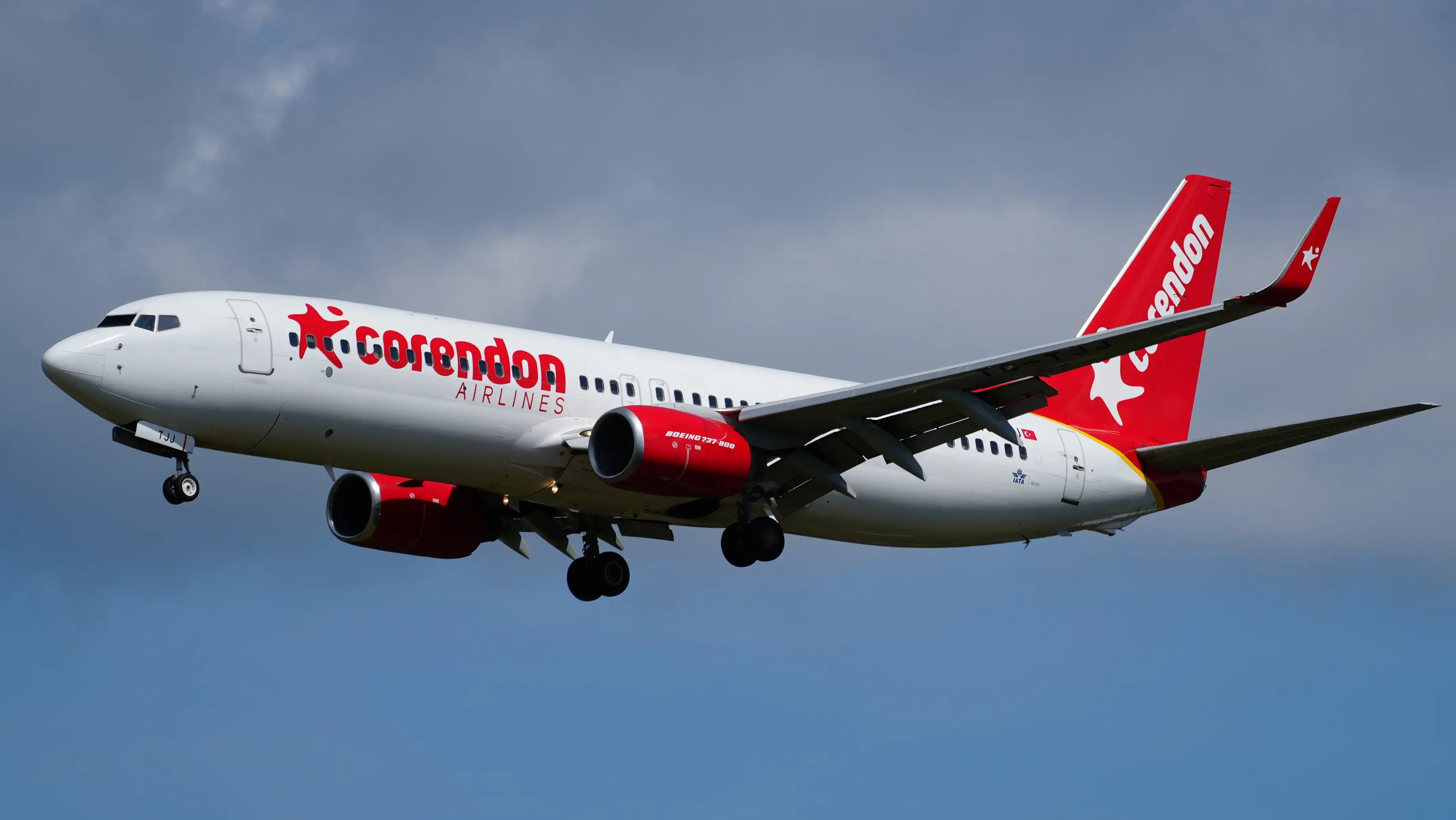
Corendon operates an all-Boeing 737 fleet across all three AOCs. This single-type strategy keeps training costs low and allows pilots to move between subsidiaries without needing a new type rating. The fleet is composed of two variants: the older but proven Boeing 737-800 (NG) and the newer, more fuel-efficient Boeing 737 MAX 8. Corendon became the first Boeing 737 MAX operator in Turkey when it took delivery of its first MAX 8 in May 2018. The Dutch subsidiary also operates the Boeing 737 MAX 9, taking delivery of its first unit in September 2023.
In addition to its own fleet, Corendon Dutch Airlines operates a wet-leased Airbus A350-900 from Spanish carrier World2Fly for long-haul services to Curacao and Bonaire in the Caribbean. This aircraft is not crewed by Corendon pilots.
| Airline | Aircraft Type | Approx. In Service | Notes |
|---|---|---|---|
| Corendon Airlines (Turkey) | Boeing 737-800 | ~12 | Workhorse of the Turkish operation. 189 pax config. |
| Corendon Airlines (Turkey) | Boeing 737 MAX 8 | ~5-6 | Newer deliveries replacing older 737-800s. |
| Corendon Airlines Europe (Malta) | Boeing 737-800 / MAX 8 | ~15 | Serves European bases (Germany, Belgium, Greece). |
| Corendon Dutch Airlines (NL) | Boeing 737 MAX 9 | 3 | Replaced 737-800s from late 2023. Amsterdam base. |
| Corendon Dutch Airlines (NL) | Airbus A350-900 (wet-lease) | 1 | World2Fly crew. Caribbean routes only. |
Fleet data as of early 2026. Exact numbers fluctuate with seasonal leases and sub-leases (e.g., 5 aircraft were leased to IndiGo until March 2026).
The group has historically retired older types as the fleet modernised. Former types include the Boeing 737-300, 737-400, Airbus A320, A321, and even a single A330-300 used briefly for charter work. No public orders for additional aircraft have been announced, but the airline is reportedly evaluating future narrowbody and widebody additions to support its expansion into long-haul markets.
All Corendon pilots fly the Boeing 737 family. Since the 737-800 (NG) and 737 MAX share the same type rating (B737), pilots can operate both variants. For experienced pilots joining with an existing B737 type rating, Corendon provides a company conversion course (ground school, simulator sessions, and supervised line flying) at no cost to the pilot. For trainee First Officers without a type rating, the airline offers a self-sponsored pathway through Global Aviation Training in Madrid, where candidates complete their B737 type rating before joining the line.
Pilot Salary & Compensation Breakdown
Pilot compensation at Corendon is structured around a base salary plus a per-block-hour (BLH) rate, with the exact figures depending on your contract type (Maltese, German, or Turkish). Salary scales are tied to total flight experience on B737 aircraft types and automatically increase as pilots cross experience thresholds. Pilots on the European contracts (Corendon Airlines Europe) are paid in euros, while Turkish-contract pilots receive their salary in Turkish Lira. The salary figures below reflect the European contracts as of February 2025.
First Officer Pay Scale (European Contracts)
| Experience Level | Monthly Base (Maltese) | Monthly Base (German) | BLH Rate |
|---|---|---|---|
| Entry-level F/O | €3,590 | ~€4,500 | €38 (Malta) / €48 (Germany) |
| Mid-experience F/O | ~€4,800 | ~€5,700 | €38 (Malta) / €48 (Germany) |
| Senior F/O | ~€6,160 | ~€6,900 | €38 (Malta) / €48 (Germany) |
Base salary increases with accumulated B737 flight hours. With ~75 block hours per month on average, total monthly gross earnings for a senior F/O on a German contract can reach approximately €10,000.
Captain Pay Scale (European Contracts)
| Experience Level | Monthly Base (Maltese) | Monthly Base (German) | BLH Rate |
|---|---|---|---|
| Entry Captain | €6,500 | ~€7,800 | €50 (Malta) / €62 (Germany) |
| Captain, 3+ yrs seniority | ~€8,500 | ~€9,500 | €50 (Malta) / €62 (Germany) |
| Senior Captain | ~€10,400 | ~€11,200 | €50 (Malta) / €62 (Germany) |
A Captain on a German contract flying 75 block hours per month can expect approximately €12,000 to €16,000 gross monthly including base and block-hour pay.
These figures are compiled from Corendon's published pilot FAQs and recruitment materials (Maltese and German contract versions). Actual take-home pay depends on the applicable tax regime: Maltese contracts benefit from relatively low personal income tax rates, while German contracts carry higher social charges but include broader social protections. Turkish-contract pilots are paid in Turkish Lira, which has experienced significant depreciation in recent years, substantially reducing the purchasing power of their earnings when measured in euros. No explicit profit-sharing, signing bonuses, or retention bonuses have been publicly disclosed by Corendon. Always verify current figures directly with the airline's recruitment team.
Roster Pattern & Quality of Life
Corendon Airlines is a leisure carrier, and like most airlines in this segment, its operations are highly seasonal. Summer (April to October) is the peak period, when aircraft utilisation and pilot block hours are at their highest. Winter brings a significant reduction in European holiday traffic, and Corendon has adopted a creative solution: approximately half the fleet is redeployed to India during the low season, where pilots operate on temporary detachment for 35-40 day rotations, typically making 2-3 trips over the winter months.
Average monthly block hours across the full year sit at approximately 75 hours. In summer, this can climb to 80+ hours, while winter months may see as few as 40 hours. The Turkish DGCA (SHGM) and EASA both cap duty time at 100 block hours per 28 consecutive days, and Corendon adheres to whichever regime applies based on the operating AOC.
📅 Sample Month: Summer Season, First Officer (Antalya Base)
Turkish labour law mandates a minimum of 7 days off per month, and Corendon complies with this as a baseline. European-contract pilots may receive slightly different off-day patterns depending on their base country's labour regulations. Rosters are generally organised in blocks (e.g., 4-5 days flying followed by 2-3 days off), though the exact pattern varies with seasonal demand and operational needs. Rosters can change with relatively short notice, which is a common concern among leisure-carrier pilots.
The primary base for Turkish-contract pilots is Antalya, with seasonal operations from Izmir and Ankara. European-contract pilots can be based in Germany (Dusseldorf, Hanover, Cologne), Belgium (Brussels), Greece (Heraklion), or at other locations as the airline establishes new bases. Base assignments are determined by operational needs and are not guaranteed. During the winter low season, pilots should expect temporary detachments to locations like India, where Corendon operates wet-lease services. Living in Antalya is relatively affordable compared to Western European cities, which partially offsets the lower salary scale for Turkish-contract pilots.
Benefits, Travel Perks & Insurance
Corendon's benefits package is modest compared to legacy carriers and even some competing leisure airlines. The airline provides the basics required by law in each jurisdiction, but several benefits that pilots at larger carriers take for granted, such as loss-of-license insurance and company pension schemes, are notably absent from Corendon's publicly documented offerings.
The absence of company-provided loss-of-license (LoL) insurance is one of the most notable gaps in Corendon's benefits package. LoL insurance protects pilots financially if they lose their medical certificate and can no longer fly. At larger carriers like SunExpress, Turkish Airlines, and most European legacy airlines, LoL is included as standard. Corendon pilots should budget for a private LoL policy, which typically costs between €1,000 and €3,000 per year depending on age and coverage level. This is an important factor to weigh when comparing Corendon's total compensation against competitors.
Career Progression & Seniority
Career progression at Corendon is tied primarily to total block-hour experience and company seniority. Unlike some legacy carriers with rigid, decades-long seniority ladders, Corendon's relatively small size and ongoing growth can create faster upgrade opportunities, particularly for pilots willing to join the European operation. The airline accepts direct-entry Captains with sufficient experience, which distinguishes it from carriers like Air France or Lufthansa that promote exclusively from within.
| Career Milestone | Typical Requirements | Notes |
|---|---|---|
| Trainee First Officer | EASA CPL/IR + MCC | Self-sponsored type rating via Global Aviation (Madrid). No minimum hours required. |
| Experienced First Officer | 500+ hrs on B737, 1 yr civil exp. | Company-funded conversion. Most common entry path. |
| Captain (internal upgrade) | ~3+ yrs as F/O, 5,000 hrs total | Must meet experience thresholds and pass command assessment. |
| Captain (direct entry) | 5,000+ hrs total, 2,500 PIC, 1,000 on B737 | Accepted for both Turkish and European AOCs. |
| Training Captain / TRE / TRI | Variable | Separate selection and instructor qualification. |
Salary scales increase automatically as pilots accumulate block hours on the B737. After 3 or more years with the company, Captains move to an enhanced pay scale. The single-type fleet (all B737) means there is no fleet transition process. Whether you fly the 737-800 or the 737 MAX, the type rating and career path remain the same.
Corendon is actively expanding its European presence, with 10 aircraft based in Germany by summer 2026 and new base openings planned. This growth creates demand for both First Officers and Captains. The airline recruits year-round for its European operation and periodically for the Turkish AOC. However, contracts are typically fixed-term (renewable annually or with a set end date, e.g., November 2026), which means long-term job security is less certain than at carriers offering permanent or unlimited contracts. Pilot forums note relatively high turnover at Corendon, partly driven by the fixed-term contract structure and the competitive Turkish pilot market.
Recruitment Process & Requirements
Corendon recruits pilots through two main pathways: experienced pilots (First Officers and Captains with existing B737 type ratings) and trainee First Officers (lower-hour pilots who obtain their type rating through a self-sponsored programme). The experienced pilot path is the more common route, with positions advertised on the Corendon Airlines careers page and third-party aviation job boards.
Experienced First Officer: Requirements
Direct-Entry Captain: Requirements
Selection Stages
Online Application
Submit CV, license with B737 type rating, Class 1 medical, logbook pages, and PBN endorsement via the Corendon careers portal. Applications are reviewed on a rolling basis.
Online Assessment & Interview
Candidates complete an online psychological assessment and a competency-based personal interview (often conducted via video call). Tests may include ATPL knowledge, B737 systems, reasoning, English language, and personality assessments.
Simulator Assessment
A simulator session held in Antalya (Turkey) or Madrid (Spain). Candidates are assessed on flying skills, CRM, decision-making, and handling of non-normal situations on the B737. Travel and accommodation costs to the assessment location are borne by the candidate.
HR Interview & Final Review
A face-to-face or video HR interview focusing on motivation, cultural fit, and career expectations. Corendon reimburses up to €200 for travel to the interview location for European candidates.
Contract & Conversion Training
Successful candidates receive a fixed-term contract and begin conversion training in Antalya. Training includes ground school, simulator sessions, and supervised line flying. Accommodation and meals are provided during the training period.
For pilots without a B737 type rating, Corendon offers a Trainee First Officer programme. This is a self-sponsored pathway: candidates must hold at least an EASA CPL/IR (multi-engine) and fund their own type rating through Global Aviation Training in Madrid. Upon successfully completing the type rating, base training, and line training, trainees are offered employment with Corendon Airlines Europe. No minimum flight hours are required beyond the CPL/IR, making this an accessible path for lower-hour pilots. However, the self-funded nature of the type rating (typically €25,000-€35,000) means this is a significant financial commitment.
Turkey vs. Europe: Two Contracts, One Airline
One of the most distinctive features of Corendon as an employer is its dual-contract structure. Because the airline operates under three separate AOCs (Turkish, Maltese, and Dutch), pilots can be employed under fundamentally different legal, tax, and regulatory frameworks while flying the same aircraft types on overlapping route networks. Understanding these differences is critical for any pilot evaluating a position with Corendon.
| Factor | Turkish Contract (Corendon Airlines) | European Contract (Corendon Airlines Europe) |
|---|---|---|
| Employment law | Turkish Labour Code | Maltese or German labour law |
| Salary currency | Turkish Lira (TRY) | Euro (EUR) |
| Tax regime | Turkish income tax + SGK contributions | Maltese or German income tax + social contributions |
| FTL regulation | Turkish DGCA (SHGM): 100 hrs / 28 days | EASA FTL: 100 hrs / 28 days |
| Primary base | Antalya (AYT) | Germany, Belgium, Greece, Malta, or other |
| Contract type | Fixed-term (annual renewal) | Fixed-term (e.g., to Nov 2026) |
| F/O BLH rate | Lower (TRY-denominated) | €38 (Malta) / €48 (Germany) |
| Captain BLH rate | Lower (TRY-denominated) | €50 (Malta) / €62 (Germany) |
| Health insurance | Turkish SGK (statutory) | Maltese/German statutory system |
| Loss of License | Not provided | Not provided |
| Pension | Turkish SGK pension | Maltese/German statutory pension |
| Union representation | No formal pilot union | No specific pilot union identified |
| Base flexibility | Mainly Antalya; seasonal Izmir, Ankara | Bases shift with operational needs |
| Winter operations | India detachments (35-40 day rotations) | May also include India detachments |
For most foreign pilots (non-Turkish nationals), the European contract via Corendon Airlines Europe is the more attractive and accessible option. It offers euro-denominated pay, clearer tax treatment, and the protections of EU labour law. The German contract in particular provides the highest block-hour rates (€48/BLH for F/Os, €62/BLH for Captains) and access to Germany's comprehensive social security system, though at the cost of higher tax deductions.
The Maltese contract offers lower base salary figures but benefits from Malta's comparatively low personal income tax rates, which can result in higher net take-home pay depending on individual circumstances. Turkish-contract pilots face the additional challenge of currency risk: the Turkish Lira has depreciated significantly against the euro in recent years, eroding the real purchasing power of TRY-denominated salaries.
The best contract depends on your personal situation. If you are a Turkish national based in Antalya with low living costs, the Turkish contract may work well despite the lower nominal pay. If you are an EU citizen seeking euro-denominated stability, the German or Maltese contracts are generally preferable. Consider factors like tax residency, currency exposure, social security contributions, and where you plan to live. Speaking with a tax advisor familiar with aviation employment across multiple jurisdictions is strongly recommended before signing.
How Corendon Compares: Airline Radar Chart
How does Corendon stack up against its two closest Turkish-market competitors: SunExpress (the Antalya-based joint venture between Turkish Airlines and Lufthansa) and Pegasus Airlines (Turkey's largest low-cost carrier, based in Istanbul)? Below is a comparative analysis across five key metrics for pilots evaluating their options in the Turkish aviation market.
Key Takeaways from the Comparison
Salary: SunExpress and Pegasus lead. SunExpress Captains earn €9,200 to €10,400 gross monthly on full-time rosters plus retention bonuses of €30,000 over two years, while Pegasus reportedly pays Captains around €8,000 net monthly including sector pay during high season and offers A320 Captain packages of €12,000-€15,000 net. Corendon's European-contract Captains can reach similar gross figures (€12,000-€16,000 including BLH pay), but the base salary is lower and there are no retention bonuses.
Work-life balance: All three are demanding. Leisure and LCC operations in Turkey are known for intensive summer schedules. SunExpress reportedly pushes 130-160 duty hours per month in peak season. Pegasus has faced criticism on pilot forums for roster instability and fatigue concerns. Corendon's 75-hour average is moderate, but the winter India detachments and fixed-term contracts add uncertainty.
Fleet: Pegasus has the edge in size, Corendon in simplicity. Pegasus operates over 100 Airbus A320-family aircraft with one of the youngest fleets in Turkey (average age ~5.8 years). SunExpress is expanding to 85 aircraft by summer 2025 (B737 fleet). Corendon's 35-38 aircraft fleet is smaller but the all-B737 strategy keeps things operationally simple.
Benefits: SunExpress wins clearly. SunExpress provides union-negotiated benefits including loss-of-license insurance via TALPA (Turkish Airline Pilots' Association), retention bonuses, and more structured leave policies. Pegasus offers medical insurance and sector bonuses. Corendon's benefits package is the thinnest of the three, with no LoL insurance, no retention bonus, and no identified union representation.
Job security: Mixed across all three. SunExpress, backed by Turkish Airlines and Lufthansa, offers the strongest institutional stability. Pegasus is publicly listed and profitable but has experienced significant pilot turnover. Corendon's fixed-term contracts and smaller scale create more uncertainty, though the airline's growth trajectory is positive.
Scores are editorial estimates based on publicly available salary data, pilot recruitment brochures, pilot forum discussions (PPRuNe, PilotJobsNetwork), airline press releases, and industry benchmarks. They represent a general assessment for an experienced B737 pilot considering a career in the Turkish aviation market. Individual experiences vary based on contract type, seniority, and base. Scores will be updated as dedicated guides are published for SunExpress and Pegasus.
Verdict: Who Is Corendon Airlines For?
🎯 Our Take
Corendon Airlines is a growing leisure carrier that offers a straightforward entry point into commercial aviation on the Boeing 737 family. The dual-contract structure (Turkish and European) provides flexibility for pilots with different nationalities and tax situations. Euro-denominated European contracts with German block-hour rates of up to €62/BLH for Captains represent reasonable compensation for a mid-size leisure airline, and the company-funded conversion training for experienced pilots removes a major financial barrier.
The trade-offs are significant. Fixed-term contracts create job insecurity. The absence of loss-of-license insurance and a dedicated pension scheme puts Corendon behind competitors like SunExpress. The seasonal nature of the operation, including winter detachments to India, demands lifestyle flexibility. No formal pilot union means less collective bargaining power. And pilot forums consistently mention relatively high turnover as an indicator of working conditions.
For B737-rated pilots looking to build hours quickly in a growing airline environment, particularly those early in their career or those seeking European contract options, Corendon can serve as a solid stepping stone. For pilots seeking long-term career stability and comprehensive benefits, larger carriers in the region may be a better fit.
1 Does Corendon pay for the type rating?
For experienced pilots who already hold a B737 type rating, Corendon covers the cost of company conversion training (ground school, simulator, and line training). For trainee First Officers without a type rating, the programme is self-sponsored: candidates fund their own B737 type rating through Global Aviation Training in Madrid before joining the airline. No training bond has been publicly reported for either pathway.
2 What is the minimum flight experience to join as a First Officer?
Experienced First Officers need a minimum of 500 hours on the B737 (CL/NG/MAX) and at least one year of civil airline experience. Trainee First Officers need only an EASA CPL/IR (multi-engine) with no minimum flight hours, but must complete a self-funded type rating before starting line operations.
3 Are contracts permanent or fixed-term?
Corendon offers fixed-term contracts, which are renewable based on performance and operational needs. Turkish contracts are typically renewed annually. European contracts have set end dates (e.g., November 2026). There is no guarantee of renewal, and this is one of the most common concerns raised by pilots considering Corendon.
4 Can non-Turkish pilots apply?
Yes. Corendon Airlines Europe (Maltese AOC) actively recruits non-Turkish pilots. EU passport holders are eligible for European contracts. Non-EU pilots may need a work permit for the Turkish AOC. The European operation is the primary pathway for foreign pilots, with bases in Germany, Belgium, Greece, and Malta.
5 What happens during the winter low season?
European holiday traffic drops significantly in winter. Corendon redeploys approximately half its fleet to India for wet-lease operations. Pilots may be assigned to 35-40 day rotations in India, typically making 2-3 trips over the winter months. Block hours in winter can drop to around 40 per month (compared to 80+ in summer), which directly affects earnings since a significant portion of pay comes from block-hour rates.
6 Is there loss-of-license insurance?
No. Corendon does not provide loss-of-license (LoL) insurance for its pilots. This is a notable gap compared to competitors like SunExpress, which negotiates LoL coverage through the TALPA union. Pilots at Corendon are strongly advised to arrange private LoL insurance independently, at an annual cost of roughly €1,000 to €3,000 depending on age and coverage level.
7 How does the Maltese contract compare to the German contract?
The German contract offers higher base salaries and block-hour rates (€48/BLH for F/Os vs. €38 on the Maltese contract) but comes with higher tax and social security deductions. The Maltese contract has lower gross figures but benefits from Malta's lower income tax rates. Net take-home pay can end up similar depending on individual tax circumstances. The German contract also provides access to Germany's comprehensive social security system, including stronger employment protections.
8 What are the main pilot bases?
For the Turkish AOC, the primary base is Antalya (AYT), with seasonal operations from Izmir and Ankara. For the European operation, current bases include Dusseldorf, Hanover, and Cologne in Germany, Brussels in Belgium, and Heraklion in Greece. Bases can shift depending on commercial needs, and the airline is expanding its German presence with plans for 10 aircraft based in the country by summer 2026. Base preferences can be expressed but are not guaranteed.
Official Links & Resources
Before applying or making any career decisions, always verify information directly with official sources. These are the key websites and organisations relevant to Corendon pilot careers:
Before applying, download and read both the Maltese contract FAQ and the German contract FAQ from Corendon's recruitment pages. These documents contain the most detailed and up-to-date salary scales, base options, and contractual terms. Cross-reference with pilot discussion threads on PPRuNe for real-world pilot experiences and feedback.