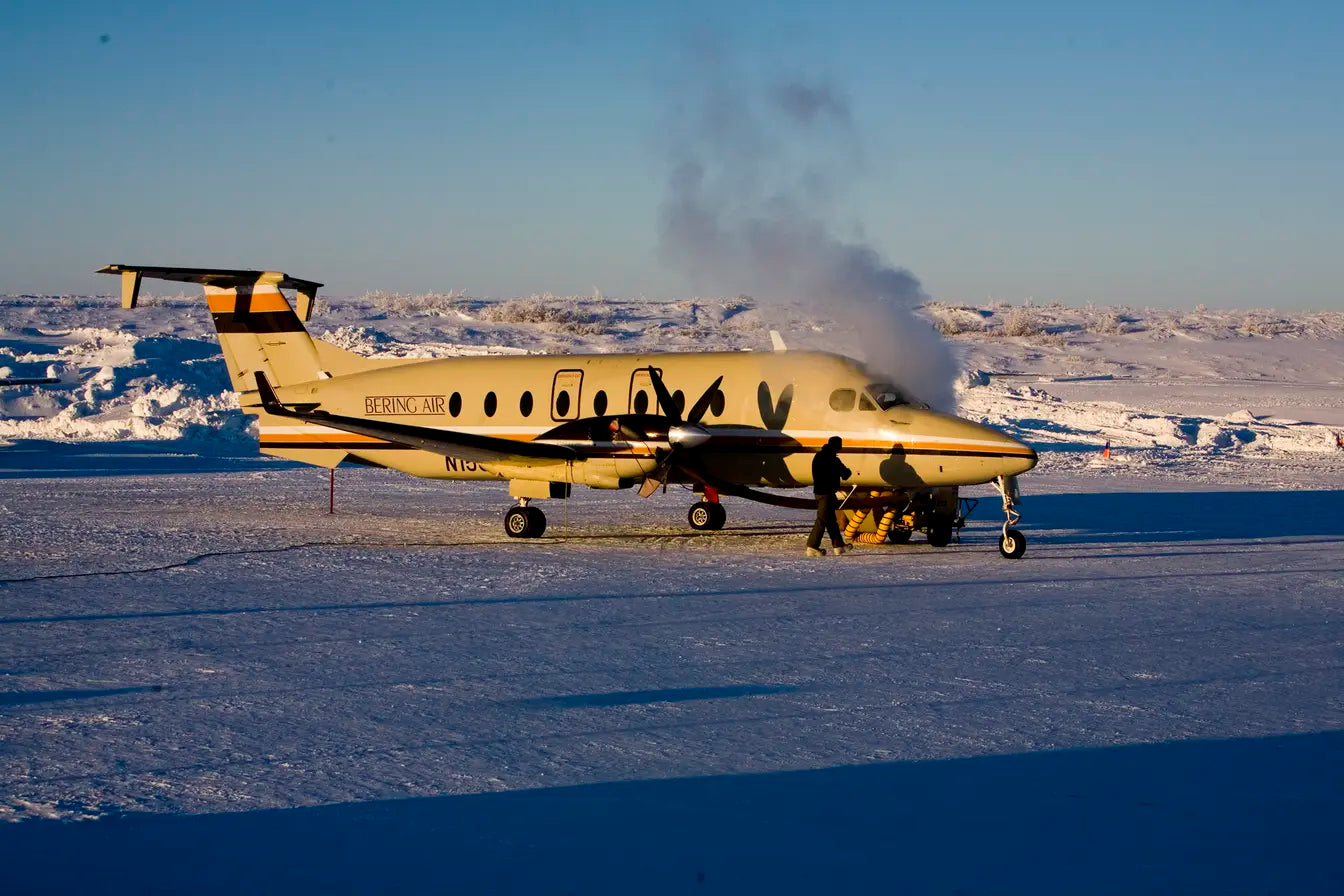
Bering Air Overview & Company Profile
Bering Air is an independently owned regional airline headquartered in Nome, Alaska, providing essential air transportation to some of the most remote communities in the United States. Founded on October 3, 1979, by Jim and Christine Rowe, the airline has grown from a single De Havilland Canada DHC-3 Otter into a fleet of approximately 39 aircraft serving 32 communities across western Alaska. In a state where roughly 82% of communities are not connected to the road system, Bering Air fills a role that goes far beyond commercial aviation: it is a lifeline.
The airline operates from three hubs: Nome (its headquarters), Kotzebue (26 miles north of the Arctic Circle), and Unalakleet on the southern coast of the Seward Peninsula. Together, these bases support approximately 66 daily flights carrying passengers, cargo, mail, and medical evacuations across an enormous swath of Arctic and sub-Arctic territory. Bering Air employs roughly 150 people in total, including its pilot corps, mechanics, dispatchers, and ground staff. The airline is also notable for its helicopter division, established in 1998, and for operating charter flights to the Russian Far East since 1988, when Jim Rowe personally piloted the first crossing from Nome to Provideniya.
In July 2020, Bering Air acquired operational facilities in Aniak, Kotzebue, Nome, and Unalakleet from Ravn Alaska's bankruptcy auction, significantly expanding its infrastructure. The airline participates in the Medallion Foundation Safety Program and is a member of the Alaska Air Carriers Association, reflecting its commitment to operational standards in one of the world's most challenging flying environments.
Fleet Composition & Aircraft Types
Bering Air operates one of the most diverse fleets among Alaska bush carriers, carefully selected to match the operational realities of remote Arctic flying. The fleet ranges from single-engine turboprops for village-hopping to twin-engine aircraft for higher-capacity routes, dedicated cargo haulers, air ambulance platforms, and a full helicopter division. In 2015, Bering Air placed the largest order for new aircraft by any Alaskan bush carrier: nine brand-new Cessna 208EX Grand Caravans, featuring 867-horsepower engines (up from 675 hp on older models), Garmin G1000 avionics with synthetic vision, TCAS, GPWS, and enhanced de-icing systems. More recently, the airline introduced the Cessna 408 SkyCourier in freighter configuration starting August 2025, doubling cargo payload capacity compared to the standard Caravan.
| Aircraft Type | Role | In Service | Notes |
|---|---|---|---|
| Cessna 208EX Grand Caravan | Scheduled pax / cargo | ~17 | Backbone of fleet. 9 pax. Garmin G1000 avionics, enhanced de-icing. Largest fleet type. |
| Cessna 408 SkyCourier | Cargo (freighter) | 4 | Newest addition (Aug 2025). Twin-engine, 3x LD3 capacity. Pratt & Whitney PT6A engines. |
| Beechcraft 1900D | Combi (pax + cargo) | 4 | 19-seat capacity. Used on busier routes requiring maximum payload. |
| Beechcraft King Air 200 | Air ambulance / medevac | 4 | Dedicated medical evacuation. Pressurized cabin for patient transport. |
| Piper PA-31 Navajo | Scheduled pax | 4 | 9 pax. Legacy fleet type. Dual-qualified with Caravan pilots. |
| Casa 212-200 | Cargo | 2 | Large-volume freight. Oversized cargo, building materials, consolidated shipments. |
| Airbus AS350 B3 (H125) | Helicopter | 2 | All-season ops. Pilot + 5 pax. Long-line capable for remote logistics. |
| Bell UH-1H (Huey) | Helicopter | 2 | Completely refurbished. Max engine power. Heavy-lift external loads. |
| MD 500E | Helicopter | 3 | External sling loads up to 1,100 lbs. Light/medium-duty operations. |
| Robinson R44 Raven II | Helicopter | 3 | 3 pax. Scenic tours, light transport, field surveys. |
Fleet data as of late 2025. Numbers are approximate and change with ongoing deliveries and operational adjustments.
Bering Air's investment in brand-new Cessna 208EX Grand Caravans represented a significant commitment to safety and performance. The newer engines deliver 28% more horsepower than older models, enabling shorter takeoff rolls, faster climbs, and improved performance in icing conditions. The Garmin G1000 glass cockpit replaced legacy analog gauges, giving pilots moving map displays, synthetic vision for terrain awareness, and integrated traffic and ground proximity warnings. Single-point refueling systems also speed up turnarounds at remote village strips. The airline has described this as the largest new-aircraft order by any Alaskan bush carrier.
Pilot Salary & Compensation
Bering Air positions itself as the best-paying bush carrier in Alaska, and multiple industry sources and pilot forums support this claim. The airline explicitly advertises "industry leading pay" in its recruitment materials, and experienced Alaska bush pilots consistently rank Bering Air at or near the top for compensation among Part 135 operators in the state. According to salary aggregator data from early 2025, the average Bering Air pilot earns approximately $189,000 per year, with a range spanning roughly $107,000 for line pilots to over $200,000 for senior captains. Compensation is structured as a combination of base pay, flight-hour rates, per diems, and yearly raises tied to seniority.
Estimated Pay Ranges by Position
| Position | Annual Gross (est.) | Hourly Rate (est.) | Notes |
|---|---|---|---|
| Captain (C208 Caravan) | $160,000 - $206,000 | ~$75 - $100/hr | Most common PIC position. Dual-qual with Navajo typical. |
| Captain (BE200 King Air) | $170,000 - $210,000+ | ~$80 - $105/hr | Air ambulance operations. Higher pay reflects medevac responsibility. |
| Captain (B1900D / C408) | $165,000 - $210,000+ | ~$80 - $100/hr | Multi-engine combi or cargo operations. |
| First Officer (B1900D / C212 / C408) | $85,000 - $120,000 | ~$45 - $60/hr | Entry-level multi-engine position. Upgrade path to PIC. |
Figures are estimates compiled from salary aggregators (Salary.com, Indeed), pilot forums, and recruitment postings. Actual compensation depends on aircraft type, schedule choice, seniority, and flight hours logged.
Bering Air does not publicly disclose detailed pay scales. The figures above are compiled from third-party salary data, pilot forum discussions, and job posting details. Individual compensation will vary based on schedule selection (15/15 vs. 20/10), aircraft assignment, seasonal flying volume, and seniority. The per diem rate has been reported at approximately $25/day. Alaska has no state income tax, which effectively increases take-home pay compared to pilots earning similar gross salaries in states with income tax. Always verify current compensation directly with Bering Air's chief pilot during the interview process.
Roster Pattern & Quality of Life
Bering Air offers more scheduling flexibility than most Alaska bush operators, which is one reason the airline consistently ranks high for pilot retention. Captain positions come with a choice of rotation patterns, while first officers typically follow a structured initial training schedule before transitioning to their preferred rotation. All pilots should expect to work 20 days per month during their first three months while completing training, qualification checkrides, and Initial Operating Experience (IOE).
After qualification (typically around month three), captains choose from the following schedule options:
📅 Sample Month: Caravan Captain, 20/10 Rotation (Nome Base)
The Nome base functions as a full-time operation where pilots can live locally and work more conventional weekly patterns. The Kotzebue base operates on a more traditional bush rotation model, where pilots commute in for their working block and return home for their off days. Unalakleet serves as the third base, primarily supporting eastern Norton Sound communities. Pilots on 15/15 or 20/10 rotations often commute from Anchorage, Fairbanks, or even the lower 48 states during their off periods.
These are small, remote Alaskan communities with limited amenities. Nome has approximately 3,600 residents, a handful of restaurants, basic retail, and no road connections to the rest of Alaska. Kotzebue (population ~3,200) sits above the Arctic Circle and experiences extreme seasonal darkness in winter and 24-hour daylight in summer. Temperatures range from -30°F in winter to +65°F in summer. Entertainment options are minimal compared to larger cities. However, the natural environment is spectacular, and many bush pilots find deep satisfaction in the unique lifestyle. Bering Air reportedly provides housing assistance or company-provided accommodations for pilots at remote bases, though specifics should be confirmed during the hiring process.
Benefits, Perks & Retirement
As a private Part 135 operator in remote Alaska, Bering Air's benefits package is more modest than what legacy carriers or major airlines offer. However, for the bush aviation segment, the airline provides a competitive package that addresses the essential needs of pilots living and working in some of the most isolated communities in the United States. The combination of strong base pay, Alaska's zero state income tax, and the unique lifestyle perks of Arctic flying create a compelling overall value proposition.
Alaska's lack of state income tax is a significant financial advantage for pilots. A pilot earning $180,000 in Nome keeps substantially more than a pilot earning the same gross salary in a state like California (13.3% top rate) or New York (10.9% top rate). Combined with the relatively low cost of living outside Anchorage (though goods are expensive in remote villages), Alaska-based bush pilots often find their effective compensation competitive with pilots at much larger carriers when all factors are considered. The Permanent Fund Dividend, paid annually to Alaska residents, provides an additional $1,000 to $2,000+ per year depending on fund performance.
Career Progression & Upgrade Path
Career progression at Bering Air follows the typical Alaska bush aviation model, where pilots build experience on smaller or multi-crew aircraft before upgrading to single-pilot PIC operations on the Caravan or Navajo. The airline does not operate on a strict seniority list like legacy carriers. Instead, upgrades are based on a combination of experience, proficiency, and operational need. The chief pilot and check airmen evaluate readiness for progression, and the relatively small pilot group means that upgrade opportunities can arise faster than at larger Part 121 carriers.
| Career Milestone | Typical Timeline | Notes |
|---|---|---|
| Hired as First Officer (B1900D / C212 / C408) | Day 1 | Entry position for pilots meeting 500-hour minimum. Multi-crew operations. |
| Initial training & IOE | ~3 months | 20 days/month during qualification. Sim training, aircraft systems, line checks. |
| Upgrade to Caravan PIC | 1 - 3 years | Requires ATP certificate, 3,000 TT, 1,000 hrs Alaska time. Single-pilot ops. |
| Dual qualification (Caravan + Navajo) | After Caravan PIC | Bering Air cross-qualifies most captains on both types for operational flexibility. |
| King Air 200 Captain (medevac) | 3 - 5+ years | Senior position. Air ambulance operations require additional training and experience. |
| Check Airman / Training Pilot | Variable | Selected by chief pilot based on demonstrated proficiency and instructional ability. |
For many pilots, Bering Air serves as either a long-term career destination within Alaska bush flying or as a stepping stone toward Part 121 regional and mainline carriers. The multi-engine PIC time, instrument experience in challenging weather, and single-pilot turbine operations built at Bering Air are highly valued by regional airlines recruiting from the bush pipeline. Pilots who prefer to stay in Alaska find that Bering Air offers the highest pay and best equipment among bush operators, making it a natural top-of-the-ladder position within the state's Part 135 ecosystem.
The traditional career path for Alaska bush pilots starts at smaller operators flying Cessna 206/207 piston singles on gravel strips, progresses to turbine singles (Caravan, Pilatus) at mid-tier carriers, and peaks at carriers like Bering Air flying Caravans, Navajos, King Airs, and 1900s. From there, pilots often transition to Alaska Airlines, major Part 121 regionals, or remain in the bush long-term. Bering Air's reputation as the premium bush employer means it attracts experienced pilots from across the Alaska aviation community, and the airline's dual-qualification policy gives captains diverse flying experience that translates well to any future career move.
Recruitment Process & Requirements
Bering Air recruits pilots through its careers page and through direct application to the chief pilot via email (jobs@beringair.com). The airline seeks experienced pilots who are comfortable operating in Alaska's demanding environment, where weather conditions, remote airstrips, and extreme temperatures create challenges rarely encountered in lower-48 flying. Unlike many Part 121 carriers, there is no formal multi-stage selection process with assessment centers. Applications are reviewed by the chief pilot, and suitable candidates are typically invited for an interview and evaluation.
Captain Requirements
First Officer Requirements
Helicopter Pilot Requirements
Hiring Process
Application Submission
Submit resume and application via the Bering Air careers page or by emailing jobs@beringair.com. Include total flight time, certificates held, Alaska experience, and aircraft type experience.
Chief Pilot Review & Interview
The chief pilot reviews applications and contacts qualified candidates for an interview. This may be conducted by phone, video, or in person in Nome. Expect questions about Alaska flying experience, weather decision-making, and single-pilot resource management.
Pre-Employment Drug Testing
All pilot positions are safety-sensitive under FAA regulations. Negative results required for marijuana, cocaine, opiates, PCP, and amphetamines before employment can begin.
Training & Qualification (First 3 Months)
New hires work 20 days/month during the initial period, completing simulator training (if applicable), aircraft systems training, qualification checkrides, and IOE flights under supervision of a check airman. After qualification, pilots transition to their chosen schedule.
Bering Air values real-world Alaska experience above all else. Prior bush flying on gravel strips, float plane time, mountain flying in marginal weather, and demonstrated judgment in no-go decisions all carry significant weight. The airline's strict non-smoker requirement reflects both the confined cockpit environment of small aircraft and the health considerations of operating in remote locations with limited medical access. Pilots who have spent at least one full season in Alaska, either flying or living in the state, have a clear advantage in the hiring process.
How Bering Air Compares: Airline Radar Chart
How does Bering Air measure up against other Alaska bush and regional operators? Below is a comparative analysis against Grant Aviation (a Part 135 operator serving southwestern and western Alaska since 1971) and Ravn Alaska (the former largest rural Alaska carrier, which permanently ceased operations in August 2025). Scores reflect editorial estimates based on publicly available data, pilot forum discussions, and industry benchmarks.
Key Takeaways from the Comparison
Bering Air leads on salary. With average pilot earnings around $189,000 and captain pay reaching over $200,000, Bering Air significantly outpaces Grant Aviation (where Indeed data suggests averages around $37,000, though this likely reflects part-time or seasonal positions) and exceeded Ravn Alaska's compensation before that carrier's shutdown. Multiple pilot forum discussions confirm that Bering Air is consistently recognized as the best-paying bush operator in Alaska.
Fleet quality favors Bering Air. The investment in brand-new Cessna 208EX Caravans and the recent introduction of Cessna 408 SkyCourier cargo aircraft sets Bering Air apart. Grant Aviation operates a capable but older fleet, while Ravn Alaska struggled with fleet maintenance and lease issues that ultimately contributed to its closure. Bering Air's diverse fleet (fixed-wing and helicopter, piston and turbine, single and multi-engine) provides pilots with broader experience than most competing operators.
Job security is stronger at Bering Air. As a privately held, family-owned business with 45+ years of continuous operation and no debt-driven ownership changes, Bering Air has demonstrated remarkable stability. Ravn Alaska's permanent shutdown in August 2025, after years of financial distress including a 2020 bankruptcy, illustrates the vulnerability of Alaska regional carriers. Grant Aviation, while stable, operates on a smaller scale. Bering Air's acquisition of Ravn facilities in 2020 further consolidated its market position.
Work-life balance is the trade-off. All Alaska bush flying positions require significant time in remote communities with limited amenities, extreme weather, and challenging living conditions. Bering Air's scheduling flexibility (multiple rotation options) gives it an edge, but no bush carrier can match the lifestyle offerings of lower-48 carriers or urban-based operations. This is the fundamental trade-off of Alaska bush aviation.
Scores are editorial estimates based on publicly available salary data, pilot forum discussions (Airline Pilot Central, JetCareers, Backcountry Pilot), airline websites, and industry context. Ravn Alaska scores reflect its operational state before the August 2025 shutdown. Grant Aviation salary data from Indeed may underrepresent full-time captain compensation. Individual pilot experiences will vary significantly based on base assignment, aircraft type, seniority, and personal priorities.
Safety Record & Industry Context
Any honest assessment of Bering Air must address the inherent risks of Alaska bush flying and the airline's safety history. Operating in western Alaska means contending with some of the harshest flying conditions on Earth: extreme cold, whiteout conditions, severe icing, rapidly changing weather, unprepared or poorly maintained airstrips, and vast distances from emergency services. These factors create a safety environment fundamentally different from scheduled airline operations in the lower 48 states.
On February 6, 2025, Bering Air Flight 445, a Cessna 208B Grand Caravan (registration N321BA, manufactured in 2020), crashed onto sea ice in Norton Sound while en route from Unalakleet to Nome. All ten occupants, one pilot and nine passengers, were killed. The NTSB's preliminary report, released in March 2025, found that the aircraft departed overweight by approximately 1,058 pounds for icing conditions and over 800 pounds for normal conditions. Ice accumulation was found on the tail of the recovered aircraft. In the final moments of the flight, airspeed decreased to approximately 70 knots at 3,100 feet before radar contact was lost. The investigation is focusing on Bering Air's ground operations and cargo loading practices.
Prior to the 2025 accident, Bering Air's recorded incident history includes a December 1987 Cessna 207 crash in mountainous terrain during bad weather (pilot fatality), a January 1993 Mitsubishi MU-2 accident due to fuel starvation, a December 1995 Beechcraft G18S in-flight fire, a March 2003 Cessna 208 crash into sea ice in whiteout conditions, and several other incidents of varying severity over its 45+ year operating history.
Alaska has the highest per-capita rate of aviation accidents in the United States. The combination of vast distances, lack of road infrastructure, extreme weather, mountainous terrain, and reliance on small aircraft creates inherent risk that cannot be fully eliminated. The NTSB has long identified Alaska aviation as a priority focus area. Bering Air participates in the Medallion Foundation Safety Program and is a member of the Alaska Air Carriers Association, both of which promote safety standards above FAA minimums. Prospective pilots should approach bush flying with clear-eyed awareness of these risks. The February 2025 accident serves as a stark reminder that operational discipline, particularly around weight and balance, remains a critical safety factor.
Bering Air does not appear to have formal pilot union representation. Pilot working conditions, compensation, and safety concerns are managed through direct company-pilot relationships rather than collective bargaining agreements. The absence of union representation is typical among Alaska Part 135 operators, where small pilot groups and high turnover rates have historically complicated unionization efforts. The Air Line Pilots Association (ALPA) maintains industry-wide safety advocacy but does not represent Bering Air pilots specifically.
Verdict: Who Is Bering Air For?
🎯 Our Take
Bering Air is widely regarded as the top bush flying employer in Alaska. The combination of the highest pay in the bush segment (averaging ~$189,000 for pilots, with captains exceeding $200,000), a modern and diverse fleet featuring brand-new Cessna Caravan EX aircraft and Garmin G1000 avionics, flexible scheduling options (15/15, 20/10, or custom rotations), and 45+ years of continuous family-owned operations makes it the premium destination for experienced Alaska bush pilots.
The trade-offs are significant and should not be minimized. Living in Nome, Kotzebue, or Unalakleet means accepting extreme isolation, harsh winter conditions, limited social and entertainment options, and distance from family and friends. The February 2025 Flight 445 accident, which killed all ten people aboard, underscores that bush flying in Arctic Alaska carries real, life-threatening risks that are substantially higher than in most other aviation environments. Benefits, while adequate, cannot match the comprehensive packages offered by major airlines or legacy carriers. There is no pilot union representation, and career progression beyond Alaska requires transitioning to a different type of operator.
For pilots who thrive on challenging flying, who value the independence and responsibility of single-pilot turbine operations, and who find meaning in providing essential transportation to communities that have no other access to the outside world, Bering Air offers something truly unique in American aviation.
1 Do I need Alaska flying experience to get hired at Bering Air?
For captain positions, yes. Bering Air requires a minimum of 1,000 hours of Alaska flying or at least one full season of living and flying in Alaska. This reflects the unique challenges of bush operations: unprepared strips, extreme weather, whiteout conditions, and mountain flying that cannot be adequately simulated elsewhere. For first officer positions on multi-crew aircraft (B1900D, C212, C408), Alaska experience is preferred but not strictly mandatory, making the FO role a potential entry point for pilots with strong multi-engine backgrounds.
2 What is the typical upgrade timeline from First Officer to Captain?
Upgrade timelines at Bering Air are not fixed by a rigid seniority system. A first officer who builds hours efficiently, demonstrates strong airmanship, and meets the captain minimums (3,000 TT, ATP, 1,000 hrs Alaska time) could potentially upgrade within 1 to 3 years, depending on operational need and individual proficiency. This is significantly faster than upgrade timelines at Part 121 carriers, where 5 to 15 years is common.
3 Can I commute to Bering Air, or do I have to live in Nome?
Both options are available. The Nome base operates more like a full-time position where local residence is practical, with weekly schedule options (5/2 or 4/3). The Kotzebue base operates on a traditional bush rotation model, making it more commuter-friendly. Pilots on 15/15 or 20/10 rotations commonly commute from Anchorage, Fairbanks, or even the lower 48 during their off blocks. Commercial flights connect Nome and Kotzebue to Anchorage via Alaska Airlines.
4 Why does Bering Air require pilots to be non-smokers?
This is a strict company policy reflecting both health and operational considerations. Bush aircraft have confined cockpits, and pilots operate in remote locations with extremely limited medical infrastructure. Tobacco use is seen as incompatible with the occupational health requirements of the role. This policy applies to all pilot positions and is non-negotiable, regardless of experience level or qualifications.
5 How does Bering Air compare to Alaska Airlines for pilot careers?
These are fundamentally different operations. Alaska Airlines is a Part 121 mainline carrier based in Seattle with structured seniority, union representation (ALPA), comprehensive benefits, and jet equipment (737, A320neo). Bering Air is a Part 135 bush operator with single-pilot turboprop operations in remote Alaska. Bering Air offers faster upgrade times, more autonomy, and competitive pay for Alaska, but cannot match Alaska Airlines' long-term compensation trajectory, retirement benefits, or lifestyle amenities. Many bush pilots use Bering Air as a stepping stone to Alaska Airlines or similar carriers.
6 What happened with the February 2025 crash, and is Bering Air safe?
Bering Air Flight 445 crashed into sea ice in Norton Sound on February 6, 2025, killing all ten occupants. The NTSB preliminary report found the aircraft departed overweight by over 1,000 pounds in icing conditions, with ice accumulation found on the tail. The investigation is ongoing and focusing on the airline's ground operations and cargo loading practices. Alaska bush flying carries inherently higher risk than most aviation environments, and this accident is a serious event. Prospective pilots should research the NTSB investigation findings and assess their own risk tolerance. Bering Air participates in the Medallion Foundation Safety Program and has operated continuously since 1979, but no amount of safety programs can eliminate the fundamental hazards of Arctic bush flying.
7 Does Bering Air provide housing for pilots?
Bering Air has been reported to offer housing assistance or company-provided accommodations at remote bases. However, specific details regarding housing arrangements, allowances, and availability should be confirmed directly with the airline during the interview process. In remote Alaska communities, private rental options are extremely limited and often expensive, so company housing support is an important consideration when evaluating an offer.
8 Is there a pilot union at Bering Air?
No. Bering Air pilots are not represented by a union. This is common among Alaska Part 135 operators, where small pilot groups and high turnover rates have historically made unionization difficult. Compensation, scheduling, and working conditions are negotiated directly between pilots and management. Some pilots view this as a disadvantage (no collective bargaining power), while others appreciate the more flexible, direct relationship with the chief pilot and management team.
Official Links & Resources
Before applying or making career decisions, always verify information directly with official sources. Below are the key websites and organizations relevant to a Bering Air pilot career:
Before applying, spend time on the Airline Pilot Central Forums Bering Air thread and the Backcountry Pilot forums. Current and former Bering Air pilots occasionally share candid insights about pay, schedules, base life, and the day-to-day realities of bush flying in western Alaska. These firsthand accounts are invaluable for setting realistic expectations before committing to a remote Alaska posting.