

Lockheed L-1011-100 History: Program Launch, Development, and Variant Evolution
The Lockheed L-1011 TriStar program originated in the mid-1960s, when American Airlines approached both Lockheed and Douglas seeking a wide-body airliner smaller than the Boeing 747 yet capable of serving high-density transcontinental and transatlantic routes. Although American ultimately chose the Douglas DC-10, the requirement shaped the tri-jet wide-body concept. Lockheed proceeded with its design after securing commitments from other carriers, and on 29 March 1968, a joint announcement by Eastern Air Lines, TWA, and Air Holdings Ltd. covering 144 aircraft officially launched the L-1011 program. The aircraft was named TriStar following an internal contest among Lockheed employees.
Lockheed selected the Rolls-Royce RB211 three-spool turbofan as the sole powerplant for the L-1011, a decision that tied the entire programme to a single engine supplier. The RB211 promised lower noise, higher efficiency, and advanced materials compared with contemporary engines. However, in February 1971, crippling development costs drove Rolls-Royce into receivership, halting L-1011 final assembly and threatening the programme's survival. The British government nationalised Rolls-Royce to keep the RB211 alive, while Lockheed secured a U.S. government loan guarantee to continue operations. Production resumed, but the delay allowed the competing McDonnell Douglas DC-10, powered by the General Electric CF6, to enter commercial service roughly a year ahead of the TriStar.
The base L-1011-1 received FAA type certification in April 1972. Eastern Air Lines began scheduled TriStar service on 30 April 1972 between Miami and New York, and TWA followed on 25 June 1972 on the St. Louis-Los Angeles route. On 25 May 1972, test pilots flew an L-1011 from Palmdale, California, to Washington Dulles using the aircraft's Automatic Flight Control System (AFCS) from takeoff through landing with no manual control input, demonstrating the type's industry-leading autoland and automation capabilities.
While the L-1011-1 excelled on medium-range domestic routes, airlines soon required greater range for transatlantic and longer intercontinental sectors. Lockheed responded by developing the Lockheed L-1011-100, an extended-range derivative that added a centre-section fuel tank and raised the maximum takeoff weight (MTOW) from approximately 430,000 lb (195,000 kg) to around 463,000 lb (210,000 kg). The additional fuel capacity enabled the L-1011-100 to fly roughly 930 miles (1,500 km) farther than the baseline -1, bringing typical range to approximately 3,660 nautical miles (6,780 km). Crucially, existing L-1011-1 airframes could be converted to -100 standard without requiring a new-build aircraft, making the upgrade attractive for current operators.
The L-1011-100 entered airline service in the mid-to-late 1970s. TWA made a formal decision in early 1978 to convert six of its TriStars to L-1011-100 configuration for transatlantic operations from New York JFK to European destinations. Delta Air Lines also operated the -100 and remains notably the only major airline to have flown all five TriStar variants (-1, -100, -200, -250, and -500). Air Canada operated a fleet of L-1011-1/100/150 models alongside later variants. Several carriers across the Middle East and Asia, including airlines with expanding long-haul networks, also benefited from the -100's improved range on routes that the baseline TriStar could not serve economically.
What Distinguishes the Lockheed L-1011-100 from Other TriStar Variants
The L-1011-100 occupied a specific niche between the original L-1011-1 and the later, more capable L-1011-200. While the -100 retained the same Rolls-Royce RB211-22B engines producing approximately 42,000 lbf (187 kN) of thrust each, its range and weight improvements came entirely from additional fuel capacity and structural reinforcement. By contrast, the L-1011-200 introduced higher-thrust RB211-524 engines, offering superior takeoff and climb performance in hot-and-high conditions. The later L-1011-500 featured a shortened fuselage, RB211-524 engines, and further aerodynamic refinements for true intercontinental range.
Key variant identifiers of the Lockheed L-1011-100 include:
- Engines: 3 x Rolls-Royce RB211-22B (approximately 42,000 lbf / 187 kN each), same as the L-1011-1
- Maximum takeoff weight: approximately 450,000-463,000 lb (204,000-210,000 kg), up from 430,000 lb on the -1
- Fuel system: wing tanks plus an additional centre-section fuel tank not present on the base -1
- Range: approximately 3,660 nm (6,780 km), roughly 930 miles greater than the L-1011-1
- Airframe dimensions: identical to the L-1011-1 (length 54.17 m, wingspan 47.34 m, height 16.87 m)
- Conversion availability: existing L-1011-1 airframes could be modified to -100 standard via structural kits and centre-tank installation
The broader L-1011 programme concluded in 1983, with Lockheed having built a total of 250 TriStars across all variants. The type achieved an in-service reliability rate of 98.1% and earned a strong safety reputation. However, the programme's financial losses, stemming from the Rolls-Royce crisis, delayed market entry, and lower-than-projected sales (446 DC-10s were delivered by comparison), led Lockheed to exit the commercial airliner market permanently. The L-1011 TriStar remains the company's final civil transport aircraft.

A Lockheed L-1011 TriStar aircraft in flight, featuring additional Court Line titles. This trijet airliner is known for its distinctive design and was used primarily for commercial passenger services.
Lockheed L-1011-100 Technical Specifications, Systems and Engine Overview
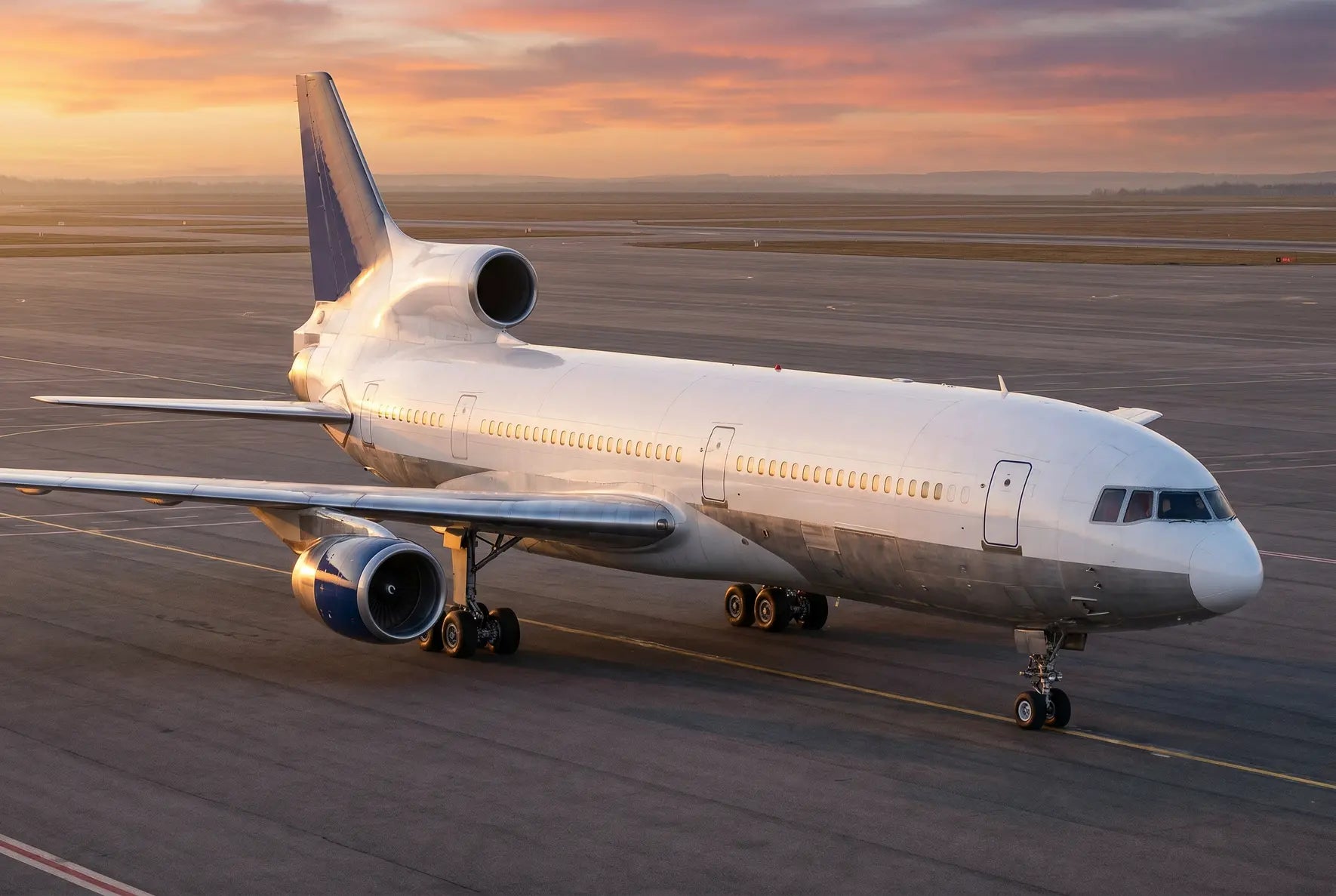
The Lockheed L-1011-100 was an extended-range derivative of the original L-1011-1 TriStar, sharing the same airframe dimensions and three-engine layout but incorporating a critical design change: the addition of a centre-section fuel tank and a higher maximum takeoff weight. This trade-off sacrificed virtually nothing in terms of passenger capacity or airport compatibility while adding roughly 790 nautical miles of range, enough to open viable transatlantic routes for operators such as Delta Air Lines and TWA. The -100 retained the RB211-22B engines of its predecessor rather than moving to a higher-thrust powerplant, meaning the extra capability came entirely from fuel system and structural upgrades.
From a design philosophy standpoint, the L-1011-100 inherited the TriStar family's emphasis on redundancy, automation and passenger comfort. Four independent hydraulic systems, a triple-channel autopilot capable of Category III autoland, and the unique Direct Lift Control (DLC) system were all carried over. These features made the TriStar one of the most technologically advanced widebody airliners of the 1970s and gave the -100 variant a strong operational foundation for its longer-range mission.
- Overall length: 54.17 m (177 ft 8 in)
- Wingspan: 47.35 m (155 ft 4 in)
- Height: 16.87 m (55 ft 4 in)
- Wing area: 329.0 m² (3,541 ft²)
- Typical seating: 256 passengers in two-class layout; up to 400 in high-density configuration
- Maximum takeoff weight (MTOW): 211,374 kg (466,000 lb)
- Operating empty weight (OEW): approximately 111,300 kg (245,400 lb), varying by operator fit-out
- Fuel capacity: approximately 26,502 US gal (100,320 litres), increased from the L-1011-1's 23,814 US gal thanks to the added centre-section tank
- Range (max passengers, reserves): approximately 3,660 nm (6,778 km)
- Maximum cruising speed: Mach 0.84 (approximately 972 km/h / 525 kt at cruise altitude)
- Service ceiling: 13,110 m (43,000 ft)
- Engines: 3 x Rolls-Royce RB211-22B turbofans, each rated at 186.8 kN (42,000 lbf)
Systems, Flight Controls and Automation
The L-1011-100 featured an entirely hydraulically powered flight control system with no manual reversion. All primary surfaces, including ailerons, elevators, rudder, leading-edge slats and trailing-edge flaps, were actuated through four independent hydraulic circuits, providing an unusually high level of redundancy for the era. The triple-channel Automatic Flight Control System (AFCS) enabled fail-operational autoland: three autopilot computers ran simultaneously and cross-monitored each other, so that a single disagreement could be voted out while the approach continued safely. The TriStar was among the first widebody airliners certified for routine Category III landings in near-zero visibility.
A standout feature was the Direct Lift Control system. On final approach with flaps extended beyond 30 degrees, inboard spoiler panels moved to a partially raised neutral position. From there, the AFCS could increase or decrease spoiler deflection to fine-tune the descent rate without significant pitch changes, resulting in remarkably stable approaches appreciated by both crews and passengers. The TriStar also incorporated an early Flight Management System, certified by the FAA in 1977, that offered inertial navigation, Mach/IAS cruise optimisation and an automated descent mode, concepts that only became mainstream in later-generation airliners. Anti-skid braking with touchdown protection rounded out the ground-handling systems, while automatic spoiler deployment on landing improved deceleration and stopping performance.
Published performance figures for the L-1011-100 should always be read with context. Actual range, takeoff field length and payload capability varied significantly depending on operator-specific cabin configuration, passenger load, atmospheric conditions (temperature, altitude, wind), runway surface state and reserve-fuel policy. The MTOW of 466,000 lb and the 3,660 nm range figure assume manufacturer-standard conditions. Airlines operating the -100 on specific routes often worked with performance numbers tailored to their operational requirements and crew training standards, meaning no single number tells the complete story.
The Rolls-Royce RB211-22B: Powering the L-1011-100
The Lockheed L-1011-100 was powered exclusively by three Rolls-Royce RB211-22B high-bypass turbofan engines, each delivering 42,000 lbf (186.8 kN) of takeoff thrust. The RB211 was a landmark powerplant: it introduced Rolls-Royce's signature three-shaft architecture, where the fan, intermediate-pressure compressor and high-pressure compressor each spin on their own concentric shaft at independently optimised speeds. This layout, comprising a single-stage fan, a seven-stage IP compressor, a six-stage HP compressor and corresponding turbine stages, allowed fewer total stages and a shorter, stiffer engine structure compared to contemporary two-shaft designs.
Development of the RB211 began in the late 1960s and was marked by serious challenges. The original fan blades were designed using Hyfil, a carbon-fibre composite, but the material failed bird-strike testing and had to be replaced with solid titanium blades, adding weight, cost and delay. These problems, combined with broader cost overruns, contributed directly to Rolls-Royce's financial collapse and nationalisation in 1971. Despite this turbulent start, the engine entered airline service with the L-1011 in 1972 and proved reliable in operation.
The RB211-22B remained the standard powerplant for the L-1011-1 and the L-1011-100. Later TriStar variants, such as the L-1011-200 and L-1011-500, moved to the more powerful RB211-524B family. The three-shaft architecture pioneered by the RB211 went on to form the basis of the RB211-535E4 (used on the Boeing 757), the RB211-524 series (Boeing 747), and ultimately the entire Rolls-Royce Trent engine family that powers aircraft from the Airbus A330 to the Boeing 787.
Lockheed L-1011 TriStar Variants Comparison (-1, -100, -200, -500)
Scroll horizontally to see more →
| Parameter | Lockheed L-1011-100 | Lockheed L-1011-1 | Lockheed L-1011-200 | Lockheed L-1011-500 |
|---|---|---|---|---|
| Entry into service | 1973 | 1972 | 1977 | 1979 |
| Engines | 3 × Rolls-Royce RB211-22B turbofans | 3 × Rolls-Royce RB211-22B turbofans | 3 × Rolls-Royce RB211-524B turbofans | 3 × Rolls-Royce RB211-524B4 turbofans |
| Length | 54.2 m | 54.2 m | 54.2 m | 50.1 m |
| Wingspan | 47.3 m | 47.3 m | 50.1 m | 50.1 m |
| Height | 16.9 m | 16.9 m | 16.9 m | 16.9 m |
| Typical seating and layout (short description + approximate passengers) | 2–3-class: 250–317 passengers | 2–3-class: 250–315 passengers | 2–3-class: 250–315 passengers | 2–3-class: 230–300 passengers |
| MTOW | 211 t | 195 t | 231 t | 231 t |
| Range | 4,800 nm | 3,700 nm | 4,800 nm | 5,345 nm |
| Cruise speed | 0.84 Mach | 0.84 Mach | 0.84 Mach | 0.84 Mach |
| Service ceiling | 42,000 ft | 42,000 ft | 42,000 ft | 42,000 ft |
| Program note | Extended-range TriStar variant with extra center-section fuel, enabling true long-haul missions beyond the original -1. | Baseline TriStar aimed at medium- to long-haul routes as Lockheed’s first widebody competitor to the DC-10 and 747. | Higher-thrust, higher-MTOW development optimized for hotter-and-higher operations and longer sectors than earlier models. | Shorter-fuselage, long-range flagship TriStar tailored for intercontinental services and premium long-haul markets. |
Scroll horizontally to see more →
The table compares key specs across four Lockheed L-1011 TriStar variants. The -1 is the baseline with the lowest MTOW (195 t) and shortest range (3,700 nm), while the -100 boosts range to 4,800 nm. The -200 raises MTOW to 231 t with higher-thrust RB211-524 engines for tougher conditions. The -500 shortens the fuselage (50.1 m vs 54.2 m) but delivers the longest range at 5,345 nm; cruise speed and ceiling stay the same.
Lockheed L-1011-100 Operations: Airlines, Routes and Typical Missions Worldwide
The Lockheed L-1011-100 was designed as a medium-to-long-range widebody, bridging the gap between the shorter-legged L-1011-1 and the true long-haul L-1011-500. Powered by three Rolls-Royce RB211-22B engines and equipped with an additional centre-section fuel tank providing roughly 8,600 kg of extra fuel capacity, the variant was well suited to transcontinental, transatlantic and dense regional trunk services. In a typical two-class layout carrying around 256 passengers, the aircraft could cover approximately 4,850 nm (8,970 km), while high-density charter configurations seating up to 384 passengers reduced the practical range to around 4,020 nm (7,440 km). Typical sector lengths in scheduled service ranged from two to nine hours, covering everything from high-frequency domestic trunks to medium-haul intercontinental routes. Active mainline aircraft commonly logged between 10 and 14 block hours per day, depending on the operator's route structure and turnaround patterns.
Most flag carriers deployed the Lockheed L-1011-100 in classic hub-and-spoke networks. British Airways operated the type from London Heathrow and Gatwick, feeding long-haul spokes to the United States East Coast, the Middle East and selected African destinations into its connecting banks. Air Canada based its TriStars at Toronto Pearson and Montréal Dorval, covering transatlantic sectors to Europe as well as long domestic legs to Vancouver. TWA used the variant on prestige transatlantic routes from New York JFK and on high-density domestic trunks through its St. Louis hub. In contrast, leisure and charter carriers such as LTU in Germany and British Airtours in the United Kingdom favoured point-to-point operations, flying dense out-and-back rotations from Northern European bases to Mediterranean, Canary Islands and Caribbean holiday markets.
Operators faced several structural challenges. The aircraft's sole-source dependency on Rolls-Royce RB211 engines left airlines with no bargaining leverage and limited alignment with existing engine-support networks. Early RB211-22B units delivered higher-than-expected specific fuel consumption, and the financial collapse of Rolls-Royce in 1971 had already delayed TriStar deliveries by over a year, handing valuable market share to the competing McDonnell Douglas DC-10, which offered multiple engine options. As widebody twins such as the Boeing 767 and Airbus A300/A310 gained ETOPS certification, operators found that two-engine aircraft could cover the same routes at significantly lower trip costs. Lockheed's limited production run of only 250 TriStars across all variants also drove up per-unit support overhead and progressively reduced spare-parts availability. By the late 1980s and 1990s, parts scarcity and a shrinking pool of qualified maintenance technicians accelerated fleet retirements.
Where the Lockheed L-1011-100 Operated Around the World
The Lockheed L-1011-100 saw service on four continents, with the bulk of operations concentrated in Europe and North America. European operators ranged from full-service flag carriers running scheduled long-haul networks to inclusive-tour charter airlines filling high-density cabins for holiday traffic. In North America, major US and Canadian carriers placed the type on transcontinental domestic trunks and transatlantic services. Asian operators used it on regional trunk routes and medium-haul international sectors, while Middle Eastern and African carriers deployed both new-build and second-hand airframes on intercontinental services and high-density pilgrimage flights. For context on how airlines have historically tackled demanding long-haul and ultra-long-haul operations, the type's medium-range profile meant it was typically assigned sectors well below the extreme durations flown by later-generation widebodies.
- Europe - British Airways was a primary operator, flying the L-1011-100 from London on scheduled transatlantic and Middle East services. British Airtours and Caledonian Airways used the type on high-density leisure charters to the Mediterranean and Caribbean. LTU operated from Düsseldorf on inclusive-tour services to the Canary Islands, North Africa and Caribbean. TAP Air Portugal deployed the variant from Lisbon on South Atlantic routes to Brazil and former colonial destinations in Africa. Court Line was an early UK charter operator before ceasing operations in 1974, and later carriers such as Air Europe and EuroAtlantic Airways flew second-hand L-1011-100 airframes on ACMI and ad-hoc charter missions worldwide.
- North & South America - TWA operated the L-1011-100 on prestige transatlantic routes from New York JFK and domestic trunks through St. Louis. Air Canada flew the type on transatlantic sectors from Toronto and Montréal and on long domestic runs to Vancouver. Eastern Air Lines and Delta Air Lines deployed TriStars (primarily the L-1011-1, with some -100 airframes) across US domestic trunk networks and Caribbean/Latin American routes. In South America, Faucett Peru and Lloyd Aéreo Boliviano acquired second-hand TriStars for international services from Lima and Bolivia to Miami and Europe.
- Asia - Cathay Pacific became one of the largest non-US TriStar operators, flying the L-1011-100 from Hong Kong on regional trunk routes to Southeast Asia, Japan and Australia. All Nippon Airways used TriStars on high-density domestic services within Japan. Air Lanka (now SriLankan Airlines) operated ex-British Airways airframes on medium-to-long-haul routes from Colombo to Europe, the Middle East and East Asia. Several smaller carriers in South and Southeast Asia leased L-1011-100s for Hajj pilgrimage charters.
- Africa & Middle East - Saudia (Saudi Arabian Airlines) was a major operator, using the L-1011-100 from Jeddah and Riyadh on services to Europe, the Indian subcontinent and on high-density Hajj and Umrah pilgrim flights. Gulf Air deployed the type on intra-Gulf and international routes from Bahrain, while Royal Jordanian (Alia) flew TriStars from Amman to Europe and North America. In Sub-Saharan Africa, several carriers in Nigeria, Congo and Angola operated second-hand L-1011 airframes on regional trunk services and ad-hoc charters, though documentation for these smaller operators is limited.
Typical Seating Configurations on the Lockheed L-1011-100
Cabin layouts on the Lockheed L-1011-100 varied considerably between scheduled network carriers and leisure operators. The twin-aisle cabin, typically arranged in a 2-4-2 or 2-5-2 cross-section, allowed airlines significant flexibility. In a standard two-class configuration, most scheduled carriers seated approximately 256 passengers, split between roughly 28 business-class and 228 economy-class seats. TWA configured its L-1011-100 fleet in a three-class domestic and international layout with 18 First Class, 40 Ambassador Class and 214 Coach seats for a total of 272. Delta Air Lines, which leased L-1011-100s from TWA for its early London services, typically seated around 241 passengers in its TriStar cabins, according to the Delta Flight Museum.
Charter and leisure operators pushed density higher, often moving to nine-abreast economy seating and reducing or eliminating premium cabins entirely. Some high-density configurations accommodated up to 384 passengers. Early TriStar cabins frequently featured distinctive amenities such as a lower-deck galley system, forward passenger lounges and generous overhead storage, though many of these features were removed in later cabin refreshes to maximise seat counts. For network carriers, the quiet cabin environment and wide aisles remained selling points throughout the type's service life, while charter operators prioritised revenue seats over onboard amenities.
In this video, discover how the Lockheed L-1011 pioneered advanced automation, even landing itself, and learn why this innovative widebody still failed commercially, exploring the technical and market forces behind its fate.
Lockheed L-1011-100 Safety Record: How Safe Is the TriStar?
Lockheed built 250 L-1011 TriStars in total between 1970 and 1983. The L-1011-1 and L-1011-100 accounted for the majority of that production run, with roughly 140 to 150 airframes delivered to airlines worldwide. The type served in scheduled passenger operations for over three decades, from 1972 until the last commercial operators retired their fleets in the early 2000s. Across the entire L-1011 programme, the Aviation Safety Network records 10 hull-loss accidents and approximately 540 fatalities. Given the decades of service and the global reach of the fleet, this figure is comparatively low for a widebody aircraft of that generation. The TriStar was widely recognised by operators and regulators for its systems redundancy, advanced autopilot capability and overall structural integrity.
Notable Accidents Involving the L-1011 TriStar 1/100 Family
Eastern Air Lines Flight 401 (December 1972) remains one of the most studied accidents in aviation history. The L-1011-385-1, registration N310EA, crashed into the Florida Everglades during approach to Miami, killing 101 of the 176 occupants. The crew became fixated on a faulty nose-gear indicator light and failed to notice the autopilot had disengaged from altitude-hold mode, allowing the aircraft to descend gradually into the marshland. The NTSB report (AAR-73-14) cited the flight crew's failure to monitor instruments as the probable cause. This accident became a foundational case study in Crew Resource Management (CRM). Airlines and regulators worldwide subsequently introduced formal CRM training programmes, emphasising task prioritisation, cross-checking of instruments and assertive communication among crew members.
Delta Air Lines Flight 191 (August 1985) involved an L-1011-385-1 (N726DA) that encountered a severe microburst on final approach to Dallas/Fort Worth International Airport. The aircraft struck the ground short of the runway, killing 137 of the 163 people on board plus one person on the ground. The NTSB investigation (AAR-86-05) identified the microburst-induced wind shear as the primary cause. This disaster accelerated the development and deployment of ground-based Low-Level Wind Shear Alert Systems (LLWAS) and Terminal Doppler Weather Radar (TDWR) at airports, as well as mandatory pilot training for wind-shear recognition and escape manoeuvres.
TWA Flight 843 (July 1992) was a rejected takeoff at New York JFK involving an L-1011-385-1 (N11002). All 292 occupants survived, though the aircraft was destroyed by the post-evacuation fire. The event highlighted the importance of rapid evacuation procedures and reinforced training standards for cabin crews managing high-speed abort scenarios.
It is worth noting that Saudia Flight 163 (August 1980), which killed all 301 occupants after a cargo-hold fire and a catastrophic failure to evacuate at Riyadh, involved an L-1011-200 rather than an L-1011-100. However, this tragedy prompted industry-wide changes to cargo-compartment fire detection and suppression requirements, as well as stricter evacuation procedures, all of which benefited TriStar operators across every variant.
How Safe Is the Lockheed L-1011-100?
When evaluating the safety of any aircraft type, context matters. None of the major L-1011 accidents were attributed to a fundamental structural or aerodynamic flaw in the design. Eastern 401 and Delta 191 were caused by human factors and meteorological phenomena respectively, not by deficiencies inherent to the airframe. The TriStar was, in fact, the first widebody certified for Category IIIb automatic landings, allowing approaches in near-zero visibility, a testament to the sophistication of its flight-control systems. Lockheed reported an operational reliability rate of 98.1% during the type's service life. Compared with its contemporary rival, the McDonnell Douglas DC-10, which experienced several design-related catastrophic accidents in the 1970s, the L-1011 had a notably cleaner safety profile. The FAA Lessons Learned library references the TriStar in the context of procedural and training improvements rather than design deficiencies. For readers interested in how safety records compare across different narrowbody and widebody types, the Boeing 737-600 profile offers a useful point of reference from a later generation of aircraft design. Ultimately, the Lockheed L-1011-100 contributed meaningfully to advances in cockpit discipline, weather-hazard mitigation and evacuation standards. Aviation remains statistically one of the safest forms of transport, and the lessons drawn from the TriStar programme continue to shape modern safety culture.
01 What was the typical role and range of the Lockheed L-1011-100?
The Lockheed L-1011-100 was designed mainly for medium- to long-haul routes, with a typical range of around 6,000–6,500 km depending on payload and configuration. Airlines used it on transcontinental services and shorter transatlantic or high-density regional routes. It was well suited to missions where widebody capacity was needed but ultra-long range was not essential. This made it common on trunk routes between major hubs in North America, Europe, and parts of Asia and the Middle East.
02 How was the cabin layout and comfort on the Lockheed L-1011-100?
Most Lockheed L-1011-100 aircraft had a wide 2-4-2 seating layout in economy, which many passengers found more comfortable than the tighter 3-4-3 layouts seen on some other widebodies. The cabin cross-section allowed relatively wide seats and aisles, and the design emphasized even airflow and quiet operation. Airlines typically offered spacious galleys and large overhead bins for the era, contributing to a less cramped feeling. Overall, the cabin was considered advanced and comfortable compared with many contemporary widebody designs.
03 Which airlines operated the Lockheed L-1011-100 and on what kinds of routes?
Major operators of the Lockheed L-1011-100 included Eastern Air Lines, Delta Air Lines, TWA, and British Airways, along with several carriers in the Middle East and Asia. These airlines used the type on high-demand routes such as New York–Los Angeles, London–Mediterranean leisure destinations, and regional services within the Gulf and Asia-Pacific. Charter and holiday airlines also flew the L-1011-100 on seasonal routes to tourist hotspots. Over time, many aircraft moved from flagship carriers to secondary and charter operators before leaving passenger service.
04 How did the Lockheed L-1011-100 perform compared with similar widebody aircraft?
The Lockheed L-1011-100 competed directly with early variants of the McDonnell Douglas DC-10 and the Airbus A300 on medium- and long-haul routes. Its Rolls-Royce RB211 engines and advanced systems gave it good performance, smooth handling, and strong reliability once early engine issues were resolved. Fuel efficiency was competitive for its generation but not significantly better than rivals, which affected its commercial success. Technically, it was regarded as an advanced and pilot-friendly aircraft, even if total sales remained lower than those of the DC-10.
05 What is notable about the safety record and design features of the Lockheed L-1011-100?
The Lockheed L-1011-100 incorporated several advanced safety features for its time, including sophisticated automatic flight controls, a modern autopilot, and strong redundancy in critical systems. The design of the center engine intake within the tail structure avoided some of the maintenance and structural challenges seen in other trijets. Overall, its safety record is viewed as solid, with relatively few accidents compared with the total number of cycles flown. Many incidents involving the type were related to external factors such as weather or operational issues rather than inherent design flaws.
06 What should a traveller know about the passenger experience on a Lockheed L-1011-100?
Travellers who experienced the Lockheed L-1011-100 often noted its relatively quiet cabin and smooth ride, helped by its advanced autopilot and stable wing design. Window seats offered a good view, though some sections near the wing or engines could be slightly noisier, as on most widebodies of the era. The 2-4-2 economy layout meant that no passenger was more than one seat from an aisle, which many found convenient on longer flights. While the aircraft is no longer in mainstream passenger service, it is still remembered fondly by frequent flyers and crew for its comfort and refined handling.