


Airbus A319 100: History, Program Launch and Development of the Variant
The Airbus A319 100 is a shortened fuselage derivative of the Airbus A320 family, conceived to serve airlines requiring a smaller single aisle aircraft for short to medium haul routes with lower passenger demand. Its creation was driven by market pressure from the Boeing 737 300 and the need to complete the A320 family lineup, which already included the baseline A320 and the stretched A321. By removing fuselage sections forward and aft of the wing, Airbus produced an aircraft seating 124 to 156 passengers in a typical configuration while retaining full cockpit commonality and a common type rating across the family.
Program Launch and Key Milestones
Airbus first offered the A319 for sale on 22 May 1992. Anticipating orders from Swissair and Alitalia, the manufacturer formally launched the programme on 10 June 1993, committing an estimated $275 million to development. The approach was deliberately low risk: the A319 100 shared roughly 95% of its airframe and systems with the A320 200, making it one of the most cost effective derivatives in commercial aviation history.
Final assembly of the first aircraft (registration F WWDB, the 546th airframe on the A320 family production line) began at the Airbus facility in Hamburg, Germany on 23 March 1995. The aircraft was rolled out on 24 August 1995 and completed its maiden flight on 25 August 1995 from Hamburg Finkenwerder. The certification programme required 350 flight hours using two test aircraft.
European JAA certification for the CFM56 5B6/2 powered variant was granted in April 1996. The CFM56 5A variant followed with certification in May 1996, and the IAE V2524 A5 powered version received its approval on 18 December 1996. International Lease Finance Corporation (ILFC) had been the first customer, signing for six aircraft. However, it was Swissair that took delivery of the first production A319 100 on 25 April 1996, entering the aircraft into commercial service shortly afterwards.
Airbus continued to refine the variant over the following decades. In 2006, the A320 Enhanced programme introduced incremental improvements across the family, targeting better fuel efficiency through aerodynamic optimisation and weight reduction. Sharklet wingtip devices, initially developed for the A320neo programme announced in December 2010, were also made available as an option on the A319 100 (ceo), delivering approximately 4% fuel savings and extending range by up to 100 nautical miles. The A319 100 remained in production until 2021, when the last example was delivered to Tibet Airlines, ending a 25 year production run with a total of nearly 1,500 orders.
About the Manufacturer
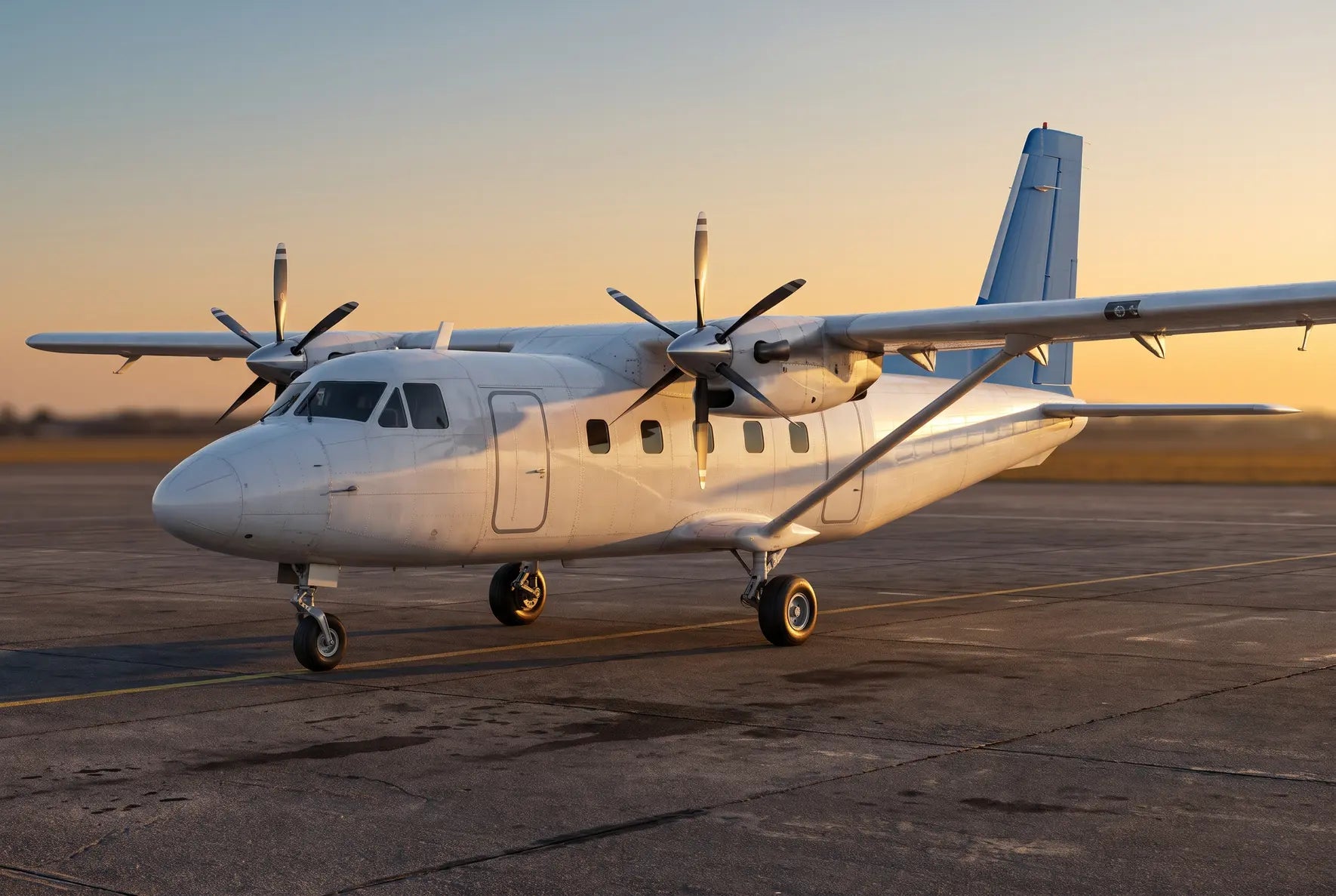
The A319 100 was developed and produced by Airbus S.A.S., headquartered in Toulouse, France. Final assembly of the A319 took place at the Airbus plant in Hamburg, Germany, and later also at the Tianjin facility in China. Airbus, originally formed as a European consortium known as Airbus Industrie in 1970, became a single integrated company in 2001. Today, it is one of the two largest commercial aircraft manufacturers in the world, producing the entire A320 family alongside wide body programmes such as the A330, A350, and the double deck A380. Curious about aircraft from other global manufacturers? Explore the profile of the Antonov An 28, a short takeoff utility aircraft with a very different design philosophy.
What Distinguishes the A319 100 from Other Variants
The A319 100, also referred to as the A319ceo (current engine option), occupies a specific niche between the smaller A318 and the baseline A320 200. Its fuselage measures 33.84 metres in length, which is 3.73 metres shorter than the A320 200. This reduction was achieved by removing four fuselage frames forward and three aft of the wing centre section, a minimum change approach that allowed Airbus to retain the same wing, landing gear, empennage, and cockpit. The lower passenger count also translated into a lighter aircraft, giving the A319 100 a notably longer range of up to approximately 3,700 nautical miles (6,850 km) compared to the A320 200, making it well suited for thinner, longer routes.
The A319 100 also formed the basis for the A319CJ (Corporate Jetliner), a VIP and government transport variant capable of intercontinental range thanks to additional centre fuel tanks. A further derivative, the A319LR, was offered with a range of up to 4,500 nautical miles for operators like Qatar Airways.
The following summarises the key variant identifiers of the Airbus A319 100:
- Engine options: CFM International CFM56 5A series (e.g., CFM56 5A4, 5A5) and CFM56 5B series (e.g., CFM56 5B5, 5B6); IAE V2500 A5 series (e.g., V2524 A5, V2527M A5)
- Maximum takeoff weight (MTOW): Up to 75,500 kg (166,449 lb), depending on weight variant
- Fuselage length: 33.84 m (111 ft 0 in), 3.73 m shorter than the A320 200
- Typical seating capacity: 124 (two class) to 156 (high density)
- Wingtip devices: Wingtip fences standard; optional sharklet wingtip devices on later production aircraft
- EASA Type Certificate: Covered under TCDS EASA.A.064 (shared with A318, A320, A321)
- Common type rating: Full cross crew qualification with A318, A320, and A321

A United Airlines Airbus A319 aircraft is captured mid-flight with its landing gear deployed, approaching for landing under a clear blue sky.
Airbus A319-100 vs A318-100 vs A320-200 vs A321-200 Specifications Comparison
Scroll horizontally to see more →
| Parameter | Airbus A319-100 | Airbus A318-100 | Airbus A320-200 | Airbus A321-200 |
|---|---|---|---|---|
| Entry into service | 1996 | 2003 | 1988 | 1994 |
| Engines | 2 × CFM56-5B or IAE V2500 | 2 × CFM56-5B or IAE V2500 | 2 × CFM56-5B or IAE V2500 | 2 × CFM56-5B or IAE V2500 |
| Length | 33.8 m | 31.4 m | 37.6 m | 44.5 m |
| Wingspan | 34.1 m | 34.1 m | 34.1 m | 34.1 m |
| Height | 11.8 m | 12.5 m | 11.8 m | 11.8 m |
| Typical seating and layout | 2-class: 124–144 passengers | 2-class: 107–132 passengers | 2-class: 150–180 passengers | 2-class: 185–220 passengers |
| MTOW | 75 t | 68 t | 77 t | 93 t |
| Range | 3,700 nm | 3,100 nm | 3,100 nm | 3,200 nm |
| Cruise speed | 0.78 Mach | 0.78 Mach | 0.78 Mach | 0.80 Mach |
| Service ceiling | 41,000 ft | 41,000 ft | 39,000 ft | 39,000 ft |
| Program note | Shortened A320 family member for 120-140 passengers, longest range in class | Shortest A320 family variant, lowest capacity for thin routes | Baseline A320 family workhorse, highest selling narrowbody | Stretched A320 family high-capacity variant for dense short/medium routes |
Scroll horizontally to see more →
The table compares key specs across the Airbus A320 family. A319-100 sits between A318 and A320 in size (33.8 m) and typical capacity (124–144), but stands out with the longest range at 3,700 nm and a 41,000 ft ceiling. A321-200 is the longest and heaviest (44.5 m, 93 t) with the most seats (185–220). All share similar engines and a 34.1 m wingspan.
Airbus A319-100 Operations: Typical Routes, Airlines and Global Missions
The Airbus A319-100 is a short to medium range narrowbody jet designed to serve sectors typically ranging from 1 to 4 hours in duration, with a maximum range of approximately 6,900 km (3,700 nmi). In practice, most commercial operators deploy the aircraft on routes between 500 and 3,000 km, making it ideal for domestic trunk routes, intra-regional connections and thinner international sectors where a larger A320 or A321 would carry too many empty seats. Average daily utilisation for the type sits between 7 and 9 block hours depending on the operator and network structure, with low cost carriers pushing closer to 10 hours through quick turnarounds, while legacy carriers on shorter hub feeder legs typically average around 7 to 8 hours per day.
The Airbus A319-100 thrives in both hub and spoke and point to point networks. At major hubs such as London Heathrow, Frankfurt, Charlotte Douglas and Philadelphia, the aircraft feeds long haul connections by shuttling passengers from secondary cities. Conversely, low cost carriers exploit its range and lower seat capacity to open point to point routes between secondary or regional airports where demand does not justify a larger narrowbody. The type's performance on short runways and at high altitude airports also makes it valuable in operationally challenging environments. Drukair in Bhutan famously uses the A319 to serve Paro Airport, one of the world's most demanding approaches surrounded by peaks above 5,000 m. For operators, the principal challenge today is the age of remaining fleets: many A319-100s have exceeded 20 years in service, which increases maintenance costs and reduces fuel efficiency compared to newer generation aircraft. Several airlines, including easyJet and Delta Air Lines, have announced plans to phase out their A319s by the late 2020s, replacing them with A320neo family jets or similar types such as the Bombardier CRJ1000 on thinner regional segments.
Where the Airbus A319-100 Operates Around the World
As of late 2025, approximately 1,264 Airbus A319 aircraft remain in service with around 87 operators worldwide, according to industry data. The type is most heavily concentrated in Europe and North America, where it serves dense domestic and intra-continental networks. In Asia, Chinese carriers dominate A319 operations, using the aircraft on domestic routes including high altitude sectors in western China. South America sees the type primarily on domestic and regional routes within the continent, while Africa has a smaller but notable presence, with the aircraft historically serving both legacy and state carriers on regional missions.
- Europe: The continent is one of the largest markets for the Airbus A319-100. easyJet has been the biggest customer in history with 172 aircraft delivered, of which approximately 82 remained active in early 2025, deployed on high frequency point to point routes across Western and Southern Europe. British Airways operates 27 units from London Heathrow and London Gatwick on short haul European sectors. Eurowings, the low cost arm of the Lufthansa Group, flies 28 A319s on leisure and domestic German routes, though the type is being phased out. Other European operators include Croatia Airlines and Vueling, which use the aircraft on thinner intra-European connections.
- North America and South America: American Airlines is the world's largest operator with 133 Airbus A319-100s, inherited partly from US Airways and former Frontier Airlines aircraft, used extensively on domestic routes from hubs like Charlotte, Philadelphia and Phoenix. United Airlines operates 81 units, recently retrofitted with updated cabins, while Delta Air Lines maintains 57 examples, many of which are former Northwest Airlines frames now exceeding 25 years of age. Allegiant Air flies 34 A319s on leisure oriented point to point routes to smaller US cities. In South America, LATAM Airlines is the principal operator with approximately 40 A319s connecting domestic destinations across Chile, Peru and Colombia.
- Asia: Chinese carriers form the backbone of A319 operations in the region. Air China operates 27 aircraft, while China Eastern Airlines flies 33 units on domestic services. Tibet Airlines received the last A319-100ceo produced in 2021, employing the type on challenging high altitude routes to airports in Tibet and western China. Drukair in Bhutan and Maldivian in the Maldives both use the A319 on specialised missions, from mountain approaches to premium island services.
- Africa: The continent has a smaller fleet of A319s. South African Airways historically operated the type to replace aging Boeing 737-200s on regional routes from Johannesburg, though these aircraft were returned to lessors during the airline's 2020 restructuring. Afriqiyah Airways in Libya is listed among current operators, while Tunisair has used the A319-100 as part of its all Airbus narrowbody fleet on routes across North Africa and to Europe.
Typical Seating Configurations on the Airbus A319-100
The Airbus A319-100 has a certified maximum seating capacity of 160 passengers (with overwing exits) or 150 in standard exit configuration, but real world layouts vary widely by operator type. The cabin features a standard 3+3 abreast arrangement in a single aisle layout. Network carriers typically configure the aircraft with two or three classes. American Airlines seats 128 passengers across First Class (8 seats), Main Cabin Extra (24 seats) and Main Cabin (96 seats). United Airlines offers 126 seats split between First (12 seats at 37 inch pitch), Economy Plus (36 seats at 35 inch pitch) and Economy (78 seats at 30 inch pitch). British Airways configures its A319-100 with Euro Traveller and Club Europe cabins for short haul European services.
Low cost and leisure operators maximise density. easyJet fits 156 all economy seats with a seat pitch of around 29 inches, among the highest density layouts in the A319 fleet worldwide. Allegiant Air adopts a similar high density approach for its leisure routes. At the other end of the spectrum, Maldivian operates an all business class A319 for premium services, illustrating the flexibility of the cabin. These differences mean that travellers can expect anywhere from 124 to 156 seats on an Airbus A319-100, depending on the airline and its market positioning.
In this video, take a Premium Rouge flight review aboard an Air Canada Rouge Airbus A319-100 from Toronto to Québec City, comparing the leisure subsidiary experience with Air Canada mainline service.
Airbus A319 100 Safety Record: How Safe Is This Aircraft?
The Airbus A319 100 has accumulated an outstanding safety record since entering commercial service in 1996. With approximately 1,500 units delivered and around 900 still flying worldwide as of early 2025, the type has completed millions of revenue flights across nearly three decades of continuous operation. Notably, the A319 has recorded zero hull loss accidents throughout its entire service history, a distinction that underscores the robustness of both the airframe and the broader A320 family design philosophy. For context, the complete A320 family (A318, A319, A320 and A321) had a fatal hull loss rate of just 0.12 per million departures through 2015, according to data compiled by the Aviation Safety Network. Airbus classifies the A320 family as generation 4 aircraft, which achieved the lowest fatal accident rate of all jet generations at 0.04 per million flight cycles in 2024.
Notable Incidents Involving the Airbus A319
Although the A319 100 has never suffered a hull loss, a handful of serious incidents have tested the variant and led to meaningful safety improvements across the fleet.
- Sichuan Airlines Flight 3U8633 (May 2018) – An Airbus A319 100 (registration B 6419) experienced a catastrophic right cockpit windshield failure at 32,000 feet while flying from Chongqing to Lhasa. Explosive decompression partially ejected the first officer, and the flight crew faced sub zero temperatures, extreme noise and multiple system failures. Captain Liu Chuanjian successfully diverted to Chengdu, landing with only minor injuries to two crew members and no passenger casualties. The Civil Aviation Administration of China (CAAC) investigation determined that degraded seal material allowed moisture ingress, which caused electrical arcing that cracked the heated glass layers. Following the event, Airbus updated its abnormal and emergency checklists to prioritise immediate fastening of shoulder harnesses whenever a windshield crack is detected, reducing the risk of flight crew incapacitation should the panel fail completely.
- British Airways G EUOE, London Heathrow (May 2013) – Both engine fan cowl doors separated from a British Airways A319 131 during takeoff, puncturing a fuel line on the right engine and causing an external fire upon return. The crew executed a safe landing with no injuries. The UK AAIB final report (AAR 1/2015) found the doors had been left unlatched after overnight maintenance, and visual checks before departure failed to detect the condition. Five safety recommendations followed, addressing fan cowl door certification standards, cockpit warning systems, fatigue risk management for maintenance technicians and enhanced walk around procedures. Airbus subsequently issued service bulletins for improved latch designs, and the broader industry strengthened pre flight inspection protocols across the entire A320 family.
- IRS and ADIRU Drift Events (multiple operators, 2010s onwards) – Several A319 operators reported uncommanded autopilot and autothrust disconnects caused by vertical shock loads transmitted through the nose landing gear to the Air Data Inertial Reference Units (ADIRU). Investigations by the UK AAIB traced the root cause to overextended nose gear shock absorbers amplifying runway surface vibrations beyond the ADIRU qualification envelope. Airbus responded with technical follow up notices for more precise nose gear servicing, installed accelerometers on affected aircraft for data collection, and developed improved servicing equipment to prevent recurrence.
How Safe Is the Airbus A319 100?
When measured against the volume of flights it has performed, the A319 100 stands among the safest commercial aircraft ever built. The A320 family's combined fatal accident rate of 0.09 per million flights, as reported by AirSafe.com, places it on a par with the best performing widebody types. Several design features contribute directly to this record. The fly by wire flight control system incorporates hard flight envelope protections that prevent pilots from exceeding critical angle of attack, load factor or speed limits, even under stress. Airbus accident statistics show that these protections have reduced loss of control in flight events by roughly 90% compared to earlier generation jets. Standardised type ratings across the A320 family also allow pilots to transition between the A318, A319, A320 and A321 with minimal additional training, reinforcing consistent standard operating procedures across operators. Aspiring pilots curious about the communities that discuss these procedures can explore resources such as airline pilot forums for first hand professional insights.
Continuous regulatory oversight from authorities including EASA and the FAA ensures that every airworthiness directive, service bulletin and operational procedure update reaches the global fleet promptly. Combined with robust crew resource management training and a mature global maintenance network, these layers of defence keep the A319 100 operating at the highest safety standards. Aviation remains, statistically, one of the safest modes of transport, and the Airbus A319 100 is a clear reflection of that achievement.
01 What is the typical range and mission profile of the Airbus A319-100?
The Airbus A319-100 has a maximum range of about 3,700 nautical miles (6,900 km), making it suitable for short- to medium-haul routes like transcontinental flights or intra-European hops. With fewer seats than the A320, it carries 124 to 156 passengers efficiently on missions up to 6,700 km in some configurations. Airlines use it for routes balancing passenger load and fuel efficiency.
02 What are common cabin layouts and passenger comfort features on the Airbus A319-100?
Cabin layouts vary by airline, but typically seat 124 to 156 passengers in single-aisle configuration, with examples like Delta's 12 first-class, 24 comfort, and 96 main cabin seats. Seat widths range from 18 to 21 inches, with pitches of 30-37 inches, and underseat storage around 18x18x11 inches. Noise levels are low due to its design, offering a comfortable ride for medium-haul flights.
03 Which airlines operate the Airbus A319-100 and on what routes?
Major operators include British Airways with 25 in their fleet for European and short transatlantic routes, Delta for domestic U.S. flights up to 2,835 miles, and Lufthansa for medium-range European services. Low-cost carriers like EasyJet use high-density 156-seat versions for short-haul intra-Europe routes. It serves both regional hops and longer thin routes effectively.
04 How does the Airbus A319-100 perform compared to similar aircraft?
The A319-100 cruises at around 515-525 mph (Mach 0.78) with twin turbofan engines like CFM56 or IAE V2500, offering better range than the Boeing 737-700 due to its fuel capacity despite fewer seats. It is shorter than the A320 by 3.73 meters, providing similar performance but optimized for lower passenger loads. The neo variant improves fuel efficiency by up to 15% with sharklets and new engines.
05 What is the safety record and key design features of the Airbus A319-100?
The Airbus A319-100 shares the excellent safety record of the A320 family, with advanced fly-by-wire controls, redundant systems, and sharklets on newer models for efficiency. It features two overwing exits in standard config, robust landing gear, and engines derated for reliability. No major design flaws noted; it benefits from ongoing updates like the neo's air purification.
06 What practical tips should travelers know about the Airbus A319-100?
Opt for forward seats in main cabin for quicker deplaning and less noise; window seats offer good views with large windows typical of A320 family. It handles turbulence smoothly due to its stable wing design, and most configs have movable armrests in comfort areas. Check airline seat maps for specifics, as lavatories lack wheelchair accessibility on some.