Boeing 747-200B: History, Development and What Set It Apart
The Boeing 747-200B emerged as the dedicated passenger evolution of the original 747 family, a programme that redefined commercial aviation in the late 1960s. Boeing launched the 747 programme in 1966 after Pan American World Airways placed a landmark order for 25 aircraft on 13 April 1966. Assembly took place at Boeing's purpose built facility in Everett, Washington, which remains the largest building by volume ever constructed for aircraft manufacturing. The original 747-100 completed its maiden flight on 9 February 1969 and entered commercial service with Pan Am on 22 January 1970, proving that a wide body, twin aisle airliner could operate profitably on high density long haul routes.
Airlines quickly requested greater range and payload capability. Boeing responded with the 747-200 series, which introduced more powerful engines, reinforced structures and increased fuel capacity. The 747-200B, the standard passenger variant of the series, completed its first flight on 11 October 1970. The FAA granted type certification under certificate number A20WE in late 1970, and the variant entered commercial service in February 1971. Production continued at Everett until 1991, with Boeing delivering a total of 393 aircraft across all 747-200 sub variants, of which 225 were passenger 747-200B airframes.
Major operators of the Boeing 747-200B included Pan Am, KLM Royal Dutch Airlines, Lufthansa, British Airways, Qantas, Japan Airlines and numerous other flag carriers that used the type as the backbone of their intercontinental networks throughout the 1970s and 1980s. The airframe also served in government and military roles: the two VC-25A aircraft that have operated as Air Force One since 1990 are modified 747-200B platforms, fitted with secure communications, aerial refuelling capability and defensive countermeasures. These presidential transports are scheduled for replacement by VC-25B aircraft based on the Boeing 747-8.
Engine options evolved significantly over the production run. Early 747-200B deliveries used Pratt & Whitney JT9D-7 series turbofans, but Boeing later offered the General Electric CF6-50E2 (rated at 233.5 kN / 52,500 lbf per engine) and the Rolls-Royce RB211-524D4 (235.8 kN / 53,000 lbf), making the 747-200B the first 747 variant with a three manufacturer engine catalogue. The most powerful option was the JT9D-7R4G2, producing 243.5 kN (54,750 lbf) of thrust per engine. These powerplant upgrades, combined with structural reinforcements to the wings, fuselage and landing gear, raised the maximum takeoff weight to 833,000 lb (378,000 kg) and extended the range to approximately 6,560 nmi (12,150 km) with a full passenger load, compared to around 4,620 nmi for the baseline 747-100.
The early widebody era that produced the Boeing 747-200B also saw other manufacturers enter the market. Turboprop predecessors such as the Vickers Viscount 800 had pioneered pressurised air travel for shorter routes in the 1950s, but the 747-200B operated at an entirely different scale, carrying over 350 passengers across oceans in a single flight. Its success demonstrated that high capacity wide body jets could sustain profitable operations on the world's longest routes and paved the way for the later 747-300 and 747-400.
What Distinguishes the Boeing 747-200B from Other 747 Sub Variants
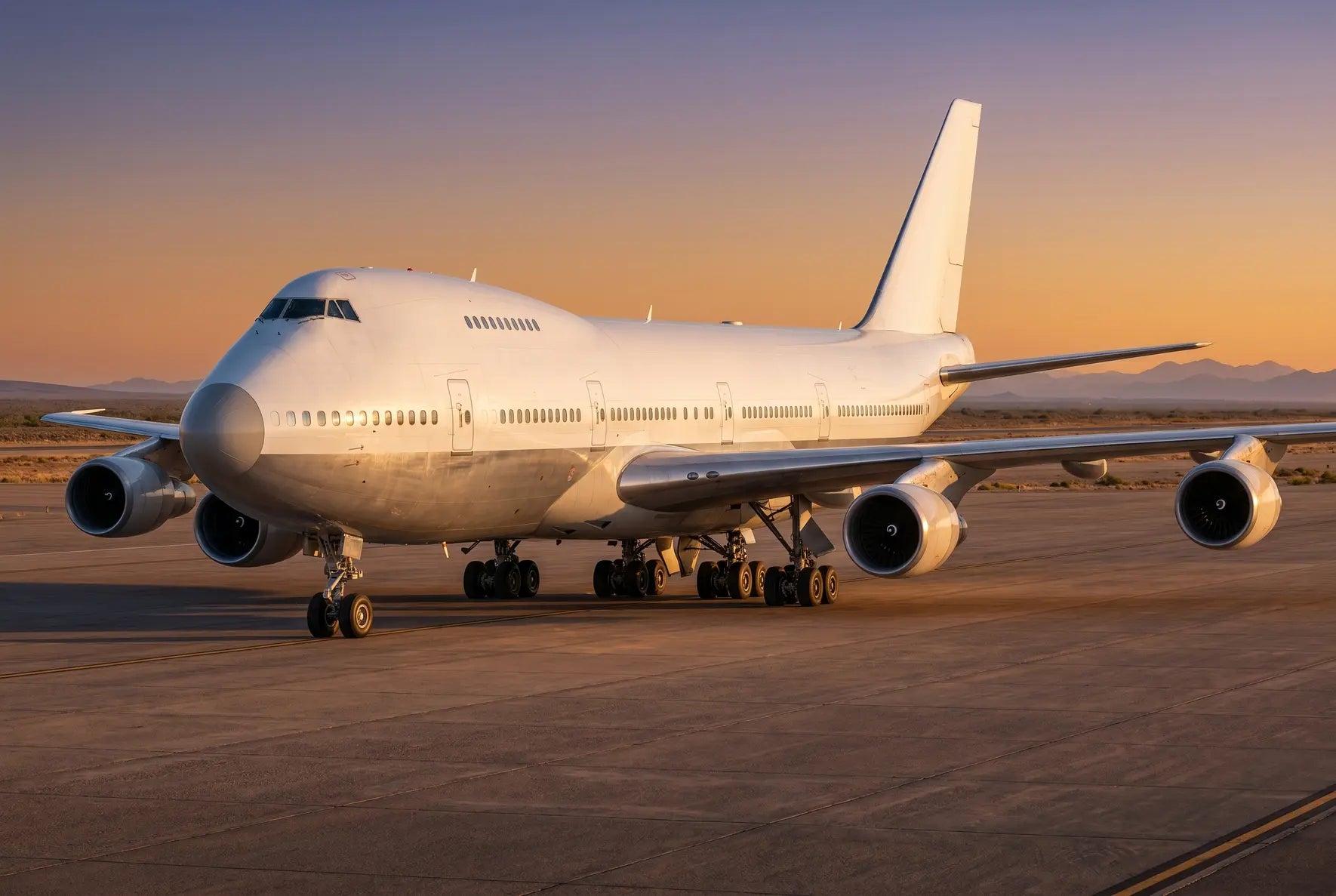
Within the 747-200 family, the "B" suffix identifies the standard all passenger configuration. Unlike the 747-200F (freighter), the 747-200B has no hinged nose cargo door and carries no structural provisions for main deck freight. It also differs from the 747-200C (convertible), which can switch between passenger and cargo layouts, and the 747-200M (combi), which features a side cargo door to accommodate freight pallets on the aft section of the main deck alongside forward passenger seating.
Compared with the earlier 747-100, the 747-200B offered a substantially higher MTOW (833,000 lb versus 735,000 lb), greater fuel capacity, a wider selection of engines from three manufacturers, and a redesigned upper deck featuring 10 windows per side as standard (the original 747-100 launched with just three windows per side on its upper deck). The horizontal stabiliser leading edge also received a curved profile on the 747-200, replacing the straight edge of the 747-100, which is a visual spotting feature for aviation enthusiasts.
The following list summarises verified variant identifiers for the Boeing 747-200B:
- Engine options: Pratt & Whitney JT9D-7R4G2 (243.5 kN), General Electric CF6-50E2 (233.5 kN), Rolls-Royce RB211-524D4 (235.8 kN)
- Maximum takeoff weight: 833,000 lb (378,000 kg)
- Typical range (full passenger load): approximately 6,560 nmi (12,150 km)
- Cruise speed: Mach 0.85 (approximately 490 kn / 900 km/h)
- Passenger capacity: up to 366 in three class layout; maximum single class up to approximately 480
- Upper deck: 10 windows per side (standard), typically configured for premium seating
- FAA type certificate: A20WE
- Total passenger 747-200B airframes built: 225

A Boeing 747 aircraft with Iberia livery soars above a landscape of green fields and a body of water. The plane is adorned with the airline's signature red, orange, and yellow colors.
Boeing 747 200B Technical Specifications, Systems and Engine Options
The Boeing 747 200B was designed as a long range, high capacity widebody airliner, building directly on the original 747 100 airframe while addressing its most significant limitation: range with a full payload. Boeing achieved this primarily through higher maximum takeoff weight (MTOW) ratings, more powerful engine options, and increased fuel capacity. The result was an aircraft capable of serving demanding intercontinental routes that the 747 100 could not reach without payload restrictions.
From a design standpoint, the 747 200B retained the same fuselage cross section, wing geometry, and partial double deck layout of the original 747. The key trade offs centred on structural reinforcement to support higher operating weights, which in turn unlocked greater range at the expense of slightly increased operating empty weight. Three competing engine families were certified for the type, giving operators flexibility to match powerplant choice to fleet commonality, maintenance infrastructure, and route economics. For readers interested in how other manufacturers approached regional and medium haul missions with very different design philosophies, the Antonov An 158 offers a compelling contrast.
- Overall length: 70.5 m (231 ft 4 in)
- Wingspan: 59.6 m (195 ft 8 in)
- Height: 19.3 m (63 ft 5 in)
- Wing area: 511 m² (5,500 ft²)
- Typical MTOW: up to 378,000 kg (833,000 lb), depending on engine and structural option
- Operating empty weight (OEW): approximately 172,000 kg (379,000 lb)
- Maximum landing weight: 256,000 to 286,000 kg (564,000 to 630,500 lb), depending on configuration
- Range: up to 12,150 km (6,560 nmi) with JT9D 7R4G2 engines, as documented in Boeing published specifications
- Cruise speed: Mach 0.85 (approximately 900 km/h / 490 kt TAS)
- Maximum operating speed (Mmo): Mach 0.92
- Service ceiling: 13,700 m (45,100 ft)
- Fuel capacity: approximately 53,600 US gallons
- Takeoff field length: approximately 3,300 m (10,900 ft) at maximum weight
- Passenger capacity: 366 in typical three class layout; up to 480 in high density configuration
- Flight crew: three (two pilots plus flight engineer)
- Engines: four high bypass turbofans; Pratt & Whitney JT9D series, General Electric CF6 50 series, or Rolls Royce RB211 524 series
Systems, Flight Controls and Handling Technology
The 747 200B used a conventional hydraulic flight control architecture with mechanical cable linkages transmitting pilot inputs to the control surfaces. It was not a fly by wire aircraft. Four independent hydraulic systems, each operating at approximately 3,000 psi, powered the primary flight controls (ailerons, elevators, upper and lower rudders, and spoilers) through dual tandem power control units (PCUs). This redundancy was a defining safety feature: the aircraft remained controllable even with two engines inoperative and multiple hydraulic system failures, as detailed in Aviation Week's analysis of the 747's safety design. Artificial feel was generated by a dual feel computer, giving pilots consistent stick forces across the flight envelope.
The avionics baseline centred on the Carousel IV (C IV) triple redundant Inertial Navigation System (INS), which served as the primary long range navigator and eliminated the need for a dedicated navigator crew member. The autopilot was a two axis system (pitch and roll), integrated with a flight director, autothrottle, and full time yaw damper operating on both upper and lower rudders. Autothrottle modes included EPR for takeoff and climb, Mach hold for cruise, and speed hold for approach. Braking relied on multi disc units on the 16 wheel main landing gear, supported by antiskid protection and a reserve hydraulic braking capability.
Published performance figures for the 747 200B can vary significantly depending on the installed engine variant, structural weight option, cabin configuration, passenger and cargo load, atmospheric conditions, and runway elevation. Range values, for instance, are typically quoted at manufacturer standard assumptions (specific payload, reserves, and ISA conditions) and may differ considerably in real world airline operations. Takeoff distances are similarly sensitive to MTOW, temperature, altitude, and runway surface. Any direct comparison with other types should account for these variables and treat published numbers as reference values rather than absolute guarantees.
Engine Options: JT9D, CF6 50, and RB211 524
One of the distinctive features of the 747 200B was the availability of three competing engine families, each from a major manufacturer, allowing airlines to select powerplants based on fleet strategy and operational requirements.
The Pratt & Whitney JT9D was the launch engine for the Boeing 747 programme and holds the distinction of being the world's first high bypass ratio turbofan to power a widebody airliner. Development began in the mid 1960s, with the JT9D entering service on the 747 100 in January 1970. The JT9D 7 series, used on the 747 200B, covered thrust ratings from 46,300 to 50,000 lbf (206 to 222 kN), while the JT9D 7Q series reached 53,000 lbf (236 kN). It featured a two spool axial flow design with a single stage fan, a bypass ratio of approximately 4.8:1, and a fan diameter of 93.4 inches. Over 3,200 JT9D engines were produced before production ended around 1990, succeeded by the PW4000 family. Beyond the 747, the JT9D also powered early Boeing 767, Airbus A300, and Airbus A310 variants.
The General Electric CF6 50 was a derivative of the CF6 6 originally developed for the McDonnell Douglas DC 10 30. Introduced in 1972, the CF6 50 delivered thrust ratings of 46,000 to 54,000 lbf (205 to 240 kN), with the CF6 50E2 variant producing approximately 51,800 lbf (230 kN) for the 747 200B. It used an 86.4 inch fan, a bypass ratio of approximately 4.3:1, and an overall pressure ratio of 29.2 to 31.1. The architecture comprised a single fan stage, three stage low pressure compressor, 14 stage high pressure compressor, two stage high pressure turbine, and four stage low pressure turbine. The CF6 50 was also selected for the Airbus A300, the DC 10 Series 30, and military platforms such as the KC 10 Extender (as the F103).
The Rolls Royce RB211 524 brought a distinctive three shaft architecture (low, intermediate, and high pressure spools) to the 747 200B. The RB211 524B and 524D4 variants were certified for the type, with the RB211 524D4 rated at approximately 53,000 lbf (236 kN). The series featured a fan diameter of around 86.3 inches and a bypass ratio of roughly 4.1:1. Originally developed in the late 1960s, the RB211 family entered service on the Lockheed L 1011 TriStar before the higher thrust 524 variants were adapted for the 747. Later 524G/H variants, producing up to 60,600 lbf, went on to power the Boeing 747 400 and 767. The three shaft design offered a shorter, stiffer engine casing and contributed to low vibration levels, a feature that Rolls Royce carried forward into the Trent family.
Boeing 747-200B vs 747-100 vs 747-400 vs Airbus A380-800 Specifications Comparison
Scroll horizontally to see more →
| Parameter | Boeing 747-200B | Boeing 747-100 | Boeing 747-400 | Airbus A380-800 |
|---|---|---|---|---|
| Entry into service | 1971 | 1970 | 1989 | 2007 |
| Engines | 4 × Pratt & Whitney JT9D-7 | 4 × Pratt & Whitney JT9D | 4 × GE CF6-80C2 / PW4000 / RR RB211 | 4 × Rolls-Royce Trent 900 / Engine Alliance GP7200 |
| Length | 70.6 m | 70.6 m | 70.6 m | 72.7 m |
| Wingspan | 59.6 m | 59.6 m | 64.4 m | 79.8 m |
| Height | 19.3 m | 19.3 m | 19.4 m | 24.1 m |
| Typical seating and layout | 3-class: 366–465 passengers | 3-class: 366 passengers | 3-class: 416 passengers | 3-class: 525–555 passengers |
| MTOW | 378 t | 333 t | 396 t | 575 t |
| Range | 6,560 nm | 4,620 nm | 7,260 nm | 8,000 nm |
| Cruise speed | 0.85 Mach | 0.85 Mach | 0.85 Mach | 0.85 Mach |
| Service ceiling | 45,000 ft | 42,000 ft | 45,000 ft | 43,000 ft |
| Program note | Basic passenger version with increased fuel capacity and more powerful engines over -100 | Original production passenger variant, first 747 jumbo jet | Advanced final passenger version with significant range and efficiency improvements | Largest passenger airliner ever built, double-deck very large aircraft competitor |
Scroll horizontally to see more →
The table compares key specifications of the Boeing 747-200B, 747-100, 747-400 and Airbus A380-800. It highlights how the 747 line kept similar length but gained wingspan, MTOW and range over time, with the 747-400 offering the best 747 range. The A380 is larger in wingspan and height, carries more passengers, and has the highest MTOW and range overall.
Boeing 747-200B Operations: Routes, Airlines, and Missions Worldwide
The Boeing 747-200B was conceived as a long-range, high-capacity workhorse for intercontinental air travel. With a maximum range of approximately 6,560 nautical miles (12,150 km) when equipped with Pratt & Whitney JT9D-7R4G2 engines, as documented by Wikipedia's Boeing 747 overview, this variant enabled nonstop services on demanding transatlantic and transpacific routes that had previously required intermediate stops or were beyond the reach of earlier widebody types.
Typical missions for the Boeing 747-200B centred on long-haul intercontinental flying. Transatlantic sectors such as New York to London, covering roughly 3,000 nautical miles, took between 6 and 8 hours at a cruise speed of around Mach 0.85. Transpacific routes, for example Los Angeles to Tokyo (approximately 4,800 nautical miles), required 9 to 11 hours of flight time. According to Planephd specifications, the aircraft consumed approximately 4,530 US gallons of fuel per hour, which made it economically viable only on high-demand trunk routes where load factors remained consistently high. Airlines operating the type on long-haul services typically achieved daily utilisation rates of 10 to 12 block hours per aircraft.
The Boeing 747-200B was designed for hub-and-spoke operations at major international gateways. Its large capacity was best suited to consolidating passenger flows between primary hubs such as London Heathrow, New York JFK, Tokyo Narita, and Frankfurt. The aircraft required a takeoff distance of roughly 10,900 feet (3,300 metres), which limited its use to airports with long runways and full international infrastructure. It was not suited for secondary or regional airports, and this restriction channelled deployments toward a relatively small number of high-volume intercontinental corridors.
Operators faced several challenges. The four-engine configuration and high fuel burn made per-seat economics unfavourable compared to later twin-engine widebodies such as the Boeing 777. Maintenance costs increased as airframes aged, and regulatory requirements, including airworthiness directives issued by authorities like the FAA, added operational complexity. These pressures, combined with evolving noise regulations and the arrival of more efficient aircraft, led most airlines to retire their Boeing 747-200B fleets by the early 2000s.
Where the Boeing 747-200B Operated Around the World
The Boeing 747-200B saw service across four broad regions, connecting major hubs on every inhabited continent. In Europe, flag carriers deployed the type on transatlantic routes and services to Asia and Africa. In North America, it served as the backbone of international long-haul fleets, while South American carriers used it to link their capitals with Europe and North America. Across Asia, the aircraft connected fast-growing economies with the rest of the world. In Africa and the Middle East, a smaller number of operators relied on the type for prestige intercontinental services. For those interested in how airlines across different regions structure their operations, this profile of Binter Canarias offers an insightful look at a regional carrier model.
- Europe: Major operators included British Airways (transatlantic and Far East routes from London Heathrow), Lufthansa (Frankfurt to New York, Tokyo, and other intercontinental destinations), Air France (Paris CDG to North America and Asia), KLM (Amsterdam Schiphol hub operations), Swissair, Alitalia, Iberia, SAS, SABENA, TAP Air Portugal, Olympic Airways, Condor, and Aer Lingus, which operated two aircraft on transatlantic services.
- North & South America: Pan American World Airways was one of the most prominent operators, using the type worldwide from its base at New York JFK. Other North American carriers included TWA, Northwest Airlines, United Airlines, American Airlines, Continental Airlines, National Airlines, and Canadian operators Wardair and Canadian Pacific Airlines. In South America, VARIG of Brazil operated Boeing 747-200B aircraft on routes from São Paulo and Rio de Janeiro to Europe and Miami, and Aerolineas Argentinas used the type from Buenos Aires to Madrid and New York.
- Asia: The aircraft was widely used by Japan Airlines and Cathay Pacific (Hong Kong to London and Los Angeles), Singapore Airlines, Korean Air, Thai Airways International, Qantas (on transpacific and kangaroo routes to Europe), Garuda Indonesia, and Philippine Airlines. Many of these carriers operated the type on ultra-long-haul services connecting Asia with Europe and North America.
- Africa and Middle East: South African Airways operated the Boeing 747-200B on routes from Johannesburg to London and other international destinations. In the Middle East, operators included Iran Air, El Al, Saudi Arabian Airlines, Kuwait Airways, Royal Jordanian, Iraqi Airways, and Middle East Airlines, generally using the aircraft to connect their hubs with Europe and Asia.
Typical Seating Configurations on the Boeing 747-200B
The Boeing 747-200B offered considerable flexibility in cabin layout, and configurations varied significantly between network carriers and leisure operators. According to Planephd data, the aircraft could seat up to 465 passengers. In a typical two-class arrangement (business and economy), airlines configured between 416 and 452 seats. Network carriers such as British Airways, Cathay Pacific, and Lufthansa favoured three-class layouts with first, business, and economy cabins, often placing premium classes on the iconic upper deck and forward main deck. A documented Cathay Pacific layout, referenced by Frequently Flying, featured 35 first-class seats split between both decks, 36 business-class seats in the Marco Polo cabin, and 337 economy seats, for a total of 408 passengers.
Charter and leisure operators typically removed first-class cabins entirely and installed high-density all-economy or minimal-premium layouts seating 450 to over 500 passengers. The partial double-deck design, with its spacious main deck and smaller upper deck, made the Boeing 747-200B especially adaptable to these divergent commercial strategies. The aircraft's maximum single-class capacity was certified at up to 568 seats, although this extreme configuration was rarely used in regular service.
In this video, experience a VIP journey aboard a Presidential Boeing 747 BBJ, following the GOLD Flight from London to Beijing and exploring what it is like to travel on this exclusive private jet.
Boeing 747-200B Safety Record: Accidents, Incidents and How Safe It Is
Boeing built 225 examples of the 747-200B passenger variant between 1971 and 1991, and the wider 747-200 series totalled 393 airframes including freighter, combi and convertible models. Over roughly four decades of commercial operations, these aircraft accumulated millions of flight hours and cycles on long haul routes across every continent. Within that operational lifespan, the 747-200 series was involved in a number of hull loss accidents. According to the Aviation Safety Network database, several dozen hull loss events have been recorded for all Boeing 747-200 variants combined. When measured against the vast number of departures logged by the worldwide fleet, the per-flight accident rate remains low, yet the sheer scale of operations and the era in which the type flew meant it was exposed to security threats, evolving maintenance practices and navigation technology that had not yet matured. The final passenger 747-200B was retired by Iran Air in 2016, closing a chapter that saw meaningful safety progress driven, in part, by lessons learned from this very aircraft.
Major Accidents and the Safety Lessons They Produced
Several high profile events involving 747-200B sub-variants led directly to lasting improvements in aviation safety, security and regulation.
- Korean Air Lines Flight 007 (1983) – A Boeing 747-230B (registration HL7442) deviated more than 300 kilometres into Soviet prohibited airspace on a flight from Anchorage to Seoul and was shot down by a military interceptor near Sakhalin Island, killing all 269 occupants. The ICAO investigation attributed the deviation to a navigation system error, most likely an incorrectly engaged autopilot mode. In response, President Reagan announced that the United States would make its Global Positioning System (GPS) freely available for civilian aviation once operational, a decision that transformed aerial navigation worldwide. ICAO also adopted an amendment to the Chicago Convention prohibiting the use of weapons against civil aircraft in flight, which entered into force in 1998.
- Air India Flight 182 (1985) – A Boeing 747-237B was destroyed by a bomb concealed in checked luggage while over the Atlantic Ocean off Ireland, killing all 329 people on board. The disaster exposed critical gaps in baggage screening and prompted the introduction of mandatory passenger baggage reconciliation procedures, enhanced explosive detection technologies and more rigorous protocols for interline luggage on international flights. These measures became foundational pillars of modern aviation security.
- South African Airways Flight 295 (1987) – A Boeing 747-244B Combi (registration ZS-SAS) suffered an uncontrollable in-flight fire while over the Indian Ocean en route from Taipei to Johannesburg, resulting in the loss of all 159 occupants. The investigation highlighted the risk of cargo fires on main deck combi configurations. Regulatory authorities subsequently tightened requirements for cargo compartment fire detection and suppression systems and imposed stricter rules on the classification and transport of hazardous materials aboard passenger and combi aircraft.
- China Airlines Flight 611 (2002) – A Boeing 747-209B (registration B-18255) broke apart in flight over the Taiwan Strait, killing all 225 on board. The Taiwan Aviation Safety Council determined that metal fatigue cracking had propagated from an improperly repaired tail strike sustained 22 years earlier. The investigation led to recommendations requiring structural repairs to follow manufacturer approved procedures precisely, reinforced the importance of the Repair Assessment Program for aging aircraft and called for enhanced self audit inspection of pressure vessel repairs across the global fleet.
Each of these events, while tragic, catalysed measurable improvements in design oversight, maintenance standards, navigation technology and security screening that continue to protect passengers today. Even aircraft types unrelated to the 747, such as regional turboprops like the Fairchild Swearingen Metro II, benefit from the regulatory frameworks that were strengthened in the wake of these accidents.
How Safe Is the Boeing 747-200B?
Evaluating the safety of the Boeing 747-200B requires context. The type entered service at a time when cockpit automation, satellite navigation and crew resource management training were still in their infancy. Many of its most serious incidents were rooted in external threats such as bombings or military action rather than inherent design flaws. The 747-200B itself introduced structural strengthening and more powerful engines compared to the original 747-100, and its design philosophy prioritised redundancy across flight controls, hydraulic systems and electrical architecture.
Over the decades, successive airworthiness directives issued by the FAA and other regulators addressed emerging risks, from fuselage fatigue and cargo fire protection to wiring inspections. Standard operating procedures evolved in parallel, and the broader 747 fleet benefited from one of the most extensive operational feedback loops in commercial aviation. According to Boeing’s own statistical summary, industry wide hull loss rates have fallen dramatically since the 1970s, a trend to which lessons from the 747-200 contributed significantly.
No aircraft can claim a perfect record, and the 747-200B is no exception. However, its accident history must be weighed against the millions of safe flights completed over more than four decades of service. Continuous improvements in engineering, training, regulation and security have made commercial aviation, across all types, consistently one of the safest forms of transport available.
01 What is the typical range and mission profile of the Boeing 747-200B?
The Boeing 747-200B has a maximum range of about 6,850 nautical miles with typical passenger loads, making it suitable for long-haul transoceanic flights like New York to London or Los Angeles to Tokyo. It was designed for high-capacity missions, often carrying 366 to 440 passengers in three-class or all-economy configurations on busy international routes. Operators used it for point-to-point services rather than ultra-long ETOPS flights due to its four-engine reliability.
02 What was the cabin layout and passenger experience like on the Boeing 747-200B?
The Boeing 747-200B featured a distinctive upper deck for first class with 10-20 seats and a spacious main deck divided into economy, business, and sometimes lounge areas, totaling around 400 seats. Passengers enjoyed large windows, quieter upper-deck seating away from engines, and a more stable ride due to the high-wing design, though noise levels were higher than modern jets without advanced insulation. Frequent flyers recall the iconic spiral staircase and roomy feel compared to narrow-body aircraft.
03 Which airlines operated the Boeing 747-200B and on what routes?
Major operators included British Airways, Pan Am, United Airlines, Qantas, and Lufthansa, with some still in cargo service by companies like Cargolux. They flew it on high-demand transatlantic routes like London to New York, transpacific services such as Sydney to Los Angeles, and intra-Asia long hauls. By the 2000s, most were phased out for newer variants, but a few freighters persist on global cargo networks.
04 How does the performance and fuel efficiency of the Boeing 747-200B compare to similar aircraft?
Powered by four Pratt & Whitney JT9D or General Electric CF6 engines, the 747-200B cruised at Mach 0.85 with a takeoff weight up to 833,000 pounds, offering better capacity than the DC-10 or L-1011 but lower fuel efficiency at around 5-6 miles per gallon per passenger. It outperformed earlier 747-100s with higher thrust and range but lagged behind the 747-400's 25% better efficiency due to older tech. Compared to twins like the 777, it prioritized volume over per-seat economy.
05 What is the safety record of the Boeing 747-200B?
The Boeing 747-200B has a strong safety record with few hull-loss accidents relative to its millions of flight hours, bolstered by redundant four-engine design and robust structure from the original 747 family. Notable incidents were rare and often non-fatal, with improvements like strengthened wings after early fatigue tests. Overall, it shares the 747's reputation as one of the safest widebodies, with rigorous maintenance key to its longevity.
06 What practical tips should travelers know about flying on a Boeing 747-200B?
Opt for upper-deck seats for quieter rides and quicker boarding, or main-deck window seats in economy rows like 23A or 43K for great views of the wings. The aircraft handles turbulence smoothly due to its size and mass, but the rear main deck may feel more movement. Bring noise-canceling headphones as engine hum is noticeable, and check airline configs for lounge access on longer flights.