

Airbus A350-900: History, Program Launch, and Development of the Baseline XWB Variant
The Airbus A350-900 is the baseline member of the A350 XWB (eXtra Wide Body) family, a clean sheet, long range, twin engine widebody designed and manufactured by Airbus in Toulouse, France. Its creation was driven by a need to compete directly with the Boeing 787 Dreamliner and replace aging widebody fleets on high demand, long haul routes. The path from concept to certification, however, was shaped by a dramatic mid program redesign that transformed the aircraft from an A330 derivative into one of the most advanced commercial jets ever built.
Origins and the Original A350 Concept (2004 to 2006)
Airbus first announced the A350 programme on 10 December 2004, when shareholders granted authority to offer a new aircraft family comprising the A350 800, A350 900, and A350 1000. At that stage the design was essentially a re engined and re winged evolution of the existing A330, intended to reach the market quickly with modest development costs estimated at around €3.5 to €4 billion. Qatar Airways placed the first major order for 60 aircraft at the June 2005 Paris Air Show, and an industrial launch was confirmed in October 2005.
Several influential customers, however, criticised the original concept as insufficient. In early 2006, leasing giant ILFC publicly described the design as a "Band Aid reaction to the 787," echoing concerns that the aircraft lacked the step change in fuel efficiency airlines demanded. Facing eroding market confidence, the Airbus board approved a complete restart.
The Clean Sheet A350 XWB Redesign (2006 to 2013)
On 1 December 2006, the Airbus board approved the industrial launch of the redesigned A350 XWB. The new aircraft featured a wider fuselage cross section (5.61 m cabin width at armrest level), wings and fuselage panels constructed from over 50% carbon fibre reinforced polymer by weight, and a dedicated new powerplant: the Rolls Royce Trent XWB 84, producing 84,200 lbf of thrust. This engine, with a 118 inch fan diameter, 9.6:1 bypass ratio, and 50:1 overall pressure ratio, was engineered exclusively for the A350 and became the sole powerplant option for the A350 900.
Final assembly of the first A350 900 began in 2012, although the programme experienced a three month schedule slip announced in July 2012, pushing entry into service from early 2014 to late that year. The prototype (MSN1) completed its maiden flight on 14 June 2013 from Toulouse Blagnac airport.
Certification, Delivery, and Entry into Service
The A350 900 received EASA type certification on 30 September 2014 under type certificate number EASA.A.151, followed by FAA type certification on 12 November 2014 (TCDS T00063IB). The first production aircraft was delivered to launch customer Qatar Airways on 22 December 2014, and the type entered commercial service on 15 January 2015 operating the Doha to Frankfurt route. By Airbus's own reporting, the A350 programme had broken even financially by 2019.
Notable incremental developments since entry into service include the A350 900ULR (Ultra Long Range), designated weight variant WV013, which entered service with Singapore Airlines in October 2018 on the world's longest commercial flight from Singapore to Newark. The ULR uses modified fuel tank breather volumes to carry additional fuel, raising range from approximately 8,100 nm to over 9,700 nm while retaining the same Trent XWB 84 engine. In April 2025, EASA certified the Trent XWB 84 EP (Enhanced Performance) engine upgrade for the A350 900, delivering approximately 1% lower fuel burn through improved fan, compressor, and turbine aerodynamics. The programme also experienced supply chain pressures, including late fuselage parts from Spirit AeroSystems, as well as a high profile dispute between Airbus and Qatar Airways over accelerated paint degradation on several A350 airframes. EASA concluded that the paint issue posed no airworthiness concern, and the dispute was eventually resolved. Unlike the smaller regional jets such as the CRJ700, the A350 900 was designed from the outset for intercontinental operations and received ETOPS approval enabling extended twin engine flights over vast oceanic distances.
What Differentiates the A350 900 from Other A350 Variants
The A350 900 occupies the middle position in the family. The shorter A350 800 (60.5 m fuselage) was originally planned alongside it but was formally cancelled due to insufficient market demand and overlap with the A330neo. The longer A350 1000 (73.8 m fuselage) adds an 11 frame stretch, uses the more powerful Trent XWB 97 engine (97,000 lbf), employs a six wheel main landing gear bogey instead of the A350 900's four wheel configuration, and carries a higher MTOW of up to 322 tonnes. The A350 1000 entered service with Qatar Airways on 24 February 2018.
Key identifiers that distinguish the Airbus A350 900 from its sister variants:
- ICAO type designator: A359
- Engines: Two Rolls Royce Trent XWB 84 (84,200 lbf per engine)
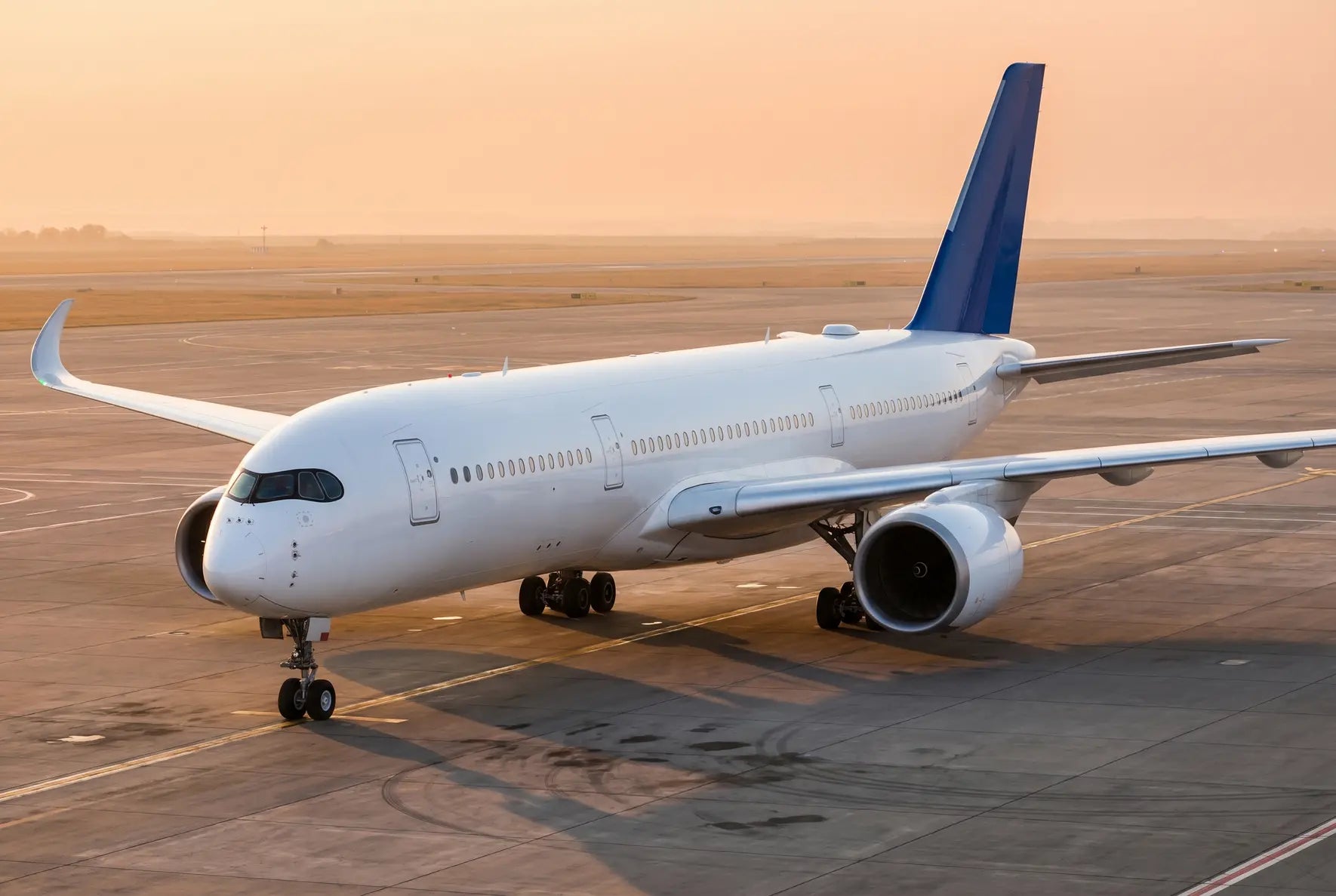
- Fuselage length: 66.80 m (219 ft 2 in)
- Wingspan: 64.75 m with curved sharklet style wingtips
- Typical seating: 300 to 350 passengers in two or three class layout
- MTOW: up to 283 tonnes
- Range: approximately 8,100 to 8,300 nm (15,000 to 15,400 km); ULR sub variant extends to 9,700 nm
- Main landing gear: four wheel bogey (vs. six wheel on A350 1000)

The image shows an Airbus A350-941, marked as the A350 XWB Launch Customer, in flight with Qatar Airways branding. The sleek design is emphasized against a plain sky backdrop.
Airbus A350-900 Technical Specifications, Systems, and Engine Overview
The Airbus A350-900 is a clean sheet, long range widebody designed to serve trunk routes typically connecting major hubs over distances up to 8,500 nautical miles. Its airframe comprises approximately 53% carbon fibre reinforced polymer (CFRP) by weight, complemented by aluminium lithium alloys (19%), titanium (14%), and steel (7%). This extensive use of composites reduces structural weight, improves fatigue resistance, and lowers fuel consumption by roughly 25% compared to the previous generation of widebody jets it was designed to replace. The fuselage cross section, with an outer diameter of 5.96 m and a maximum cabin width of 5.61 m, supports a versatile interior ranging from 332 to 352 passengers in a typical three class layout, up to a maximum of 440 seats in high density configurations. The A350-900 from Airbus is offered in multiple weight variants, with the highest certified MTOW reaching 283 tonnes, giving operators flexibility to balance payload and range for specific network requirements.
From a design philosophy standpoint, the A350-900 inherits the Airbus fly by wire tradition while introducing significant upgrades. Its wing, spanning 64.75 m including curved sharklet wingtip devices, is aerodynamically optimised for long range cruise efficiency at Mach 0.85 (approximately 903 km/h). The aircraft also operates at a lower cabin altitude of 6,000 feet at cruise, enabled by the composite fuselage tolerating higher differential pressure, which contributes to reduced passenger fatigue on long haul sectors.
- Overall length: 66.80 m
- Wingspan: 64.75 m (with integrated sharklet wingtip devices)
- Height: 17.05 m
- Fuselage outer diameter: 5.96 m | Max cabin width: 5.61 m
- Typical seating: 332 to 352 passengers (three class) | Max: 440
- MTOW (highest variant): 283 tonnes
- MLW: 207 tonnes
- MZFW: 195.7 tonnes
- Fuel capacity: approximately 141,000 litres (standard)
- Range: up to 8,500 nm (15,750 km) with typical three class configuration
- Cruise speed: Mach 0.85 (903 km/h / 488 kn)
- Service ceiling: 43,100 ft (13,100 m)
- Engines: 2 × Rolls Royce Trent XWB 84 (84,000 lbf / 374 kN per engine)
- Cargo: up to 11 pallets or 36 LD3 containers in lower hold
- Avionics: Integrated Modular Avionics (IMA) with Thales displays and onboard maintenance system
- Airframe composition: 53% CFRP, 19% aluminium lithium, 14% titanium, 7% steel
Systems Architecture and Handling Technology
The A350-900 cockpit is built around an Integrated Modular Avionics (IMA) architecture that centralises computing resources across multiple aircraft systems. The flight deck features large format LCD displays and supports Electronic Flight Bag (EFB) integration. Fly by wire flight controls, a hallmark of Airbus design, are enhanced on the A350 with improved flight control laws, active load alleviation on the wings to manage gust and manoeuvre loads, and refined envelope protection. These features, combined with side stick controllers and a shared type rating philosophy with the A330, make the A350 both operationally efficient and familiar for trained Airbus crews. The onboard maintenance system leverages IMA for real time health monitoring and predictive maintenance, supporting dispatch reliability that operators have reported above 99%. For those interested in how different turboprop and regional aircraft approach similar avionics and systems challenges, the Fokker 50 overview offers an informative comparison from an earlier generation.
Published performance figures for the A350-900 should always be interpreted with context. Values such as range, takeoff field length, and payload capacity vary significantly depending on the selected weight variant, operator cabin configuration, passenger load, atmospheric conditions (temperature, altitude, wind), and runway state. For instance, SKYbrary lists indicative performance at lower MTOW values (268 tonnes), while the maximum certified MTOW of 283 tonnes unlocks the full advertised range. Fuel burn figures also depend on mission profile, cruise altitude selection, and step climb strategy, so direct comparisons between variants or competitors require careful alignment of assumptions.
Rolls Royce Trent XWB 84: The Sole Engine for the A350-900
The Airbus A350-900 is exclusively powered by the Rolls Royce Trent XWB 84, making it a single engine source airframe. The Trent XWB (Extra Wide Body) was developed specifically for the A350 family and is not used on any other aircraft type. The higher thrust Trent XWB 97 variant powers the larger A350 1000 and the forthcoming A350F freighter, but both share core architecture and components with the XWB 84.
The Trent XWB 84 is a three shaft, high bypass turbofan with a fan diameter of 118 inches (approximately 3.00 m) and a bypass ratio of around 9.3:1. Its compressor section consists of a single stage fan, an eight stage intermediate pressure (IP) compressor, and a six stage high pressure (HP) compressor, achieving an overall pressure ratio exceeding 50:1. On the turbine side, a single stage HP turbine, a two stage IP turbine, and a six stage LP turbine extract energy efficiently. The engine produces a maximum takeoff thrust of 84,000 lbf (374 kN) and weighs approximately 7,277 kg dry. According to Rolls Royce, the Trent XWB delivers a fuel consumption improvement of approximately 10 to 15% over previous generation widebody engines and is certified for ETOPS 420 minutes.
Development of the Trent XWB began in the mid 2000s as Airbus finalised the A350 XWB programme. The engine completed extensive ground and flight testing before entering commercial service with Qatar Airways in January 2015 aboard the first A350 900 delivery. Since then, the fleet has accumulated millions of flight hours. In late 2024, Rolls Royce introduced the enhanced Trent XWB 84EP variant, which offers at least a further 1% improvement in specific fuel consumption, reduced noise levels (up to 2 dB quieter), and certification for 50% Sustainable Aviation Fuel (SAF) blending, with a pathway to 100% SAF capability. The XWB 84EP received EASA type certificate approval in December 2024, making it the current production standard for new A350 900 deliveries.
Airbus A350 Variants vs Boeing 787-9: Key Specs Comparison
Scroll horizontally to see more
| Parameter | Airbus A350-900 | Airbus A350-1000 | Airbus A350-900ULR | Boeing 787-9 |
|---|---|---|---|---|
| Entry into service | 2015 | 2018 | 2018 | 2014 |
| Engines | 2 × Rolls-Royce Trent XWB-84 | 2 × Rolls-Royce Trent XWB-97 | 2 × Rolls-Royce Trent XWB-84 | 2 × GE GEnx-1B or Rolls-Royce Trent 1000 |
| Length | 66.8 m | 73.8 m | 66.8 m | 56.7 m |
| Wingspan | 64.8 m | 64.8 m | 64.8 m | 60.1 m |
| Height | 17.1 m | 17.1 m | 17.1 m | 16.9 m |
| Typical seating and layout | 3-class: 325–350 passengers | 3-class: 350–410 passengers | 3-class: 300–325 passengers | 3-class: 290–310 passengers |
| MTOW | 283 t | 319 t | 283 t | 254 t |
| Range | 8,500 nm | 8,100 nm | 9,700 nm | 7,600 nm |
| Cruise speed | 0.85 Mach | 0.85 Mach | 0.85 Mach | 0.85 Mach |
| Service ceiling | 43,000 ft | 43,000 ft | 43,000 ft | 43,000 ft |
| Program note | Baseline long-range widebody, cornerstone of A350 family | Stretched higher-capacity variant of A350-900 | Ultra-long-range version for 18+ hour flights | Main Dreamliner competitor, smaller but efficient |
Scroll horizontally to see more
The table compares core specifications of the Airbus A350-900, A350-1000, A350-900ULR and Boeing 787-9. The A350-1000 is the largest and heaviest (73.8 m, 319 t) with higher typical capacity, while the A350-900ULR delivers the longest range at 9,700 nm. The 787-9 is smaller and lighter (254 t) but cruises at a similar Mach 0.85, with less range than the A350 variants.
Airbus A350-900 Operations: Typical Routes, Missions and Airlines Worldwide
The Airbus A350-900 is built for long haul operations, typically covering sectors between 8,000 and 15,000 km (4,300 to 8,100 nm). Its design range of 8,500 nautical miles allows it to serve virtually every major intercontinental city pair, from transatlantic crossings such as Paris to New York and Frankfurt to Los Angeles, to transpacific routes like Singapore to San Francisco and Hong Kong to London. Typical block times range from 8 to 17 hours depending on sector length and wind conditions. The ultra long range variant, the A350-900ULR, pushes this further to approximately 9,700 nm, enabling the world's longest commercial flight between Singapore and New York (around 18 to 19 hours).
Fleet wide, the A350-900 demonstrates high daily utilisation. Early in its career, operators achieved an average of around 12.5 block hours per day globally. Finnair has been noted for pushing daily utilisation up to 15 flight hours per day on its Helsinki to Asia network, while airlines on standard long haul missions typically average between 11 and 13 hours per day. This efficiency is comparable to, and often exceeds, the generation of widebodies it was designed to replace, including types such as the McDonnell Douglas DC-8-63, which once served similar long haul trunk routes decades earlier.
The Airbus A350-900 operates predominantly in hub and spoke networks, radiating from large intercontinental hubs such as Singapore Changi, Doha Hamad, Paris Charles de Gaulle, Frankfurt, Istanbul, and Hong Kong. However, it also serves point to point routes where origin and destination demand is strong enough to bypass traditional hubs, such as nonstop services between secondary European cities and North American gateways. Some operators also deploy it on select high density medium haul routes, especially in Asia, where Japan Airlines uses the type on domestic and regional sectors.
Operational challenges for A350-900 operators include managing augmented crew requirements on ultra long haul sectors exceeding 16 hours, coordinating heavy maintenance checks (such as C checks every 40 days for high utilisation ULR fleets), and optimising turnaround times at outstations on routes requiring significant fuel loads of up to 141,000 litres for long sectors.
Where the Airbus A350-900 Operates Around the World
The Airbus A350-900 is a truly global aircraft, with over 700 units delivered to more than 40 operators across Europe, North & South America, Asia, and Africa. In Europe, it forms the backbone of long haul fleets for legacy carriers on transatlantic, South American, and Asian routes. In Asia, it is the dominant new generation widebody, deployed on high demand intercontinental corridors and, in some cases, on premium regional routes. North America sees the type primarily with Delta Air Lines, while in Africa, it is the flagship long haul aircraft for the continent's largest carriers connecting African hubs to Europe, Asia, and the Middle East.
- Europe: European operators form one of the largest groups of A350-900 users. Air France flies approximately 40 aircraft on long haul routes from Paris CDG to destinations across North America, Asia, and Africa. Lufthansa operates around 31 units from Frankfurt and Munich to major intercontinental destinations. Iberia uses around 23 on transatlantic routes from Madrid to South America and North America. Finnair deploys 18 on its signature services from Helsinki to Asia, including Tokyo, Bangkok, and Singapore. Turkish Airlines operates about 30 from its Istanbul hub, one of the fastest growing A350 fleets in Europe. ITA Airways uses a smaller fleet on intercontinental services from Rome.
- North & South America: Delta Air Lines is the sole major North American operator, with approximately 28 to 37 A350-900s deployed on flagship routes from Atlanta and Detroit to Europe, Asia, and other long haul destinations. Delta uses the aircraft as a premium product showcase featuring its Delta One Suites. In South America, the type has seen limited use; LATAM Airlines previously operated the A350-900 but retired the type during fleet restructuring.
- Asia: Asia accounts for the highest number of A350-900 operators. Singapore Airlines leads globally with 65 aircraft (including 7 ULR variants), serving destinations across Europe, North America, and Oceania. Cathay Pacific operates 30 from Hong Kong on routes to Europe and North America. Air China flies 30 on intercontinental services from Beijing and Chengdu. Japan Airlines operates approximately 24, including on domestic trunk routes. Thai Airways uses around 22 from Bangkok, while Asiana Airlines (15), China Airlines (15), Vietnam Airlines (14), China Eastern Airlines (20), China Southern Airlines (20), and Starlux Airlines (10) all deploy the type on their long haul networks. Emirates is a rapidly growing operator with 13 delivered as of late 2025 and a total commitment of 73 aircraft.
- Africa: Ethiopian Airlines is Africa's largest A350 operator with 22 aircraft, connecting Addis Ababa to Europe, Asia, and North America. The airline has ordered six additional units to expand its intercontinental network. EgyptAir took delivery of its first A350-900 in early 2026 from an order of 16, intended for long haul routes from Cairo. South African Airways also operates a small fleet of 4 leased A350-900s on intercontinental routes from Johannesburg.
Typical Seating Configurations on the Airbus A350-900
Seating capacity on the Airbus A350-900 varies widely depending on the operator's market positioning. Airbus quotes a typical three class layout of 300 to 350 passengers. In practice, premium focused network carriers tend to configure between 280 and 310 seats in three classes (business, premium economy, and economy), while operators prioritising capacity may seat up to 340 to 360 passengers in a two class layout.
Delta Air Lines offers a representative three class example with 306 seats: 32 Delta One Suites in a 1-2-1 layout, 48 Delta Premium Select seats, and 226 in economy. Qatar Airways uses a two class layout with 283 seats: 36 in business (1-2-1) and 247 in economy (3-3-3). Singapore Airlines deploys both a two class version with around 303 seats (40 business and 263 economy) and a three class variant with approximately 253 seats including premium economy. Iberia uses a dense two class configuration with 348 seats: 31 business and 317 economy.
A consistent trend across operators is the use of a 1-2-1 staggered or reverse herringbone business class, ensuring direct aisle access for every passenger. Economy class is almost universally arranged in a 3-3-3 layout. Leisure oriented and low cost long haul carriers may push total seat counts higher, while premium carriers invest in more spacious cabins. The Delta A350-900 seat map and Qatar Qsuites configuration illustrate this range effectively.
In this video, explore how the Airbus A350-900ULR achieves its ultra long range, with a deep dive into the aircraft design, fuel capacity, efficiency upgrades, and operational choices that enable record-setting routes.
Airbus A350-900 Safety Record: How Safe Is This Widebody Jet?
The Airbus A350-900 holds one of the strongest safety records of any commercial aircraft flying today. Since entering revenue service with Qatar Airways in January 2015, the type has accumulated over a decade of operations with approximately 598 aircraft delivered by early 2026, according to Airbus order and delivery data. Across millions of flight hours and cycles, the A350-900 has recorded just one hull loss and zero fatalities among its occupants. That single hull loss, the January 2024 Haneda Airport runway collision, resulted in a complete evacuation with all 379 people on board surviving. No structural or design flaw of the aircraft has ever been identified as the cause of a fatal event. When measured against the size of the global fleet and the volume of daily departures the type operates, the safety performance of the A350-900 is exceptional by any standard.
Notable Incidents Involving the Airbus A350-900
The most significant event in the operational history of the A350-900 occurred on 2 January 2024 at Tokyo Haneda Airport. Japan Airlines Flight 516, operated by a two year old A350-900 (registration JA13XJ), collided on the runway with a Japan Coast Guard De Havilland Canada Dash 8 Q300 shortly after touchdown. The Coast Guard aircraft had entered the active runway without clearance. The resulting fire destroyed both aircraft. All 367 passengers and 12 crew members aboard the A350-900 evacuated safely, though five of the six occupants of the Coast Guard aircraft lost their lives. The Japan Transport Safety Board (JTSB) published interim findings pointing to a runway incursion by the smaller aircraft and communication misunderstandings with air traffic control. The successful evacuation was widely attributed to the structural integrity of the A350's carbon fibre composite fuselage, the effectiveness of crew training, and the cabin layout that met stringent certification standards. Subsequent reviews focused on runway safety procedures at high density airports, stop bar lighting systems, and communication protocols between ATC and ground traffic.
On 5 December 2021, an Air Caraïbes A350-900 (registration F HNET) encountered sudden turbulence during approach to Cayenne Félix Éboué Airport in French Guiana. The event, investigated by the French Bureau of Enquiry and Analysis for Civil Aviation Safety (BEA), injured the purser seriously and two other cabin crew members. No passengers were harmed and the aircraft was not damaged. The BEA report highlighted limitations in weather information available to the crew and recommended improvements in convective weather data shared with flight decks during tropical approaches.
Beyond these two classified accidents, the Aviation Safety Network database lists a number of serious incidents involving the A350-900, most commonly related to clear air turbulence injuries, in flight engine shutdowns handled per standard procedures, and isolated hydraulic or system anomalies. In every case, crews followed established standard operating procedures and aircraft landed safely. None of these events led to hull damage or fatalities.
How Safe Is the Airbus A350-900?
By every measurable criterion, the Airbus A350-900 ranks among the safest widebody aircraft ever built. With zero occupant fatalities over more than ten years and hundreds of thousands of completed flights, the type's fatal accident rate effectively stands at zero. For context, the IATA 2024 Annual Safety Report recorded a global all accident rate of 1.13 per million flights across all jet and turboprop types, a figure that has fallen steadily from 1.75 per million in 2015.
Several design and regulatory factors underpin this record:
- Advanced composite airframe: Approximately 53% of the A350-900 structure is made from carbon fibre reinforced polymer, which offers superior fatigue resistance and corrosion protection compared to traditional aluminium alloys.
- Fly by wire flight controls: The digital flight control system provides flight envelope protection, reducing the risk of loss of control events.
- Fuel tank inerting: A nitrogen generation system reduces flammability in the fuel tanks, a safeguard mandated after earlier industry lessons.
- Redundant systems architecture: Triple hydraulic circuits, multiple electrical buses, and independent avionics channels ensure continued safe operation even after component failures.
- Stringent certification: The A350-900 received EASA Type Certificate in September 2014 and FAA validation in November 2014, meeting the most current airworthiness standards for crashworthiness, evacuation, and systems integrity.
Airlines operating the A350-900, from major flag carriers to specialised operators profiled in resources such as pilot and airline guides, follow rigorous maintenance programmes and crew training regimes approved by their national aviation authorities. Regulatory oversight by EASA, the FAA, and equivalent bodies worldwide ensures that any emerging safety concern is addressed through mandatory airworthiness directives and operational bulletins.
In summary, the Airbus A350-900 benefits from modern engineering, robust regulatory frameworks, and a continuously evolving safety culture across the aviation industry. Commercial aviation as a whole remains one of the safest forms of transport, and the A350-900's track record reinforces that position.
01 What is the range and typical mission profile of the Airbus A350-900?
The Airbus A350-900 has a maximum range of about 15,000 kilometers, enabling nonstop flights like London to Singapore or New York to Hong Kong. It excels on long-haul routes of 8 to 16 hours, carrying 300 to 350 passengers efficiently. Airlines use it for high-demand transoceanic and intercontinental missions.
02 What cabin features contribute to comfort on the Airbus A350-900?
The A350-900 features wider seats, higher cabin humidity, and advanced air purification for reduced fatigue on long flights. Its quieter cabin, with noise levels around 50 decibels, minimizes disturbance from engines. Large windows with electronic dimming enhance the passenger experience by providing natural light control.
03 Which airlines operate the Airbus A350-900 and on what routes?
Major operators include Singapore Airlines, Qatar Airways, Delta Air Lines, and Cathay Pacific. They deploy it on premium long-haul routes such as Doha to Los Angeles, Singapore to London, and Atlanta to Tokyo. Over 50 airlines use it for efficient medium to ultra-long range operations.
04 How does the Airbus A350-900 compare in performance and fuel efficiency to similar aircraft?
The A350-900 offers 25% better fuel efficiency than older twin-aisles like the Boeing 777-200 due to its carbon-fiber fuselage and Rolls-Royce Trent XWB engines. It cruises at Mach 0.85 with lower operating costs per seat. Compared to the Boeing 787-9, it carries more passengers on longer routes with similar efficiency.
05 What is the safety record and key design features of the Airbus A350-900?
The A350-900 has an exemplary safety record with no fatal accidents since entering service in 2015, backed by rigorous testing and advanced systems. Key features include reinforced composite wings for durability, enhanced fire-resistant materials, and automated turbulence detection. Its fly-by-wire controls improve handling and redundancy.
06 What practical tips help with seat choice and comfort on the Airbus A350-900?
Window seats in economy rows like 20A or 20K offer better legroom due to exit row positioning on many layouts. The aircraft handles turbulence smoothly thanks to its flexible wings, reducing perceived bumps. Opt for upper deck seats in two-class configurations for quicker boarding and quieter areas.