

Airbus A320-200: History, Program Launch, and Development of the Definitive Variant
The Airbus A320-200 is the standard production version of the A320, the narrow body twinjet that became the first commercial airliner equipped with a fully digital fly-by-wire flight control system. Developed by Airbus Industrie, a European consortium comprising Aérospatiale (France), Deutsche Airbus/MBB (Germany), British Aerospace (United Kingdom) and CASA (Spain), the A320 programme was conceived to challenge the dominance of the Boeing 737 in the single aisle market. Airbus Industrie later restructured into a fully integrated company, Airbus SAS, on 1 January 2001. Today, Airbus SE holds the EASA type certificate EASA.A.064 for the entire A318/A319/A320/A321 family.
The A320 programme was officially launched on 2 March 1984 with 96 orders, the largest commitment coming from Air France. British Caledonian had already placed the first firm orders for seven aircraft in October 1983. Cyprus Airways became the first airline to order the IAE V2500 powered variant in November 1984, followed by Pan Am with 16 firm orders and 34 options in January 1985. The rollout of the first A320 took place on 14 February 1987 in Toulouse, France, in a ceremony attended by the Prince and Princess of Wales. Just eight days later, on 22 February 1987, the aircraft completed its maiden flight, lasting 3 hours and 23 minutes, initiating a certification campaign of approximately 1,200 flight hours across 530 test flights.
The Joint Aviation Authorities (JAA) awarded type certification on 26 February 1988. The first delivery to Air France followed on 28 March 1988, and the airline began revenue service on 18 April 1988. The FAA issued U.S. type certification on 18 November 1988 under Type Certificate Number A28NM. Northwest Airlines became the first North American operator, receiving its initial A320 on 8 June 1989.
The A320 introduced several technologies that were unprecedented in commercial aviation. It was the world's first production airliner with digital fly-by-wire controls and side-stick controllers, replacing traditional mechanical linkages and yokes with electronic signal interpretation through flight control computers. This system incorporated flight envelope protection, preventing the aircraft from exceeding safe pitch, bank, and speed limits. The innovation set a new benchmark for cockpit design and directly influenced all subsequent Airbus types. Pilots transitioning to the type typically require a dedicated type rating instructor (TRI) to master these digital flight controls and the associated philosophy.
What Distinguishes the Airbus A320-200 from Other Sub-Variants
The initial production aircraft were designated A320-100. Only 21 units were built, delivered to Air France and Air Inter. The A320-100 had a maximum takeoff weight (MTOW) of 68 tonnes and a fuel capacity of approximately 4,185 US gallons. It lacked wingtip devices and offered limited range, which reduced its commercial appeal, particularly for longer domestic routes in the United States.
The A320-200 addressed every significant shortcoming of the initial variant. Airbus introduced structural reinforcements to support an MTOW of up to 77 tonnes (an increase of 9 tonnes), added an optional centre fuel tank that raised capacity to approximately 6,300 US gallons, and fitted distinctive wingtip fences to reduce induced drag and improve fuel efficiency. These changes extended the aircraft's range to approximately 2,870 nautical miles with a full passenger load, transforming it into a viable platform for medium haul operations. The A320-200 quickly superseded the A320-100 and became the definitive production standard for the A320 family.
A further aerodynamic upgrade arrived when Airbus announced Sharklets at the Dubai Airshow in November 2009. These 2.4 metre tall blended wingtip devices replaced the original fences on new build aircraft. The first A320 equipped with Sharklets completed its maiden flight on 30 November 2011, and the first delivery to an airline took place in early 2013. According to Airbus, Sharklets reduce fuel burn by up to 4 percent on longer sectors compared to the original fences, yielding an annual CO2 saving of roughly 700 to 900 tonnes per aircraft.
The following list summarises the principal identifiers and options that define the Airbus A320-200 across its production run:
- Engine options: CFM International CFM56-5A and CFM56-5B series, or International Aero Engines (IAE) V2500-A5 series
- Wingtip devices: wingtip fences (standard on earlier builds) or Sharklets (optional from 2012, standard on A320neo)
- MTOW range: 73.5 to 77 tonnes, depending on customer selection and weight variant
- Fuel capacity: approximately 6,300 US gallons (with optional supplementary centre tank)
- Typical range: up to 2,870 nautical miles at full passenger load
- Flight controls: fully digital fly-by-wire with side-stick controllers and flight envelope protection
- Certification basis: EASA TCDS EASA.A.064 / FAA TC A28NM

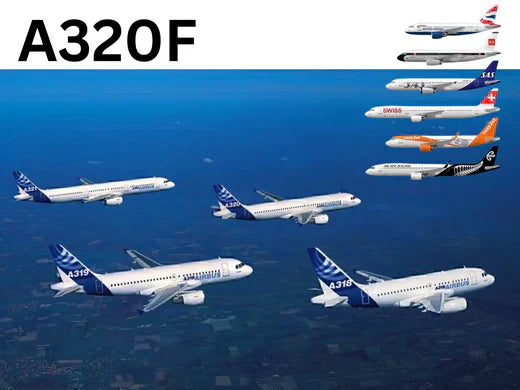
An Airbus A320-214 is shown in mid-flight against a backdrop of cloudy skies. The aircraft is marked with Airbus branding and displays the A320 model number on its tail.
Airbus A320 200 Technical Specifications, Systems and Engine Options
The Airbus A320 200 is the definitive production variant of the A320 family, replacing the short lived A320 100 with the addition of wingtip fences (later optional Sharklets) and increased fuel capacity. Designed as a short to medium haul narrowbody, the A320 200 balances payload, range and runway performance to serve routes from high density domestic shuttles to transcontinental sectors of up to 3,300 nm. Its 3.96 metre wide fuselage accommodates six abreast seating, wider than competing single aisle types, while the lower hold accepts standard LD3 45 containers for efficient cargo operations.
From a design standpoint, the A320 200 inherits the fully digital fly by wire architecture that made the A320 the first commercial aircraft to feature such a system when it entered service in 1988. Multiple MTOW options allow operators to tailor the aircraft to their network: lower weight variants save on landing fees and structural fatigue on short sectors, while higher MTOW options unlock the full range capability. This flexibility, combined with a choice of two engine families, has made the A320 200 one of the most versatile and widely ordered narrowbodies in aviation history. For readers interested in how this aircraft compares with its main rival in the same era, the Boeing 737 300 offers an informative counterpoint.
- Overall length: 37.57 m
- Wingspan: 34.10 m (with wingtip fences); 35.80 m with optional Sharklets
- Height: 11.76 m
- Fuselage outer width: 3.96 m
- Seating capacity: up to 180 passengers in high density layout; typically 150 to 164 in two class configuration
- MTOW options: from 73,500 kg (162,040 lb) up to 78,000 kg (171,960 lb), depending on engine and customer selection
- Maximum landing weight (MLW): 66,000 kg (145,505 lb)
- Maximum zero fuel weight (MZFW): 62,500 kg (137,789 lb)
- Fuel capacity: approximately 24,210 litres (6,300 US gal) in standard configuration; optional additional centre tank increases capacity to approximately 27,200 litres
- Range: up to 6,200 km (3,350 nm) with Sharklets at typical two class load, per Airbus published figures
- Maximum operating speed (VMO/MMO): 350 KIAS / Mach 0.82
- Typical cruise Mach: approximately Mach 0.78
- Service ceiling: 39,800 ft (12,131 m)
- Engines: CFM International CFM56 5A / 5B series or IAE V2500 A5, thrust class from 22,000 to 33,000 lbf depending on sub variant
- Avionics baseline: Thales/Honeywell glass cockpit with six ECAM displays, dual FMGC, and fully digital fly by wire sidestick controls
- Wingtip devices: standard wingtip fences; optional Sharklets (retrofit or line fit) providing approximately 4% fuel burn reduction on longer sectors
Systems, Flight Controls and Handling Technology
The A320 200 uses a triple redundant fly by wire system managed by seven flight control computers: two ELACs (Elevator Aileron Computers), three SECs (Spoiler Elevator Computers) and two FACs (Flight Augmentation Computers). In Normal Law, the system provides full flight envelope protection, including angle of attack limitation, load factor limiting, pitch attitude protection, bank angle protection and overspeed prevention. If computers degrade, the system transitions through Alternate Law to Direct Law, and ultimately to mechanical backup for the trimmable horizontal stabiliser and rudder. This layered approach means that complete loss of electronic control authority is an extremely remote scenario.
Braking on the A320 200 uses a digital anti skid system integrated with autobrake modes (LO, MED, MAX). Carbon brakes are standard on most current production aircraft. Spoiler deployment on ground is automatic (ground spoilers armed), with five spoiler panels per wing managed by the SECs. The Flight Management and Guidance System (FMGS) computes takeoff and landing performance using pilot entered weights, runway data and atmospheric conditions, while the Centralised Fault Display System (CFDS) logs maintenance data and supports on wing troubleshooting through Built In Test Equipment (BITE).
Published performance numbers for the A320 200 vary considerably depending on operator selected MTOW, cabin configuration (which affects operating empty weight), engine sub variant, atmospheric assumptions (ISA vs ISA+15°C), runway elevation, slope and condition. Airbus publishes baseline figures at standard ISA conditions with a typical two class layout and standard fuel reserves. Real world takeoff field lengths, landing distances and sector ranges will differ from these manufacturer baselines. Pilots and engineers should always refer to the aircraft specific performance documentation and approved flight manual for operational planning.
Engines: CFM56 5 and IAE V2500 Families
The A320 200 offers a choice between two engine families, each produced by a multinational partnership. The CFM56 5 series is manufactured by CFM International, a 50/50 joint venture between GE Aerospace (United States) and Safran Aircraft Engines (France). The original CFM56 5A, derived from the proven CFM56 2 and CFM56 3 families used on military tankers and the Boeing 737 Classic, powered the first A320 into service in 1988. The 5A series covers a thrust range of 22,000 to 26,500 lbf (98 to 118 kN) and was manufactured until 2003. It introduced Full Authority Digital Engine Control (FADEC) to commercial narrowbody aviation and achieved dispatch reliability above 99.9%. The later CFM56 5B series, certified in 1994, expanded the thrust envelope up to 33,000 lbf (147 kN) to cover the entire A320 family from A318 through A321. The 5B introduced a single bill of materials concept, allowing operators with mixed A320 family fleets to simplify spare parts inventory. Common A320 200 sub variants include the CFM56 5B4 and CFM56 5B6.
The IAE V2500 A5 is produced by International Aero Engines, a consortium that historically included Pratt & Whitney, Rolls Royce, Japanese Aero Engine Corporation (JAEC) and MTU Aero Engines. The V2500 entered A320 service in May 1989 and was selected by numerous major carriers as an alternative to the CFM56. It features wide chord fan blades for aerodynamic efficiency and a five stage low pressure compressor. Thrust ratings for A320 200 applications are typically derated to 22,000 to 27,000 lbf (98 to 120 kN), with higher ratings available for the A321. Both engine families incorporate FADEC and are managed identically from the flight deck, making the choice largely an airline economic and maintenance network decision rather than a handling or operational one. Beyond the A320 family, the broader CFM56 programme also powers variants of the Boeing 737 Classic and Next Generation, as well as military platforms, making it one of the most produced jet engines in history with over 33,000 units delivered.
Airbus A320 Family Variants Comparison (A319, A320ceo, A321, A320neo)
Scroll horizontally to see more →
| Parameter | Airbus A320-200 | Airbus A319-100 | Airbus A321-200 | Airbus A320neo |
|---|---|---|---|---|
| Entry into service | 1988 | 1996 | 1996 | 2016 |
| Engines | 2 × CFM56-5B or IAE V2500 | 2 × CFM56-5A or IAE V2500 | 2 × CFM56-5B or IAE V2500 | 2 × CFM LEAP-1A or PW GTF |
| Length | 37.6 m | 33.8 m | 44.5 m | 37.6 m |
| Wingspan | 35.8 m | 35.8 m | 35.8 m | 35.8 m |
| Height | 11.8 m | 11.8 m | 11.8 m | 11.8 m |
| Typical seating and layout | 2-class: 150–180 passengers | 2-class: 120–140 passengers | 2-class: 185–220 passengers | 2-class: 150–180 passengers |
| MTOW | 77 t | 75.5 t | 93.5 t | 79 t |
| Range | 3,100 nm | 3,700 nm | 3,000 nm | 3,400 nm |
| Cruise speed | 0.78 Mach | 0.78 Mach | 0.78 Mach | 0.78 Mach |
| Service ceiling | 39,000 ft | 39,000 ft | 39,000 ft | 39,000 ft |
| Program note | Baseline narrowbody for medium-haul routes | Shortened variant for higher density regional routes | Stretched high-capacity variant for dense short/medium routes | New engine option with 20% fuel savings and Sharklets |
Scroll horizontally to see more →
The table compares key specs across Airbus A320-family variants, showing how the A319 is shorter with fewer seats but the longest range (3,700 nm), while the A321 is the stretched, highest-capacity option (185–220 seats) with the highest MTOW (93.5 t) yet slightly less range (3,000 nm). The A320neo matches A320 dimensions and seating but updates to LEAP-1A/PW GTF engines, boosting range to 3,400 nm versus 3,100 nm for the A320ceo.
Airbus A320-200 Operations: Typical Routes, Missions and Airlines Worldwide
The Airbus A320-200 is optimised for short to medium haul missions, typically covering stage lengths between 500 and 5,500 km (270 to 2,970 nm). Most commercial flights operated by this variant fall within the 1,000 to 3,500 km range, with flight durations spanning roughly 1.5 to 6 hours. According to FlightGlobal, Airbus reports an average flight duration of 1.82 hours per cycle across the A320 family fleet, a figure that exceeds the original design assumption of 1.25 hours per cycle. In daily service, operators typically achieve between 7 and 8.5 block hours per aircraft per day, translating into three to five flight cycles depending on sector length and turnaround times.
The Airbus A320-200 thrives in both hub and spoke networks and point to point operations. Full service carriers deploy it on dense domestic trunk routes and intra continental connections radiating from major hubs such as London Heathrow, Frankfurt, Paris Charles de Gaulle, Dubai, Delhi and Beijing. Low cost carriers favour it on high frequency point to point services linking secondary and regional airports where lower aeronautical charges and rapid turnarounds maximise aircraft utilisation. Its ability to operate from runways as short as 2,100 m at sea level and its compliance with ICAO Code C standards allow it to serve a very wide range of airports.
Operators of the older A320 200 (ceo) variant face several challenges. Fuel burn is approximately 15 to 20 percent higher per seat mile compared with the A320neo, which places pressure on operating economics, particularly on longer sectors. Ageing airframes also carry a growing maintenance burden as structural inspections and component overhauls become more frequent. At hot and high airports, where ambient temperatures and elevation reduce engine thrust and aerodynamic lift, the A320-200 may require payload restrictions or reduced takeoff weights to meet field length requirements. Additionally, stricter noise regulations at certain European airports may limit curfew operations for ceo powered aircraft compared with their quieter neo successors. For pilots and engineers seeking a deeper understanding of the A320-200 and its systems, the comprehensive reference Ready for Take Off covers key technical topics relevant to interview preparation and operational knowledge.
Where the Airbus A320-200 Operates Around the World
The Airbus A320-200 has been delivered to more than 300 operators since its entry into service in 1988, making it one of the most widely distributed narrowbody aircraft ever built. Its global footprint spans Europe, North and South America, Asia and the Middle East, and Africa. In Europe, it serves as the backbone of both legacy carriers and the continent's extensive low cost sector, connecting capitals, leisure destinations and regional cities. Across North and South America, it supports high frequency domestic shuttle routes and cross border services alike. In Asia, the type underpins rapid traffic growth in markets such as India, China and Southeast Asia, while Middle Eastern operators use it for regional connectivity. In Africa, a smaller but growing number of airlines rely on the A320-200 for domestic and intra continental services.
- Europe: The region hosts some of the largest A320-200 fleets in the world. easyJet operates over 300 A320 family aircraft on routes throughout western and southern Europe. Wizz Air uses more than 200 A320 family jets to connect central and eastern European cities at low fares. Vueling deploys around 124 A320 family aircraft from its Barcelona base. Among full service carriers, Lufthansa operates approximately 181 A320 family aircraft on short haul services from Frankfurt and Munich, while Air France uses the type for domestic and European routes out of Paris Charles de Gaulle. Aegean Airlines, Aer Lingus and Finnair also rely on A320-200s for their intra European networks.
- North and South America: In North America, Frontier Airlines and Spirit Airlines operate all Airbus fleets that include A320-200s on ultra low cost domestic and Caribbean routes. JetBlue also uses the type on services across the eastern United States and the Caribbean. Air Canada operates A320-200s for domestic and transborder shuttle services. In South America, LATAM Airlines group and JetSmart deploy A320-200s on domestic and regional routes across Chile, Colombia, Peru and Argentina, often in all economy high density configurations to maximise capacity on competitive routes.
- Asia and the Middle East: AirAsia operates approximately 69 A320-200s across its Southeast Asian network, making it one of the largest regional operators of the type. IndiGo in India retains a number of A320-200 ceo aircraft alongside its growing neo fleet. China Southern Airlines and China Eastern Airlines use A320-200s extensively on domestic routes within China. In the Middle East, Qatar Airways operates 29 A320-200s for regional services, Air Arabia deploys 35 on low cost routes from Sharjah, and Middle East Airlines flies 9 A320-200s from Beirut. flyadeal in Saudi Arabia operates 11 A320-200 ceo aircraft alongside its neo fleet.
- Africa: South African Airways is one of the continent's most prominent A320-200 operators, with a fleet of approximately 14 A320-200s used for domestic routes and regional connections across southern and eastern Africa. Air Côte d'Ivoire operates seven A320 family aircraft connecting West African destinations. Tunisair also uses the type for domestic and regional services from Tunis. The growing adoption of the A320-200 in Africa reflects improving air connectivity on the continent, although fleet sizes remain smaller than in other regions.
Typical Seating Configurations on the Airbus A320-200
The Airbus A320-200 cabin is 3.70 m wide, making it the widest single aisle aircraft in its class and 18 cm (7 inches) wider than the Boeing 737. Standard seating is arranged in a six abreast, 3+3 layout. According to manufacturer data, the A320-200 accommodates 150 passengers in a typical two class layout or up to 180 in a high density all economy configuration.
Full service network carriers generally configure their A320-200s with between 150 and 168 seats split across two or three cabin classes. American Airlines, for example, fits 150 seats: 12 in First Class with 21 inch wide seats at 36 inch pitch, 18 in Premium Economy at 34 inch pitch, and 120 in Economy. Delta Air Lines offers 157 seats with 16 in First Class (2+2 layout), 18 in Comfort+ and 123 in Main Cabin. Lufthansa configures its A320-200s with 168 seats in a two class European layout. These carriers prioritise extra legroom and premium products to attract business travellers on competitive short haul routes.
Low cost and leisure carriers favour high density layouts that maximise revenue per flight. Qantas configures its A320-200 with 180 all economy seats at a tighter pitch of 28 to 30 inches. Similarly, ultra low cost carriers like Frontier and Spirit push towards the 180 seat mark in all economy, single class cabins. These configurations use slimline seats to preserve passenger space while fitting more rows into the fuselage. Seat maps for specific airlines can be compared on resources such as SeatMaps.com.
In this video, watch the Airbus A380-800 and Aer Lingus Airbus A320-200 take off from Birmingham Airport BHX-EGBB, highlighting the size contrast and noting the A320’s 24.2-year service life and 2025 breakup.
Airbus A320 200 Safety Record: How Safe Is This Aircraft?
Since entering service in 1988, the Airbus A320 200 has accumulated one of the most extensive operational histories of any commercial airliner. As part of the broader A320 family, which had surpassed 12,260 cumulative deliveries by October 2025, the type operates with hundreds of airlines worldwide. Airbus reports nearly 12,000 single aisle aircraft in active service as of early 2026. Through to 2015, the A320 family recorded a fatal hull loss rate of 0.12 per million takeoffs, placing it among the safest narrowbody jets ever produced. As of March 2024, the family had been involved in 38 hull loss accidents across roughly 180 recorded incidents, a figure that must be weighed against the billions of passengers carried and tens of millions of flight cycles completed over more than three decades. The vast majority of those flights have been completed without any safety event, and the overall trend has been one of continuous improvement in both aircraft design and operational procedures.
Notable Accidents and the Lessons They Prompted
Several high profile events involving the A320 200 and closely related sub variants have driven meaningful changes in aviation safety. While each event was tragic, the industry response has consistently resulted in stronger safeguards for crews and passengers.
- Air France Flight 296Q, Habsheim (1988): During a low altitude demonstration flyover at Mulhouse Habsheim Airport, the A320 struck trees at the end of the runway. Three of the 136 occupants lost their lives. The BEA investigation concluded that the primary factors were the very low flyover height, very slow speed, and late application of go around power, rather than any mechanical failure. Recommendations included banning passengers from demonstration flights and ensuring crews receive full airfield reconnaissance and detailed maps before such operations.
- US Airways Flight 1549, New York (2009): An A320 214 struck a flock of Canada geese shortly after takeoff from LaGuardia Airport, resulting in the loss of thrust in both engines. The crew successfully ditched the aircraft in the Hudson River, and all 155 occupants survived. The NTSB investigation (Report AAR 10/03) praised crew decision making and resource management. The event accelerated work on improved bird ingestion testing standards for turbofan engines, enhanced wildlife hazard management programmes at airports, and reinforced the importance of ditching preparedness training for flight crews.
- Germanwings Flight 9525, French Alps (2015): An A320 211 was deliberately crashed by the co pilot, who had locked the captain out of the flight deck. All 150 occupants perished. The EASA Task Force responded with six key recommendations: mandatory psychological evaluation of pilots before entering service and during recurrent medicals, random drug and alcohol testing, stronger oversight of aeromedical examiners, the creation of pilot peer support programmes, and the recommendation that at least two authorised persons remain in the cockpit at all times during flight.
- AirAsia Flight 8501, Java Sea (2014): An A320 216 was lost during a flight from Surabaya to Singapore in convective weather, with all 162 occupants perishing. The Indonesian KNKT investigation identified a malfunctioning rudder travel limiter sensor and the subsequent crew response as contributing factors. Airbus mandated inspections and upgrades to the rudder travel limiter components across the A320 fleet, and airlines revised pilot training to emphasise high altitude upset recovery and improved use of weather radar.
Each of these events, despite their different circumstances, led to tangible improvements in aircraft design, crew procedures, regulatory oversight, or all three. The willingness of the aviation industry to investigate thoroughly and act decisively is a key reason why safety records continue to improve.
How Safe Is the Airbus A320 200 Today?
When measured against the sheer volume of flights operated every day, the Airbus A320 200 stands as one of the safest aircraft types in service. According to Airbus accident statistics, all commercial jet generations combined achieved a fatal accident rate of just 0.09 per million flight cycles in 2025. Generation 4 fly by wire aircraft, which include the A320 family, recorded an even lower 10 year moving average of 0.04 per million flight cycles, reflecting the benefits of flight envelope protection, alpha floor safeguards, and redundant hydraulic and electrical systems. The type's digital fly by wire architecture actively prevents the aircraft from exceeding safe limits in speed, bank angle, and angle of attack, reducing the potential for loss of control events by over 90 per cent compared to earlier generation jets.
Regulatory bodies such as EASA and the FAA continuously review and update airworthiness directives, while operators follow standardised operating procedures refined over decades of service. Pilot training programmes now incorporate enhanced upset recovery techniques, crew resource management, and mental health awareness, all strengthened by lessons learned from past events. These layers of defence, from aircraft design to crew training to regulatory oversight, work together to make commercial flying remarkably safe. According to industry data, the risk of a fatal accident on a commercial jet remains far below that of everyday road travel, confirming that aviation continues to be one of the safest modes of transport available.
01 What is the typical range of the Airbus A320-200?
The Airbus A320-200 has a range of up to 6,500 km (4,000 miles) depending on configuration and load. Standard variants achieve 2,600 to 2,870 nautical miles with typical fuel capacity. Higher gross weight models with supplementary tanks extend this to around 3,050 nautical miles.
02 What are common cabin configurations and passenger capacity on the Airbus A320-200?
Passenger capacity reaches up to 180 seats in a single-class layout. Airlines like British Airways and Delta configure it with 157 seats including 16 first-class, 18 comfort, and 123 main cabin seats. Seat pitch varies from 30-36 inches, with widths around 17-21 inches.
03 Which airlines operate the Airbus A320-200 and on what routes?
Major operators include British Airways with 60 aircraft, Lufthansa, Delta, and Discover Airlines. It serves short- to medium-haul routes like intra-European flights, transatlantic hops under 4,000 miles, and regional U.S. routes. The aircraft excels on high-frequency routes with 2-4 hour durations.
04 How fuel-efficient is the Airbus A320-200 compared to similar aircraft?
The A320-200 offers good fuel efficiency for its class, with variants burning less per seat than older Boeing 737-300s. Sharklets on later models reduce fuel use by 3.5-4%. Newer A320neo upgrades cut consumption by up to 20% over ceo models.
05 What is the safety record and key design features of the Airbus A320-200?
The A320-200 has a strong safety record as part of the reliable A320 family, with fly-by-wire controls enhancing stability and reducing pilot workload. Features like advanced wing design and dual engines (IAE V2500 or CFM56) contribute to its safety. No design flaws have led to widespread issues.
06 What should passengers know about comfort and seat selection on the Airbus A320-200?
Rows 1 and emergency exit rows offer extra legroom but may have fixed armrests. Windows align well over seats A and F; avoid D for center views. The cabin is relatively quiet with low noise levels, and winglets help smooth turbulence response on this stable narrowbody.