

Sud Aviation Caravelle III: programme launch, evolution and identity
The Sud Aviation Caravelle III sits at an important point in the SE 210 Caravelle story: the moment when the original French short to medium range jetliner matured from its early production standard into the most widely built Avon powered series. To understand why the Caravelle III existed, it helps to start with the requirement that shaped the whole family. In October 1951, French authorities issued a specification for a medium range transport, and the design response eventually converged on a twin engine jet with engines mounted at the rear for a cleaner wing and lower cabin noise. The resulting Caravelle programme also benefited from licensing and design influences from the de Havilland Comet, including the nose and cockpit layout, while the rest of the airframe was locally developed.
Programme origins and the step from prototypes to production
After evaluation of competing proposals, SNCASE was selected and formally tasked to build prototypes. On 6 July 1953, an order was placed for two prototypes plus static airframes for fatigue testing. The first prototype rolled out on 21 April 1955 and flew on 27 May 1955, beginning a flight test effort that would position the Caravelle as one of the defining European jet airliners of its era. During this period, the manufacturer itself changed shape: in 1956, SNCASE was merged into Sud Aviation, but the aircraft retained its original SE designation.
As the prototypes accumulated flight hours and demonstrated the value of the rear engine layout and low wing, airline interest translated into early orders. Air France placed an order in 1956, followed by Scandinavian Airlines System in 1957. In May 1959, the Caravelle received airworthiness certification, enabling passenger operations. On 26 April 1959, the Caravelle performed its first flight with paying passengers for SAS, and service with Air France followed shortly after. For a concise reference on the programme timeline and the full variant family tree, see Sud Aviation Caravelle.
The first production standard was the Caravelle I, which first flew on 14 May 1958. It established the baseline airframe dimensions used by the early series and introduced the Avon powered production configuration that would be refined rather than reinvented through subsequent marks. Sud Aviation assembled Caravelles at Blagnac near Toulouse, while major components were also produced via subcontracting across France and abroad, reflecting a production approach that mixed central final assembly with distributed manufacture.
Why the Sud Aviation Caravelle III was created
The Caravelle family evolved largely through engine development. As Rolls Royce improved the Avon, Sud Aviation could offer more thrust without changing the fundamental airframe concept. This path led directly to the Sud Aviation Caravelle III, created around the uprated Avon installation that distinguished it from the Caravelle I and the interim Caravelle IA. The Caravelle IA, powered by Avon Mk 526, first flew on 11 February 1960, but the more significant step was the Caravelle III, which first flew on 30 December 1959 and entered service with Alitalia in April 1960.
On the Caravelle III, the defining technical milestone is its powerplant standard: Rolls Royce Avon RA 29/3 Mk 527 and Mk 527B engines, each rated at 5,170 kgf of thrust. In practical airline terms, this represented a straightforward but valuable improvement route: keep the established Caravelle handling qualities and cabin concept, while strengthening performance margins through more available thrust. It also became the volume variant within the Avon generation: the Series III was the best selling Caravelle series, with 78 built, and earlier Caravelle I aircraft were widely upgraded to the Series III standard.
For additional context on the Caravelle as a landmark French civil jet and the way multiple variants were developed over time, the Musée de l’Air et de l’Espace provides an official overview of the SE 210 Caravelle family and its significance as a post war civil aviation renewal aircraft: Sud Aviation SE 210 Caravelle.
While the Caravelle III itself is best understood as an engine driven refinement rather than a radical redesign, it sits in a broader development arc. Later Avon powered Caravelles such as the VI N pushed thrust and weights further, and the VI R introduced thrust reversers plus other changes including revised cockpit glazing and brake improvements, reflecting a gradual response to airline operating preferences and airport performance expectations. For safety and service context across the type, including baseline entry into service timing and general aircraft information, the Flight Safety Foundation’s Aviation Safety Network maintains a type reference: Sud Aviation SE 210 Caravelle specs.
Pilots and engineers studying classic rear engine jet transports often focus on how powerplant changes ripple into performance planning, dispatch margins and handling considerations. For structured learning support that complements technical reading, pilot coaching programmes can help connect aircraft development details to real world operating decision making.
How the Sud Aviation Caravelle III differs from adjacent variants
The Sud Aviation Caravelle III is closest in configuration to the Caravelle I and Caravelle IA, sharing the same overall early series airframe dimensions and general systems philosophy, but it is clearly separated from them by its Avon Mk 527 or 527B installation and the associated thrust level. Compared with the later VI N and VI R, the Caravelle III represents the earlier, simpler Avon generation before the VI R introduced thrust reversers and other operator driven refinements. In other words, the Caravelle III is often the reference point for the mature baseline Avon Caravelle before the series diversified further for specific airline demands.
Variant identifiers for the Sud Aviation Caravelle III include:
- First flight: 30 December 1959
- Entry into service: April 1960 with Alitalia
- Engines: Rolls Royce Avon RA 29/3 Mk 527 or Mk 527B
- Rated thrust: 5,170 kgf per engine
- Production and upgrade context: Series III was the best selling Caravelle series with 78 built, and earlier Series I aircraft were widely upgraded to Series III standard

An Air France Sud Aviation SE-210 Caravelle III, registered F-BHRS and named 'Normandie', is captured mid-flight against a clear blue sky.
Sud Aviation Caravelle III technical specifications and systems highlights
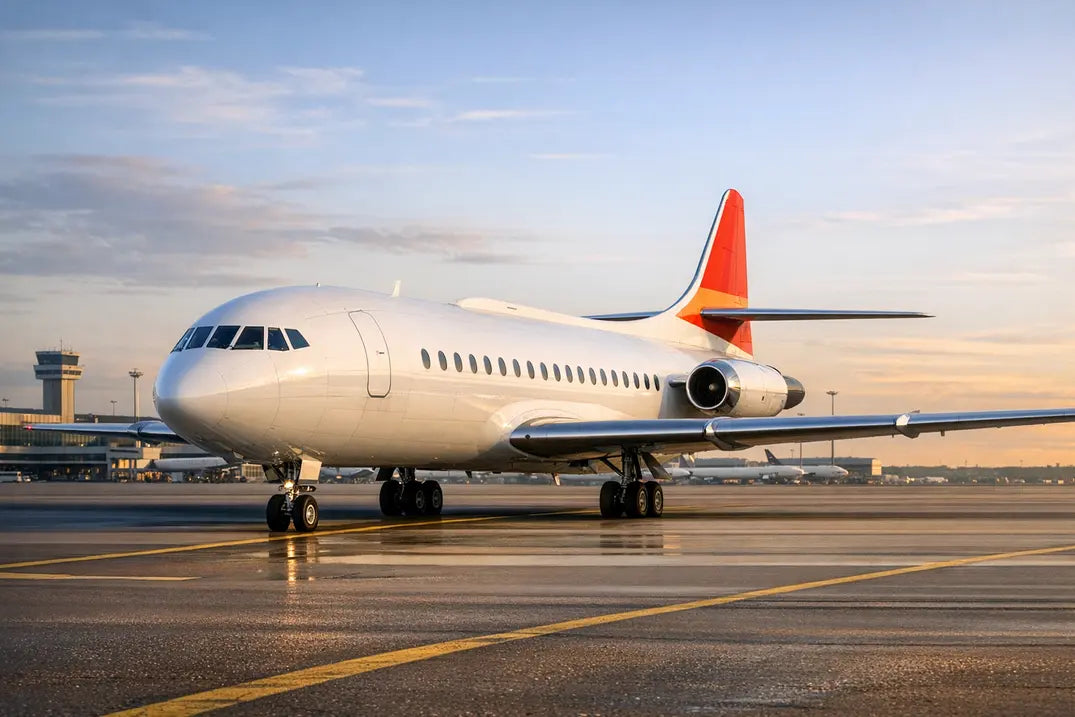
The Sud Aviation Caravelle III is an early generation twin jet designed for high frequency European sector lengths where turn time, runway flexibility and passenger comfort mattered as much as raw range. Compared with the first production Caravelle versions, the Caravelle III is primarily defined by its uprated Rolls Royce Avon turbojets, while retaining the same core airframe concept: a clean swept wing with the engines moved aft to keep the wing aerodynamically efficient and the cabin quieter than many wing mounted contemporaries.
Technically, the Caravelle III is a study in practical trade offs. Rear fuselage mounted engines simplify wing structure and keep high lift devices unobstructed, but concentrate mass at the rear and place much of the propulsion and accessory complexity in the tail zone. For operators and engineers, the aircraft’s value is not in advanced automation, but in robust first generation jet systems, straightforward performance planning, and a design philosophy that prioritised predictable airline use. For type specific operational notes and community discussion around legacy airliner handling and procedures, structured pilot communities can be useful, including guides such as airline pilot forums and why they matter.
- Aircraft variant: Sud Aviation Caravelle III
- Role: short and medium range narrow body jet airliner
- Configuration: twin engine, rear fuselage mounted engines, T tail
- Flight control actuation: fully hydraulic flight controls (Caravelle family feature noted by the Musée de l’Air et de l’Espace)
- Powerplant family: Rolls Royce Avon turbojet series (Caravelle III uses the Avon Mk 527 standard in most published data)
- Crew concept: classic three crew cockpit (two pilots plus flight engineer) typical of early jetliners
- Wing geometry (published figure): swept wing with a clean leading edge concept intended to support high lift flap performance without engine nacelle interference
- Operational emphasis: dispatch reliability and predictable sector performance rather than long range cruise optimisation
Systems and handling relevant design features
From a systems perspective, the Sud Aviation Caravelle III sits firmly in the pre digital airline era. The cockpit philosophy is based on direct pilot control with limited automation, supported by a flight engineer managing engine and aircraft systems. This architecture influences workload distribution: pilots focus on flight path and manual energy management, while the engineer handles configuration and system monitoring, particularly around start, pressurisation management, and abnormal checklists.
One of the most important family level technical characteristics is the Caravelle’s fully hydraulic flight control system, highlighted by the Musée de l’Air et de l’Espace in its description of the SE 210 Caravelle design. For pilots, hydraulic actuation provides consistent control forces across the envelope compared with purely mechanical linkages, but also makes hydraulic integrity and procedural discipline central to safe operations. In service, this affects maintenance priorities around leak checks, fluid contamination control, and functional testing after component replacement.
The rear engine layout also shapes handling and line operations. With engines mounted on the rear fuselage, the wing remains aerodynamically clean, supporting efficient lift generation and flap effectiveness for the typical short and medium range mission. It also changes ground servicing patterns: engine access, inspection routines, and foreign object damage risk management are concentrated around the rear ramp and tail zone rather than underwing stands. This arrangement can also benefit cabin noise levels, a design aim often cited for early rear engine airliners.
Published performance figures for the Caravelle III should be treated as representative rather than absolute. Numbers vary because operators flew different cabin layouts and payload profiles, because weights and equipment differed across airframes and conversions, and because performance depends heavily on atmospheric assumptions, runway slope, surface condition, and regulatory reserve policies. Even when two sources quote the same maximum speed or range, the underlying basis may differ, so comparisons should always specify the condition, for example typical payload versus maximum payload, and standard day versus hot and high conditions.
Rolls Royce Avon powerplant on the Sud Aviation Caravelle III
The defining technical differentiator of the Sud Aviation Caravelle III is its Rolls Royce Avon installation, representing the continuing development of the Avon turbojet line used across several major civil and military programmes. On the Caravelle III, the Avon is a pure turbojet rather than a turbofan, which has direct operational consequences: higher specific fuel consumption than later low bypass designs, strong thrust response characteristics for its era, and a noise signature that later drove the industry toward higher bypass ratios and improved acoustic treatments.
In practical airline service, the Avon installation shaped both performance and maintenance planning. Turbojet efficiency tends to penalise longer sectors compared with later turbofan Caravelle variants, so the Caravelle III is best understood as optimised for the stage lengths it was built for: frequent cycles, moderate cruise altitudes for its era, and a focus on dependable thrust rather than fuel economy. Maintenance wise, Avon equipped aircraft rely on inspection discipline around hot section condition, oil system health, and vibration trends. While modern health monitoring and FADEC style control logic are not part of the Caravelle III era, the straightforward nature of the engine and its systems made troubleshooting methodical: verify indications, isolate systems, and follow procedural fault finding supported by engineering judgement.
For readers who want authoritative museum backed context on the Caravelle design and its broader technical lineage, two useful references are the Flygvapenmuseum presentation of the TP 85 Caravelle (based on the Caravelle III airframe) and the aircraft description pages maintained by major museums that preserve the type, such as the Pima Air and Space Museum SE 210 Caravelle exhibit. While preserved aircraft may represent different sub variants, these institutional sources help anchor the design’s core configuration and systems philosophy in documented collection records.
Comparison of Early Jet Airliners: Caravelle III vs Rivals
Scroll horizontally to see more
| Parameter | Sud Aviation Caravelle III | de Havilland Comet 1 | Sud Aviation Caravelle VI-N | BAC One-Eleven 200 |
|---|---|---|---|---|
| Entry into service | 1960 | 1952 | 1963 | 1965 |
| Engines | 2 × Rolls-Royce Avon RA.29/3 Mk.527 | 4 × de Havilland Ghost | 2 × Rolls-Royce Avon RA.29/6 Mk.531 | 2 × Rolls-Royce Spey |
| Length | 32.0 m | 28.6 m | 32.4 m | 28.5 m |
| Wingspan | 34.3 m | 35.1 m | 34.3 m | 29.0 m |
| Height | 8.7 m | 8.7 m | 8.7 m | 7.3 m |
| Typical seating and layout | 2-class: 64–72 passengers | 2-class: 44–56 passengers | 2-class: 76–80 passengers | 2-class: 70–89 passengers |
| MTOW | 46 t | 48 t | 50 t | 47 t |
| Range | 1,000 nm | 1,300 nm | 1,350 nm | 1,500 nm |
| Cruise speed | 0.82 Mach | 0.83 Mach | 0.82 Mach | 0.84 Mach |
| Service ceiling | 39,000 ft | 35,000 ft | 39,000 ft | 37,000 ft |
| Program note | Most-built Caravelle variant with uprated Avon Mk.527 engines | Pioneer jet airliner, first commercial jet service | Further uprated engines and improved performance variant | British short-haul rival with underwing engines |
Scroll horizontally to see more
This table compares the Sud Aviation Caravelle III with similar early jet airliners, including the Comet 1, Caravelle VI-N, and BAC One-Eleven 200. While the Caravelle III offered a solid balance of speed, range, and passenger capacity for its time, the Comet had a longer range but was earlier and less spacious. The One-Eleven 200 featured the highest cruise speed and passenger capacity, indicating its more advanced short-haul performance. Each aircraft reflects different priorities in early jetliner development.
Sud Aviation Caravelle III routes missions and airlines worldwide
Sud Aviation Caravelle III was built for short and medium range airline work: frequent, timetable driven services linking major cities, with enough performance for longer Mediterranean and Middle East sectors when payload and weather allowed. Its rear mounted turbojets kept the wing clean and helped passenger comfort forward of the engines, while the aircraft’s integrated rear stairs suited airports with limited ground infrastructure, reducing dependence on terminal boarding bridges and mobile steps.
In practice, operators scheduled the aircraft on sectors that balanced cruise efficiency, turnaround time, and the economics of a first generation twin jet. A useful snapshot of real utilisation comes from the Air France Caravelle III registered F BOHB: the airframe had accumulated 1001 airframe hours over 579 flights at the time of its loss on 11 September 1968, an average of about 1 hour 44 minutes per flight. The record is documented in the Aviation Safety Network entry and supports the idea of the Caravelle III as a multi sector, high cycle aircraft in scheduled service, rather than a long stage length machine.
Typical missions therefore ranged from sub one hour hops between close city pairs to two hour plus sectors across seas and deserts. In Europe this often meant dense trunk and domestic patterns from capital city airports and primary hubs, while also reaching secondary airports where a self contained boarding solution and relatively modest passenger capacity worked well. The aircraft’s period of service also explains why it is so closely associated with legacy network carriers: it was introduced in an era of regulated fares and structured route authorities, long before the modern low cost expansion. For context on those business models, see differences between low cost and legacy airlines.
Operationally, the Caravelle III demanded careful cost control. Turbojets brought higher fuel burn than later turbofans, and noise became a growing constraint as airports tightened procedures and, later, regulation. On the technical side, operators also had to manage classic early jet items: hot day performance margins, brake and tyre wear on short turn schedules, and engine support for the Avon family. These factors pushed many airlines toward later Caravelle versions or newer competitors when available, even where crews and passengers appreciated the aircraft’s handling and cabin ambience.
Where the Sud Aviation Caravelle III operated worldwide
The operational footprint of the Sud Aviation Caravelle III was global, but it was not uniform. Europe was the centre of gravity, where flag carriers and specialist domestic operators used it on business heavy schedules and Mediterranean links. In North and South America, Caravelle III aircraft appeared both in early jet age services and later in secondary markets, often with smaller carriers that valued an affordable, proven airframe. In Asia, the type served regional missions ranging from Levant to Gulf sectors to Southeast Asian services where airports and route structures suited a roughly eighty to ninety seat jet. In Africa, Maghreb operators and later West African users employed the Caravelle III on a mix of domestic trunk flying, links to Europe, and ad hoc charter style missions.
Because many airframes moved between owners over decades, a single Caravelle III could have a European start and later operate in Africa or the Americas. That second life pattern is part of what makes the variant interesting for fleet history: it connects the early European jet age with later, more diverse operational environments.
- Europe: Air France used Caravelle aircraft as a core medium range tool on Europe and Mediterranean flying, as described in its official fleet history (Air France fleet history). Air Inter built a high frequency domestic network around the Caravelle III, concentrating on business routes from Paris Orly to major French cities. Alitalia operated the Caravelle III on Italian domestic and near international services suited to high cycle utilisation. Swissair employed the type on intra European links from Zurich and Geneva where schedule density and premium passengers valued speed. SAS integrated the Caravelle family into Scandinavian and European flying during its transition to jets, a role highlighted by the Norwegian Museum of Science and Technology Caravelle exhibit. Finnair also featured Caravelles early in its jet era, with preserved examples and restoration work helping document that chapter.
- North & South America: Varig introduced the Caravelle III into Brazilian operations in the early jet age, and the type appears in the safety record as a Varig operated Caravelle III (for example, PP VJD in Brazil). Avensa operated Caravelle III aircraft in Venezuela, also visible in the Aviation Safety Network database (YV C AVI). SAETA in Ecuador and Aerovías Guatemala in Central America are associated with Caravelle III operations in the later life of at least one airframe, reflecting the aircraft’s continued usefulness in thinner markets where runway and passenger demand matched its capabilities.
- Asia: Middle East Airlines operated the Caravelle III on regional routes, including Levant to Gulf missions, and the aircraft type is documented in the accident record (OD AEM). Thai Airways International appears in Caravelle III occurrences in the Aviation Safety Network type listing, consistent with regional services that benefited from a medium capacity jet. Air Cambodge also appears in the Caravelle III record in the same database, illustrating the aircraft’s role in Southeast Asian scheduled operations during that era.
- Africa: Royal Air Maroc used the Caravelle III on services linking Moroccan cities and European points, with the type documented in the accident record involving CN CCV on an Agadir to Casablanca sector that continued onward toward Paris (CN CCV). Air Algérie operated Caravelle III aircraft in North African and Mediterranean contexts, as evidenced by Aviation Safety Network photo documentation of an Air Algérie Caravelle III airframe. In West Africa, later operators such as Kabo Air flew Caravelle III aircraft in high utilisation, short to medium haul patterns where the combination of capacity and acquisition cost remained attractive.
Typical seating and cabin layouts
Most Sud Aviation Caravelle III cabins followed a simple, efficient narrow body layout built around five abreast seating in a two plus three arrangement. Across operators, the cabin was commonly configured for roughly eighty to around ninety passengers, with differences driven by the operator’s business model and route structure. Network airlines often balanced seat count with service standards, sometimes reserving additional space for a small premium section, galleys, and coat storage to support business travellers and higher yield city pairs. Higher density, single class arrangements tended to appear with charter or secondary market operators, where unit costs mattered more than onboard product.
Several documented passenger loads help illustrate the practical scale of the aircraft. For example, the Air France Caravelle III involved in the 11 September 1968 event carried 89 passengers on a domestic sector, with the official investigation material accessible via the BEA investigation report page. Preservation and restoration projects also provide valuable insight into cabin layout details, materials, and ergonomics; the ongoing work around a displayed Caravelle in Finland is summarised by Finavia’s note on the Turku Airport Caravelle.
For passengers, the layout combined the early jet age feel of a compact fuselage with relatively large cabin windows and a rear airstair boarding experience that remained memorable long after the aircraft left front line service. For operators and engineers, the cabin configuration had to align with weight and balance limits on short sectors with high baggage variation, a theme also noted in Air France’s historical fleet narrative (Air France fleet history).
This video presents the Sud Aviation SE 210 Caravelle, a pioneering short to medium-range jet airliner developed by the French Sud-Est industrial association, showcasing its design, history, and aviation legacy.
Sud Aviation Caravelle III safety record and how safe it is overall
The Sud Aviation Caravelle III is an early production variant of the SE 210 Caravelle family, a pioneering short to medium range European jetliner that entered airline service on 26 April 1959 and saw 282 aircraft produced between 1958 and 1972, according to an IATA historical overview of the programme. In service, Caravelle aircraft were typically used on high frequency routes, which is important context for safety: short sectors mean many take offs and landings, and those are the phases where most accidents occur.
Public, consolidated totals for the number of flights and cycles flown specifically by the Sud Aviation Caravelle III (as a standalone sub variant across all operators and decades) are not generally published in a single authoritative dataset. However, individual aircraft records show how cycle intensive this fleet could be: the Air France Caravelle III involved in Flight 1611 had accumulated 579 flights (cycles) in 1,001 airframe hours by September 1968 (ASN record). That utilisation pattern helps explain why Caravelle safety discussions often centre on approach, landing, and operational decision making, as well as fire prevention and containment.
Overall, the Caravelle III accident history should be read in the context of the first generation jet era. Compared with modern airliners, the aircraft operated with less automation, less capable weather and navigation aids, and without many later safety barriers such as advanced ground proximity warning, modern cockpit resource management standards, and today’s cabin fire detection requirements. When serious events occurred, investigative findings fed into changes in procedures, training, and system protection, both at operator level and through wider regulatory learning.
Notable accidents and serious incidents, and what changed afterwards
- Air France Flight 2005 (1961), a Sud Aviation Caravelle III, crashed during approach near Rabat in very low visibility. The ASN summary highlights challenging fog conditions and a non precision navigation context, with the investigation attributing the outcome primarily to instrument interpretation and approach execution factors (ASN record). In the years that followed across the industry, recurring lessons from similar events contributed to tighter discipline around non precision approach procedures, clearer stabilised approach criteria, stronger cross checking, and more conservative divert decisions when weather and approach aids do not support a safe continuation.
- Swissair Flight 306 (1963), a Sud Aviation Caravelle III, was lost after a fire initiated by brake overheating during taxi, which then led to the loss of essential structure. The official Swiss investigation report is publicly available (SUST final report), and the event is also summarised in the recognised Aviation Safety Network database (ASN record). Operationally, this type of accident reinforced conservative taxi techniques, clear limits on high power taxi practices, stronger attention to brake energy and cooling, and a sharper focus on wheel well and landing gear bay fire risk management through procedures, inspection, and design protections.
- Middle East Airlines Flight 444 (1964), a Sud Aviation Caravelle III, was lost during the approach into Dhahran in adverse conditions, including reduced visibility during a sandstorm. The investigation was unable to establish a single probable cause (ASN record). From a safety systems perspective, accidents in this category historically supported stronger operational guidance for approaches in severe visibility degradation, improved weather reporting and dissemination, clearer go around decision triggers, and enhanced altitude awareness practices, particularly when visual cues can be unreliable.
- Air France Flight 1611 (1968), a Sud Aviation Caravelle III, was lost after an in flight cabin fire, with the investigation concluding that the aircraft was lost due to a cabin fire of undetermined origin (ASN record). Cabin fire events, including those involving lavatory and galley areas, helped drive a long term tightening of cabin fire prevention and response: stronger crew drills, improved material standards, better containment and extinguishing capability for waste and electrical fires, and progressively stricter limitations on ignition sources in the cabin environment.
How safe is the Sud Aviation Caravelle III?
The Sud Aviation Caravelle III was certified and operated under the airworthiness and operational standards of its time, and its safety record broadly reflects the risk profile of early commercial jet transport: intensive short haul utilisation, less capable navigation and warning systems than those used today, and a learning curve in procedures as jet operations matured. Many of the most important safety improvements relevant to Caravelle era events, such as better approach stabilisation criteria, more effective fire detection and suppression philosophy, and standardised multi crew operating practices, were implemented progressively across commercial aviation rather than being specific to one aircraft type.
For practical safety comparisons, it is more meaningful to benchmark against modern commercial aviation statistics than to imply a simple one to one equivalence between a 1960s design and current fleets. IATA reports that the all accident rate in 2024 was 1.13 accidents per million flights, across 40.6 million flights, while emphasising the long term trend of continuous improvement (IATA 2024 Safety Report release). ICAO has also published recent global safety statistics and trends in its State of Global Aviation Safety reporting (ICAO safety data update).
In operational terms, the biggest determinant of safety is not the badge on the nose but the system around the aircraft: maintenance quality, disciplined standard operating procedures, and training that supports sound judgement in weather, approach planning, and abnormal situations. That is why structured training pathways and robust airline operating cultures matter, whether in type ratings, recurrent training, or early career programmes (example training pathway). In summary, the Caravelle III belongs to an earlier generation with a different safety environment, but the industry’s learning from aircraft like it is part of the reason aviation remains one of the safest modes of transport.
01 What were the typical routes and range for the Sud Aviation Caravelle III?
The Sud Aviation Caravelle III had a range of 1,650 to 2,500 km, making it ideal for medium-haul European routes like Paris to Rome or London to Madrid. Airlines used it for efficient operations on these shorter jet services, often carrying up to 80 passengers. An extra fuel tank in this variant extended its reach compared to earlier models.
02 How was the cabin laid out on the Sud Aviation Caravelle III, and what was the passenger experience like?
The Caravelle III seated about 80 passengers in a narrow-body layout with a single aisle. Its rear-mounted engines provided a quieter cabin than many early jets, with good noise reduction from upgraded Rolls-Royce Avon engines. Passengers enjoyed large windows and a smooth ride due to the clean wing design.
03 Which airlines operated the Sud Aviation Caravelle III and on what routes?
Alitalia was the launch customer, entering service in April 1960, with others like Finnair converting earlier models to III standard. These airlines flew it on intra-European routes and some trans-Mediterranean paths. It became the most produced variant, serving many carriers on medium-distance flights.
04 How did the Sud Aviation Caravelle III perform compared to similar aircraft?
Powered by Rolls-Royce Avon Mk 527 engines with 5,170 kgf thrust each, it cruised at 746-845 km/h up to 12,000 m, outperforming props but matching contemporaries like the BAC One-Eleven in speed. Better takeoff performance than the Caravelle I allowed heavier loads. It competed with the de Havilland Comet and early DC-9 on efficiency for short jets.
05 What was the safety record and key design features of the Sud Aviation Caravelle III?
The Caravelle series, including the III, had a strong safety record for its era with few major incidents tied to design flaws. Key features included rear engines for reduced cabin noise, a cruciform tail for stability, and tricycle landing gear. Some were equipped with early automatic landing systems like Sud-Lear Phase IIIA.
06 What practical tips would a traveler on the Sud Aviation Caravelle III appreciate?
Seats near the wings offered the smoothest ride during turbulence due to the clean aerodynamics. Large windows provided excellent views, especially from forward rows. The quieter cabin from rear engines made it comfortable for the 80-passenger layout on typical 2-hour flights.