

Oman Air Overview & Company Profile
Oman Air is the flag carrier of the Sultanate of Oman, founded in 1993 and headquartered at Muscat International Airport (MCT). Once part of the Oman Aviation Group umbrella, the airline today sits directly under the Oman Investment Authority (OIA), the country's sovereign wealth fund, after a major restructuring that dissolved the holding group and redistributed assets between Oman Air and Oman Airports Management Company. The carrier became a full member of the oneworld alliance on June 30, 2025, joining British Airways, Qatar Airways, American Airlines, Cathay Pacific, Iberia, Finnair and Japan Airlines on a single global network.
Oman Air operates around 41 to 44 destinations across 24 countries, with India alone accounting for 16 destinations and the rest split between the Gulf, the wider Middle East, East Africa, Southeast Asia and Europe. Following the 2024 to 2025 restructuring that cut roughly 1,100 jobs, total headcount sits at approximately 3,200 staff, with the airline focused on a leaner cost base, a streamlined Boeing-dominated fleet, and selective network growth aligned with Oman's Vision 2040 economic diversification programme. Tourism and aviation are core pillars of that national plan, and Oman Air is the primary instrument for delivering both.
Oman Air's profile in 2026 is very different from that of 2019. Under CEO Con Korfiatis, the airline has shed roughly 25% of its workforce, retired the Embraer E175 regional fleet, simplified to an essentially Boeing-led narrowbody and widebody mix, and aligned schedules around the oneworld global network. Pilots evaluating WY today are looking at a smaller, leaner, more focused airline than the pre-COVID version, with growth scheduled through a planned narrowbody order in early 2026 and six widebody arrivals from 2028 onwards.
Fleet Composition & Type Ratings
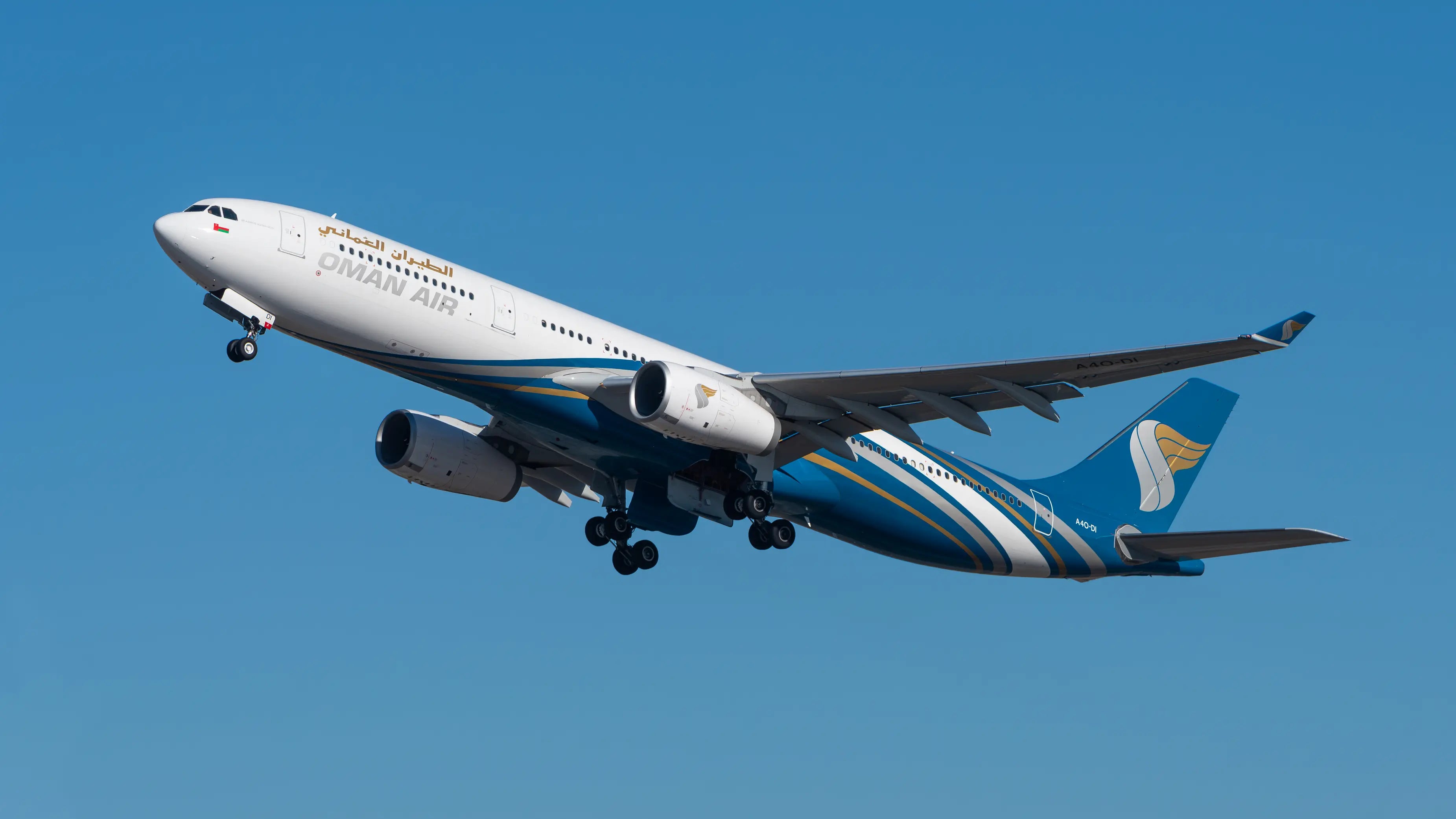
Oman Air operates a fleet of around 33 aircraft built around two main pillars: the Boeing 737 family for narrowbody short and medium-haul flying out of Muscat, and the Boeing 787 Dreamliner for long-haul services to Europe and the Far East. A residual Airbus A330 fleet, inherited from the airline's pre-2020 widebody strategy, still flies on selected medium and long routes, but the long-term direction is firmly toward an all-Boeing widebody operation. The Embraer E175 regional fleet, which once linked Muscat to thinner regional points, was retired in March 2025 and the four airframes were placed up for sale or lease.
The 737 narrowbodies cover Gulf, Indian subcontinent, East African, Iranian and Levant routes, while the 787-8 and 787-9 Dreamliners handle nearly all non-stop services to London, Frankfurt, Munich, Bangkok, Kuala Lumpur, Jakarta and other long-haul markets. CFM engine availability has been a recurring issue across the global narrowbody fleet, and a small number of Oman Air's 737 NG aircraft have spent periods on the ground awaiting engine returns. A new narrowbody order is expected to be announced in early 2026, with six additional widebody aircraft scheduled to arrive from 2028 onward to support post-oneworld network growth.
| Aircraft Type | Role | In Service | Routes / Notes |
|---|---|---|---|
| Boeing 737-800 | Narrowbody | ~21 | Backbone of regional flying. Gulf, India, East Africa, Iran. Some airframes affected by CFM engine returns. |
| Boeing 737-900ER | Narrowbody | ~5 | High-density narrowbody. Used on busy Indian subcontinent and Gulf routes. |
| Boeing 737 MAX 8 | Narrowbody | ~2 (growing) | Latest deliveries. Fuel-efficient replacement for 737-800. More on order. |
| Boeing 787-8 | Widebody | ~4 | Long-haul: London, Frankfurt, Bangkok, Kuala Lumpur. Reduced from prior fleet size. |
| Boeing 787-9 | Widebody | ~3 | Newer Dreamliner variant. Munich and other premium long-haul routes. |
| Airbus A330-200 | Widebody | ~4 | Legacy widebody. Used on selected long and medium-haul routes. |
| Airbus A330-300 | Widebody | ~6 | Higher-capacity widebody. India, Gulf, Asian markets. |
Fleet snapshot based on ch-aviation and Oman Air press releases for 2025 to 2026. Numbers shift with deliveries, returns and engine-related groundings.
For pilots recruited through Oman Air's official campaigns, the airline traditionally pays for type rating training on the assigned fleet. Most expat First Officer hires arrive already type-rated on the Boeing 737NG, since the historical entry requirement included 500 hours on B737NG for Captains and 300 hours on B737NG for First Officers (per Pilot Jobs Network data). New cadets are streamed onto the 737, with progression to the 787 Dreamliner reserved for in-house pilots. Captains hired directly from outside are placed on either the 737 or 787 depending on prior experience and current vacancies. The A330 fleet, while still active, is no longer a long-term career platform.
Pilot Salary & Compensation Breakdown
Oman Air pilot pay sits on the conservative side of the Gulf market. Salaries are lower in headline terms than at Emirates, Qatar Airways or Etihad, but the package is fully tax-free (Oman has no personal income tax), denominated in Omani Rial (OMR) which is pegged to the US Dollar at roughly 1 OMR = 2.60 USD, and bolstered by housing, transport, schooling and end of service benefits. Total compensation includes a fixed monthly salary, an hourly flight pay component, layover per diems, accommodation and transport allowances, and statutory end of service gratuity under Omani labour law.
Public salary data for Oman Air is thinner than for the larger Gulf carriers. The most widely cited reference, Pilot Jobs Network, was last updated in March 2015 and shows base figures that have been revised upward and then partially compressed during the 2020 to 2021 restructuring. The figures below blend that anchor with current pilot reports, recruitment listings and regional benchmarking.
First Officer (F/O) Pay Scale
| Seniority / Fleet | Monthly Fixed (USD) | Annual Gross Est. (USD) | Hourly Pay |
|---|---|---|---|
| F/O Year 1 (737NG) | $3,200 to $3,800 | ~$50,000 to $65,000 | 4 OMR/hr (low band) |
| F/O Year 3 to 5 (737) | $4,000 to $5,000 | ~$65,000 to $80,000 | 10 to 18 OMR/hr |
| F/O Senior (737/787) | $5,500 to $7,000 | ~$85,000 to $100,000 | 20 to 25 OMR/hr (>75 hrs) |
First Officer fixed salary historically included around 600 OMR (~$1,560) of housing and pilot allowance. Hourly bands reflect Oman Air's flight pay structure documented on Pilot Jobs Network.
Captain (CDB) Pay Scale
| Seniority / Fleet | Monthly Fixed (USD) | Annual Gross Est. (USD) | Hourly Pay |
|---|---|---|---|
| Direct Entry Captain (737) | $10,000 to $12,000 | ~$140,000 to $170,000 | $2.60 to $46.80/hr (banded) |
| Captain, mid-seniority (737) | $12,000 to $14,000 | ~$160,000 to $185,000 | Higher hourly band |
| Senior Captain (787) | $14,000 to $17,000 | ~$190,000 to $230,000 | Top hourly band >140 hrs |
Captain monthly base is reported around $5,500 in core fixed salary on the older Pilot Jobs Network data (inclusive of accommodation and transport allowance). Real-world take-home for active widebody Captains, with flight pay, allowances and per diems, sits substantially higher and tax-free.
The figures above are estimates compiled from Pilot Jobs Network, regional pilot recruitment listings, Gulf airline benchmarking and post-restructuring market intelligence. Oman Air does not publish a public collective pay scale because there is no pilot collective bargaining agreement in Oman. Compensation was reduced during the 2020 to 2021 contraction and further rebalanced during the 2024 to 2025 restructuring; restoration to pre-COVID levels has been gradual rather than full. Always verify final terms in your individual contract, including the split between fixed pay, hourly pay, and allowances, and the exact OMR exchange exposure.
Roster Pattern & Quality of Life
Roster construction at Oman Air is governed by company SOPs, the operator's Operations Manual Part A, and Flight Time Limitation rules issued by the Civil Aviation Authority of Oman (formerly PACA). The CAA framework follows ICAO Annex 6 and aligns broadly with EASA and FAA philosophies on crew duty, rest and fatigue management, with maximum flight duty periods generally capped between 11 and 13 hours depending on report time, sectors and crew augmentation. Pilots typically log 65 to 80 block hours per month on narrowbody, and 60 to 75 hours on widebody operations, with annual block totals usually staying well below the regulatory ceiling.
One of Oman Air's strongest selling points is annual leave: pilots receive around 42 days of paid annual leave per Pilot Jobs Network data, comfortably above the regional norm of 30 to 35 days. Combined with 8 to 11 days off per month built into the roster, this gives a meaningful runway for travel home, family time, and decompression. Days off tend to cluster less than at large rostered carriers like Emirates, but the smaller pilot community at Muscat usually allows for reasonable bid responsiveness and predictable swap requests.
📅 Sample Month, Narrowbody First Officer (Muscat MCT)
Widebody patterns are different. A typical 787 long-haul rotation involves an outbound flight, a 24 to 72 hour layover at destination, and a return sector, followed by a 2 to 4 day local rest period in Muscat. Augmented crews of three pilots are deployed on the longest routes (such as London, Frankfurt and Munich) where flight times push beyond the standard two-pilot duty limits. Widebody pilots fly fewer days per month overall, but trips are blockier and recovery time on each end is critical.
All Oman Air pilots are based in Muscat: there are no satellite bases and no formal commuting contract on the scale of Emirates' programme. That makes residency in or near Muscat effectively mandatory. The city offers a relatively relaxed quality of life by Gulf standards, with strong international schools, modern healthcare, low crime, easy access to beaches and the Hajar Mountains, and cost of living below Dubai or Doha. The expatriate aviation community is small but tight-knit, and most flights from Muscat to long-haul Asian and European destinations are scheduled outside the peak Gulf curfew hours, supporting more sociable rosters than competitors based further north.
Benefits, Travel Perks & End of Service
The benefits package is where Oman Air narrows the gap with its larger Gulf rivals. While headline pay is more modest, the airline pairs a tax-free salary with a comprehensive set of expat-focused perks that materially improve net household economics for pilots with families. Key components include accommodation (either company-leased or as an allowance), schooling support, full medical cover, business class joining tickets, annual home leave tickets, and an end of service gratuity calculated under Omani labour law.
Joining oneworld on June 30, 2025 gave Oman Air pilots and their families substantially better staff travel options than the airline previously offered through bilateral interline deals. ID90 standby tickets are now available across the alliance: British Airways to London, Iberia to Madrid, American Airlines across the US, Cathay Pacific to Hong Kong, Japan Airlines to Tokyo, Finnair to Helsinki and beyond. Pilots also benefit from the alliance's codeshare and frequent flyer reciprocity, which simplifies leisure and home-leave travel planning. This is one of the meaningful upgrades to the package since the airline's restructuring.
Under the Omani Labour Law applicable to private-sector expatriate employees, end of service gratuity is calculated based on the last basic salary, not total package. The standard formula is 15 days of basic pay for each of the first three years of service, then one full month of basic pay for each subsequent year. For a Captain who completes 10 years at Oman Air, that translates into roughly 8.5 months of basic salary as a lump sum at end of service, fully tax-free. It is a useful long-term wealth accumulation mechanism, but it is calculated on basic salary alone, so allowances and flight pay are not included in the base figure.
Career Progression & Seniority
Oman Air operates a pragmatic mix of internal upgrades and direct entry Captain hiring, similar to most Gulf carriers. The airline does accept direct entry Captains (DECs) from outside, with a published historical requirement of 5,000 total hours, 1,500 PIC on multi-pilot aircraft, and 500 hours on the B737NG. This is materially below the 6,000 to 8,000 hour DEC thresholds applied at Emirates and Qatar Airways. Internal upgrades from First Officer to Captain are based on a combination of seniority, fleet vacancies, and command assessment performance, with realistic timelines of 5 to 8 years on the 737 in a normal recruitment cycle, longer when growth slows.
Fleet transitions are tightly controlled. Most pilots enter through the 737 and stay there for the bulk of their early career, with the 787 reserved as a senior bid. The legacy A330 fleet is a finite platform: pilots transitioning to it now will likely face another transition (likely to the 787 or future widebody arrivals from 2028) within a few years, and is therefore not a long-term planning anchor.
| Career Milestone | Typical Timeline | Notes |
|---|---|---|
| Cadet ATPL training (Omani cadets) | ~24 months | Sponsored ATPL programme; 102 cadets reported in pipeline (Trade Arabia, 2024). |
| Join as F/O on 737NG / MAX | Day 1 post-training | Standard entry fleet for both cadets and direct hires. |
| Senior F/O (line check, 1,000 to 2,000 hrs on type) | 2 to 4 years | Eligibility for command screening. |
| Captain upgrade (737) | 5 to 8 years | Internal command course, simulator and line check. Subject to fleet vacancies. |
| Direct Entry Captain (737) | Immediate post-training | 5,000 total hrs / 1,500 PIC / 500 on B737NG (PJN benchmark). |
| Widebody transition (787) | Senior bid | Typically post-Captain upgrade, by seniority. Limited annual movement (small WB fleet). |
| Training Captain / TRE / TRI | Variable | Separate selection. Required for command course delivery and recurrent training. |
The 2024 to 2025 restructuring cut total headcount by around 1,100 staff, but pilot recruitment has continued in parallel through the Omani cadet pipeline and selective expat hiring on both the 737 and 787 fleets. With a planned narrowbody order in early 2026 and six widebody arrivals scheduled from 2028, the medium-term picture supports steady command and widebody bid movement, but at a much smaller absolute scale than at Emirates or Qatar Airways. Pilots planning a full career at Oman Air should expect modest growth, longer queues for widebody seats, and structural exposure to oil price and tourism cycles, partially offset by oneworld revenue and network synergies.
Recruitment Process & Requirements
Oman Air recruits through three channels: the Omani Cadet Pilot Scheme (sponsored ATPL training for Omani nationals), direct entry First Officer campaigns aimed primarily at type-rated 737NG pilots, and direct entry Captain campaigns for experienced jet command holders. Vacancies are advertised through the official Oman Air careers portal and increasingly through LinkedIn job postings. The cadet programme reflects the country's Omanisation policy, which prioritises Omani nationals for skilled positions; Trade Arabia reported in 2024 that Oman Air had 102 Omani cadets active in the ATPL pipeline.
Cadet Pilot Scheme: Requirements
Direct Entry First Officer (Expats Welcome)
Direct Entry Captain
Selection Stages
Application & Document Screening
Submit CV, licence, medical, logbook summary, type rating documentation and references through the Oman Air careers portal or LinkedIn posting. HR shortlisting focuses on hours, recency and type currency on the relevant fleet (B737NG for narrowbody intakes).
Technical & HR Interviews
Combination of remote and in-person interviews. Technical questions cover B737 systems, performance, abnormal procedures and operational scenario handling. HR interview focuses on Crew Resource Management, motivation for relocating to Muscat, family situation and long-term career intent.
Simulator Assessment
Standard Gulf-style simulator profile in a 737NG simulator. Typical content: standard departure, raw data ILS, single-engine handling, non-precision approach, go-around and missed approach. Crew Resource Management and standard call-out compliance carry significant weight.
Medical & Background Checks
Class 1 medical (CAA Oman conversion if needed), background and reference checks. Successful candidates receive a conditional offer subject to medical clearance, security clearance and visa processing.
Contract, Type Rating & Line Training
Type rating (if not already current), line training under check captains, and base check. New joiners typically operate as Second Officer / First Officer for the first contract period. Captains complete a command line check before unrestricted operations.
Currency matters more than total hours. Pilots who have been out of the cockpit for an extended period, or who lack recent 737NG line flying, are screened out earlier than candidates with slightly lower totals but recent type-relevant experience. ICAO Level 5 or 6 English is now expected for shortlisting. Omani nationals and pilots with prior Gulf experience (Salam Air, flydubai, Air Arabia, Qatar Airways) are at a structural advantage in the current cycle. Always apply through the official careers page; no third-party agency holds an exclusive recruitment mandate.
Top 5 Layover Destinations
Long-haul layovers from Muscat are concentrated on a handful of Boeing 787 routes to Europe and Southeast Asia. Hotel arrangements are airline-contracted and generally 4-star, located in central districts in major cities. Layovers are usually 24 to 48 hours on European turns, with some Southeast Asian rotations stretching to 60 hours when scheduling balances out. Augmented crew (3 pilots) is standard on the longest Europe runs. The smaller widebody fleet means bid competition for these trips is intense among senior First Officers and Captains.
Crew hotels and ground transport are arranged by Oman Air's crew planning department. Layover length is determined primarily by the inbound and outbound flight scheduling rather than pilot bid; longer rests are common in Asia where return slots are constrained, while European turns are tighter. Per diems are paid in destination currency and scaled by layover duration. Pilots cannot privately upgrade or downgrade their crew accommodation, but free travel days can typically be added at end of leave or annual home leave to extend personal time on the road.
How Oman Air Compares: Airline Radar Chart
How does Oman Air stack up against the two regional giants pilots most commonly compare it against, Emirates and Qatar Airways? The chart below benchmarks the three airlines across the same six metrics used in the scorecard. Scores are editorial estimates based on publicly available data, pilot forum reports, recruitment listings and union benchmarking from ECA and IFALPA.
Key Takeaways from the Comparison
Salary: Emirates and Qatar Airways win on absolute pay. A Captain on the A380 at Emirates or A350 at Qatar Airways will typically out-earn an Oman Air 787 Captain by 30 to 50% in headline tax-free terms. The gap narrows when comparing 737 Captain to 737 Captain at Salam Air or flydubai, where Oman Air is broadly competitive. Combined with cost of living, the net pay gap is real but smaller than the gross gap suggests.
Work-life balance: Oman Air's quiet edge. 42 days annual leave, a single base in Muscat, no commuting culture and a smaller pilot group give Oman Air a more sustainable rhythm than the bid-driven megacarriers. Emirates and Qatar Airways offer broader rosters but at the cost of higher block hours, more complex bid systems and tighter rest patterns on key routes.
Fleet diversity favours the megacarriers. Emirates' all-widebody fleet of A380s, 777s and incoming A350s gives long-term widebody career options at a scale Oman Air cannot match. Qatar's A350 and A380 fleet is similarly deep. Oman Air's 787 fleet of around 7 aircraft and its residual A330s offer fewer widebody seats and slower rotation onto premium long-haul.
Benefits: closer than headline pay suggests. All three airlines are tax-free, all three offer housing and schooling support, all three provide ID-staff travel benefits. Oman Air's joining of oneworld in June 2025 meaningfully closed the staff travel gap with Qatar Airways (also oneworld) and against Emirates' bilateral programme. End of service gratuity rules under Omani labour law are similar to UAE and Qatar arrangements.
Job security: smallest carrier, most cyclical exposure. Oman Air has gone through two restructuring waves since 2020 and remains the most exposed of the three to oil-revenue cycles and Vision 2040 strategic decisions. Emirates and Qatar Airways have larger balance sheets, deeper sovereign backing and more diversified networks; both withstood COVID without the same scale of long-term headcount cuts.
Scores are editorial estimates based on Pilot Jobs Network data, oneworld and airline press releases, ECA and IFALPA benchmarking, ch-aviation fleet data and pilot forum reports. They are intended as a first-pass orientation for pilots considering Gulf carriers, not a substitute for current contract negotiation. Individual experience varies materially with seniority, fleet, base loading and bid system mechanics.
Industrial Relations & Regulator
Unlike Air France, Lufthansa or BA, where powerful pilot unions sit across the table from management, Oman Air operates in a labour environment without independent pilot unions or formal collective bargaining. The Sultanate of Oman does not allow trade unions to negotiate collective contracts in the same way, and pilot terms are governed instead by individual contracts, the Omani Labour Law, and the operational and safety framework set by the Civil Aviation Authority of Oman (formerly known as PACA, the Public Authority for Civil Aviation).
Regulatory Framework
Recent Labour History & Key Decisions
The absence of a pilot union has two real consequences. First, terms and conditions are mostly individually negotiated, with limited transparency on what your colleagues are actually being paid, so do your own homework on Pilot Jobs Network, recent recruitment posts and pilot forums before signing. Second, in periods of stress (oil shocks, pandemic, restructuring) there is no collective backstop equivalent to BALPA, ALPA or SNPL: contract changes can be implemented faster, and individual exposure is higher. The flip side is a less politicised work environment and management style that is, by Gulf standards, generally professional and pragmatic.
Verdict: Who Is Oman Air For?
🎯 Our Take
Oman Air is the smallest, quietest and arguably most balanced of the major Gulf carriers. It pays less than Emirates or Qatar Airways in headline terms, but it offers a tax-free package, a single base in a relaxed Gulf city, around 42 days of annual leave, full schooling and housing support, and access to the oneworld global network for staff travel. It is not the airline you join to maximise raw earnings; it is the airline you join when you want a Gulf career that protects family time and lifestyle.
The trade-offs are real. The carrier has gone through two waves of restructuring since 2020, has no pilot union, and operates a small widebody fleet that limits long-haul movement. Job security depends materially on national strategic decisions and oil revenue cycles. Career progression to Captain is achievable in 5 to 8 years, faster than at saturated European legacies but slower than at growing low-cost regional operators in the Gulf. Direct entry Captain hiring on the 737 keeps the door open for experienced jet command holders.
For pilots whose priority is sustainable lifestyle, family stability, oneworld network access and tax-free income without committing to a megacarrier roster, Oman Air remains a strong fit. For pilots optimising for maximum gross pay, fleet diversity or long-haul widebody career depth, Emirates or Qatar Airways will still rank higher.
1 Is Oman Air really part of oneworld now?
Yes. Oman Air became a full member of the oneworld alliance on June 30, 2025 after being elected to join in 2022. The integration was delayed from an initial 2024 target, but is now live: codeshares, frequent flyer reciprocity, lounge access and ID-staff travel are all in place across British Airways, American Airlines, Qatar Airways, Cathay Pacific, Japan Airlines, Iberia, Finnair and other partners.
2 Does Oman Air pay for the type rating?
For pilots recruited through the official Oman Air campaigns, type rating is typically airline-funded with a service bond. Cadet pilots have their full ATPL and type rating covered by Oman Air through partner Approved Training Organisations. Direct entry First Officers are usually expected to arrive type-rated on the B737NG, but this can vary by recruitment cycle and demand.
3 How long does it take to upgrade to Captain at Oman Air?
Internal upgrade from First Officer to Captain on the 737 typically takes 5 to 8 years, depending on fleet vacancies, recruitment cycles and command course performance. Direct entry Captain hiring (5,000 total hours, 1,500 PIC, 500 on B737NG) bypasses the wait for experienced applicants. Widebody command on the 787 is a senior bid that comes after Captain upgrade and is constrained by the small widebody fleet size.
4 Can non-Omani citizens apply?
Yes for direct entry First Officer and Captain positions. The Cadet Pilot Scheme (sponsored ATPL training) is reserved for Omani nationals as part of the country's Omanisation strategy, which prioritises local talent in skilled jobs. Expat pilots are recruited from a wide range of nationalities, with current crews including Europeans, Asians and other Middle Eastern nationals.
5 Is there a pilot union or collective agreement at Oman Air?
No. Oman does not host an independent pilot union, and there is no collective bargaining agreement at Oman Air. Pilot terms are individually contracted under Omani labour law, with safety and FTL rules set by the Civil Aviation Authority of Oman. International bodies such as IFALPA and ECA provide reference benchmarks but no direct representation.
6 How does Oman Air pay compare to Emirates and Qatar Airways?
Oman Air pays less in headline tax-free terms than Emirates or Qatar Airways. A senior 787 Captain at WY will typically earn 30 to 50% less in gross pay than an A380 or A350 Captain at the megacarriers. The gap narrows when factoring in cost of living in Muscat, schooling and housing support, and the higher annual leave entitlement, but raw earnings still favour Emirates and Qatar Airways. Oman Air competes on lifestyle, base predictability and Muscat quality of life rather than on top-line pay.
7 What aircraft types does Oman Air operate today?
As of late 2025, Oman Air operates around 33 aircraft: about 21 Boeing 737-800s, 5 Boeing 737-900ERs, 2 Boeing 737 MAX 8s, 4 Boeing 787-8s, 3 Boeing 787-9s, 4 Airbus A330-200s and 6 Airbus A330-300s. The Embraer E175 regional fleet was retired in March 2025. A new narrowbody order is expected to be announced in early 2026, with six additional widebody arrivals scheduled from 2028 onwards.
8 How safe is the long-term outlook for Oman Air pilots?
The airline has gone through two restructuring waves since 2020, including the 2024 to 2025 round that cut around 1,100 jobs. That history is a real signal: Oman Air is more exposed to oil price cycles and sovereign strategic decisions than larger Gulf carriers. The flip side is direct sovereign ownership through the Oman Investment Authority, oneworld alliance backing, modern Boeing fleet ordering, and a Vision 2040 strategy that explicitly positions aviation as a national priority. The job security score is mid-range rather than top-tier.
Official Links & Resources
Before applying or signing a contract, always verify information directly with the source. The following links are the authoritative references for Oman Air pilot careers and the Omani aviation regulatory environment:
Because Oman Air does not publish a formal collective pay scale, your best signal for current pay and hiring conditions is a combination of (1) the official careers portal, (2) Pilot Jobs Network, (3) recent LinkedIn job postings tagged Oman Air, and (4) pilot forum threads about Salam Air, flydubai, Air Arabia and Oman Air, which often share fresh contract intelligence between candidates. Cross-check at least three sources before treating any number as definitive.