

Fokker 50: History, Program Launch, and Development of a Turboprop Icon
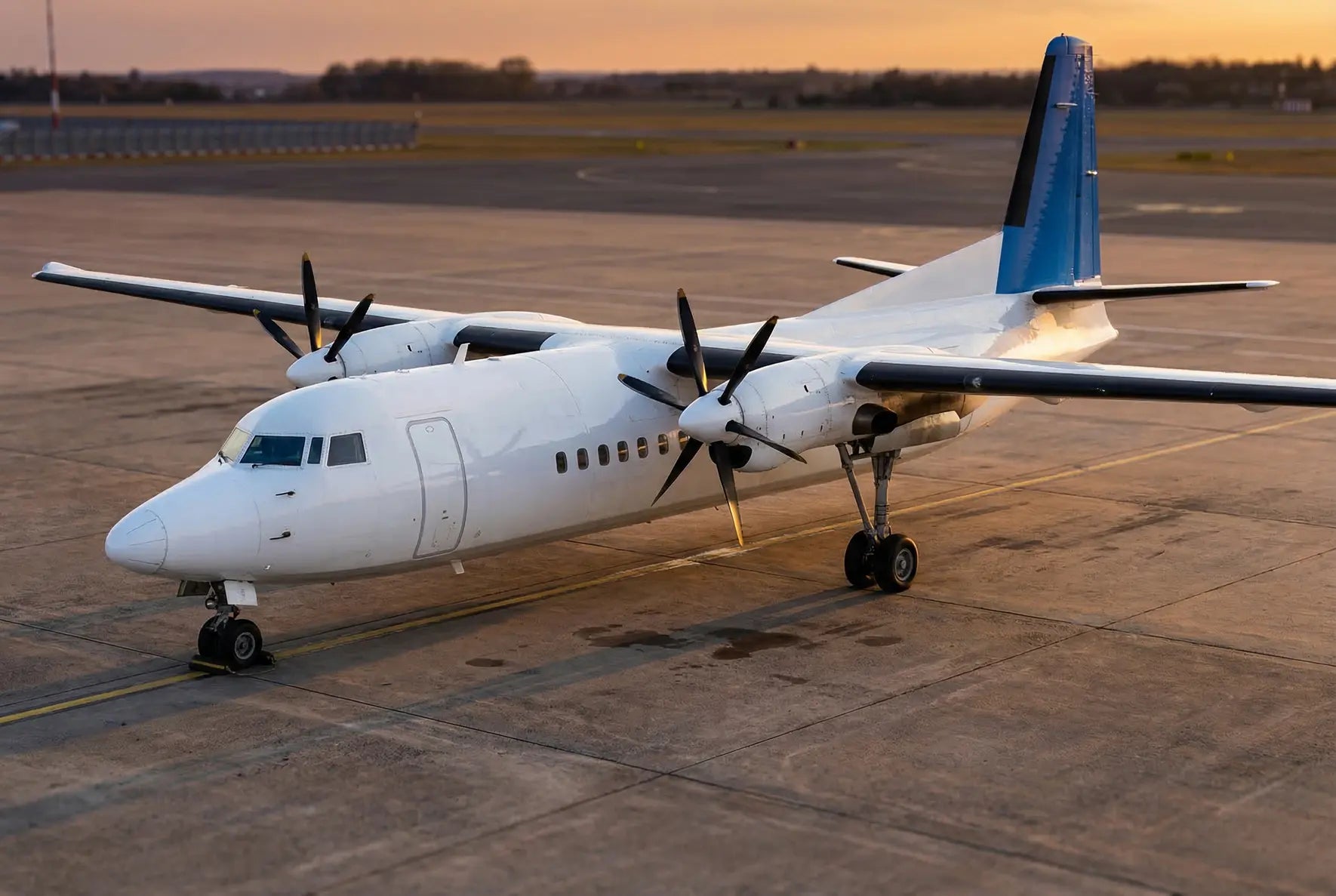
The Fokker 50 is a twin engine turboprop regional airliner developed by the Dutch manufacturer Fokker, based in Amsterdam, the Netherlands. The aircraft was conceived as a thoroughly modernised successor to the legendary Fokker F27 Friendship, one of the most successful turboprop airliners ever built, with 786 units produced. By the early 1980s, sales of the F27 were declining sharply. Rather than designing an entirely new airframe, Fokker elected to retain the proven F27 structure while incorporating the latest advances in propulsion, avionics, materials, and cabin comfort. The result was an aircraft that shared the same basic wing, fuselage cross section, and empennage as the F27, yet offered substantially improved fuel efficiency, lower noise levels, and a modern cockpit environment.
In November 1983, Fokker officially launched the Fokker 50 program alongside its jet sibling, the Fokker 100. Both programs were intended to revitalise the company's product line and secure its position in the regional aviation market. Two prototypes were constructed using modified F27 airframes. The first of these prototypes completed its maiden flight on 28 December 1985, marking the start of an intensive flight test and certification campaign.
Certification by the Dutch Rijksluchtvaartdienst (RLD) was granted in May 1987. The first production aircraft was delivered to the German regional carrier DLT (Deutsche Lufttransport) on 7 August 1987, and the type entered revenue service that same year. FAA certification followed in February 1989, opening the North American market to operators. Over its production run, the Fokker 50 attracted a wide range of customers, from European flag carriers such as KLM Cityhopper and Lufthansa CityLine to regional airlines across Africa, Asia, and Australasia.
The heart of the upgrade was the powerplant: two Pratt & Whitney Canada PW125B turboprop engines, each rated at 1,864 kW (2,500 shp), replacing the F27's Rolls Royce Dart engines. These modern turboprops delivered approximately 30% better fuel efficiency and drove slow turning, six bladed Dowty Rotol composite propellers (3.66 m diameter) that significantly reduced cabin noise and vibration. The cockpit adopted a "dark cockpit" philosophy with an Electronic Flight Instrument System (EFIS) and digital engine controls. Structurally, the Fokker 50 introduced composite materials in secondary structures, a redesigned nose section, double cabin windows, a twin wheel nose landing gear (replacing the F27's single wheel), small winglets on the wingtips for improved aerodynamic efficiency, and hydraulic systems in place of the F27's pneumatic boot de icing. Much like other turboprops of its era, the Fokker 50 competed for regional routes with aircraft such as the ATR 42, Saab 340, and the de Havilland Canada Dash 8. In a different segment of regional aviation, Soviet built types like the Tupolev Tu 154B served medium haul domestic routes in Eastern Bloc countries, illustrating the vast range of regional aircraft philosophies during the same period.
In September 1990, a hot and high performance variant was introduced, optimising the aircraft for operations at elevated airports and in warm climates. The Fokker 60 Utility, a stretched military derivative, first flew on 2 November 1995. It featured a lengthened fuselage, a large cargo door, more powerful PW127B engines rated at approximately 2,050 kW (2,750 shp), and an increased maximum takeoff weight of 22,950 kg. Four Fokker 60 airframes were built, all for the Royal Netherlands Air Force.
The Fokker 50 program, however, was inextricably linked to the financial fate of its manufacturer. Daimler Benz Aerospace (DASA), Fokker's majority shareholder, withdrew financial support in January 1996 after sustained losses across the Fokker 50 and Fokker 100 product lines. Fokker declared bankruptcy on 15 March 1996. Production continued briefly to fulfil remaining orders, and the last Fokker 50 was delivered in 1997. In total, 213 Fokker 50 and Fokker 60 aircraft were built. After the bankruptcy, Fokker Services Group (linked to the Stork industrial group) assumed the type certificate and has continued to provide maintenance, modifications, and logistics support for the remaining fleet. Proposals to restart production, including interest from India's Hindustan Aeronautics Limited, did not materialise.
What Distinguishes the Fokker 50 from the F27 and the Fokker 60
The Fokker 50 occupies a distinct position between the original F27 Friendship and the later Fokker 60. Compared to the F27, the Fokker 50 retained the same fuselage length (25.25 m) and high wing configuration but introduced a fundamentally different engine and propeller combination, a glass cockpit, composite materials, improved cabin insulation and window design, and revised landing gear. Compared to the Fokker 60, the standard Fokker 50 has a shorter fuselage, a lower maximum takeoff weight (up to 20,820 kg versus 22,950 kg), and was designed primarily for commercial passenger operations rather than military utility transport. The Fokker 60's PW127B engines also offered greater power retention in demanding conditions.
The following list summarises the key variant identifiers of the Fokker 50:
- Type designation: F27 Mark 050 (baseline passenger variant)
- Engines: two Pratt & Whitney Canada PW125B turboprops, 1,864 kW (2,500 shp) each; PW127B on the Fokker 60 and select high performance configurations
- Propellers: six bladed Dowty Rotol composite propellers (3.66 m diameter)
- Seating capacity: 46 to 58 passengers depending on pitch (30 to 34 inches)
- MTOW options: 18,990 kg to 20,820 kg (standard Fokker 50); 22,950 kg (Fokker 60)
- Cockpit: EFIS with dark cockpit philosophy, digital engine controls
- Wingtips: small winglets for improved efficiency
- Nose gear: twin wheel (versus single wheel on F27)
- Cabin windows: smaller but more numerous double pane windows compared to F27
- Total production: 213 units (including 4 Fokker 60 airframes), 1987 to 1997

A KLM Cityhopper aircraft is seen in upward flight against a gray sky. The plane, painted in KLM's signature blue and white colors, showcases its propeller engines and distinctive branding.
Fokker 50 Technical Specifications, Systems and Engine Overview
The Fokker 50 was conceived as a modernised successor to the legendary Fokker F27 Friendship, retaining the proven high-wing, pressurised fuselage layout while introducing contemporary engines, avionics and aerodynamic refinements. Designed for regional routes of up to roughly 1,500 NM, the aircraft balances short-field capability with a useful payload of up to 5,500 kg. Winglets (branded Foklets), a horn-balanced rudder and a twin-wheel nose gear replaced the F27's single-wheel unit, improving directional stability and ground handling on unpaved strips.
The result is a 50-seat turboprop that can operate into short runways, including steep-approach airports such as London City, while offering lower cabin noise than its predecessor thanks to slow-turning six-bladed composite propellers and vibration absorbers. For operators flying routes across diverse terrains and conditions, the Fokker 50 remains a versatile platform, equally capable as a passenger airliner, a Class E freighter carrying over 7,000 kg, or a government special-mission aircraft.
- Length: 25.25 m (82 ft 10 in)
- Wingspan: 29.00 m (95 ft 2 in), with Foklet wingtips
- Height: 8.32 m (27 ft 4 in)
- Wing area: 70.0 m²
- Typical seating: 46 (at 34 in pitch) to 56 (at 30 in pitch)
- Maximum payload: 5,500 kg (12,100 lb)
- MTOW: 19,950 kg standard; 20,820 kg (45,900 lb) high gross weight option
- Maximum landing weight (MLW): 19,500 kg standard; 19,730 kg high gross weight option
- Operating empty weight (OEW): approximately 12,520 kg
- Maximum zero fuel weight: 18,600 kg
- Engines: 2 × Pratt & Whitney Canada PW125B turboprops, flat-rated at 1,864 kW (2,500 shp) each; optional PW127B at 2,050 kW (2,750 shp)
- Propellers: six-bladed Dowty Rotol composite units, 3.66 m (12 ft) diameter
- Fuel capacity: approximately 5,140 litres
- Cruise speed: approximately 526 km/h (284 kt TAS), varies with weight and altitude
- Service ceiling: 7,620 m (25,000 ft)
- Manufacturer range: approximately 2,632 km (1,421 NM) with typical payload; varies with configuration
- Avionics baseline: EFIS glass cockpit, UNS-1 Series Navigation Management System; options include ADS-B Out V2 and LPV approach capability
- Noise certification: ICAO Chapter 3 compliant
Systems, Automation and Handling
Primary flight controls on the Fokker 50 are mechanically operated through a rod-and-cable system, with hydraulic power assistance. The Automatic Flight Control System (AFCS) integrates two Flight Directors, a dual-channel Autopilot covering pitch, roll and heading stabilisation, a Flight Augmentation System providing yaw damping and turn coordination, and an Elevator Feel Control System with a Longitudinal Stability Augmentation System (LSAS) for pitch stability. Guidance modes include heading select, VOR/LOC tracking, air data holds, and FMS lateral navigation (LNAV).
The cockpit follows a dark cockpit philosophy, meaning warning lights and annunciators remain dark during normal operation and only illuminate when attention is required. A three-level prioritised alerting system supports crew decision-making without information overload. Engine power and propeller pitch are managed through a single-lever control per engine, linked to the Electronic Engine Control (EEC), which reduces pilot workload significantly compared to the older F27's separate throttle and propeller levers. The Fokker 50 supports Cat II approaches as standard and can be upgraded with modern FMS solutions to meet evolving airspace mandates. Many operators also equip the aircraft with an Auxiliary Power Unit (APU) for ground independence at remote airfields.
Published performance figures for the Fokker 50 should always be interpreted with care. Values such as range, takeoff field length and payload depend heavily on the chosen MTOW option (standard versus high gross weight), cabin configuration, atmospheric conditions (temperature, altitude, humidity), runway surface and slope, and operator-specific equipment. The manufacturer's stated range, for example, assumes a defined passenger count and reserve policy; actual operational range can differ substantially. Cruise speed figures also vary with altitude, weight, and cost-index settings selected by the operating crew.
Pratt & Whitney Canada PW125B and the PW100 Engine Family
The standard Fokker 50 is powered by two Pratt & Whitney Canada PW125B turboprops, each flat-rated at 1,864 kW (2,500 shp). This engine belongs to the PW100 family, a three-shaft free-turbine turboprop series developed by P&WC in the early 1980s. The PW100 completed its first engine run in 1981, achieved first flight in 1982, and received initial certification for the PW120 variant in 1983. Commercial deliveries began in December 1984 when the engine entered service on the de Havilland Canada Dash 8-100.
The PW100 architecture uses separate low-pressure and high-pressure compressor spools feeding a free power turbine that drives the propeller gearbox. This modular three-shaft design allows efficient power extraction across a wide rating band, from roughly 1,800 shp up to over 5,000 shp in the PW150A variant. By 2024, Pratt & Whitney Canada had produced over 9,000 PW100-series engines, accumulating close to 200 million flight hours across approximately 3,000 aircraft operated by more than 600 operators worldwide.
Beyond the Fokker 50, the PW100 family powers several of the most widely used regional turboprops in aviation history. The ATR 42 and ATR 72 use various PW120, PW121, PW124, PW126 and PW127 variants. The de Havilland Canada Dash 8 series relies on PW120, PW123 and PW150A models, with the PW150A powering the larger Q400. The Embraer EMB-120 Brasilia and the Airbus C295 military transport also draw from this engine family. The latest evolution, the PW127XT, entered service in 2022 as the standard powerplant on all new ATR deliveries, offering improved time on wing and reduced maintenance costs compared to earlier variants. For the Fokker 50 High Performance variant, the optional PW127B rated at 2,050 kW (2,750 shp) provided increased climb and hot-and-high performance over the baseline PW125B.
Fokker 50 vs ATR 42-500 vs Dash 8 Q400 vs Embraer E175: Specifications Comparison
Scroll horizontally to see more
| Parameter | Fokker 50 | ATR 42-500 | De Havilland Dash 8 Q400 | Embraer E175 |
|---|---|---|---|---|
| Entry into service | 1987 | 1996 | 2004 | 2005 |
| Engines | 2 × P&WC PW125B | 2 × P&WC PW127E | 2 × P&WC PW150A | 2 × GE CF34-8E |
| Length | 25.2 m | 27.2 m | 37.7 m | 36.6 m |
| Wingspan | 29.0 m | 24.6 m | 28.9 m | 29.0 m |
| Height | 8.3 m | 7.1 m | 9.6 m | 9.8 m |
| Typical seating and layout | 2-class: 46–56 passengers | 2-class: 48–50 passengers | 2-class: 68–78 passengers | 2-class: 76–88 passengers |
| MTOW | 20.8 t | 18.6 t | 30.5 t | 37.6 t |
| Range | 1,500 nm | 1,500 nm | 2,040 nm | 2,200 nm |
| Cruise speed | 0.40 Mach | 0.40 Mach | 0.45 Mach | 0.75 Mach |
| Service ceiling | 25,000 ft | 31,000 ft | 25,000 ft | 41,000 ft |
| Program note | Baseline regional turboprop successor to F27 for short-haul routes | Direct competitor, shorter fuselage, similar capacity and performance | Stretched regional turboprop for higher capacity short/medium-haul | Modern regional jet alternative with higher speed and similar size |
Scroll horizontally to see more
The table compares key specs of four regional aircraft, contrasting older turboprops with a modern regional jet. Fokker 50 and ATR 42-500 are similar in range (1,500 nm) and cruise (0.40 Mach), but the ATR is longer and has higher ceiling. Dash 8 Q400 carries more passengers and flies farther than both turboprops, while the E175 leads in speed (0.75 Mach), ceiling (41,000 ft), range (2,200 nm) and MTOW.
Fokker 50 Operations: Typical Routes, Missions and Airlines Around the World
The Fokker 50 was designed from the outset as a regional workhorse, ideally suited to short and medium haul routes where turboprop economics outperform regional jets. With a maximum range of approximately 1,852 km (1,000 nmi) and a cruising speed of around 500 km/h (270 kn), the type typically covers stage lengths between 200 and 900 km, translating into flight times of roughly 30 minutes to two hours. Regional turboprops of this class typically achieve between 5.5 and 7 block hours per day, depending on route density and turnaround efficiency. The Fokker 50 consumes up to 30% less fuel than a regional jet of comparable capacity, according to Fokker Services Group, giving it a distinct cost advantage on thin regional routes.
Operationally, the Fokker 50 thrives in hub and spoke networks linking secondary or regional airports to major hubs. Its short field performance and ability to operate from unpaved or rough runways make it particularly valuable for connecting remote communities with limited aviation infrastructure. The aircraft is also certified for steep approaches, enabling it to serve constrained airports such as London City Airport. These characteristics have made it a popular choice for public service obligation (PSO) routes, cargo and postal services, humanitarian flights, and charter operations.
Operators face several challenges with the type today. Since Fokker declared bankruptcy in 1996, no new airframes have been produced, and the total production run reached only 213 units. Spare parts availability has become an increasing concern, and airframe age now exceeds 27 years for every example built. In November 2025, Kenya's Civil Aviation Authority banned the import of additional Fokker 50 aircraft into the country, citing safety concerns. Market preferences have also shifted: Australia's Alliance Airlines retired its entire Fokker 50 fleet in 2022 after customers expressed a preference for jet equipment on charter operations. Despite these pressures, approximately 70 Fokker 50s remained in commercial service as of recent estimates, concentrated mainly in Africa and Latin America. Unlike wide body types such as the Airbus A300B2, the Fokker 50 was built for an entirely different mission: short sectors, small communities, and operational flexibility on the ground.
Where the Fokker 50 Operates: Airlines by Region
Over its service life, the Fokker 50 has been operated on every inhabited continent. In Europe, it served as a backbone of regional networks connecting smaller cities to national hubs. In Africa, it remains one of the most widely used turboprops, valued for its ruggedness on remote and unprepared strips. In North and South America, the type supports domestic scheduled services and charter work. In Asia, it was historically deployed on intra island and domestic feeder routes, though most operators have since retired the type in favour of newer equipment.
- Europe: KLM Cityhopper (Netherlands) was among the earliest and largest European operators, using around 20 Fokker 50s on feeder services into Amsterdam Schiphol. VLM Airlines (Belgium) operated up to 20 aircraft on short European routes. Skyways Express (Sweden) flew 18 on Scandinavian regional services. Luxair (Luxembourg), Austrian Airlines, Contact Air (Germany), Maersk Air (Denmark), and Air Iceland Connect also used the type historically. Today, Amapola Flyg (Sweden) is the last significant European operator, maintaining a fleet of around 12 Fokker 50s for postal cargo flights on behalf of PostNord and passenger PSO services in Scandinavia and Ireland.
- North and South America: Avianca (Colombia) was a major operator with 10 aircraft on domestic feeder routes. Air Panama continues to fly up to five Fokker 50s on scheduled domestic services, including routes such as Panama City to Bocas del Toro, although it is gradually introducing Dash 8 Q400 replacements. Historical operators include Nordeste Linhas Aéreas Regionais and Rio Sul (Brazil), SAM Colombia, and InselAir (Curaçao), all of which used the type on short haul regional and inter island services.
- Asia: The Fokker 50 was historically deployed by Philippine Airlines, Mandarin Airlines (Taiwan), TransNusa and Pelita Air (Indonesia), and operators in Malaysia and Iran such as Kish Air. These airlines used the aircraft primarily for domestic island hopping and feeder routes. Most Asian operators have since retired the type in favour of ATR or Dash 8 turboprops.
- Africa: Africa remains the Fokker 50's largest active market. Ethiopian Airlines operated at least three Fokker 50s from 1996 until 2012 on domestic and regional routes. In Kenya, carriers such as Skyward Express, Renegade Air, Jetways Airlines, Jubba Airways, and Freedom Airline Express continue to use the type extensively for passenger, charter, and cargo operations into remote airstrips across East Africa and Somalia. Newer entrants such as Rayaan Air (Somalia) took delivery of their first Fokker 50 in early 2026, highlighting the type's continued relevance in the region despite growing regulatory pressure.
Typical Seating Configurations
The Fokker 50 cabin is 15.96 m long and 2.50 m wide, arranged in a consistent 2+2 abreast layout with a centre aisle. The standard configuration seats 46 to 58 passengers depending on seat pitch and operator requirements, though 50 seats in a single class economy layout is by far the most common arrangement. Seat pitch typically ranges from 30 to 33 inches (76 to 84 cm), with seat width around 17 inches (43 cm).
Most network carriers and regional operators, such as KLM Cityhopper and VLM Airlines, configured the aircraft with 50 economy seats at a pitch of approximately 30 to 31 inches. Alliance Airlines in Australia offered a slightly more generous 33 inch pitch for its charter focused operations. Some operators opted for a reduced 46 seat layout with wider spacing, suited to higher comfort expectations on longer regional sectors. The Fokker 50 does not feature a business class section in any documented airline configuration; all known layouts are single class. Detailed seat maps for various operators can be found on SeatMaps.com.
In this video, learn about Skyward International F-50 5Y-CET’s Nairobi takeoff on Jul 2, 2014, when 27 warnings sounded and multiple alerts activated, yet the crew proceeded, raising safety questions.
Fokker 50 Safety Record: Accident History and How Safe Is This Turboprop?
With 213 airframes delivered between 1987 and 1997, the Fokker 50 accumulated millions of flight hours across regional airlines on every continent. The type served heavily in Europe, Asia and Africa, operating short domestic routes and feeder services, often from challenging airfields with short or unpaved runways. Over nearly four decades of commercial service, the Fokker 50 fleet has been involved in a limited number of hull loss accidents relative to the total flights performed. Most of these events occurred in regions where infrastructure, maintenance oversight or crew training standards varied considerably. Several accidents, however, prompted important changes in aircraft design, operator procedures and regulatory requirements that improved safety for the entire turboprop community.
Major Accidents and Safety Lessons
Malaysia Airlines Flight 2133 (1995) was the first fatal hull loss involving a Fokker 50. On 15 September 1995, the aircraft (9M‑MGH) overran runway 17 at Tawau Airport in Sabah, Malaysia, after a steep, high speed approach. ATC sequencing delays had kept the crew at a higher altitude than desired, and the captain elected to continue the unstabilised approach despite repeated Ground Proximity Warning System (GPWS) alerts. The Fokker 50 touched down far beyond the ideal point, leaving insufficient stopping distance. It crashed into a residential area beyond the runway, killing 34 of the 53 people on board. The Malaysian investigation report identified the captain's decision to land despite inadequate runway remaining as the primary cause, with contributing factors including scheduling pressure and poor crew resource management (CRM). The accident led to strengthened CRM training requirements and reinforced the importance of stabilised approach criteria for Malaysian operators.
Luxair Flight 9642 (2002) crashed on 6 November 2002 during approach to Luxembourg Findel Airport, killing 20 of the 22 occupants. The crew, caught off guard by an early approach clearance from ATC, attempted a hastily prepared ILS approach in low visibility. During a rapid descent, a pilot inadvertently moved the power levers past the primary flight idle stop, engaging reverse propeller pitch in flight. This caused an irreversible loss of control, and the aircraft struck the ground approximately 700 metres short of the runway. The official Luxembourg AET investigation attributed the accident to crew error, inadequate approach preparation and the failure to implement a previously recommended modification to the power lever protection system. This event highlighted the critical need for mechanical safeguards against in flight reverse thrust selection on the Fokker 50.
Kish Air Flight 7170 (2004) crashed on 10 February 2004 while on approach to Sharjah International Airport in the UAE, killing 43 of the 46 people on board. In a scenario closely mirroring the Luxair accident, a pilot moved the power levers below flight idle during final approach, activating reverse thrust in flight. The resulting asymmetric drag was unrecoverable. The UAE GCAA investigation report found that the aircraft's anti skid control unit had not yet received a mandatory modification issued by Fokker after the 2002 Luxair crash. Following this second accident involving the same failure mode, airworthiness authorities worldwide accelerated compliance deadlines, and operators were required to complete the modification before further flight.
How Safe Is the Fokker 50?
When assessed against the total number of departures and flight hours logged over its operational life, the Fokker 50's fatal accident rate is broadly comparable to that of other regional turboprops of the same generation. The most significant design related vulnerability, the potential for in flight reverse thrust selection, was identified and addressed through mandatory modifications after 2002. Beyond that issue, the Fokker 50 benefits from a robust airframe derived from the proven Fokker F27 Friendship platform, reliable Pratt & Whitney Canada PW125B engines, six bladed Dowty propellers and modern (for its era) avionics including GPWS. The aircraft was certified to operate from short and unpaved runways, giving it considerable structural margins.
Operators flying the Fokker 50 today, primarily cargo and charter companies in Africa and parts of Asia, remain subject to continuing airworthiness oversight from national regulators and ICAO standards. Standard operating procedures (SOPs), recurrent simulator training, and rigorous crew preparation for challenging conditions all contribute to maintaining safe operations with ageing fleets. According to industry wide statistics published by Airbus, the global fatal accident rate for commercial aviation has fallen steadily over the decades, and turboprop operations have followed the same positive trend. While no aircraft type is immune to accidents, the lessons drawn from each Fokker 50 event have contributed to a safer aviation system overall. Commercial air travel, including on regional turboprops, remains one of the safest modes of transport available.
01 What is the typical passenger capacity and cabin layout of the Fokker 50?
The Fokker 50 typically seats up to 50-58 passengers in a single-class configuration with a spacious cabin cross-section, wide aisle, and seat widths comparable to a Boeing 737. Cabin height is 1.96 meters and width is 2.5 meters, providing a comfortable environment. Optional LED lighting enhances the experience while keeping weight low.
02 How does the Fokker 50 perform in terms of range, speed, and typical routes?
The Fokker 50 has a range of about 1,500-3,000 km with maximum payload, cruising at around 530 km/h at up to 7,600 meters altitude. It excels on regional short- to medium-haul routes, including remote destinations without refueling, and unpaved runways. Operators use it for flexible missions like 500 nm out-and-back flights with full passengers.
03 What is the noise level and passenger comfort like on the Fokker 50?
Cabin noise is exceptionally low at around 77 dB(A) thanks to slow-turning six-bladed propellers and vibration absorbers. Passengers enjoy generous air-conditioning and a quiet ride throughout much of the cabin. The four-door design allows quick boarding and turnarounds.
04 Which airlines operate the Fokker 50 and on what kinds of routes?
Over 30 operators worldwide use the Fokker 50, including regional carriers like Alliance Airlines for versatile turboprop services. It serves short-haul regional routes, charters, and remote airfields with low runway requirements. Some are converted for freighter use with up to 7,000 kg payload.
05 How fuel-efficient is the Fokker 50 compared to similar aircraft?
The Fokker 50 uses up to 30% less fuel than regional jets with similar capacity, producing under 100 grams of CO2 per passenger per km. Powered by PW125B or PW127B turboprops, it offers low fuel burn and excellent performance from short runways. This efficiency supports economic operations on varied routes.
06 What is the safety record and key design features of the Fokker 50?
The Fokker 50 has a strong safety record with design features like a 90,000-landing lifespan, steep-approach capability for airports like London City, and compliance with modern standards including ADS-B and LPV. It includes prioritized warning systems and single-lever propeller control for reduced pilot workload. Noise levels exceed ICAO requirements by over 18 EPNdB.