

Bristol Britannia: History, Program Launch, and Development of the Whispering Giant
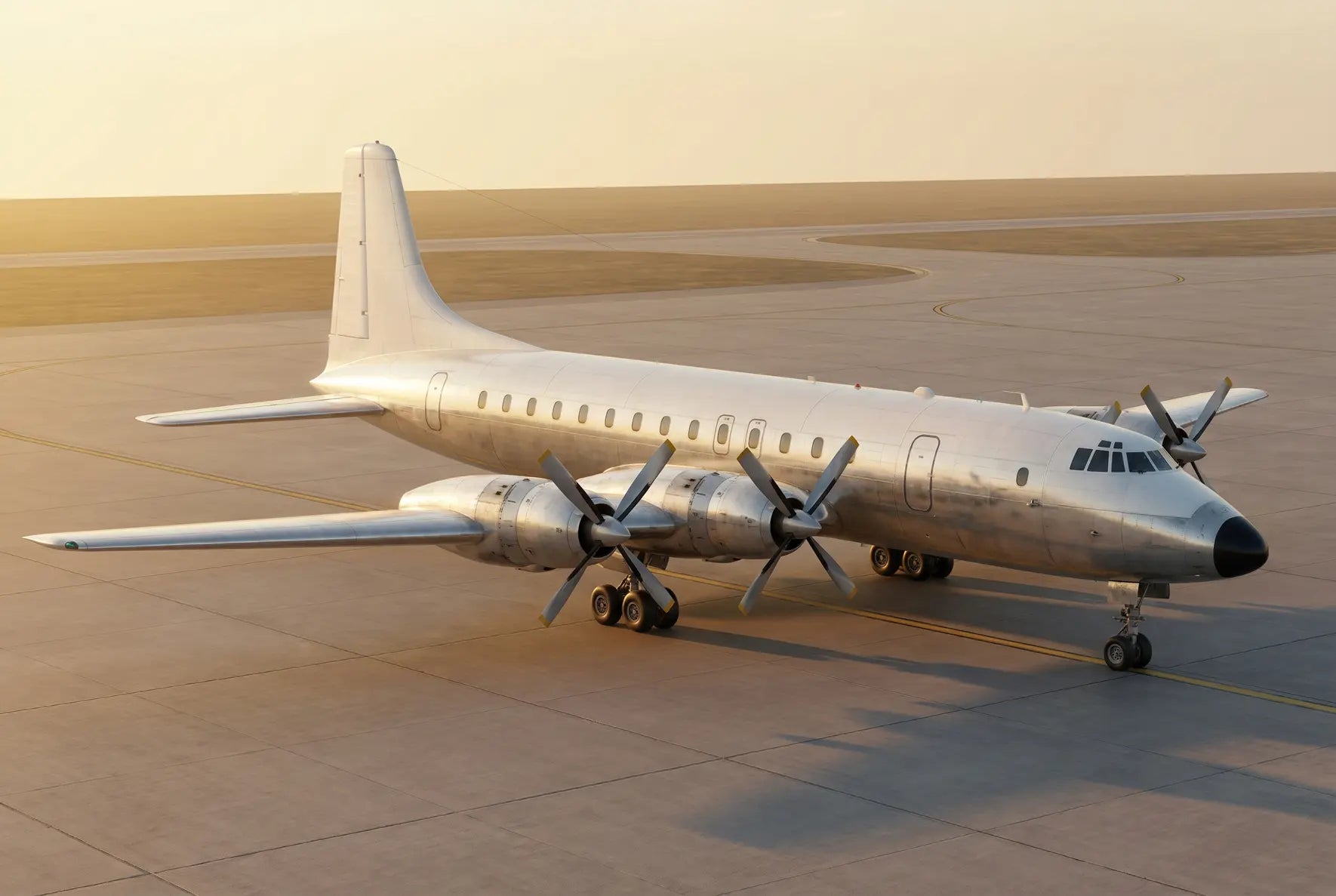
The Bristol Britannia, officially designated the Bristol Type 175, was a British medium-to-long-range turboprop airliner developed by the Bristol Aeroplane Company at Filton Aerodrome, near Bristol, England. Conceived in the late 1940s to meet post-war demand for modern air transport across the British Empire, the Britannia became the world's first large turboprop-powered transport aircraft. Its remarkably quiet operation in flight earned it the lasting nickname "The Whispering Giant."
The program originated in 1946, when British Overseas Airways Corporation (BOAC) and a government commission issued the Medium Range Empire (MRE) requirement for a new airliner capable of carrying 32 to 36 passengers over imperial routes. In April 1947, the Ministry of Supply formalised this need by issuing Specification C.2/47. Bristol responded with its Type 175 proposal, initially designed around four Bristol Centaurus piston engines. By July 1948, Bristol received official approval to proceed with the project.
On 5 July 1949, the Ministry of Supply ordered three prototypes, and on 28 July 1949, BOAC purchased options for 25 production aircraft. Although the initial specification called for Centaurus piston engines, both parties agreed to transition to the more advanced Bristol Proteus turboprop. By October 1949, the Centaurus option was dropped entirely, and the design was enlarged to accommodate approximately 74 passengers.
The first prototype, registered G-ALBO, completed its maiden flight on 16 August 1952 from Filton Aerodrome. Early flights revealed issues including over-sensitive controls, cockpit smoke ingress, and a stuck landing gear, though these were resolved by September 1952. The aircraft was demonstrated at the 1952 SBAC Show at Farnborough, where its low noise levels drew immediate attention.
However, the development program suffered serious setbacks. The Proteus turboprop engines proved susceptible to inlet icing, a problem that caused multiple in-flight engine failures and contributed to the loss of two prototypes during testing. During the first eight months of intensive trials in 1955 and 1956, engineers recorded 16 in-flight failures and 49 unscheduled engine changes. These reliability issues delayed the full Certificate of Airworthiness, which was not awarded until late 1955, after modifications to the Proteus 765 engine significantly reduced failure rates. The delays pushed entry into service approximately two years behind the original target.
BOAC received the first two production Series 100 aircraft (Model 102) on 30 December 1955 for crew training. Scheduled revenue service finally began on 1 February 1957, with a BOAC flight from London to Johannesburg. Services to Sydney followed in March 1957 and to Tokyo in July 1957. The longer-range Series 300 entered BOAC transatlantic service from London to New York in September 1957. In 1959, the Royal Air Force ordered 23 Britannia aircraft for Transport Command (designated C.1 and C.2). Production concluded in 1960 after a total of 85 aircraft had been built.
Despite its technical qualities, the Britannia's delayed entry into service proved commercially damaging. By 1958, jet-powered competitors such as the Boeing 707 and Douglas DC-8 were entering the market. BOAC operated its last scheduled Britannia flight in April 1965, replacing the type with de Havilland Comets and Boeing 707s. Several aircraft went on to serve with charter airlines, most notably British Eagle International Airlines, which operated up to 17 Britannias by 1965. The design also influenced the Canadian-built Canadair CL-44, a licensed derivative developed for military and cargo roles featuring a distinctive swing-tail fuselage. While the Bristol Britannia shares no direct lineage with modern regional types such as the Embraer ERJ-140, both aircraft represent important milestones in the evolution of purpose-built airliners for specific market segments.
What Distinguishes Each Bristol Britannia Variant
The Bristol Britannia was produced in three principal series, each tailored to different operational requirements. The Series 100 was the initial short-to-medium-range passenger variant, featuring a fuselage length of 114 ft (34.75 m), four Bristol Proteus 705 or 755 turboprops rated at approximately 4,000 to 4,120 shp each, and a maximum takeoff weight (MTOW) of around 155,000 lb (70,300 kg). It typically seated 74 to 90 passengers. Fifteen Series 100 aircraft were built for BOAC.
The Series 300 was the most widely produced variant, with 45 built. It introduced a fuselage stretch of 10 ft 3 in (3.12 m), bringing total length to 124 ft 3 in (37.87 m), and was powered by four upgraded Proteus 765 engines producing up to 4,450 shp each. Passenger capacity increased to 139 in a coach-class layout. The MTOW rose to 155,000 lb initially, with later configurations reaching up to 185,000 lb (83,915 kg). The Series 300 also featured heavier gauge fuselage skin, strengthened stringers, and larger 40-inch main wheel tyres rated at 195 psi, compared to the 36-inch tyres at 150 psi used on the Series 100.
The Series 310 was a long-range sub-variant of the 300, distinguished by the addition of outer wing fuel tanks that extended range to approximately 4,268 miles (6,869 km). It retained the same fuselage dimensions and wingspan of 142 ft 3 in (43.36 m), with an MTOW of up to 185,000 lb. This was the variant used on BOAC's prestigious transatlantic routes. The Series 250, meanwhile, served the RAF as a military transport, combining the stretched Series 300 airframe with cargo and troop-carrying capabilities.
Key identifiers that distinguish the Bristol Britannia variants include:
- Engines: Proteus 705/755 (Series 100) vs. Proteus 765 (Series 300/310), ranging from 4,000 to 4,450 shp per engine
- Fuselage length: 114 ft (Series 100) vs. 124 ft 3 in (Series 300/310), a stretch of 10 ft 3 in
- Maximum takeoff weight: approximately 155,000 lb (Series 100) vs. up to 185,000 lb (Series 300/310)
- Passenger capacity: 74 to 90 (Series 100) vs. 139 to 146 (Series 300/310)
- Fuel system: standard wing tanks (Series 100/300) vs. additional outer wing tanks (Series 310)
- Structural reinforcement: heavier gauge skin and stringers on the Series 300/310 airframes

A Bristol Britannia aircraft, operated by BOAC, is captured in flight against a backdrop of clouds. The aircraft's landing gear is extended, indicating it is preparing to land.
Bristol Britannia Technical Specifications, Systems and Engine Overview
The Bristol Britannia was designed in the early 1950s to fulfil BOAC's requirement for a medium-to-long-range airliner capable of non-stop transatlantic crossings. Its four-turboprop configuration prioritised range and fuel efficiency over outright speed, a deliberate trade-off that earned it the nickname Whispering Giant for its remarkably quiet cabin. The airframe inherited lessons from wartime Bristol designs, but the integration of the new Bristol Proteus turboprop engines represented a major leap in British civil aviation. The Series 310, the principal long-range production variant, was optimised for intercontinental routes with strengthened structure and higher cabin pressurisation (0.35 psi differential versus 0.25 psi on the earlier Series 100).
One of the Britannia's defining design choices was its reliance on aerodynamic servo-tab flight controls rather than hydraulically boosted surfaces, making it one of the largest airliners ever built with fully manual primary controls. This approach reduced system complexity and weight, but demanded careful speed management and thorough crew training. During the late 1950s, while carriers such as LOT Polish Airlines were expanding European networks with Soviet-built turboprops, BOAC used the Britannia to inaugurate the first scheduled non-stop turboprop transatlantic service in December 1957.
- Length: 37.87 m (124 ft 3 in)
- Wingspan: 43.36 m (142 ft 3 in)
- Height: 11.43 m (37 ft 6 in)
- Wing area: 192.8 m2 (2,075 sq ft)
- Max takeoff weight (MTOW): approximately 83,915 kg (185,000 lb) for the Series 310
- Operating empty weight (OEW): approximately 39,190 kg (86,400 lb), Series 310
- Typical passenger capacity: 139 in single-class layout (up to 146 in high-density configuration)
- Cruise speed: approximately 575 km/h (310 kt) at 22,000 ft
- Maximum speed (Vne): approximately 639 km/h (345 kt)
- Range (max fuel): 7,130 to 8,590 km (3,850 to 4,640 nm), depending on payload and configuration
- Service ceiling: 7,300 to 8,500 m (24,000 to 28,000 ft)
- Fuel capacity: approximately 30,500 litres (8,050 US gal)
- Engines: 4 x Bristol Proteus 765 turboprops, each rated at approximately 4,450 eshp
- Crew: 3 to 4 flight crew (captain, first officer, flight engineer, and navigator on long-range operations)
Systems Architecture and Handling Technology
The Britannia's primary flight controls (elevators, ailerons, and rudder) used free-floating surfaces actuated by full-span servo-tabs. Pilot inputs moved the tabs, which generated aerodynamic forces to deflect the control surfaces. The ailerons featured five tabs each, with the innermost interconnected to the rudder torque tube for automatic roll-yaw coupling, improving lateral stability. On the ground, a hydraulic locking system centralised and locked all surfaces via a lever near the engine power levers, with five warning lamps and Desynn repeaters on the cockpit roof panel showing actual surface positions. This architecture, documented in detail by Emerald Publishing, later influenced the Short Belfast freighter. Production Britannias were equipped with a Smiths Dual Flight System integrated with a Smiths autopilot, providing coupled attitude and navigation guidance through two primary panels: the Director Horizon and the Beam Compass.
The Proteus engines employed an early form of electrical throttle signalling, sometimes described as a precursor to fly-by-wire engine control. Anti-icing for the Proteus remained a persistent operational challenge throughout the type's career, and crews routinely adopted altitude management strategies to mitigate icing conditions.
Published performance figures for the Bristol Britannia vary across sources. Differences arise from sub-variant (Series 100 vs. 310), operator-specific cabin configurations, actual takeoff weight, atmospheric conditions, and runway elevation. Range values in particular depend on payload-fuel trade-offs: maximum fuel range assumes reduced passenger load, while maximum payload range assumes shorter sectors. Cruise speed figures also vary with altitude and temperature assumptions. All numbers quoted above should be understood as representative of the Series 310 under typical conditions, not as absolute guarantees.
Bristol Proteus Engines: History, Variants and Legacy
The Bristol Proteus was the Bristol Engine Company's first mass-produced gas turbine, a reverse-flow turboprop whose development began in 1944. It featured a 12-stage axial compressor followed by a single centrifugal stage, achieving a pressure ratio of 7.2:1 with an air mass flow of approximately 20 kg/s. Combustion gases passed through a two-stage gas generator turbine before driving a separate two-stage free power turbine connected to four-bladed propellers. Early development used a turbojet derivative, the Bristol Phoebus, tested in an Avro Lincoln bomber from 1946.
Production Britannias used the Proteus 755 (Series 100/200 aircraft) and the more powerful Proteus 765 (Series 300/310), which delivered approximately 4,450 equivalent shaft horsepower including residual jet thrust. Specific fuel consumption was around 0.495 lb/hr per eshp. After extensive reliability work on bearings and turbine blades, overhaul life reached 2,000 hours by the late 1950s. Bristol merged into Bristol Siddeley Engines in 1959, which was subsequently absorbed by Rolls-Royce in 1968.
Beyond the Britannia, the Proteus powered the Saunders-Roe Princess flying boat (using coupled Proteus 600-series engines driving contra-rotating propellers) and was planned for the Bristol Brabazon Mk.II. The Canadair CL-44, a freighter derivative of the Britannia airframe, also used Rolls-Royce Tyne turboprops rather than the Proteus, reflecting the engine's limited adoption outside the original Bristol programme. Military variants of the Britannia operated by RAF Transport Command used the Proteus Mk.255, closely related to the civil 765. Total Proteus production exceeded 1,000 units, but the rapid ascent of pure-jet airliners from the late 1950s curtailed further development.
Bristol Britannia vs Viscount 800 vs L-188 Electra vs Handley Page Herald: Specifications Comparison
Scroll horizontally to see more
| Parameter | Bristol Britannia | Vickers Viscount 800 | Lockheed L-188 Electra | Handley Page Herald |
|---|---|---|---|---|
| Entry into service | 1958 | 1958 | 1959 | 1962 |
| Engines | 4 × Bristol Proteus 765 | 4 × Rolls-Royce Dart R.Da.10 | 4 × Allison 501-D13 | 2 × Rolls-Royce Dart R.Da.7 |
| Length | 37.9 m | 26.2 m | 31.9 m | 29.2 m |
| Wingspan | 43.4 m | 32.6 m | 30.8 m | 28.5 m |
| Height | 11.4 m | 8.3 m | 10.4 m | 8.2 m |
| Typical seating and layout | 3-class: 130–140 passengers | 2-class: 60–74 passengers | 2-class: 75–99 passengers | 2-class: 50–60 passengers |
| MTOW | 84 t | 32 t | 44 t | 19 t |
| Range | 4,600 nm | 1,850 nm | 2,600 nm | 1,850 nm |
| Cruise speed | 0.52 Mach | 0.56 Mach | 0.52 Mach | 0.46 Mach |
| Service ceiling | 24,000 ft | 25,000 ft | 29,000 ft | 22,500 ft |
| Program note | Long-range turboprop airliner for transatlantic routes | Medium-range turboprop, smaller capacity for regional routes | Medium-range turboprop, American competitor for mid-size markets | Twin-engine turboprop for short regional routes |
Scroll horizontally to see more
This table compares key specs of four classic turboprop airliners. The Bristol Britannia stands out for size, capacity (130–140) and long range (4,600 nm) with the highest MTOW (84 t), aimed at transatlantic service. The Viscount 800 and L-188 Electra are mid-range types, with the Electra flying highest (29,000 ft) and carrying more. The Herald is smallest and shortest-range.
Bristol Britannia Operations: Airlines, Routes and Missions Around the World
The Bristol Britannia, affectionately nicknamed the "Whispering Giant" for its remarkably quiet turboprop engines, was designed primarily for medium- and long-haul passenger services. Powered by four Bristol Proteus turboprops, Series 100 aircraft were intended for routes of around 3,000 nautical miles, while the stretched Series 300/310/312 variants could cover approximately 4,400 to 4,600 nautical miles non-stop, enabling transatlantic and intercontinental operations. A typical transatlantic crossing from London to New York took roughly 10 to 12 hours at a cruising speed of about 310 knots (575 km/h), significantly faster than piston-engine contemporaries.
The Bristol Britannia operated primarily from major hub airports in a hub-and-spoke model. British Overseas Airways Corporation (BOAC), the launch customer, based its Britannia fleet at London Heathrow, connecting the United Kingdom to destinations across the Atlantic, Africa and Asia-Pacific. Later in its career, many Britannias transitioned to charter and inclusive-tour operators, flying from secondary airports such as Liverpool, Gatwick and Manchester on point-to-point holiday services to Mediterranean resorts. Military operators, notably the Royal Air Force Squadrons 99 and 511 based at RAF Brize Norton, used the type for strategic trooping and logistics flights to the Middle East, Far East and Africa.
Operational challenges shaped the Britannia's relatively brief front-line career. Development was delayed by several years due to serious Proteus engine inlet icing issues, pushing the entry into service from 1954 to February 1957. By then, pure-jet airliners such as the de Havilland Comet 4 and Boeing 707 were on the horizon, and their superior speed quickly rendered the turboprop less competitive on prestige long-haul routes. Only 85 airframes were built before production ended in 1960, and BOAC retired its last scheduled Britannia service by April 1965, just eight years after introduction.
Where the Bristol Britannia Operated
Across Europe, North and South America, Asia and Africa, the Bristol Britannia served flag carriers, independent airlines, charter operators and military air forces. In Europe, the type was most visible with British carriers running scheduled transatlantic and African services, as well as inclusive-tour flights to Mediterranean holiday destinations. In the Americas, Canadian and Latin American operators leveraged the aircraft's long range on transpacific and regional routes. In Asia, BOAC extended Britannia services via multi-stop routings through the Pacific, while in Africa, the type served colonial-era trunk routes and later appeared with regional cargo operators.
- Europe: BOAC was the dominant operator, introducing the Britannia 102 on the London-Johannesburg route on 1 February 1957 and the Britannia 312 on the first turbine-powered North Atlantic service (London-New York) on 19 December 1957. Charter carriers including Britannia Airways, British Eagle, Caledonian Airways, British United Airways, Monarch Airlines, Invicta International Airlines and Lloyd International Airways used the type extensively on holiday charters to the Mediterranean. Irish carrier Aer Turas flew freight and trooping charters, while CSA Czechoslovak Airlines leased two airframes from Cubana for European routes between 1961 and 1969. Swiss operator Globe Air also flew ex-El Al Britannia 313s on European charters.
- North and South America: Canadian Pacific Air Lines operated Series 300 Britannias on transpacific services from Vancouver to Tokyo and on North Atlantic routes to Europe. Cubana de Aviación became the longest-serving civilian operator, flying eight or more Britannia 310/312 aircraft on transatlantic routes from Havana to Madrid and London from 1958 until around 1990. In 1975, Cuban Britannias supported Operation Carlota, transporting troops to Angola. Aeronaves de México operated two Britannia 302 aircraft on routes between Mexico and the United States.
- Asia: BOAC extended Britannia operations deep into Asia via a westbound multi-stop routing: London-New York-San Francisco-Honolulu-Wake Island-Tokyo-Hong Kong in 1959. This round-the-world service showcased the aircraft's endurance. Other regional exposure was limited, though short-term leases placed the type briefly with Cathay Pacific and Malayan Airways.
- Africa: BOAC's London-Johannesburg service was among the first Britannia routes. East African Airways leased BOAC Britannia 312 and 317 aircraft for regional trunk services. Later in the type's career, cargo operators such as African Safari Airways, African Cargo Airlines and several Zairean freight companies (Katale Air Transport, Transair Cargo) continued to fly Britannias on African cargo runs well into the 1980s. Ghana Airways also operated the type on the Accra-London route.
Typical Seating Configurations
Seating layouts on the Bristol Britannia varied considerably between scheduled and charter operators. The shorter-fuselage Series 100 typically seated around 74 to 90 passengers in a mixed-class arrangement, while the stretched Series 300/310/312, with a fuselage length of 124 ft 3 in (37.87 m) and a cabin diameter of roughly 12 ft 2 in (3.70 m), could accommodate up to 139 passengers in a high-density single-class coach layout. Some operators achieved up to 146 seats in peak charter configurations. BOAC's flagship transatlantic Britannia 312 services offered a more spacious layout, while inclusive-tour carriers such as Britannia Airways and British Eagle maximised capacity for holiday flights. The RAF Museum preserves a Britannia 312 that illustrates the cabin proportions of the type. Military variants (RAF C.Mk.1 and C.Mk.2) were configured for trooping, with spartan bench-style seating to maximise personnel capacity on strategic transport flights. For a comparison with a modern long-range freighter variant and how aircraft design has evolved since the turboprop era, see this overview of the Boeing 777F.
In this video, take an exclusive tour of the Bristol Britannia Whispering Giant, with insights from the pilot. Learn about its design, performance, and Cold War RAF aviation role.
Bristol Britannia Safety Record: How Safe Was the Whispering Giant?
The Bristol Britannia entered commercial service in 1957 and remained active with freight and charter operators into the early 1980s. A total of 85 airframes were built before production ended in 1960. Across roughly 25 years of worldwide operations, the type recorded an estimated 13 hull losses, of which around seven involved fatalities. Approximately 225 lives were lost in Britannia-related accidents. Set against the modest fleet size and a service era that predated modern cockpit automation, terrain-awareness systems and crew-resource-management training, these figures reflect the broader risks of 1950s and 1960s commercial aviation rather than an inherent flaw in the airframe itself. The Britannia earned the nickname "Whispering Giant" for its smooth, quiet ride, and many operators praised its structural robustness and transatlantic range, yet several high-profile accidents exposed weaknesses in instrument design, approach procedures and crew decision-making that the wider industry would later address.
Major Accidents and Incidents Involving the Bristol Britannia
BOAC training flight, Christchurch, 1958. On 24 December 1958, Bristol Britannia 312 G-AOVD crashed near Winkton, Dorset, during a crew-training flight operated by BOAC. Nine of the twelve people on board were killed. The investigation determined the crew misread the aircraft's three-pointer altimeter by 10,000 ft during descent in fog, resulting in controlled flight into terrain (CFIT). The accident underscored the danger of the three-pointer altimeter display, which required pilots to interpret three concentric needles simultaneously. It accelerated moves by the UK Civil Aviation Authority and ICAO to mandate clearer drum-pointer or single-pointer altimeters, and it reinforced the importance of verbal altitude call-outs during instrument approaches. A detailed record of this event is available on the Aviation Safety Network database.
British Eagle Flight 802/6, Innsbruck, 1964. On 29 February 1964, Britannia 312 G-AOVO struck Mt Glungezer while on approach to Innsbruck Airport, killing all 83 passengers and crew. The aircraft, operated by British Eagle International Airlines, descended below the minimum safe altitude in poor weather without visual ground contact. This CFIT accident, one of the deadliest in Austrian aviation history, led to stricter approach procedures at Innsbruck, including higher minima and mandatory use of distance-measuring equipment. It also contributed to the global push for ground-proximity warning systems (GPWS) that would become compulsory for large transport aircraft in the 1970s. Further details can be found in the Wikipedia entry for Flight 802/6.
Globe Air charter, Nicosia, 1967. On 20 April 1967, Britannia 313 HB-ITB, operated by the Swiss carrier Globe Air, crashed 3.5 km short of Nicosia Airport in Cyprus during a second approach in a violent thunderstorm. Of 130 occupants, 126 were killed. Contributing factors included crew fatigue, as both pilots had exceeded their authorised duty time, and the first officer had fewer than 50 hours on type. The tragedy highlighted the critical role of duty-time limitations and weather-related decision-making, areas that regulators tightened for charter operators in the years that followed.
Redcoat Air Cargo, Billerica, 1980. On 16 February 1980, Britannia 253F G-BRAC, a freighter operated by Redcoat Air Cargo, crashed into woodland near Billerica, Massachusetts, shortly after departing Boston-Logan Airport. Seven of the eight people on board died. According to the UK AAIB report (3/1981), the probable cause was degraded aerodynamic performance from ice and snow accumulation on the airframe before and after take-off, combined with severe icing conditions that the crew had not been adequately briefed about. The accident reinforced the importance of thorough pre-flight de-icing and accurate weather information for turboprop operations in winter conditions.
How Safe Was the Bristol Britannia Overall?
Judged by the standards of its era, the Bristol Britannia was a capable and generally reliable turboprop airliner. Its accident rate must be viewed in context: the type operated before the introduction of GPWS, flight-data monitoring and modern CRM training, all of which have dramatically reduced hull-loss rates across the industry. The recurring theme in Britannia accidents was CFIT, a category that affected many aircraft types until ground-proximity warning technology became widespread. Design-wise, the Britannia's four Bristol Proteus engines and robust wing structure served it well on long-haul routes, and many airframes accumulated over 30,000 flight hours. Operators such as BOAC, the Royal Air Force and several charter airlines trusted the type for demanding transatlantic and trooping missions. Modern turboprop and jet aircraft, such as the Boeing 737 MAX 8, benefit from decades of lessons learned from types like the Britannia, including enhanced avionics, redundant flight-control systems and rigorous regulatory oversight from bodies such as EASA and the FAA. Today, commercial aviation remains one of the safest modes of transport, with a global fatal accident rate below 0.2 per million flights according to IATA safety data. The Bristol Britannia played its part in that progress by contributing hard-won operational experience that shaped the safety frameworks still in use today.
01 What were the typical routes and range of the Bristol Britannia?
The Bristol Britannia had a range of about 4,000-5,000 nautical miles, suited for long-haul transatlantic and European routes. Airlines like BOAC used it on services from London to New York, Johannesburg, and Sydney, often as a turboprop alternative to jets in the late 1950s and 1960s. Its mission profile focused on reliable medium-to-long range flights with good payload capacity.
02 How was the cabin layout and passenger experience on the Bristol Britannia?
The Bristol Britannia featured a spacious cabin with 100-140 seats in a single-class layout for most variants, offering generous legroom compared to early jets. Passengers noted a quieter ride due to turboprop engines mounted far back, though some vibration occurred at cruise speeds around 350 mph. Windows were large, providing good views, and the overall experience was comfortable for its era with low noise levels.
03 Which airlines operated the Bristol Britannia and on what routes?
Major operators included BOAC (later British Airways), Air Charter, and BUA in the UK, with others like Kenya Airways and Cubana de Aviacion. They flew it on transatlantic routes, African safaris, and Caribbean services, often replacing piston-engine aircraft. By the mid-1960s, many shifted to shorter regional hops as jets took over long-haul.
04 How did the Bristol Britannia perform compared to similar aircraft?
Powered by four Bristol Proteus turboprops, the Britannia cruised at 360-380 mph with better fuel efficiency than piston airliners like the DC-7 on medium routes. It outperformed contemporaries in cabin pressurization and speed but lagged early jets like the Comet in top speed and range. Fuel burn was economical for its size, making it viable until the 1970s.
05 What is the safety record of the Bristol Britannia?
The Bristol Britannia had a solid safety record with few major incidents relative to its operations, thanks to robust design features like strong wings and redundant systems. Notable design elements included a high wing for propeller clearance and fail-safe structures. Over 85 built, most served until retirement without systemic flaws.
06 What should passengers know about flying on the Bristol Britannia?
Seat pitch averaged 38-40 inches, with forward seats offering less turbulence exposure on the high-wing design. It handled turbulence smoothly due to its size and turboprop stability, better than smaller props. Windows provided excellent natural light, but prop noise was audible though not intrusive during flight.