

Sukhoi Superjet 100-95: History, Development Path, and Variant Evolution
The Sukhoi Superjet 100-95 emerged from a strategic Russian effort to develop a modern regional jet capable of replacing aging Soviet era aircraft such as the Tupolev Tu-134 and Yakovlev Yak-42. Known initially as the Russian Regional Jet (RRJ), the program was launched around 2000 by the Sukhoi design bureau, with the goal of building a competitive 75 to 100 seat aircraft for both domestic and international markets. Sukhoi Civil Aircraft Company (also known as Grazhdanskiye Samolety Sukhogo, or SCAC) was formally established in 2000 and incorporated in September 2002 as the entity responsible for the design, production, and support of the new airliner.
From the outset, the SSJ100 program adopted an international development philosophy unusual for Russian aviation. Boeing served as a technical consultant, contributing expertise in design processes and certification strategy. The Franco-Russian PowerJet SaM146 turbofan engine, developed jointly by Snecma (now Safran Aircraft Engines) and NPO Saturn, was selected as the sole powerplant. Italian aerospace firm Alenia Aeronautica (part of Finmeccanica, now Leonardo) joined as a risk sharing partner, and in 2007 the two sides formed the SuperJet International joint venture to handle marketing, completion, and after sales support for Western customers. Thales supplied the full glass cockpit avionics suite, making the SSJ100 the first aircraft in its size class equipped with a complete digital fly by wire flight control system.
The program initially targeted first flight in 2007 and entry into service shortly thereafter. However, engine integration challenges and certification requirements pushed the timeline. In December 2005, Aeroflot signed as the launch customer with an order for 30 aircraft. The first prototype was officially rolled out on 26 September 2007 at the Yuri Gagarin Aircraft Plant in Komsomolsk on Amur, the facility responsible for final assembly. The maiden flight took place on 19 May 2008, roughly a year behind the original target. After an extensive flight test campaign involving multiple prototypes, SCAC obtained the Russian Interstate Aviation Committee (IAC) type certificate in January 2011. The first commercial flight followed on 21 April 2011, operated by Armenian carrier Armavia on a service from Yerevan. On 3 February 2012, the European Union Aviation Safety Agency (EASA) granted Type Certificate EASA.IM.A.176 for the RRJ 95, confirming compliance with European airworthiness standards and opening the door to operators in EASA member states.
The May 2012 Mount Salak accident in Indonesia, in which a demonstration flight struck terrain killing all 45 people on board, was a significant setback for the program. The Indonesian National Transportation Safety Committee determined the probable cause to be crew unawareness of terrain proximity, compounded by inadequate response to Terrain Awareness and Warning System (TAWS) alerts. While the investigation did not identify aircraft design deficiencies as causal factors, the accident underscored operational and training challenges and affected the type's international reputation.
Following Russia's invasion of Ukraine in 2022, EASA suspended the SSJ100 type certificate and Western sanctions cut off the supply of SaM146 engines, Thales avionics, and other imported components. This prompted the development of a heavily localised successor, the Yakovlev SJ 100 (formerly SSJ New), powered by the Russian made PD 8 engine and domestic avionics. The original SSJ100 95 remains in service primarily with Russian carriers, though fleet availability has been affected by spare parts constraints.
What Distinguishes the Sukhoi Superjet 100-95 from Other Sub Variants
The SSJ100 family, designated RRJ 95 in EASA documentation and SU95 by ICAO, comprises two principal sub variants: the SSJ100 95B (base) and the SSJ100 95LR (long range). Both share the same airframe dimensions, SaM146 engines, fuel tank capacity of 15,805 litres, and Thales avionics suite. The core difference lies in maximum takeoff weight and, consequently, range. The 95B carries a maximum takeoff weight (MTOW) of 45,880 kg and offers a range of approximately 3,048 km with a full passenger load, making it well suited for short haul regional routes. The 95LR raises MTOW to 49,450 kg through structural reinforcement, extending range to approximately 4,578 km and enabling operations on longer segments without additional fuel tank volume. This positions the LR variant in a competitive bracket similar to aircraft like the Bombardier CRJ705 and the Embraer E190, albeit with greater reach on the LR model.
Key identifiers that distinguish the Sukhoi Superjet 100-95 family from competing types and across its own variants include:
- Powerplant: Two PowerJet SaM146 turbofans producing up to 79 kN (17,500 lbf) of thrust per engine
- Flight controls: Full digital fly by wire system with sidestick controllers and flight envelope protection
- Avionics: Thales integrated modular avionics (IMA) suite with five large LCD displays in a dark and quiet cockpit
- Seating: Typical two class layout for 87 to 98 passengers; up to 108 in single class high density
- MTOW: 45,880 kg (95B) or 49,450 kg (95LR)
- Range: Approximately 3,048 km (95B) or 4,578 km (95LR) with standard payload
- EASA Type Certificate: IM.A.176 (suspended since 2022)

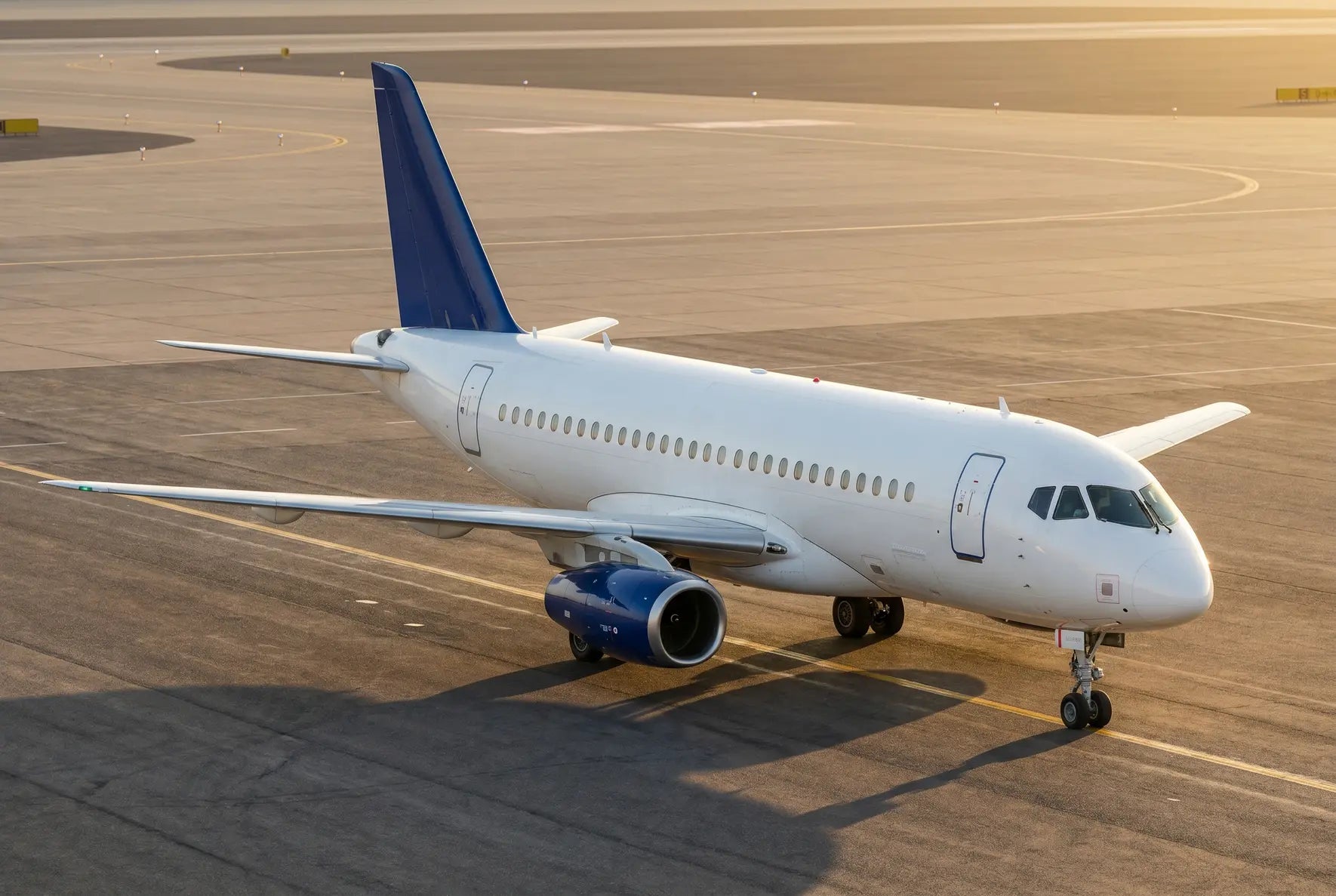
The image features a Sukhoi Superjet 100 aircraft in flight against a backdrop of a clear sky with scattered clouds. The jet is prominently marked with its branding and tail number.
Sukhoi Superjet 100-95: Technical Specifications, Systems and Engine Overview
The Sukhoi Superjet 100-95 (SSJ100/95) was designed as a next generation regional jet to compete in the 75 to 100 seat market, a segment dominated by the Embraer E-Jet family and the Bombardier CRJ series. Its engineering philosophy balances modern fly-by-wire handling, competitive fuel efficiency and the flexibility to serve both short, high frequency routes and longer thin routes through two certified weight variants: the 95B (Basic) and the 95LR (Long Range). Both share the same airframe, wing and engine installation, but differ in maximum takeoff weight and therefore usable fuel and range. The design draws on international collaboration, with major systems sourced from established Western suppliers including PowerJet for engines, Thales for avionics and Liebherr-Aerospace for flight controls and air management.
The SSJ100/95 seats up to 98 passengers in a standard layout (with configurations reaching 108 in high density), and features a cabin cross section of 3.46 m width and 2.12 m height, generous for the regional jet class. The airframe uses a conventional low wing, T-tail configuration with two underwing mounted turbofan engines, and was the first aircraft in its category to receive a full digital fly-by-wire certification from EASA.
- Overall length: 29.87 m
- Wingspan: 27.80 m
- Height: 10.28 m
- Passengers: up to 98 (standard) or 108 (high density), with 2 flight crew and 2 minimum cabin crew
- MTOW: 45,880 kg (95B) / 49,450 kg (95LR)
- MLW: 41,000 kg (both variants)
- MZFW: 40,000 kg (both variants)
- Fuel capacity: approximately 12,690 kg
- Range: 3,048 km / 1,645 nm (95B) and 4,578 km / 2,470 nm (95LR), based on 98 passengers at long range cruise, ISA, zero wind, with reserves
- Maximum cruise speed: Mach 0.81 (approximately 860 km/h)
- Typical cruise speed: Mach 0.78 (approximately 830 km/h)
- Service ceiling: 40,000 ft (12,192 m)
- Takeoff field length at MTOW: 1,731 m (95B) / 2,052 m (95LR)
- Landing field length at MLW: 1,630 m
- Engines: 2 x PowerJet SaM146 turbofans (71.6 kN normal takeoff thrust, up to 79.2 kN with Automatic Power Reserve)
- Avionics: Thales integrated modular avionics (IMA) with glass cockpit and five large LCD displays
- Noise certification: ICAO Chapter 4 compliant
Systems, Flight Controls and Onboard Technology
The SSJ100/95 was the first regional jet in its class to adopt a full digital fly-by-wire (FBW) flight control system, supplied by Liebherr-Aerospace. This system eliminates all mechanical linkages between the cockpit controls and the flight surfaces. Pilots interact through side-stick controllers, and the flight control computers enforce protective flight laws, including automatic stall prevention and flight envelope protection, similar in concept to the philosophy used in Airbus narrow bodies. Primary and secondary surfaces, including rudders, slats and flaps, are driven by electromechanical actuation managed by on-board flight control computers. Each shipset comprises over 600 individual parts.
The cockpit integrates a Thales glass avionics suite with five large switchable LCD screens arranged in a dark-and-quiet philosophy, reducing pilot workload by suppressing unnecessary alerts during normal operations. Standard equipment includes ACARS, AFDX data networking, RVSM capability and ILS CAT IIIA approach certification. Weather radar with predictive windshear detection is available, along with dual electronic flight bags (EFBs). Engine control uses a Full Authority Digital Engine Control (FADEC) system, allowing precise thrust management across all flight phases. Compared to earlier generation regional jets, such as the piston and early turboprop era airliners like the Lockheed L-049 Constellation, the automation level aboard the SSJ100/95 represents a generational leap in pilot assistance, systems integration and safety margins.
Published performance figures for the SSJ100/95 should always be interpreted in context. Actual range, takeoff distances and fuel burn vary significantly depending on operator-selected cabin density, passenger and cargo load, ambient temperature and pressure altitude, runway condition and whether the 95B or 95LR weight variant is used. Manufacturer data typically assumes standard ISA conditions, zero wind, long range cruise speed and full reserves. Operators in high altitude or hot climate regions, for example, may experience longer takeoff rolls and reduced payload range capability compared to the published baselines.
PowerJet SaM146: The Engine Behind the SSJ100
The PowerJet SaM146 is a twin spool, high bypass turbofan engine developed exclusively for the Superjet 100 family. It is manufactured by PowerJet, a 50/50 joint venture between Safran Aircraft Engines of France and NPO Saturn (part of Russia's United Engine Corporation). Development began in 2002, and the engine completed its first run on 21 February 2008. Certification by EASA followed on 23 June 2010, with Russian aviation authority approval granted in August 2010.
The SaM146 features a single stage fan, a three stage low pressure compressor, a six stage high pressure compressor, an annular combustor, a single stage high pressure turbine and a three stage low pressure turbine. Key specifications include a bypass ratio of 4.4:1, an overall pressure ratio of 28:1, a dry weight of 2,260 kg (for the 1S18 variant) and a length of 3.59 m. Specific fuel consumption at cruise is quoted at 0.629 lb/lbf/hr. Thrust output ranges from 71.6 kN (16,100 lbf) at normal takeoff to 79.2 kN (17,800 lbf) with Automatic Power Reserve (APR) engaged, with flat rating to ISA +15°C. The engine achieved 120 minute ETOPS approval in December 2018, and by August 2017 over 300 units had been assembled with more than 700,000 cumulative flight hours logged. The SaM146's core design draws on technology heritage from the CFM56 family, and the engine incorporates modern features such as blisk fan blades for improved efficiency and reduced maintenance requirements, while meeting CAEP VI emission standards.
Long duct nacelles on the SSJ100 are specifically designed to optimise acoustic performance, contributing to the aircraft's ICAO Chapter 4 noise compliance. The SaM146 is used exclusively on the Sukhoi Superjet 100 family and has not been adopted on any other aircraft type. For the Russian-built successor, the Yakovlev SJ-100, plans have shifted toward the domestically developed PD-8 engine as a replacement for the SaM146.
Sukhoi Superjet 100-95 vs E190 vs A220-100 vs CRJ900: Key Specifications Comparison
Scroll horizontally to see more →
| Parameter | Sukhoi Superjet 100-95 | Embraer E190 | Airbus A220-100 | Bombardier CRJ900 |
|---|---|---|---|---|
| Entry into service | 2012 | 2005 | 2016 | 2003 |
| Engines | 2 × PowerJet SaM146 | 2 × GE CF34-8E | 2 × PW1500G | 2 × GE CF34-8C5 |
| Length | 29.8 m | 36.2 m | 35.0 m | 36.4 m |
| Wingspan | 27.8 m | 28.7 m | 35.1 m | 24.9 m |
| Height | 10.3 m | 10.3 m | 11.5 m | 7.9 m |
| Typical seating and layout | 2-class: 75–98 passengers | 2-class: 94–114 passengers | 2-class: 100–135 passengers | 2-class: 76–90 passengers |
| MTOW | 46 t | 51 t | 61 t | 41 t |
| Range | 2,470 nm | 2,850 nm | 3,450 nm | 1,550 nm |
| Cruise speed | 0.78 Mach | 0.78 Mach | 0.78 Mach | 0.78 Mach |
| Service ceiling | 41,000 ft | 41,000 ft | 41,000 ft | 41,000 ft |
| Program note | Baseline regional jet for 75-100 seat short/medium-haul routes | Direct size competitor with proven reliability | Larger, more efficient newer generation alternative | Smaller, shorter-range regional jet competitor |
Scroll horizontally to see more →
The table compares core specs of the Sukhoi Superjet 100-95 against the Embraer E190, Airbus A220-100, and Bombardier CRJ900. The A220-100 leads in range (3,450 nm) and MTOW (61 t) with larger wingspan, while the E190 offers strong range (2,850 nm) and higher typical capacity than the Superjet. The CRJ900 is the lightest and shortest-range (1,550 nm). All cruise at Mach 0.78 and share a 41,000 ft ceiling.
Sukhoi Superjet 100-95 Operations: Routes, Airlines and Missions Worldwide
The Sukhoi Superjet 100-95 was designed to serve regional and short haul routes, replacing older Soviet era types such as the Tupolev Tu-134 and Yakovlev Yak-42. With a standard range of approximately 3,048 km (1,645 NM) for the base 95B variant and up to 4,578 km (2,470 NM) for the 95LR long range variant, the aircraft covers stage lengths that typically fall between 500 and 1,500 km. Cruising at Mach 0.78 and operating at altitudes up to 40,000 ft, it is optimised for high frequency domestic sectors and medium haul international connections.
Most operators deploy the Sukhoi Superjet 100-95 in hub and spoke networks, feeding passengers from regional cities into major hubs. Moscow Sheremetyevo is by far the dominant base, with top routes radiating to cities such as Nizhny Novgorod, Chelyabinsk, Volgograd and Tyumen. Some carriers also use the type on point to point services between secondary airports, particularly in southern Russia. Daily utilisation tends to be high on scheduled domestic services: during peak summer seasons, Russian operators collectively offered approximately 5.7 million round trip seats on the type, according to OAG schedule data reported by Simple Flying.
Operators have faced a number of challenges with the Sukhoi Superjet 100-95. Reliability issues, particularly related to the PowerJet SaM146 engines (a joint venture between Safran and NPO Saturn), have affected dispatch rates. Following Western sanctions imposed on Russia from 2022, access to spare parts and aftermarket support for Western sourced components has become increasingly difficult, reducing fleet availability. The aircraft's safety record has also drawn attention, with SKYbrary and other aviation safety databases documenting multiple incidents across the fleet's operational history.
Where the Sukhoi Superjet 100-95 Operates
The operational footprint of the Sukhoi Superjet 100-95 is overwhelmingly concentrated in Europe, and specifically within Russia, where approximately 94% of all seats are deployed on domestic routes. Outside Russia, the type has seen limited but notable use. In Europe, airlines such as CityJet in Ireland briefly operated the type on regional European routes before withdrawing it due to reliability concerns. In North and South America, Interjet in Mexico became the first Western hemisphere operator in 2013, using it on domestic Mexican routes before the airline ceased operations. In Asia, the type has generated orders from carriers such as Kartika Airlines in Indonesia, though none progressed to regular service. In Africa, no operators have been confirmed. The aircraft's market reach has been limited compared to competitors like the BAC One-Eleven 500, which in its era achieved broader international adoption as a regional jet.
- Europe: Rossiya Airlines operates the largest fleet on behalf of Aeroflot, flying from Moscow Sheremetyevo to dozens of domestic destinations, contributing around 1.48 million round trip seats per winter season. Azimuth Airlines uses the type from Rostov on Don and Krasnodar on domestic routes and international services to Istanbul, Yerevan and Minsk, offering approximately 949,000 round trip seats per season. Red Wings Airlines operates an all economy configuration on domestic routes with around 473,000 seasonal seats. Yamal Airlines, IrAero, Severstal Aircompany and Gazpromavia all operate smaller fleets on regional Russian services. Historically, Armavia in Armenia launched the first commercial Sukhoi Superjet 100-95 flight in 2011, from Yerevan to Moscow. CityJet in Ireland received seven aircraft in 2016 for European regional routes but removed them from service due to insufficient reliability.
- North and South America: Interjet in Mexico was the first and only confirmed operator in the Western hemisphere, receiving its first Sukhoi Superjet 100-95 from SuperJet International in 2013 for domestic Mexican routes. The airline eventually grounded the fleet and ceased operations.
- Asia: Yakutia Airlines operates the type on routes across eastern Russia and Siberia, offering approximately 92,000 round trip seats per season. Orders were placed by Kartika Airlines (Indonesia) and Orient Thai Airlines (Thailand), but neither progressed to confirmed revenue service.
- Africa: No airlines in Africa have operated the Sukhoi Superjet 100-95 in scheduled commercial service.
Typical Seating Configurations
The Sukhoi Superjet 100-95 features a cabin width of 3.24 m (10 ft 7 in), making it the first aircraft in its class to offer five abreast seating. This cabin dimension allows operators considerable flexibility in configuring the interior to match route demand and service philosophy.
Network carriers such as Aeroflot typically configure the aircraft with two classes: 12 business class seats in a 2+2 layout at 38 inch pitch and 75 economy class seats in a 2+3 layout at 30 inch pitch, for a total of 87 seats. Yakutia Airlines uses a similar two class arrangement with 8 business and 85 economy seats, totalling 93. In contrast, operators focused on high density regional services, such as Red Wings Airlines and Azimuth Airlines, favour all economy configurations with 100 to 103 seats. Rossiya Airlines operates both variants depending on the route: a two class 87 seat layout and a single class 100 seat version. Economy class seats across all operators are typically 18 inches wide with 30 inches of pitch, while business class seats offer 19.5 inches of width with up to 38 inches of pitch and increased recline. A business jet variant, the Sukhoi Business Jet (SBJ), has also been offered with VIP interiors including lounges, private cabins and a range of up to 4,500 km.
In this video, discover the rise and fall of the Sukhoi Superjet, tracing its ambitious development, key milestones, and the operational and market challenges that shaped its legacy in modern commercial aviation.
Sukhoi Superjet 100-95 Safety Record: Accidents, Incidents and How Safe It Is
The Sukhoi Superjet 100-95 entered commercial service in April 2011 and, as of early 2026, around 160 aircraft remain in active operation. The combined fleet has logged more than two million flight hours across well over 300,000 revenue flights. Within that operational history the type has recorded five hull losses and a total of 89 fatalities. While those figures demand serious attention, they must be weighed against the overall volume of flights and the relatively small fleet size. Like every modern airliner, the SSJ100 has been subject to continuous airworthiness oversight, manufacturer service bulletins and operator driven safety management programmes aimed at reducing risk over time.
Major Accidents and Incidents Involving the SSJ100
Mount Salak demonstration flight (May 2012) — A Sukhoi Superjet 100-95 (registration 97004) on a promotional tour in Indonesia struck the side of Mount Salak in West Java, killing all 45 people on board. The Indonesian National Transportation Safety Committee determined that the crew descended below safe altitude in mountainous terrain, disregarded repeated Terrain Awareness and Warning System (TAWS) alerts, and lacked adequate charts for the area. Contributing factors included insufficient flight briefing and air traffic control workload. The accident led to safety recommendations on cockpit resource management, TAWS response procedures and improved terrain charting for demonstration flights. Full details are available through the Aviation Safety Network accident record.
Aeroflot Flight 1492 at Sheremetyevo (May 2019) — An Aeroflot SSJ100-95B (RA-89098) was struck by lightning shortly after departure from Moscow Sheremetyevo. The electrical disruption caused a reversion to direct flight control law, removing normal envelope protection. On the emergency return the captain executed a hard landing that collapsed the main landing gear and ruptured fuel tanks, triggering a fire that engulfed the rear fuselage. Of the 78 occupants, 41 lost their lives. The Interstate Aviation Committee (IAC) final report, published in March 2025, recommended a review of landing gear resilience to secondary ground impacts, updates to the flight crew operating manual (which had incorrectly described control law behaviour), and enhanced simulator training for manual handling in degraded modes. The accident also intensified industry discussion on passenger cabin evacuation discipline after investigators noted that luggage retrieval slowed the escape from the burning aircraft.
Gazpromavia ferry flight near Kolomna (July 2024) — A Sukhoi Superjet 100-95LR (RA-89049) operated by Gazpromavia crashed into a forested area southeast of Moscow during a post maintenance test flight, killing all three crew members. The aircraft had departed Lukhovitsy and was bound for Vnukovo when it entered a rapid descent from approximately 1,500 metres. The investigation, led by the IAC, was ongoing at the time of writing. The Aviation Safety Network entry tracks updates as they become available.
Two further hull losses occurred at Yakutsk (October 2018, Yakutia Airlines) and at Akhtubinsk (October 2018), both involving runway excursions and landing gear failures with no fatalities. Factors cited included icy runway conditions, incorrect friction reporting and crew handling.
How Safe Is the Sukhoi Superjet 100-95 Today?
Assessing the safety of any aircraft type requires context. The SSJ100's five hull losses over more than two million flight hours place it in a statistical bracket that reflects both its relatively short service history and the lower total fleet hours compared to long established types such as the Fokker F28, which accumulated decades of regional operations worldwide. Investigations into the SSJ100 accidents consistently identify human factors and operational shortcomings rather than systemic airframe design failures. The manufacturer, now operating under the United Aircraft Corporation, has issued service bulletins and documentation updates, while operators have tightened crew training programmes for degraded flight control modes and emergency procedures.
From a design standpoint, the Superjet 100-95 was developed with a fly by wire flight control system, modern avionics, a full authority digital engine control (FADEC) suite and redundant hydraulic systems. It received its type certificate from the Russian aviation authority and was also validated by the European Union Aviation Safety Agency (EASA) in 2012, confirming compliance with international airworthiness standards at the time of certification. Regulatory oversight, standard operating procedures and recurrent training remain the primary safeguards for any commercial aircraft in service.
Data compiled by the Aviation Safety Network consistently shows that the global commercial aviation fatal accident rate has fallen to historically low levels, making scheduled air travel one of the safest forms of transport. The SSJ100 operates within that broader safety framework, and ongoing improvements to training, maintenance practices and regulatory standards continue to reduce risk across the entire fleet.
01 What is the typical range of the Boeing 737?
The Boeing 737 has a maximum range of about 3,000 to 3,800 nautical miles depending on the variant like the 737 MAX 8. This allows it to operate efficiently on medium-haul routes such as transcontinental US flights or Europe to Middle East paths. Airlines choose it for its balance of range and capacity on high-frequency routes.
02 How is the cabin laid out in the Boeing 737 and what is the passenger experience like?
The Boeing 737 typically features a single-aisle cabin with 2+2 seating in economy for most variants, seating 126 to 210 passengers. Noise levels are reduced in newer MAX models thanks to advanced engine technology, providing a quieter ride. Passengers often note good overhead bin space and larger windows in recent versions for better views.
03 Which airlines commonly operate the Boeing 737 and on what routes?
Major operators include Southwest Airlines, Ryanair, American Airlines, and United Airlines. They use the Boeing 737 on short to medium-haul routes like domestic US flights, intra-Europe hops, and Latin American networks. It's popular for high-utilization shuttle services due to quick turnaround times.
04 How does the Boeing 737 perform in terms of fuel efficiency compared to similar aircraft?
The Boeing 737 MAX offers 20% better fuel efficiency than the previous 737NG generation due to its CFM LEAP-1B engines and aerodynamic improvements. It competes closely with the Airbus A320neo, often matching or exceeding it on routes under 3,000 miles. This efficiency helps airlines lower operating costs on busy corridors.
05 What is the safety record of the Boeing 737?
The Boeing 737 family has a strong safety record with over 10,000 units delivered and billions of passenger miles flown safely. Newer models include enhanced flight management systems and redundancy features for reliability. Regulatory oversight and continuous upgrades address past issues, maintaining high standards.
06 What are good seat choices on the Boeing 737 for comfort and views?
Opt for seats in rows 1-5 or exit rows for extra legroom on the Boeing 737, avoiding the last rows near lavatories. Window seats like 12A or F offer larger windows on MAX variants with good turbulence handling due to the low-wing design. Check airline seat maps for specific layouts to pick quieter spots over the wings.