

Douglas DC 7: History, Development, and Evolution of the Last Great Piston Airliner
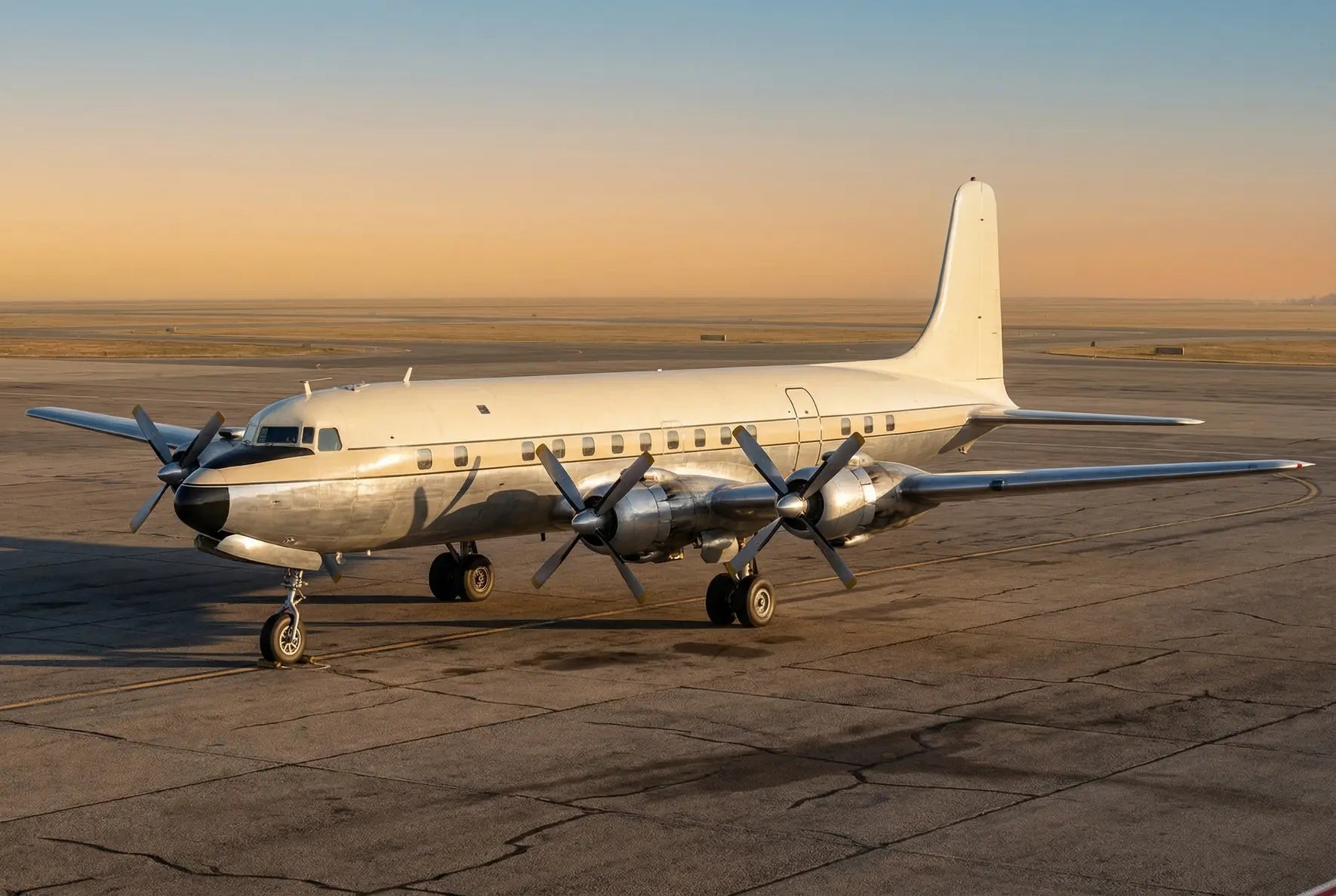
The Douglas DC 7 holds a unique place in aviation history as the last major piston engine powered airliner produced by the Douglas Aircraft Company. Built between 1953 and 1958 at the company's Santa Monica, California plant, the DC 7 represented the pinnacle of propeller driven commercial transport. It was also the first airliner capable of routine nonstop transcontinental service across the United States, a milestone that had long eluded airlines operating the earlier DC 6 series.
Douglas Aircraft Company, founded by Donald Douglas Sr. on July 22, 1921, in Santa Monica, had already established a formidable reputation through iconic types such as the DC 3 and DC 6. By the early 1950s, however, the company faced mounting pressure from airlines demanding an aircraft with enough speed and range to fly nonstop from New York to Los Angeles against prevailing headwinds, all within the eight hour crew duty limit set by Civil Air Regulations. The DC 6B, despite its reliability, could not consistently achieve this on westbound routes.
The catalyst for the DC 7 program was a firm order from American Airlines in 1951, reportedly valued at around $40 million for 25 aircraft. C.R. Smith, then president of American Airlines, pushed Douglas to develop a stretched, more powerful derivative of the DC 6B. Douglas was initially reluctant to commit to the program, but American's financial commitment covered development costs and gave the project its commercial foundation.
The DC 7 was essentially a DC 6B airframe lengthened by approximately 40 inches (1.02 m) aft of the wing, allowing room for additional passengers and fuel. The most significant technical change was the adoption of four Wright R 3350 988TC18EA1 Turbo Compound radial engines, each rated at 3,250 horsepower. These 18 cylinder powerplants featured exhaust driven power recovery turbines that fed energy back into the crankshaft, delivering substantially more power than the Pratt & Whitney engines used on the DC 6B.
The prototype completed its first flight on May 18, 1953, from Santa Monica. Certification followed swiftly, and American Airlines inaugurated revenue service on November 29, 1953, on the New York to Los Angeles route. For the first time, passengers could fly coast to coast without a refuelling stop in both directions. The Smithsonian National Air and Space Museum notes that the DC 7 was the first airliner to provide nonstop transcontinental service in both directions. Delta Air Lines followed with DC 7 operations starting April 1, 1954, on its Chicago to Miami route.
Despite its groundbreaking performance, the DC 7 was not without problems. The Wright R 3350 Turbo Compound engines proved temperamental in service. Overheating power recovery turbines, exhaust system failures, and high maintenance demands plagued early operations. Airlines reported significant engine related delays and incidents, which eroded some of the type's initial commercial appeal. Douglas and Wright worked on incremental improvements throughout the production run, but engine reliability remained a persistent concern.
Production of the baseline DC 7 totalled 105 aircraft. The improved DC 7B followed with 112 built, featuring a higher maximum takeoff weight of approximately 125,000 lb, optional saddle fuel tanks in enlarged engine nacelles, and minor aerodynamic refinements. Pan American World Airways introduced the DC 7B on transatlantic routes in June 1955, cutting travel time significantly compared to the Boeing Stratocruiser. The ultimate expression of the family, the DC 7C, nicknamed Seven Seas, added two five foot wing root inserts that increased wingspan to 127 ft 6 in, boosted fuel capacity to approximately 7,824 US gallons, and raised maximum takeoff weight to 143,000 lb. Its engines were further uprated to 3,400 hp each. A total of 121 DC 7C aircraft were built, entering service in 1957 with carriers such as Pan Am, BOAC, SAS, and Northwest Airlines for reliable nonstop transatlantic operations. Across all variants, Douglas produced a combined 338 DC 7 series aircraft.
The arrival of the jet age, spearheaded by the Boeing 707 and Douglas's own DC 8 (which first flew in 1958), rapidly rendered the DC 7 family obsolete for front line passenger service. From 1959 onward, Douglas offered conversion programs to transform passenger DC 7s into DC 7F freighters with large cargo doors, extending the working life of many airframes. Some DC 7s continued flying cargo and charter operations well into the 1960s. Douglas Aircraft Company itself merged with McDonnell Aircraft Corporation on April 28, 1967, to form McDonnell Douglas, which was later acquired by Boeing in 1997. The DC 7 remains a fascinating bridge between the propeller and jet eras. For a look at how freight aviation evolved into modern widebody operations, see the profile of the Boeing 747 400ERF.
What Distinguishes the Douglas DC 7 from Earlier and Later Variants
The baseline Douglas DC 7 occupies a distinct position between the DC 6B that preceded it and the DC 7B and DC 7C that followed. Compared to the DC 6B, the DC 7 introduced a longer fuselage, more powerful Turbo Compound engines, and the ability to complete nonstop transcontinental flights. However, it retained the same 117 ft 6 in wingspan and much of the structural architecture of its predecessor. Relative to the DC 7B, the baseline DC 7 had lower maximum takeoff weight and lacked the optional nacelle saddle tanks that extended range for overwater routes. Compared to the DC 7C Seven Seas, the original DC 7 had a shorter fuselage, narrower wingspan, less fuel capacity, and lower gross weight, making it unsuited for reliable nonstop transatlantic service. The DC 7 also featured the first commercial use of titanium in its structure, saving approximately 200 lb of weight, along with triple pane windows for improved soundproofing against the notoriously loud Turbo Compound engines.
Key variant identifiers for the Douglas DC 7 family:
- Engines: All variants powered by Wright R 3350 Turbo Compound 18 cylinder radials; baseline DC 7 at 3,250 hp per engine, DC 7C at 3,400 hp per engine
- Wingspan: DC 7 and DC 7B: 117 ft 6 in; DC 7C: 127 ft 6 in (with wing root inserts)
- Maximum takeoff weight: DC 7: approximately 122,200 lb; DC 7B: 125,000 lb; DC 7C: 143,000 lb
- Fuselage length: DC 7 and DC 7B: approximately 108 ft 11 in; DC 7C: 112 ft 3 in
- Passenger capacity: 69 in first class configuration, up to 95 in high density layouts
- Production totals: DC 7: 105; DC 7B: 112; DC 7C: 121 (338 total)
- Notable feature: First commercial airliner to use titanium structural components

A black and white photograph of a United Air Lines Douglas DC-7, identified by the registration number N6316C, in flight over a mountainous landscape. The image captures the sleek design and four engines of this classic aircraft.
Douglas DC 7 Technical Specifications, Systems and Engine Performance
The Douglas DC 7, introduced in 1953, was the ultimate expression of the piston engine era in commercial aviation. Developed by Douglas Aircraft Company as a direct evolution of the DC 6B, it was designed with one overriding goal: nonstop transcontinental service across the United States. To achieve this, Douglas mated a proven pressurised fuselage with the powerful Wright R 3350 turbo compound radial engine, accepting greater mechanical complexity in exchange for the speed and range that airlines such as American Airlines demanded. A total of 338 airframes were built across three main variants (DC 7, DC 7B, and DC 7C Seven Seas), each progressively trading structural weight and fuel capacity for longer range, culminating in transatlantic capability with the DC 7C.
The DC 7 inherited the all metal, stressed skin construction and circular cross section fuselage of its DC 6 lineage, but introduced a fuselage stretch, uprated powerplants, and higher gross weights. While the base DC 7 served domestic U.S. routes, the DC 7C added a 10 ft wing span extension (to 127 ft 6 in), a longer fuselage (112 ft 3 in), and significantly increased fuel capacity to enable nonstop flights across the Atlantic. In an era when turboprops such as the Saab 340A were still decades away, the DC 7 represented the pinnacle of what reciprocating engine technology could deliver for airline operations.
- Wingspan: 117 ft 6 in (35.81 m) for DC 7/DC 7B; 127 ft 6 in (38.86 m) for DC 7C
- Overall length: 108 ft 11 in (33.2 m) for DC 7/DC 7B; 112 ft 3 in (34.21 m) for DC 7C
- Height: approximately 28 ft 7 in (DC 7) to 31 ft 8 in (DC 7C)
- Wing area: 1,637 sq ft (152.1 m²)
- Maximum takeoff weight (MTOW): 122,200 lb (DC 7); up to 143,000 lb (64,864 kg) for DC 7C
- Operating empty weight: approximately 72,763 lb (33,005 kg) for DC 7C
- Maximum landing weight: approximately 109,000 lb (49,000 kg) for DC 7C
- Passenger capacity: 64 to 105 passengers depending on variant and cabin layout
- Engines: 4 × Wright R 3350 turbo compound 18 cylinder radial; 3,250 hp (DC 7/DC 7B) to 3,400 hp (DC 7C) per engine at takeoff
- Propellers: Hamilton Standard Hydromatic 34E60, 4 blade, constant speed, fully feathering, reversible pitch, 14 ft diameter
- Fuel capacity: approximately 4,512 US gal (DC 7); up to 7,824 US gal (29,620 litres) for DC 7C
- Cruise speed: 346 mph (301 kn) at approximately 21,600 ft
- Maximum speed: 406 mph (353 kn) at 22,700 ft
- Service ceiling: 21,700 ft at maximum gross weight (DC 7C)
- Range (max fuel): approximately 5,164 mi (DC 7); up to 5,635 mi (DC 7C with 15,310 lb payload)
- Takeoff field length: approximately 6,360 ft at maximum gross weight
- Landing distance (from 50 ft): approximately 5,100 ft
- Crew: 5 flight crew (including flight engineer) plus up to 4 flight attendants
Systems, Flight Controls and Handling
The DC 7 used conventional flight controls typical of its generation, with cable and pulley linkages for the ailerons, elevator, and rudder. There was no hydraulic boosting or power assisted control surfaces in the manner of later jet transports; pilot workload was managed through careful trim and a well harmonised control feel. The aircraft featured Fowler type flaps for increased lift during takeoff and landing, and the wing employed an NACA 23016 root / 23012 tip airfoil profile. Reversible pitch propellers provided significant deceleration on the ground, supplementing conventional wheel brakes. The flight engineer's station was critical to operation, managing engine parameters, fuel distribution among wing tanks, pressurisation, and electrical systems in flight. Titanium nacelles and firewalls were an innovative weight saving measure, reducing approximately 118 kg per nacelle compared with the stainless steel used on earlier Douglas airliners.
Published performance figures for the DC 7 vary considerably depending on the variant (DC 7, DC 7B, or DC 7C), operator configuration, cabin density, fuel load, and atmospheric conditions. Range values, for example, assume specific payload and fuel combinations; a DC 7C carrying maximum fuel could achieve over 5,600 miles, but with a full passenger load the practical range was substantially shorter. Takeoff distances are referenced to sea level, standard atmosphere, and maximum gross weight. Operators also made modifications that affected weights and performance, making it important to treat any single set of numbers as representative rather than absolute.
The Wright R 3350 Turbo Compound Engine
The Wright R 3350 Turbo Cyclone 18 was a twin row, 18 cylinder, air cooled radial piston engine displacing 3,350 cubic inches (54.9 litres), with a bore of 6.125 in and a stroke of 6.312 in. Developed by the Curtiss Wright Corporation, the R 3350 family originated in the late 1930s and first saw widespread service powering the Boeing B 29 Superfortress during World War II. The turbo compound variants, introduced in the late 1940s, added three exhaust driven power recovery turbines (PRTs) connected to the crankshaft via fluid couplings. These turbines recaptured energy from exhaust gases and fed it back into the drivetrain, adding approximately 550 hp at takeoff and significantly improving specific fuel consumption to as low as 0.40 lb/hp/hr at cruise.
On the base DC 7 and DC 7B, the engine model was the R 3350 30W, rated at 3,250 hp for takeoff, while the DC 7C Seven Seas used the uprated R 3350 988TC18EA1 2, delivering 3,400 hp at takeoff and approximately 2,800 hp in cruise at altitude. The engines drove four blade Hamilton Standard Hydromatic propellers and relied on a two speed, single stage supercharger. Fuel was 115/145 octane aviation gasoline, and anti detonant injection (a water methanol mixture) was available for additional power during takeoff. Dry weight per engine was approximately 3,514 lb, and total powerplant installation weight including the propeller reached roughly 7,375 kg per nacelle.
Beyond the Douglas DC 7 family, the R 3350 turbo compound also powered the Lockheed L 1049 Super Constellation, its direct competitor on long range routes. Earlier, non turbo compound versions of the R 3350 served on the B 29, the Lockheed P 2 Neptune maritime patrol aircraft, and the Canadair CP 107 Argus. While the turbo compound technology delivered impressive fuel efficiency for a piston engine, it came at the cost of mechanical complexity and maintenance demands. The arrival of turbojets such as the Boeing 707 and Douglas DC 8 in the late 1950s quickly rendered the DC 7 and its R 3350 engines obsolete for mainline airline service, though some airframes continued in cargo and charter roles into the late 1960s.
Douglas DC-7 vs Super Constellation vs DC-6 vs Boeing 377: Key Specs Comparison
Scroll horizontally to see more
| Parameter | Douglas DC-7 | Lockheed L-1049 Super Constellation | Douglas DC-6 | Boeing 377 Stratocruiser |
|---|---|---|---|---|
| Entry into service | 1953 | 1951 | 1947 | 1947 |
| Engines | 4 × Wright R-3350 | 4 × Wright R-3350 | 4 × Pratt & Whitney R-2800 | 4 × Pratt & Whitney R-4360 |
| Length | 34.2 m | 35.8 m | 28.5 m | 43.1 m |
| Wingspan | 38.9 m | 38.0 m | 35.8 m | 43.8 m |
| Height | 9.7 m | 7.7 m | 7.5 m | 11.7 m |
| Typical seating and layout | 3-class: 64–95 passengers | 3-class: 62–95 passengers | 2-class: 48–80 passengers | 2-class: 50–100 passengers |
| MTOW | 65 t | 60 t | 48 t | 65 t |
| Range | 4,900 nm | 5,400 nm | 3,100 nm | 4,300 nm |
| Cruise speed | 0.52 Mach | 0.53 Mach | 0.50 Mach | 0.50 Mach |
| Service ceiling | 21,700 ft | 25,000 ft | 25,100 ft | 25,000 ft |
| Program note | Ultimate piston airliner with transatlantic nonstop capability | Main competitor with similar long-range performance | DC-7 predecessor, shorter range baseline | Boeing's luxury partial double-deck transoceanic design |
Scroll horizontally to see more
The table compares four flagship piston-era airliners across dimensions, powerplants, seating, weight and performance. DC-7 and L-1049 are closest rivals, sharing R-3350 engines and similar seating, but the Super Constellation leads in range (5,400 nm) and ceiling (25,000 ft), while the DC-7 is heavier (65 t) with slightly lower ceiling. DC-6 is smaller and shorter-range (3,100 nm). Boeing 377 matches DC-7 MTOW but is the largest airframe.
Douglas DC-7 Operations: Routes, Airlines and Missions Around the World
The Douglas DC-7, built by Douglas Aircraft Company from 1953 to 1958, was developed at the request of American Airlines to become the first airliner capable of nonstop transcontinental service across the United States. The aircraft operated primarily on long haul point to point routes, with the flagship mission being the New York to Los Angeles nonstop, completed in approximately 8 hours eastbound and up to 9.5 hours westbound against prevailing headwinds. The improved DC-7C "Seven Seas" variant, with its extended range of approximately 9,800 km, enabled reliable transatlantic crossings in around 9 hours between cities such as New York or Boston and London or Paris.
Typical mission lengths ranged from medium haul domestic segments of 2 to 4 hours on routes like Chicago to Miami or Atlanta to New York, up to ultra long haul intercontinental services. SAS famously operated the DC-7C on a Copenhagen to Tokyo polar route via Anchorage, covering the distance in roughly 32 hours and saving over 2,000 miles compared to conventional routing. The aircraft was employed overwhelmingly in point to point network configurations, reflecting the industry's emphasis during the 1950s on establishing prestigious nonstop city pair connections rather than funnelling passengers through centralised hubs.
Operators faced significant challenges with the Wright R-3350 Turbo Compound engines. The rear cylinder rows were prone to dangerous overheating, and engine fires could reach temperatures of approximately 5,600 °F, threatening to melt through wing spar structures. Maintenance crews adopted aggressive inspection schedules, including replacing the five uppermost cylinders every 25 hours of operation in early service. Pilots and flight engineers learned to operate below maximum power settings to reduce heat buildup. Although later TC-18DA versions used on the DC-7C improved reliability dramatically, extending time between overhauls to over 3,000 hours, the aircraft earned the wry nickname "the world's best three engine airliner" among crews. By the late 1950s, the arrival of jets such as the Boeing 707 and Douglas DC-8 rapidly rendered the DC-7 obsolete, cutting transatlantic times from nine hours to six and transcontinental flights from eight hours to five.
Where the Douglas DC-7 Operated
The Douglas DC-7 saw service across four broad regions, though its heaviest concentration was in North America and Europe. In the United States, major trunk carriers used all three variants on domestic transcontinental and medium haul routes, while European flag carriers favoured the long range DC-7C for transatlantic and intercontinental services. In South America, operations centred on international connections linking the continent to North America. In Africa and Asia, a smaller number of carriers deployed the type on long haul international routes, reflecting the more limited but strategically important role the aircraft played in those regions. Several DC-7s later found second careers as cargo freighters and aerial firefighting tankers, extending the type's operational life well beyond scheduled passenger service.
- North & South America: American Airlines was the launch customer and largest operator, receiving 34 DC-7s and 24 DC-7Bs for its transcontinental Nonstop Mercury services. United Airlines operated 57 DC-7s on competing coast to coast routes. Delta Air Lines introduced DC-7 service in April 1954 from Chicago to Miami and eventually operated across 18 cities, with the fleet accounting for 53% of the airline's seat miles by 1958. Eastern Air Lines became the largest DC-7B operator with 49 aircraft. Other U.S. operators included National Airlines, Braniff Airways, and Continental Airlines. In South America, Panagra (Pan American Grace Airways) flew six DC-7Bs on routes linking the continent to North America, while Panair do Brasil operated several DC-7Cs on international services.
- Europe: European carriers predominantly operated the DC-7C variant for transatlantic service. BOAC acquired 10 DC-7Cs to cover transatlantic routes while awaiting delivery of the Bristol Britannia. KLM operated 15 DC-7Cs, SAS flew 14 on pioneering polar routes, Sabena used 10, Swissair operated five from Zürich, and Alitalia deployed six on international services. Secondary operators included TAI (Transports Aériens Intercontinentaux), Caledonian Airways, Dan-Air, and Spantax.
- Asia: Japan Air Lines operated four DC-7Cs on transpacific services, while Iran Air used a single example on its international network.
- Africa: South African Airways operated four DC-7Bs on regional and international routes from southern Africa.
Typical Cabin Layouts and Seating Configurations
The Douglas DC-7 featured a pressurised, narrow body cabin arranged in a 2+2 abreast seating configuration with a single centre aisle. The passenger cabin measured approximately 87 feet (26.5 m) in length. In a typical first class layout, operators configured the aircraft for around 69 passengers, as seen in Delta Air Lines' initial DC-7 service. Delta offered premium amenities including an 8 seat Sky Room and a 5 seat Sky Lounge in addition to two main passenger cabins. Coach or high density configurations increased capacity substantially, with Eastern Air Lines and others seating between 90 and 99 passengers. The maximum certified capacity reached 105 passengers on the standard DC-7 and DC-7B, while the longer fuselage DC-7C could accommodate up to 113 passengers in a high density arrangement according to published specifications. Network carriers flying premium transcontinental or transatlantic services generally favoured lower density first class layouts with lounge style facing seats, while operators on shorter domestic routes or those competing on price tended toward higher density coach configurations.
In this video, discover why pilots admired the Douglas DC-7, the last great propeller airliner. Learn about its first flight on May 18, 1953, and what made it a standout in aviation history.
Douglas DC 7 Safety Record: How Safe Was This Piston Era Airliner?
The Douglas DC 7 entered commercial airline service in 1953 and remained on frontline passenger routes until the early 1960s, when jet aircraft such as the Boeing 707 and Douglas DC 8 progressively replaced it. A total of 338 airframes were built across three main variants (DC 7, DC 7B and DC 7C), and many continued flying freight, charter and aerial firefighting missions well into the 1990s. Over that long operational span, the DC 7 family recorded 82 accidents and incidents with 714 fatalities. While that figure appears stark by modern standards, it must be evaluated against several decades of global service, the technological limitations of piston era aviation, and the far less mature air traffic control and regulatory frameworks that existed during the type's peak years of operation. The aircraft flew in an era when navigational aids were rudimentary, cockpit automation was virtually nonexistent, and crews depended heavily on visual observation and manual skills to maintain safe separation from other traffic.
One recurring factor in DC 7 operations was the Wright R 3350 turbo compound engine. Although powerful, the R 3350 was widely recognised for reliability challenges including overheating of rear cylinders, oil system failures and an elevated risk of in flight engine fires. Flight engineers played a critical role in monitoring temperatures and managing power settings to mitigate these issues. The engine's demanding maintenance requirements contributed to several hull loss events over the years and were a significant reason airlines welcomed the transition to turbine power.
Notable Accidents and Their Impact on Aviation Safety
Several DC 7 accidents stand out for their consequences on regulation, design philosophy and operational procedures.
- United Airlines Flight 718, 30 June 1956 (Grand Canyon, Arizona) – A Douglas DC 7 operating as United Flight 718 collided at 21,000 feet with TWA Flight 2, a Lockheed L 1049 Super Constellation, over Grand Canyon National Park. All 128 occupants of both aircraft perished, making it the deadliest U.S. commercial aviation disaster at that time. The Civil Aeronautics Board investigation found that both flights were operating under visual flight rules in uncontrolled airspace, relying on the see and avoid principle. The tragedy directly catalysed the Federal Aviation Act of 1958, which created the Federal Aviation Agency (later renamed the FAA), established positive controlled airspace requiring ATC clearance, and accelerated radar coverage across the United States.
- Sabena DC 7C, 18 May 1958 (Casablanca, Morocco) – A Sabena Douglas DC 7C crashed during approach to Casablanca Anfa Airport, killing 61 of the 65 people on board. The accident underscored the challenges of complex approaches with heavy piston powered aircraft and contributed to operator reviews of approach procedures and crew training in the late 1950s.
- TAI Flight 307, 24 September 1959 (Bordeaux, France) – A Transports Aériens Intercontinentaux DC 7C crashed shortly after departure from Bordeaux Airport, striking trees beyond the runway. The accident killed 54 people and drew attention to take off performance calculations and engine out procedures on four engine piston airliners.
- Panair do Brasil DC 7C, 1 November 1961 (near Recife, Brazil) – A DC 7C flying from Sal to Recife struck a hill short of the runway, resulting in 45 fatalities among the 88 occupants. The investigation identified pilot error during the approach phase, reinforcing the importance of standardised instrument approach procedures across international operators.
Later hull losses in the 1970s and 1980s predominantly involved converted DC 7CF freighters and aerial tankers. Recurring themes included engine fires, overloading, improper fuel grades and operations in remote or conflict affected areas. These events prompted stricter oversight of cargo and supplemental operators, particularly regarding airworthiness certification and maintenance record keeping.
How Safe Is the Douglas DC 7 by Historical Standards?
Assessing the safety of the Douglas DC 7 requires historical context. The aircraft operated during a transitional period when pilot working conditions, cockpit workload and crew resource management practices were far less refined than those of the jet age. Accident rates for all piston era airliners were considerably higher than those seen with modern turbine powered fleets. According to the Aviation Safety Network, global fatal accident rates have fallen by more than 90 percent since the 1950s, reflecting advances in aircraft design, materials, avionics, training and regulatory oversight. The DC 7's record, while sobering, was broadly comparable to that of contemporary types such as the Lockheed Constellation and early Boeing Stratocruiser.
The lessons drawn from DC 7 era operations – including the creation of the FAA, the introduction of radar based ATC separation, improved engine certification standards and the codification of crew procedures – laid essential groundwork for the safety culture that governs commercial aviation today. Modern air travel remains one of the safest forms of transport, with fatal accident rates measured in fractions per million flights, a standard made possible in part by the hard won experience of piston era operations.
01 What was the typical range and mission profile of the Douglas DC-7?
The Douglas DC-7 had a maximum range of about 5,635 miles with maximum fuel, enabling non-stop transatlantic flights on the DC-7C Seven Seas variant. It served mainly long-haul routes like New York to Los Angeles or transoceanic missions for airlines seeking coast-to-coast or international nonstop capability. Typical cruise speed was around 346 mph at 21,600 feet, balancing speed and fuel efficiency for intercontinental travel.
02 How was the cabin laid out on the Douglas DC-7, and what was the passenger experience like?
The Douglas DC-7 accommodated 64 to 105 passengers in a pressurized cabin with typical layouts seating up to 95 in coach configuration. Passengers enjoyed relatively quiet flights for a piston-engine airliner thanks to turbo-compound engines, though noise from four radial engines and propellers was still noticeable compared to modern jets. Comfort featured standard seating with access to meals on long flights, marking it as a premium travel option in the 1950s.
03 Which airlines operated the Douglas DC-7 and on what routes?
Major operators included American Airlines, which introduced it on New York-Los Angeles routes, along with Pan American, KLM, and others totaling 18 airlines purchasing 338 units. These carriers used the DC-7 for transcontinental U.S. flights and long overwater routes like transatlantic hops with the extended-range DC-7C. It filled a niche for reliable piston-powered long-haul service before jet airliners arrived.
04 How did the Douglas DC-7 perform compared to similar aircraft like the DC-6?
The Douglas DC-7 offered superior range and speed over the DC-6, with a top speed of 406 mph and cruise around 346 mph versus the DC-6's lower figures, powered by more efficient 3,400 hp Wright R-3350 turbo-compound engines. It required longer takeoff runs at 6,360 feet but reached service ceilings up to 28,400 feet. Fuel burn was high at about 581 gallons per hour at 75% power, reflecting its role as a final piston airliner before jets like the Boeing 707.
05 What was the safety record and key design features of the Douglas DC-7?
The Douglas DC-7 had a solid safety record for its era, with no major design flaws noted beyond typical piston-engine risks like engine fires, benefiting from proven DC-6 heritage and advancements like turbo-compound engines for better efficiency. Key features included fully-feathering reversible propellers for shorter landings and a robust structure supporting up to 143,000 pounds gross weight. Its stall speed of 97 mph aided safe operations on longer runways.
06 What practical details should travelers know about flying on a Douglas DC-7?
Seats were arranged in rows accommodating 64-95 passengers, with window seats offering good views of the four large radial engines and props, though turbulence handling was stable due to its 127-foot wingspan. Noise levels were higher than jets but manageable, and flights cruised at 20,000-25,000 feet for smoother air. Best seat choices were forward for quicker boarding and less prop noise on long nonstop routes.