Boeing 787-8: History, Program Launch, and Development of the Baseline Dreamliner
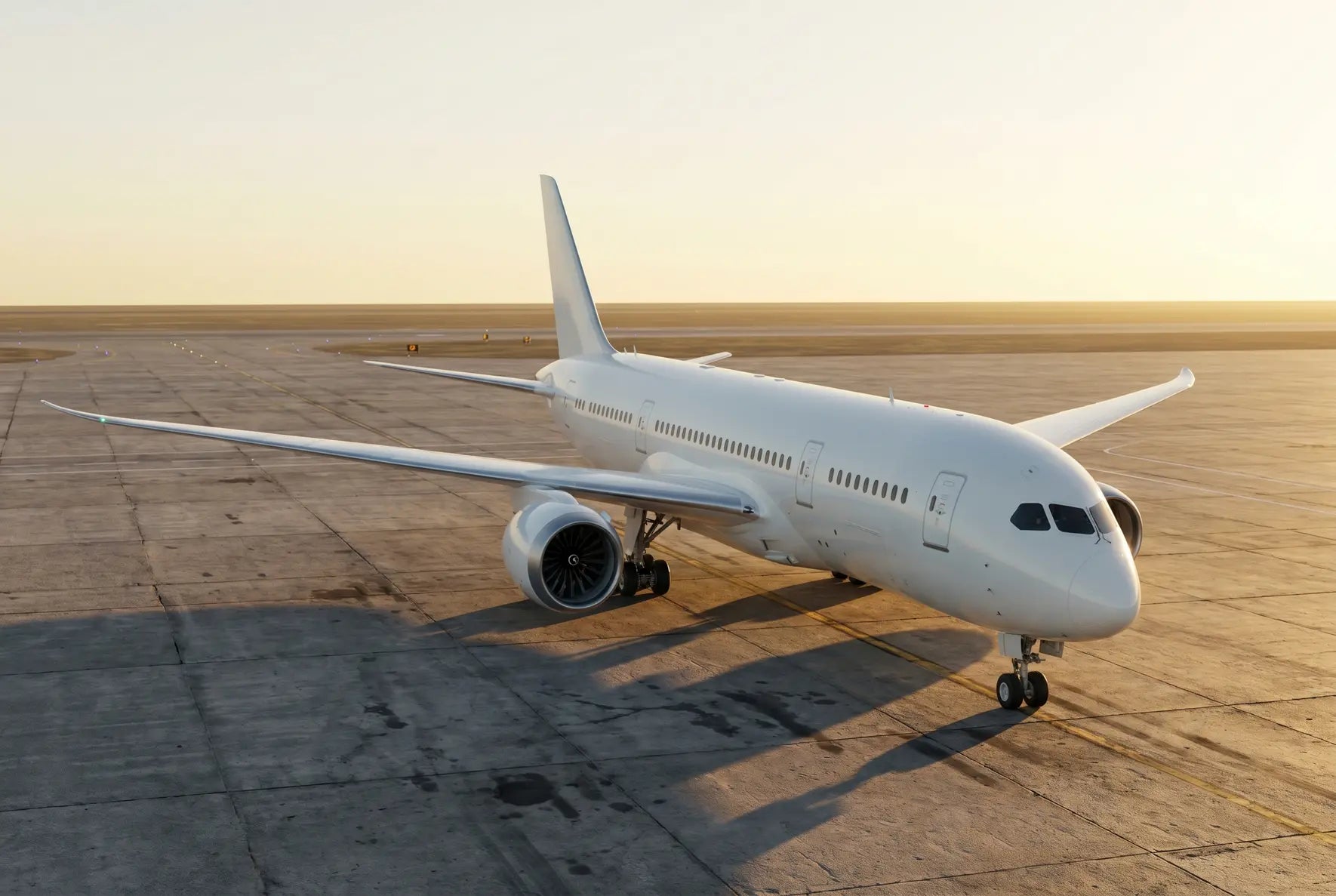
The Boeing 787-8 is the founding variant of the 787 Dreamliner family, a wide body, twin engine, long haul airliner built by Boeing Commercial Airplanes in Everett, Washington, and North Charleston, South Carolina. Conceived as a replacement for the aging 767 and a complement to the 777, the program emerged from Boeing's decision to abandon the Sonic Cruiser concept in favour of a fuel efficient, mid size jetliner. The result was an aircraft that introduced a composite airframe, an all electric architecture, and a cabin environment designed for greater passenger comfort, setting new benchmarks for the commercial aviation industry.
From the 7E7 Concept to Program Launch
Boeing formally announced what was then called the 7E7 on January 29, 2003, positioning it as a super efficient aircraft capable of opening new point to point routes that did not require the capacity of larger jets. The name Dreamliner was selected through a public vote in June 2003, and in December 2003 the Boeing board approved the program, selecting Everett, Washington, as the final assembly site. The designation was changed to 787 when the program officially launched on April 26, 2004, with All Nippon Airways (ANA) as the launch customer, placing a firm order for 50 aircraft. At that point, Boeing targeted first deliveries for late 2008.
Development Delays and Technical Challenges
The Boeing 787-8 development path proved far more complex than initially planned. Boeing adopted a globally distributed supply chain strategy, outsourcing the manufacture of large composite fuselage barrel sections to partners worldwide. While this approach reduced part counts dramatically, eliminating thousands of aluminium sheets and tens of thousands of fasteners per fuselage section, it introduced coordination difficulties that caused cascading delays.
The first prototype was rolled out at Everett on July 8, 2007, though it lacked major systems and was primarily a static display airframe. Between September 2007 and June 2009, Boeing announced a series of schedule postponements driven by supplier problems, bolt shortages, flight control software issues, incorrect fastener installation, a machinists' strike, and structural flaws discovered in fuselage sections built by partner companies. The cumulative effect pushed the maiden flight more than two years beyond the original target.
First Flight, Certification, and Entry into Service
The Boeing 787-8 achieved its maiden flight on December 15, 2009, departing Paine Field in Everett and landing at Boeing Field in Seattle after a flight of approximately three hours. An extensive test campaign followed, involving multiple airframes and accumulating thousands of flight hours. A test flight electrical fire in November 2010 caused a further six week delay, and in flight electrical issues prompted additional investigation in early 2011.
The FAA and EASA granted type certification in August 2011, clearing the 787-8 for passenger operations. Boeing delivered the first production aircraft to ANA on September 25, 2011, and ANA inaugurated commercial service on October 26, 2011, on a route between Tokyo and Hong Kong, approximately three and a half years behind the original schedule.
Post Entry Milestones and Battery Grounding
In January 2013, a series of lithium ion battery incidents led regulators to ground the entire 787 fleet worldwide. The FAA approved modified battery containment and monitoring systems in April 2013, and services resumed shortly after. The resolution involved stricter cell screening, enhanced voltage monitoring, and fire resistant enclosures. In May 2014, the FAA approved ETOPS 330 minute certification for the 787, allowing operators to fly routes up to 330 minutes from the nearest diversion airport, a significant boost for transoceanic operations. The combination of an airframe composed of approximately 50% composite materials by weight, advanced engines, and the bleedless electrical architecture delivered roughly 20% better fuel efficiency compared to the aircraft it replaced, as noted by Boeing.
What Distinguishes the Boeing 787-8 from the 787-9 and 787-10
As the baseline member of the Dreamliner family, the 787-8 is the shortest and lightest variant. The stretched 787-9 entered service in 2014 with a fuselage extended to 63 metres (206 ft), while the further stretched 787-10 followed in 2018 at 68 metres (224 ft). Although all three share the same 60 metre (197 ft) wingspan with raked wingtips, the same cockpit type rating, and the same engine options, the 787-8's lower maximum takeoff weight and shorter fuselage give it a distinct operational profile suited to thinner, longer range routes. Airlines operating smaller gauge long haul services, connecting city pairs that may not fill a larger aircraft, frequently favour the 787-8 for exactly this reason. Much like how the BAe Jetstream 32 carved out a role on regional routes by matching capacity to demand, the 787-8 occupies a niche within its own family by offering maximum range in the most compact airframe.
Key identifiers and specifications that define the Boeing 787-8 variant:
- Engine options: General Electric GEnx-1B or Rolls Royce Trent 1000, each rated at approximately 280 kN of thrust
- Fuselage length: 57 metres (186 ft)
- Typical seating: approximately 248 passengers in a two class configuration
- Range: 7,305 nautical miles (13,530 km)
- Maximum takeoff weight (MTOW): 502,500 lb (227,930 kg)
- Wingtip type: raked wingtips, shared across all 787 variants
- ETOPS rating: approved for up to 330 minutes
- Airframe composition: approximately 50% carbon fibre reinforced polymer composites by weight

A Boeing 787 Dreamliner in ANA livery soars effortlessly against a clear blue sky. The aircraft displays the words 'Inspiration of Japan' along its fuselage, highlighting its connection to All Nippon Airways.
Boeing 787-8 Technical Specifications, Systems Architecture and Engine Options
The Boeing 787-8 is the baseline and shortest fuselage variant of the Dreamliner family, designed to replace the Boeing 767 on medium to long haul routes with significantly improved fuel efficiency. Its airframe is composed of 50% composite materials by weight, including carbon fibre reinforced plastic for the fuselage barrel and wing structures, making it the first Boeing commercial aircraft built primarily from composites. This structural philosophy saves weight and reduces maintenance burden from corrosion, while enabling a higher cabin pressure altitude (equivalent to 6,000 ft) and greater humidity for passenger comfort. The 787-8 prioritises range over capacity: with a typical two class layout of 248 passengers, it can serve routes of over 7,300 nmi, connecting city pairs that previously required larger or less efficient widebodies.
Boeing offers the 787-8 with a choice of two engine families and a no bleed electrical architecture that replaces traditional pneumatic systems with electrically driven compressors for cabin air, electric wing anti ice, and electric hydraulic pumps. This design reduces fuel consumption and simplifies engine design, since no bleed air is extracted from the powerplants for airframe systems.
- Length: 56.7 m (186 ft)
- Wingspan: 60.1 m (197 ft), with raked wingtips
- Height: 16.9 m (56 ft)
- Typical seating: 248 passengers (two class)
- MTOW: 227,930 kg (502,500 lb)
- MLW: 172,365 kg (380,000 lb)
- Fuel capacity: approximately 126,206 litres (33,340 US gal)
- Range: 7,305 nmi (13,530 km) with typical two class configuration
- Cruise speed: Mach 0.85 (typical long range cruise)
- Maximum operating speed: Mach 0.90
- Service ceiling: 43,000 ft (13,100 m)
- Engines: 2 × GE GEnx-1B or 2 × Rolls-Royce Trent 1000, each rated at approximately 280 kN (64,000 lbf) thrust class
- Takeoff field length: approximately 3,100 m at MTOW (ISA, sea level conditions)
- Airframe composition: 50% composites, 20% aluminium, 15% titanium, 10% steel, 5% other
- Avionics: Common Core System (CCS) with five large format LCD displays, Honeywell fly by wire flight control electronics, and optional HUD
- Noise certification: ICAO Chapter 4 compliant
Systems Architecture and Handling Technology
The 787-8 uses a full fly by wire flight control system developed by Honeywell, with primary flight computers interpreting pilot inputs and commanding hydraulic and electric actuators on all control surfaces. Boeing retains a conventional yoke and column interface, and the control laws allow the crew to override envelope protections when necessary, following Boeing's traditional pilot authority philosophy. The aircraft employs a triple redundant hydraulic system (left, centre, right), with electrically driven hydraulic pumps replacing engine driven units on the centre system. Electric brakes, also supplied by Honeywell, replace conventional hydraulic brakes and provide anti skid and autobrake functions with reduced maintenance requirements.
The Common Core System (CCS) acts as the central computing backbone, hosting dozens of software applications in partitioned modules and replacing many standalone line replaceable units found on earlier types. An integrated Airplane Health Management (AHM) system continuously monitors airframe and systems parameters, transmitting real time data to ground stations to support predictive maintenance and improved dispatch reliability. Engine control is handled by Full Authority Digital Engine Control (FADEC) units specific to each engine option.
Published performance figures for the 787-8 can vary depending on operator selected options, actual operating empty weight, cabin configuration and seat count, atmospheric conditions, runway elevation and slope, and whether optional auxiliary fuel tanks are fitted. Manufacturer range figures assume a standard two class layout and reserve fuel policies. Takeoff field length, for example, is sensitive to temperature, altitude and flap setting, so values quoted at sea level ISA conditions will differ from those at hot and high airports. Engineers and dispatchers should always refer to the approved Airplane Flight Manual and airline specific performance documentation for operational planning.
Engine Options: GE GEnx-1B and Rolls-Royce Trent 1000
The Boeing 787-8 is offered with two competing powerplants, both developed specifically for the Dreamliner programme in the 2000s. The General Electric GEnx-1B features a 111.1 inch (2.82 m) composite fan and a two shaft architecture with a 4 stage low pressure compressor, 10 stage high pressure compressor, and 2 HP plus 7 LP turbine stages. For the 787-8, the primary variant is the GEnx-1B70, rated at 69,800 lbf (310 kN) takeoff thrust, with a bypass ratio of approximately 9:1 and a dry weight of around 6,147 kg (13,552 lb). GE reports it delivers up to 15% better specific fuel consumption than its predecessor, the CF6. The GEnx family also powers the Boeing 747-8 (in the GEnx-2B variant) and has accumulated over 3,000 engines in service or on order, making it GE Aerospace's fastest selling widebody engine.
The Rolls-Royce Trent 1000 uses a distinctive three shaft layout (LP, IP, HP) with a 2.85 m (112 in) fan, a bypass ratio of 10:1 (the highest in the Trent family), and an overall pressure ratio of 50:1. It had its first run in 2006 and entered service with the 787-8 in 2011. Dry weight ranges from 5,936 to 6,120 kg depending on variant. The Trent 1000 TEN (Thrust, Efficiency, New technology) is the latest production standard, offering improved durability and time on wing following earlier high pressure turbine blade challenges that affected some operators. Rolls-Royce claims the Trent 1000 powered 787 is 25% more fuel efficient than the Boeing 767 it replaces. The Trent 1000 is exclusive to the 787 programme across all three variants. In recent years, the GEnx has gained a larger share of new orders, though both engines continue to be offered and supported.
Boeing 787-8 vs 787-9 vs 787-10 vs Airbus A350-900 Specifications Comparison
Scroll horizontally to see more →
| Parameter | Boeing 787-8 | Boeing 787-9 | Boeing 787-10 | Airbus A350-900 |
|---|---|---|---|---|
| Entry into service | 2011 | 2014 | 2018 | 2015 |
| Engines | 2 × GEnx-1B / Trent 1000 | 2 × GEnx-1B / Trent 1000 | 2 × GEnx-1B / Trent 1000 | 2 × Trent XWB-84 / -97 |
| Length | 56.7 m | 63.0 m | 68.0 m | 66.8 m |
| Wingspan | 60.1 m | 60.1 m | 60.1 m | 64.8 m |
| Height | 16.9 m | 17.0 m | 17.0 m | 17.8 m |
| Typical seating and layout | 3-class: 240–250 passengers | 3-class: 290–300 passengers | 3-class: 330–336 passengers | 3-class: 310–325 passengers |
| MTOW | 228 t | 255 t | 254 t | 280 t |
| Range | 7,305 nm | 7,565 nm | 6,330 nm | 8,100 nm |
| Cruise speed | 0.85 Mach | 0.85 Mach | 0.85 Mach | 0.85 Mach |
| Service ceiling | 43,000 ft | 43,000 ft | 43,000 ft | 43,000 ft |
| Program note | Baseline long-range Dreamliner with composite airframe | Stretched version with increased capacity and range | Longest variant optimized for high-density routes | Mainline competitor with larger fuselage and longer range |
Scroll horizontally to see more →
The table compares key specifications of the Boeing 787-8/9/10 and the Airbus A350-900, covering size, engines, seating, MTOW, and range. The 787 family shares the same wingspan and cruise speed, but grows in length and typical capacity from the -8 to the -10. The A350-900 is wider-span and heavier, and it offers the longest range at 8,100 nm, while the 787-10 trades range for higher-density seating.
Boeing 787-8 Operations: Typical Routes, Missions and Airlines Around the World
The Boeing 787-8 is the smallest member of the Dreamliner family, designed for medium to long range missions with a maximum range of approximately 7,305 nautical miles (13,530 km). In a typical two class configuration, the aircraft seats around 242 passengers, making it ideally suited for routes where demand does not justify a larger widebody such as the 787-9 or 777. Airlines typically deploy it on sectors ranging from 3,000 to 7,000 nautical miles, covering transatlantic, transpacific and intercontinental corridors with block times between 6 and 16 hours depending on distance and winds.
According to Boeing, each 787 averages more than 12 flight hours per day, a figure that reflects the strong dispatch reliability and quick turnaround capability of the type. Some operators push utilisation even higher: Air Canada, for example, has scheduled its 787s for up to 18.5 hours per day across eight day cycles before an overnight maintenance layover. This intensive use underlines the economic appeal of the aircraft on long haul services where maximum daily utilisation directly reduces unit costs per available seat kilometre.
The Boeing 787-8 operates in both hub and spoke and point to point network models. Major full service carriers such as American Airlines, All Nippon Airways and Air India route the type from large international hubs, feeding connecting traffic onto long haul sectors. At the same time, the aircraft's efficiency on thinner routes allows airlines to open new nonstop markets that would be uneconomical with a larger widebody. American Airlines deploys its 787-8 fleet across 31 summer routes from five U.S. hubs including Philadelphia, Chicago, Miami, Dallas/Fort Worth and Los Angeles, covering destinations across Europe, South America and Asia. The variant is also well suited for secondary airports and lower density long haul markets, a role reminiscent of how earlier generation types once connected underserved city pairs, much like the pioneering Lockheed L-049 Constellation did for intercontinental air travel decades earlier.
One challenge for operators is the capacity limitation compared to the stretched 787-9. On routes where demand grows beyond what 242 seats can serve profitably, airlines must either upgrade to the larger variant or increase frequencies. Demand forecasting is therefore critical to avoid underutilisation of the airframe.
Where the Boeing 787-8 Operates Worldwide
The Boeing 787-8 serves airlines across all major continents, connecting cities in Europe, North and South America, Asia and Africa. In Europe, full service and leisure carriers deploy the type on transatlantic and intercontinental services. Across the Americas, the aircraft links major U.S. hubs to destinations in Europe, Asia and Latin America, while South American operators use it for long haul connectivity to North America and Europe. In Asia, the 787-8 is flown on both domestic trunk routes and international long haul sectors, particularly on transpacific and intra Asian corridors. African carriers rely heavily on the variant for intercontinental links between African hubs and cities in Europe, Asia and North America.
- Europe: British Airways operates 12 Boeing 787-8s on long haul intercontinental routes from London Heathrow. LOT Polish Airlines flies 8 units from Warsaw to destinations in North America and Asia, configured with 252 seats across three classes. TUI Airways uses the type in high density leisure configurations for holiday routes, while Air Europa connects Madrid with destinations in the Americas. Norwegian has also operated the variant on transatlantic low cost services.
- North and South America: American Airlines is the largest 787-8 operator with 37 aircraft, deploying them from hubs like Miami to Buenos Aires, Dallas/Fort Worth to London Heathrow and Chicago to Paris. Air Canada flies 8 units on transatlantic and transpacific routes. Aeroméxico operates 8 aircraft connecting Mexico City with Europe and Asia. LATAM and Avianca use the type for long haul services linking South America to North America and Europe.
- Asia: All Nippon Airways (ANA), the launch customer, operates the world's largest 787-8 fleet with approximately 36 aircraft, deployed on domestic trunk routes and international services to North America and Europe. Japan Airlines flies around 27 units on both domestic and international sectors including routes to Vancouver and Frankfurt. Air India operates approximately 27 aircraft on intercontinental services from Delhi and Mumbai to Europe and North America. Other operators include China Southern Airlines (10 aircraft), Korean Air, Jetstar (on leisure routes from Australia) and Scoot (as a low cost long haul operator).
- Africa: Ethiopian Airlines operates Africa's largest 787 fleet, with approximately 19 Boeing 787-8 aircraft flying intercontinental routes from Addis Ababa to cities across Europe, Asia and North America, including Washington Dulles, Singapore and Madrid. Kenya Airways deploys 8 units from Nairobi on intercontinental services. Royal Air Maroc uses the type from Casablanca, while Air Tanzania (3 aircraft) and Air Austral (2 aircraft) serve regional and intercontinental routes from their respective hubs.
Typical Seating Configurations on the Boeing 787-8
Cabin layouts on the Boeing 787-8 vary significantly depending on the operator's business model. Boeing offers the airframe with a baseline capacity of 248 seats in a typical two class arrangement, but real world configurations range from approximately 184 seats in premium heavy layouts to over 335 in high density leisure setups.
Full service network carriers generally favour two or three class configurations. American Airlines seats 234 passengers across Flagship Business (20 seats in a 1-2-1 reverse herringbone layout), Premium Economy (28 seats) and Main Cabin (186 seats). Japan Airlines stands out by using an eight abreast (2-4-2) economy layout instead of the more common nine abreast (3-3-3), resulting in wider seats and lower density configurations of around 186 total seats on international services. ANA offers variants ranging from 184 seats (with 32 business and 14 premium economy) to 240 seats in a two class layout. LOT Polish Airlines configures its 787-8 with 252 seats across business, premium economy and economy. Ethiopian Airlines typically seats 270 passengers in a two class layout of 24 business and 246 economy.
Leisure and low cost operators maximise capacity. TUI Airways configures some 787-8s in an all economy layout seating up to 325 passengers with a 3-3-3 arrangement. Jetstar fits 335 seats in a two class layout with 21 business and 314 economy seats. These high density configurations are common among carriers focused on holiday and leisure markets, where revenue per seat takes priority over cabin spaciousness. The flexible interior architecture of the 787-8, with its wider cabin cross section compared to the aircraft it replaced, allows operators to find the balance between passenger comfort and commercial efficiency that best suits their route network and brand positioning.
In this video, tour American Airlines brand new Boeing 787-8 Dreamliner cabin with the new interior. See a walkthrough of the refreshed layout and features onboard aircraft N872AN.
Boeing 787-8 Safety Record: How Safe Is the Dreamliner?
Since entering commercial service in October 2011, the Boeing 787-8 has compiled a remarkable safety record. With approximately 399 units delivered and more than 14 years of operations worldwide, the 787-8 Dreamliner has recorded zero fatal accidents and zero hull losses. Across the broader 787 family, which includes over 1,175 aircraft, the fleet had accumulated nearly 5 million flights and more than 30 million flight hours by April 2025, while carrying over 1 billion passengers. That milestone was reached faster than any other widebody in commercial aviation history. In context, this safety performance places the 787-8 among the safest widebody aircraft ever produced.
Notable Incidents and Regulatory Responses
Although the Boeing 787-8 has never suffered a fatal crash, it has been involved in several serious incidents that prompted significant changes across the industry.
- Lithium ion battery thermal runaway events (2013): On 7 January 2013, a Japan Airlines 787-8 parked at Boston Logan International Airport experienced a fire in its auxiliary power unit (APU) lithium ion battery, caused by an internal short circuit that triggered thermal runaway. Nine days later, on 16 January 2013, an All Nippon Airways 787-8 made an emergency landing at Takamatsu, Japan, after a main battery malfunction produced smoke in the cockpit. The NTSB investigation identified internal short circuits, inadequate design safeguards, and certification shortcomings as probable causes. The FAA issued an emergency airworthiness directive on 16 January 2013, grounding the entire global 787 fleet, the first such order since 1979. Boeing subsequently redesigned the battery system with a stainless steel containment enclosure, dedicated external venting ducts, reduced charging voltage, and enhanced thermal protection. The fleet returned to service in April 2013 after modifications were approved and implemented.
- Ethiopian Airlines Heathrow fire (2013): On 12 July 2013, an Ethiopian Airlines 787-8 caught fire while parked at London Heathrow. The UK Air Accidents Investigation Branch (AAIB) determined that overheating in the lithium manganese batteries of the emergency locator transmitter (ELT) caused the incident. This event was unrelated to the earlier APU battery problems but reinforced broader scrutiny of lithium battery usage on aircraft. As a result, regulators recommended the disconnection or removal of the affected ELT devices from 787 airframes.
- Manufacturing quality concerns (2019 to 2024): Over several years, reports surfaced regarding fuselage shimming gaps and assembly irregularities at Boeing production facilities. The FAA conducted detailed reviews of 787 design, certification, and manufacturing systems. Boeing temporarily halted deliveries to address these issues and conducted reinspections. Regulators confirmed that no in service safety risks were identified, but the episode underscored the importance of continuous manufacturing oversight for modern composite airframes.
Each of these events led to measurable improvements in battery technology, manufacturing protocols, and regulatory procedures, reinforcing the aviation industry's commitment to learning from every incident.
How Safe Is the Boeing 787-8 Today?
By every standard metric, the Boeing 787-8 stands out as one of the safest commercial aircraft in operation. With zero fatal accidents across millions of flights and cycles, its record compares favourably to the overall industry fatal accident rate, which the Airbus statistical analysis of commercial aviation accidents places at approximately 0.04 per million flights for modern jets as of 2024. The 787's safety profile benefits from a design philosophy centred on redundancy and advanced materials. Its carbon fibre composite fuselage resists corrosion and fatigue differently from traditional aluminium, while triple redundant fly by wire flight controls, an active turbulence dampening system, and comprehensive onboard health monitoring contribute to operational resilience. Standard operating procedures for the type are developed in close coordination between Boeing and global regulators, including the FAA and EASA, ensuring that crew training programmes address both normal and abnormal scenarios. For those interested in how other long range types compare, the Boeing 747 400ER offers a complementary perspective on widebody safety evolution. Across the industry, the data consistently confirms that commercial aviation remains one of the safest modes of transport available, and the Boeing 787-8 Dreamliner is a strong contributor to that record.
01 What is the range and typical mission profile of the Boeing 787-8?
The Boeing 787-8 has a maximum range of about 13,620 km (7,355 nautical miles), enabling nonstop flights like London to Perth or New York to Singapore. Airlines use it mainly for long-haul routes of 8-15 hours, balancing passenger capacity with fuel efficiency for transatlantic and transpacific missions. Its design optimizes for high-density economy or premium configurations on these routes.
02 How does the cabin comfort and noise level compare on the Boeing 787-8?
The Boeing 787-8 features larger windows with electronic dimming, higher humidity levels around 15-20%, and cabin altitude kept at 6,000 feet for reduced fatigue on long flights. Noise levels are about 50-60% quieter than older aircraft due to composite materials and advanced engines, creating a more restful environment. Passengers often report less jet lag and a more spacious feel from the wider fuselage.
03 Which airlines operate the Boeing 787-8 and on what routes?
Major operators include All Nippon Airways, United Airlines, Qatar Airways, and British Airways, with over 500 in service worldwide. They deploy it on long-haul routes such as Tokyo to London, Doha to Los Angeles, and New York to Delhi. Some low-cost carriers like Norwegian Air use it for transatlantic economy-focused services.
04 What are the performance and fuel efficiency advantages of the Boeing 787-8?
The 787-8 burns 20% less fuel per passenger than the Boeing 767 it replaces, thanks to 50% composite materials reducing weight by 20% and efficient GE or Rolls-Royce engines. It cruises at Mach 0.85 with a takeoff weight around 228 tons, offering better economics for airlines on medium to long ranges. Compared to the Airbus A330, it provides similar capacity with superior efficiency on routes over 5,000 km.
05 What is the safety record of the Boeing 787-8?
The Boeing 787-8 has an exemplary safety record with no fatal accidents or hull losses since entering service in 2011, flying billions of passenger miles. Key design features include redundant electrical systems replacing bleed air, lithium-ion batteries with enhanced containment, and advanced composite airframe tested to withstand extreme impacts. It meets or exceeds all FAA and EASA certification standards with rigorous maintenance requirements.
06 What practical tips should travelers know about flying on the Boeing 787-8?
Choose window seats in rows with larger windows, typically every passenger row, and use the button dimming for views without glare. The aircraft handles turbulence smoothly due to lighter weight and advanced wings, often feeling less bumpy than metal fuselages. Upper deck seats on double-decker configurations offer quieter rides away from engines.