

Antonov An-148: History, Development Path and Variant Evolution
The Antonov An-148 is a short to medium range regional jet developed by the Antonov Company (officially ASTC Antonov), headquartered in Kyiv, Ukraine. The programme originated in the early 1990s as a passenger modification of the existing Antonov An-74 military transport. Under the leadership of General Designer Petro Balabuev, the Antonov engineering team extended the An-74 fuselage and designed an entirely new supercritical wing, progressively moving the concept away from its cargo aircraft roots toward a purpose built regional airliner. By 2001, the design had diverged enough to receive a new designation: An-148.
The aircraft was conceived to fill a specific niche: replacing ageing Soviet era regional types such as the Tupolev Tu-134 and Yakovlev Yak-42 on domestic and short haul international routes across the CIS. Its high wing configuration and robust landing gear were tailored for operations from poorly equipped or unpaved airfields, a requirement common throughout Russia and Central Asia. In that regional role, the An-148 can be compared to Western counterparts like the Boeing 717 200, which also targeted the 70 to 100 seat short haul segment.
Programme Milestones and Chronological Development
Production of the first prototypes began at the Kyiv based AVIANT plant (later renamed Antonov Serial Production Plant) in 2002. Two D-436-148 turbofan engines, designed by Ivchenko Progress and manufactured by Motor Sich, were mounted in underwing pods, a layout chosen to minimise foreign object damage on rough runways.
The key milestones of the An-148 programme are as follows:
- 17 December 2004 — Maiden flight of the first prototype, piloted by test captain Yevhen Galunenko and co-pilot Serhii Troshyn, from the Sviatoshyn airfield near Kyiv.
- April 2005 — The second prototype joined the flight test campaign. Ilyushin Finance Leasing placed the first commercial order for ten aircraft (with an option for five more) destined for Krasair.
- 26 February 2007 — Type certification was granted simultaneously by Russia's Interstate Aviation Committee (IAC/MAK) and Ukraine's State Aviation Administration, covering the An-148-100 airframe, the D-436-148 engines and the AI-450-MS auxiliary power unit. Approximately 600 test flights had been completed by the two prototypes.
- 2 June 2009 — Commercial entry into service with Ukraine's Aerosvit Airlines on the Kyiv to Odessa route.
- 28 July 2009 — First flight of a serially produced An-148 assembled at VASO (Voronezh Aircraft Production Association) in Russia, where the majority of series production took place under a 2005 cooperation agreement.
- 21 December 2009 — Russian carrier Rossiya Airlines began An-148 operations on the St. Petersburg to Moscow route.
- 28 April 2010 — First flight of the stretched derivative, the An-158 (also known as An-148-200), which seats up to 99 passengers and features wingtip fences.
- 3 March 2011 — Russian certification of the An-158.
Manufacturing was shared between two assembly lines. The Antonov Serial Production Plant in Kyiv focused on Ukrainian orders and An-158 production, while VASO in Voronezh built the bulk of An-148s for Russian operators. A 2005 production sharing agreement allocated roughly 70 percent of component work to Russian enterprises. By mid 2017, VASO announced that only two final Russian assembled An-148s would be completed, effectively ending production in Russia amid the political and industrial fallout of the Russia Ukraine conflict that began in 2014.
On 11 February 2018, Saratov Airlines Flight 703, an An-148-100B (registration RA-61704), crashed shortly after takeoff from Moscow Domodedovo Airport en route to Orsk, killing all 71 people on board. The Interstate Aviation Committee's final report attributed the accident to flight crew failure to activate pitot tube heaters before departure, which led to iced over airspeed sensors, conflicting speed indications, spatial disorientation and a subsequent loss of control. The investigation highlighted systemic deficiencies in crew training, airline safety culture and oversight procedures. While no fleet wide grounding was mandated, the crash intensified scrutiny of An-148 operational standards in Russia.
What Distinguishes the An-148 Sub Variants
All An-148-100 series aircraft share the same airframe dimensions, cabin cross section (3.15 m wide, 2.00 m high) and two D-436-148 turbofan engines, each rated at approximately 63 to 67 kN of thrust. The principal differences lie in maximum takeoff weight (MTOW), fuel capacity and consequent range. Western engine alternatives, including the General Electric CF34 and Rolls Royce BR700, were studied but never adopted for production aircraft.
The following bullet list summarises the verified variant identifiers across the An-148 family:
- An-148-100A — Base short haul version; MTOW of 38,550 kg; range of approximately 2,100 km with 68 to 85 passengers; standard landing gear optimised for paved runways.
- An-148-100B — Medium range version; MTOW of 41,950 kg; range of approximately 3,500 km; reinforced landing gear for shorter or unprepared strips; the variant involved in the 2018 Saratov Airlines accident.
- An-148-100E — Extended range export version; MTOW of 43,700 kg; range of up to 4,400 km; maximum payload of 9,000 kg; delivered to operators such as Angara Airlines for Siberian routes.
- An-148-200 / An-158 — Stretched fuselage derivative seating up to 99 passengers; wingtip fences added; 95 percent structural commonality with the An-148-100 series; delivered to Cubana de Aviación from April 2013.
- Powerplant (all variants) — Two Ivchenko Progress D-436-148 turbofan engines, manufactured by Motor Sich; AI-450-MS auxiliary power unit.
- Avionics — Digital glass cockpit with fly by wire flight controls across all variants.
The An-148 family also spawned a military transport derivative, the An-178, capable of carrying up to 18 tonnes of cargo, which first flew in May 2015. Together, these aircraft form the AN-1X8 family, sharing a high degree of structural and systems commonality.

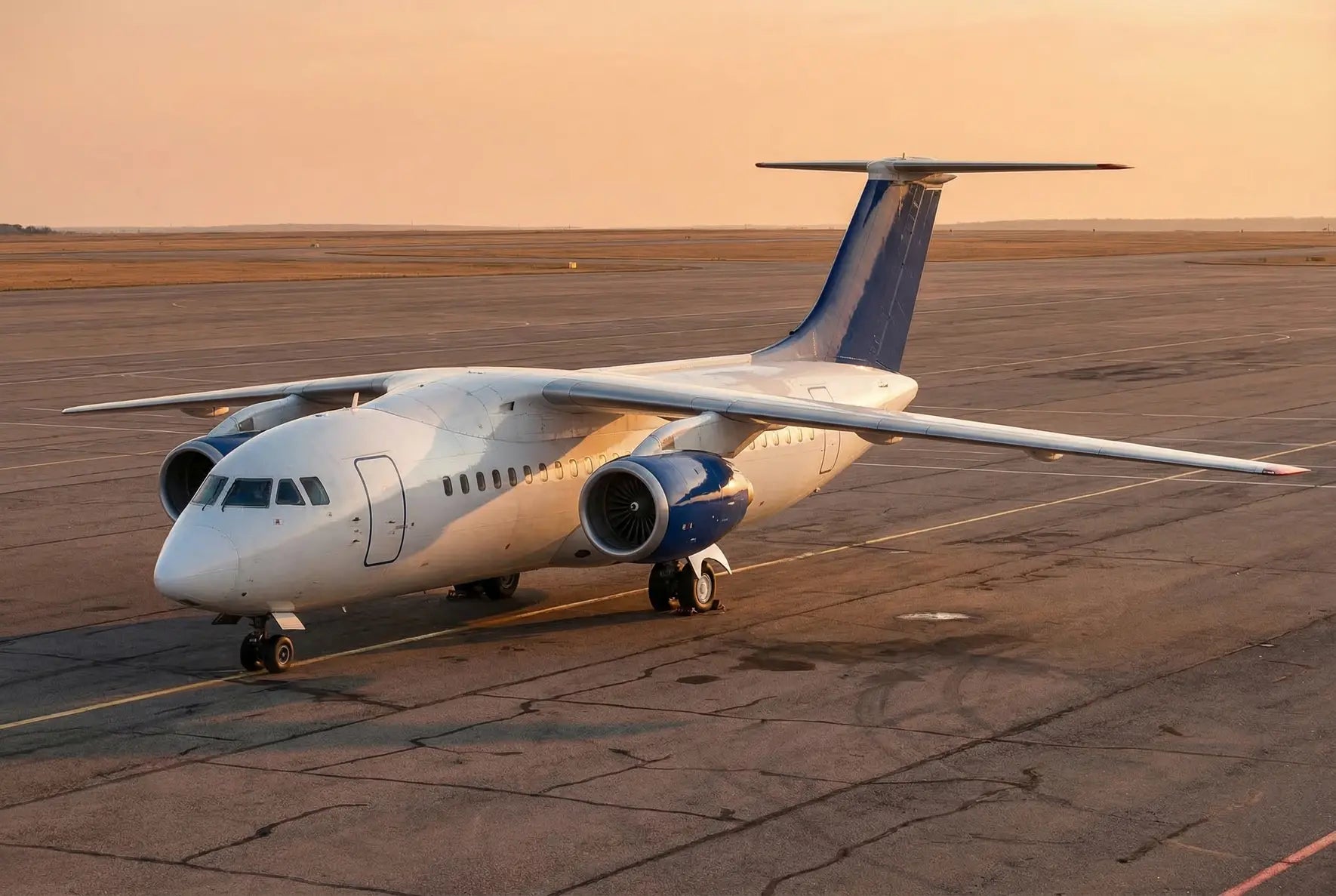
The image shows an Antonov An-148, a regional jet aircraft, captured mid-flight against a clear sky. The plane is banking, revealing its dual-engine configuration.
Antonov An 148 Technical Specifications, Systems and Engine Overview
The Antonov An 148 was conceived as a regional and short haul jet capable of linking secondary airports with minimal ground infrastructure. Its high wing configuration and underwing engine placement protect the powerplants from foreign object damage on unprepared surfaces, while a robust tricycle landing gear allows operations from paved, gravel and even compacted snow or ice covered runways. The design philosophy balances payload flexibility (68 to 85 passengers depending on layout) with field performance: the aircraft can use strips as short as 1,800 m at maximum takeoff weight under standard conditions, giving operators access to airfields that most comparable regional jets cannot serve.
Within the broader An 1x8 family, the An 148 shares its supercritical wing profile with the stretched An 158 and the freighter oriented An 178. Range varies significantly across sub variants: the baseline An 148 100A covers approximately 2,100 km, the An 148 100B extends that to around 3,500 km, and the An 148 100E reaches up to 4,400 km, primarily through increased fuel capacity rather than structural redesign. This modular approach allowed Antonov to address diverse operator requirements without major airframe changes.
- Overall length: approximately 29.13 m
- Wingspan: 28.91 m
- Wing area: 87.32 m²
- Height: 8.19 m
- Typical seating: 68 (two class) to 85 (single class high density); up to 92 in the An 148 201 variant
- Maximum takeoff weight (MTOW): up to 43,700 kg (variant dependent)
- Maximum payload: approximately 9,000 kg in passenger configuration
- Range: 2,100 km (An 148 100A) to 4,400 km (An 148 100E), manufacturer figures with typical passenger load
- Cruise speed: 820 to 835 km/h (Mach 0.75 class); maximum 870 km/h
- Service ceiling: 12,200 to 12,500 m
- Engines: 2 × Ivchenko Progress / Motor Sich D 436 148 turbofans, rated at 6,830 kgf (approximately 67 kN) takeoff thrust each
- Takeoff field length: approximately 1,800 to 1,900 m at MTOW, sea level, ISA conditions
- Cargo hold volume: 14.6 m³
- Avionics baseline: five 6 × 8 inch multifunction LCD displays (Aviapribor), fly by wire flight controls
Systems, Avionics and Handling Technology
The An 148 features a full fly by wire flight control system, enabling operation in automatic, flight director and manual modes across the full altitude envelope, including RVSM compliance. The cockpit integrates five multifunction LCD displays developed by Aviapribor, supporting automated flight planning with SID/STAR/approach and missed approach procedures. Navigation capabilities include Category II instrument landing support, early ground proximity warning, TCAS air collision avoidance, wind shear detection and 8.33 kHz VHF radio channel spacing.
Engine management relies on a digital automatic control and monitoring system integrated into each D 436 148 powerplant, which optimises engine operation across all flight phases and provides autodiagnosis for maintenance crews. An onboard auxiliary power unit (APU) enables autonomous ground operations at remote airports without external support. The aircraft also carries an airborne system for continuous registration of systems status, supporting trend monitoring and scheduled maintenance planning.
Published performance figures for the An 148 can vary considerably between sources. Differences typically arise from the specific sub variant (100A, 100B, 100E or 201), chosen cabin density, actual operating empty weight, fuel load and atmospheric assumptions such as temperature deviation from ISA and airport elevation. Runway performance numbers are especially sensitive to these factors. When evaluating An 148 data, it is important to confirm whether figures refer to manufacturer brochure conditions or to a particular operator's configuration. For broader context on how aircraft specifications translate into real world passenger experience, this airline comparison guide offers a useful framework.
Engines: The Ivchenko Progress D 436 148 Turbofan
The An 148 is powered by two D 436 148 triple spool high bypass turbofan engines, designed by SE Ivchenko Progress in Zaporizhzhia, Ukraine, and manufactured by Motor Sich. The D 436 family traces its lineage to the Soviet era Lotarev D 36, one of the first high bypass turbofans produced in the USSR. The D 436 programme incorporated technology from the larger Progress D 18 (used on the Antonov An 124), including an updated high RPM fan, low emissions combustor and redesigned compressor stages. The base D 436 engine first ran in 1985 and received certification in 1987.
The D 436 148 variant was specifically tailored for the An 148, with a derated takeoff thrust of 6,830 kgf (approximately 67 kN) to extend on wing service life. Its architecture comprises a single stage fan, a six stage intermediate pressure compressor, a seven stage high pressure compressor, and a turbine section with one HP stage, one IP stage and three LP stages. The engine achieves a bypass ratio of 4.95, an overall pressure ratio of 25.2 and a specific fuel consumption of roughly 0.377 kg/kgf·h at takeoff. Composite materials in the core fairing and main jet nozzle help reduce weight and acoustic signature, supporting compliance with ICAO noise standards. Service life is rated at up to 12,000 hours.
Beyond the An 148, other variants of the D 436 family power a range of aircraft. The D 436TP, rated at approximately 75 kN, equips the Beriev Be 200 amphibious aircraft in a version adapted for corrosion resistance in maritime operations. The D 436T2, producing around 80 kN, was selected for versions of the Tupolev Tu 334 regional jet programme. The D 436 148FM, an uprated derivative delivering 7,700 kgf (approximately 75.5 kN) at takeoff, powers the heavier An 178 military transport. During early development, Antonov also evaluated Western alternatives such as the General Electric CF34 and engines from the Rolls Royce BR700 family, with thrust ratings between 58.86 and 78.48 kN, but the D 436 148 was ultimately selected for production aircraft.
Antonov An-148 vs An-158 vs Sukhoi Superjet 100 vs Embraer E195-E2 Specifications
Scroll horizontally to see more →
| Parameter | Antonov An-148 | Antonov An-158 | Sukhoi Superjet 100 | Embraer E195-E2 |
|---|---|---|---|---|
| Entry into service | 2009 | 2013 | 2012 | 2021 |
| Engines | 2 × Progress D-436-148 | 2 × Progress D-436 | 2 × SaM146 | 2 × Pratt & Whitney PW1900G |
| Length | 29.1 m | 30.8 m | 29.9 m | 38.5 m |
| Wingspan | 28.9 m | 28.9 m | 28.0 m | 35.0 m |
| Height | 8.2 m | 8.2 m | 6.5 m | 12.1 m |
| Typical seating and layout | 2-class: 68–85 passengers | 2-class: 86–99 passengers | 2-class: 75–100 passengers | 2-class: 120–146 passengers |
| MTOW | 43.7 t | 43.7 t | 49.3 t | 65.2 t |
| Range | 2,400 nm | 1,350 nm | 2,480 nm | 2,600 nm |
| Cruise speed | 0.82 Mach | 0.82 Mach | 0.82 Mach | 0.82 Mach |
| Service ceiling | 40,000 ft | 40,000 ft | 41,000 ft | 41,000 ft |
| Program note | Regional jet for austere airstrips, baseline version | Stretched fuselage version with higher capacity | Russian regional jet competitor, similar capacity | New generation Brazilian regional jet, larger capacity |
Scroll horizontally to see more →
The table compares key specs of four regional jets, showing how the An-148/An-158 sit in the 68–99 seat class, while the E195-E2 is larger at 120–146 seats with higher MTOW (65.2 t) and slightly longer range (2,600 nm). The Superjet 100 is close in size and cruise (0.82 Mach) to the Antonovs, but offers higher MTOW and ceiling. The An-158 trades range for capacity versus the An-148.
Antonov An-148 Operations: Routes, Missions and Airlines Around the World
The Antonov An-148 is a regional jet designed for short to medium haul passenger transport on routes typically ranging from 500 to 4,400 km. Powered by two Progress D-436-148 turbofan engines and built with a high wing configuration, the aircraft was conceived to serve regional and domestic networks efficiently. Standard missions last approximately 1.5 to 5 hours depending on stage length, with typical routes connecting secondary cities to national hubs or linking regional centres on point to point services. Cruising at 800 to 870 km/h at altitudes up to 12,200 m, the An-148 fits the profile of a workhorse for operators needing dependable capacity on thin routes.
One of the defining features of the Antonov An-148 is its ability to operate from short, poorly equipped or even unprepared runways. Its high wing protects the engines from foreign object debris ingestion, and its takeoff field length of approximately 1,885 m at maximum takeoff weight allows it to serve airports that many competing regional jets cannot reach. This makes the aircraft well suited to point to point operations between regional and secondary airports, rather than exclusively hub and spoke networks. Operators have deployed it from remote Siberian airfields as well as modest domestic airports across Eastern Europe and the Caribbean.
However, the An-148 programme faced significant operational challenges. Airlines reported issues including avionics deviations, cold weather problems such as freezing water pipes below minus 20°C, and structural concerns like cracks on fuselage power frame No. 23 that required mandatory service bulletins. Most critically, the deterioration of Russia–Ukraine relations after 2014 severed the supply chain between the Ukrainian designer Antonov and Russian operators, leading to acute spare parts shortages for engines, auxiliary power units and hundreds of other components. Russia formally discontinued An-148 production in 2018 in favour of domestically designed alternatives, and by 2020, commercial operations of the type in Russia had effectively ended.
Where the Antonov An-148 Operates
The Antonov An-148 and its stretched derivative, the An-158, have served a small but geographically diverse group of operators. The vast majority of aircraft were delivered to airlines and government entities in Eastern Europe and the former Soviet space, with a handful reaching Asia, the Caribbean and Africa through proposed orders. In Europe, the type was used on domestic trunk routes and short international services. In Asia, only one carrier is known to have operated the aircraft on limited scheduled services. In the Americas, the An-158 variant served domestic routes in Cuba. No confirmed commercial operators have been documented in Africa, although interest from carriers in the region was reported during the aircraft's marketing phase. In all cases, the An-148 family served routes typical of legacy or state owned carriers rather than low cost operators.
- Europe: Aerosvit (Ukraine) became the first commercial operator in June 2009, flying routes such as Kharkiv to Kyiv, Kyiv to Odesa and Simferopol to Lviv, as well as the first An-148 service to a European Union destination in Poland in February 2010. Rossiya Airlines (Russia) launched An-148 operations in December 2009 from St. Petersburg Pulkovo to Moscow Sheremetyevo but later suspended scheduled services due to high operating costs. Saratov Airlines (Russia) operated the type on domestic routes until the fleet was grounded following a fatal crash in February 2018. Angara Airlines (Russia) took delivery of three An-148-100E aircraft for regional operations in Siberia but was forced to suspend services by 2020 owing to parts shortages and airworthiness certificate revocations. Ukraine International Airlines also operated the An-148 on domestic and short haul routes.
- North & South America: Cubana de Aviación (Cuba) received its first An-158 in April 2013, eventually operating up to five aircraft on domestic routes. The fleet was grounded by 2018 due to technical issues and the inability to source spare parts amid the Russia–Ukraine conflict, as the aircraft were leased from Ukraine but relied on Russian manufactured components.
- Asia: Air Koryo (North Korea) is the only confirmed Asian operator, having received two An-148 aircraft in 2013 and 2015. The airline uses them on a limited network of domestic and international services from Pyongyang.
- Africa: No confirmed commercial operators of the An-148 have been documented in Africa. Marketing efforts targeted airlines in the region, but no deliveries materialised.
Typical Seating Configurations on the Antonov An-148
The Antonov An-148 cabin measures approximately 3.15 m in width, offering a 2+3 seating arrangement across a single aisle. This cross section provides comparatively generous seat widths and aisle space for a regional jet of its size. The aircraft accommodates 68 to 85 passengers depending on layout, with most operators selecting a dual class configuration.
Typical two class layouts include a 68 seat arrangement with 8 business class seats at 35 inch (889 mm) pitch and 60 economy class seats at 32 inch (813 mm) pitch, as used by Angara Airlines. Air Koryo configures its An-148 with 70 seats in a similar split of 8 business and 62 economy. The manufacturer also documents 77 and 78 seat options with reduced economy pitch of 30 to 31 inches. A high density single class layout can seat up to 85 passengers at 30 inch pitch, though this configuration has rarely been adopted by commercial operators. The overhead luggage bins offer 4.2 cubic metres of storage capacity, the largest in the regional aircraft class, while underfloor baggage and cargo compartments provide an additional 14.6 cubic metres of hold space.
In this video, explore the Antonov An-148, a narrow-body regional airliner developed by Antonov in the early 2000s, and see how it became the basis for further aircraft development amid its child of divorce story.
Antonov An-148 Safety Record: Incidents, Accidents and Overall Safety
The Antonov An-148 entered commercial service in 2009 and has been produced in limited numbers, with approximately 47 airframes built before production ended in 2018. Operators have included airlines in Russia, Ukraine, Cuba and North Korea. With a relatively small fleet and modest total flight hours compared to mainstream Western narrowbodies, statistical analysis of the An-148's safety record must be viewed in that context. Across more than a decade of operations, the type has recorded one fatal hull loss accident and a handful of non-fatal incidents. That single catastrophic event, however, resulted in 71 fatalities and had far-reaching consequences for both the operator and the type's operational future.
Notable Accidents and Incidents Involving the An-148
Saratov Airlines Flight 703 (February 2018) remains the defining event in the Antonov An-148's safety history. On 11 February 2018, an An-148-100B (registration RA-61704) operating a domestic flight from Moscow Domodedovo to Orsk crashed into a snow-covered field near the village of Stepanovskoye, roughly 37 km from the airport. All 65 passengers and 6 crew members were killed. The Interstate Aviation Committee (MAK) investigation determined that the crew failed to activate the pitot tube heaters before departure. During the climb in instrument meteorological conditions, ice blocked all three pitot probes, causing erroneous and conflicting airspeed readings. The crew misinterpreted the data, pitched the aircraft nose down and lost control. The aircraft struck the ground at a steep angle. Contributing factors included the crew rushing through checklists after a delayed inbound flight, deficiencies in the airline's safety management system, and inadequate training oversight by Russian aviation authorities. Following the crash, Saratov Airlines initially suspended its An-148 operations. In March 2018, Russia's transport safety watchdog grounded the entire Russian An-148 fleet. Saratov Airlines had its air operator's certificate revoked in June 2018 and ceased all operations permanently.
Serious incident near St Petersburg (August 2011): An An-148-100B operated by Rossiya Airlines (registration RA-61703) experienced a serious incident during initial climb when the fly-by-wire (FBW) system switch was found in the OFF position, as recorded by the flight data recorder. No injuries or aircraft damage resulted, but the event highlighted the importance of proper cockpit switch verification procedures during pre-flight checks.
Tyre loss on takeoff (February 2012): An An-148 lost a tyre from the left main landing gear during the takeoff roll. The crew elected to continue the flight safely to its destination without further complications. Though classified as an incident rather than a serious event, it underscored the need for thorough pre-departure inspections of landing gear assemblies.
How Safe Is the Antonov An-148?
Assessing the overall safety of the An-148 requires balancing its single fatal accident against the type's limited fleet size and relatively low cumulative flight hours. One hull loss in a fleet of fewer than 50 aircraft yields an accident rate that, while statistically elevated per airframe, must be interpreted cautiously given the small sample. The 2018 crash was attributed primarily to operational and human factors rather than a fundamental design flaw. The An-148 features a modern fly-by-wire flight control system, a glass cockpit with five multifunction displays, and a high-wing configuration that provides natural protection for the engines and wing structure against foreign object damage. The aircraft was certified to international standards and designed for operations from unprepared or rough runways.
That said, several systemic issues identified in the Saratov Airlines investigation, including weaknesses in crew resource management, regulatory oversight and airline safety culture, are not unique to the An-148 but reflect broader challenges in some operational environments. Passengers who wish to enhance their flight experience can take comfort in knowing that the global aviation industry continuously learns from every incident and accident. Design improvements, mandatory reporting systems and strengthened standard operating procedures all contribute to making each generation of aircraft safer. According to the International Air Transport Association (IATA), commercial aviation remains one of the safest modes of transport, with accident rates declining steadily over the past two decades. While the An-148's record carries the weight of a single tragic event, the broader trajectory of aviation safety offers reassurance that lessons learned translate into tangible improvements across the entire industry.
01 What is the typical passenger capacity and range of the Antonov An-148?
The Antonov An-148 accommodates 68 to 85 passengers depending on the configuration, with a maximum range of 2,100 to 4,400 km across its variants. The standard An-148-100A carries up to 85 in dense seating over 2,100 km, while extended-range models like the An-148-100E reach 4,400 km. This makes it suitable for regional and medium-haul routes.
02 What are the cabin dimensions and passenger comfort features on the Antonov An-148?
The cabin measures 3.15 m wide by 2.00 m high, providing a spacious feel for a regional jet with seat pitches of 30-35 inches. Noise levels are low due to the high-wing design and engine placement under the wings, which also shields against foreign object damage. Passengers experience a stable ride on short to medium routes.
03 Which airlines operate the Antonov An-148 and on what routes?
Operators include Russian airlines like Rossiya Airlines and the Russian Ministry of Defence, which ordered 15 units, along with Ukrainian carriers. The Antonov An-148 serves regional routes in Russia and Ukraine, such as connecting Moscow to smaller cities or operating on routes up to 4,000 km. It excels on paved and unpaved airstrips thanks to its rugged design.
04 How does the Antonov An-148 perform in terms of speed, fuel efficiency, and comparison to similar aircraft?
It cruises at 800-820 km/h with a maximum speed of 870 km/h, powered by two D-436-148 turbofan engines burning around 1,550-1,650 kg/h of fuel. Compared to similar regional jets, its high-wing setup offers good short-field performance and efficiency for 68-85 passengers. Fuel efficiency supports economical operations on routes like 2,000-4,000 km.
05 What is the safety record and key design features of the Antonov An-148?
The Antonov An-148 features a built-in autodiagnosis system, auxiliary power unit, and engines mounted under the high wing for protection against debris, enabling safe operations from austere airstrips. Its safety record includes standard certification, though production was limited with around 15-20 built. Design emphasizes reliability for regional use without notable systemic issues.
06 What should passengers know about flying on the Antonov An-148, like seat choice and turbulence?
Opt for seats near the wings for minimal turbulence, as the high-wing design provides stability on regional flights. Large windows offer good views, and the cabin's width allows comfortable movement. Expect a quiet interior and quick boarding due to its size for 68-85 passengers.