
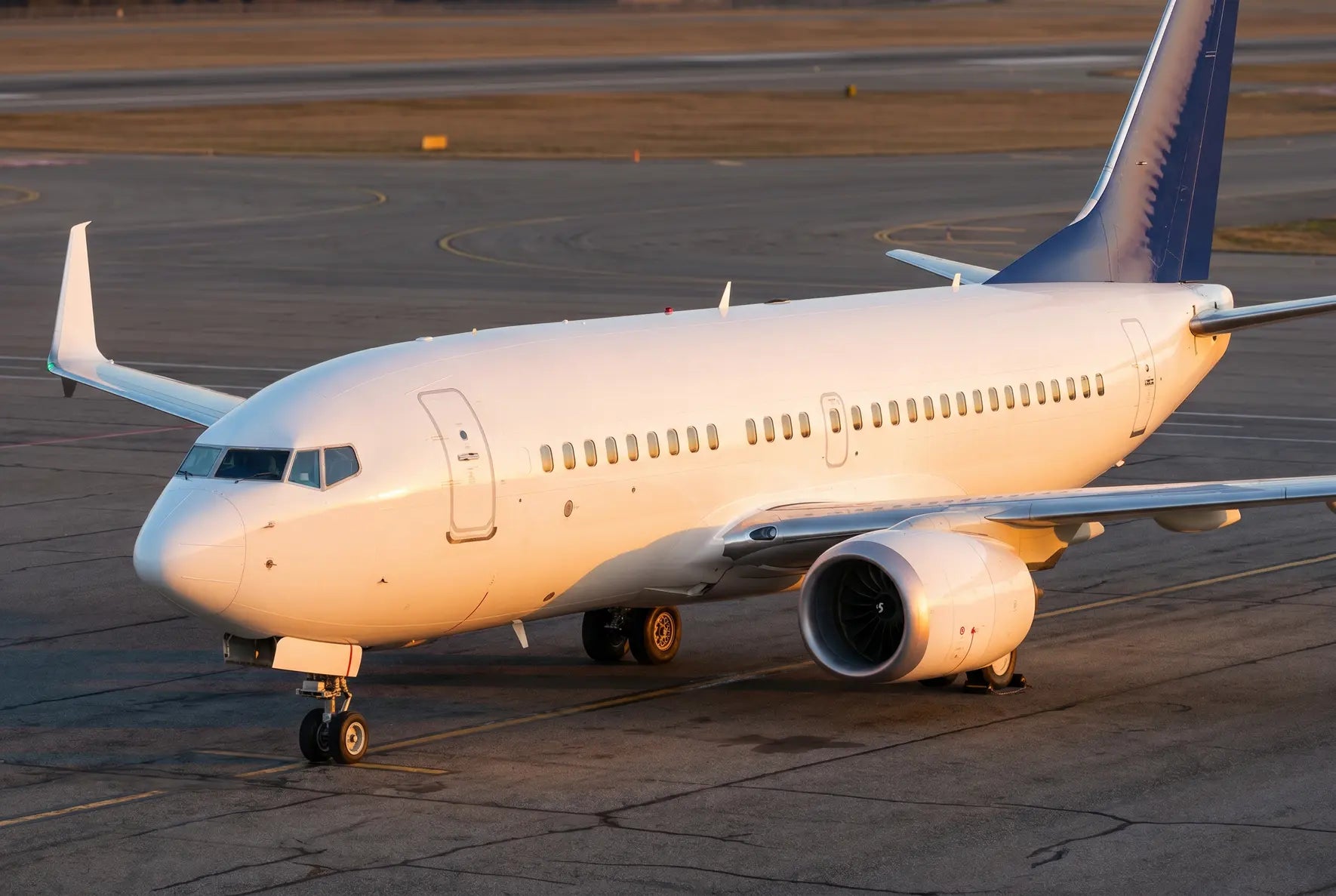
Boeing 737 MAX 7: History, Program Launch and Development Path
The Boeing 737 MAX 7 is the smallest member of the 737 MAX family, a fourth generation of the world's best selling single aisle jetliner programme. Developed by Boeing Commercial Airplanes at its Renton, Washington facility, the MAX 7 was conceived as a direct successor to the Boeing 737 700, targeting airlines that needed a fuel efficient, longer range narrowbody with lower seat counts for high frequency routes.
The broader 737 MAX programme was officially announced on August 30, 2011, with Southwest Airlines as the launch customer. The MAX family was designed to incorporate next generation CFM International LEAP 1B engines, new split tip winglets (marketed as Advanced Technology Winglets), aerodynamic refinements and updated cockpit displays, delivering approximately 20% lower fuel consumption per seat compared to the preceding 737 Next Generation series.
The MAX 7 variant was initially configured to mirror the fuselage length of the 737 700. However, early orders were sluggish, with airlines showing limited interest in the baseline design. In response, Boeing announced a significant redesign in April 2016, stretching the fuselage by 76 inches (1.93 m) to accommodate two additional rows of seats. This stretch also adopted the stronger wing structure and landing gear of the MAX 8, improving both range and payload capability. The modification transformed the variant into the longest range member of the MAX family, reaching up to 3,850 nautical miles, roughly 1,000 nm more than the 737 700 it replaced.
Key Milestones in the Boeing 737 MAX 7 Programme
Production of the first MAX 7 wing spar began in October 2017, and final assembly started on November 22, 2017. Boeing officially debuted the first 737 MAX 7 on February 5, 2018, at its Renton factory, marking the third MAX variant to roll off the production line. The aircraft (registration N7201S) completed its maiden flight on March 16, 2018, flying from Renton Municipal Airport to Boeing Field in a sortie lasting approximately three hours. Boeing reported the aircraft performed as designed across the planned test points.
The original entry into service target was 2019, with Southwest Airlines expected to receive the first deliveries. That schedule was disrupted by two fatal accidents involving the 737 MAX 8 in October 2018 and March 2019, which led to a worldwide grounding of the entire MAX family from March 2019 to late 2020. The grounding centred on the Maneuvering Characteristics Augmentation System (MCAS) and resulted in sweeping software redesigns, enhanced pilot training requirements and increased regulatory oversight across all MAX variants.
Following the MAX 8's return to service in late 2020, certification of the MAX 7 faced additional delays. A key technical issue involved the engine anti ice (EAI) system, where Boeing's proposed solution introduced new complications that required further redesign. In July 2025, unresolved EAI fixes officially pushed MAX 7 certification into 2026. In parallel, the U.S. Congress passed legislation granting Boeing additional time to certify the MAX 7 and MAX 10 under updated safety standards. As of April 2026, the FAA has confirmed the MAX 7 remains on track for certification before the end of 2026, with Southwest Airlines anticipating first deliveries and entry into service in early 2027.
What Sets the Boeing 737 MAX 7 Apart from Other MAX Variants
Within the 737 MAX lineup (MAX 7, MAX 8, MAX 9 and MAX 10), the MAX 7 occupies a distinct niche. It is the shortest fuselage variant at 35.56 m (116 ft 8 in) and carries the fewest passengers, yet offers the greatest range, making it ideal for thinner, longer routes where larger variants would be uneconomical. Compared to the MAX 8, which entered service in May 2017 and seats up to 210 passengers, the MAX 7 trades passenger capacity for operational flexibility and per trip efficiency. For operators like Southwest Airlines, which has historically relied on the 737 700 for its point to point network, the MAX 7 provides a natural fleet transition with enhanced economics. Several carriers that previously ordered the MAX 7 have since converted to other variants; WestJet, for example, switched its 22 MAX 7 orders to the MAX 8. Airlines considering fleet renewal across various models may also be interested in how carriers such as Jet2.com structure their operations around the Boeing 737 family.
The following verified specifications summarise the key identifiers of the Boeing 737 MAX 7:
- Engines: 2× CFM International LEAP 1B (approximately 119 kN / 26,785 lbf thrust per engine)
- Winglet type: Boeing Advanced Technology (AT) split tip winglets
- Maximum seating: 172 passengers (high density); 138 to 153 in a typical two class layout
- Range: up to 3,850 nm (7,130 km), the longest in the MAX family
- Maximum takeoff weight (MTOW): approximately 80,300 kg (177,000 lb)
- Overall length: 35.56 m (116 ft 8 in)
- Wingspan: 35.9 m (117 ft 10 in)
- ICAO type designator: B37M

An Alaska Airlines Boeing 737 Max 9 aircraft is depicted in flight against a clear blue sky. The plane features distinctive branding with the Alaska Airlines logo on its tail.
Boeing 737 MAX 7 Technical Specifications, Systems and Engine Overview
The Boeing 737 MAX 7 is the smallest member of the 737 MAX family, designed to replace the 737‑700 while sharing the same wing, landing gear and systems architecture as the larger 737 MAX 8. This common‑type strategy keeps pilot training differences minimal and allows airlines to rotate crews across the fleet. The airframe is optimised for shorter, thinner routes where passenger demand does not fill a larger single‑aisle, yet the full‑size wing gives the MAX 7 a notable range advantage over its predecessor, reaching approximately 3,850 nm in a typical two‑class layout.
Because the MAX 7 carries the same fuel volume and wing area as the MAX 8 on a shorter, lighter fuselage, it delivers strong runway performance and generous range per seat. The trade‑off is a smaller cabin: between 138 and 153 seats in a two‑class configuration, or up to 172 in a high‑density single‑class layout. For operators that need to connect secondary city pairs or serve hot‑and‑high airports efficiently, that balance makes the variant attractive. A summary of the key figures, drawn from publicly available specifications, is provided below.
- Overall length: 35.56 m (116 ft 8 in)
- Wingspan (with split‑tip winglets): 35.9 m (117 ft 10 in)
- Height: approximately 12.3 m (40 ft 4 in)
- Typical seating: 138 to 153 passengers (two class) or up to 172 (single class)
- Maximum takeoff weight (MTOW): 80,286 kg (177,000 lb)
- Maximum landing weight (MLW): approximately 66,040 kg (145,600 lb)
- Fuel capacity: 6,820 US gal (25,817 L)
- Range: approximately 3,850 nm (7,130 km) with a typical two‑class cabin
- Cruise speed: Mach 0.79 (approximately 450 KTAS at altitude)
- Service ceiling: 41,000 ft
- Engines: 2 × CFM International LEAP‑1B high‑bypass turbofans, rated up to 28,000 lbf (124.5 kN) each
- Avionics baseline: four large‑format LCD displays with 787‑derived flight management integration
- Wingtip device: Boeing split‑tip winglet, contributing to reduced drag and improved fuel efficiency
Systems Architecture and Handling Technology
Like every 737 generation before it, the MAX 7 retains a conventional, mechanically signalled flight control system rather than full fly‑by‑wire. Primary surfaces (ailerons, elevator, rudder) are powered by dual hydraulic systems, while pitch trim is electrically actuated through the stabiliser trim motor. The Flight Control Computers (FCCs) run the updated Maneuvering Characteristics Augmentation System (MCAS), which was redesigned after 2019 to compare inputs from both angle‑of‑attack (AoA) sensors, activate only once per high‑AoA event, and remain overridable through the control column or the stabiliser cutout switches.
Engine management is handled by a Full Authority Digital Engine Control (FADEC) system, providing precise thrust scheduling, automatic start sequencing and continuous fault monitoring. The carbon brakes and digital anti‑skid system support autobrake modes for normal, rejected takeoff and autoland operations. Boeing's Airplane Health Management (AHM) platform transmits real‑time engine and airframe data via ACARS, allowing operators to plan maintenance proactively. For a broader look at how European charter operators manage fleet operations and crew conditions, see our dedicated overview.
Published performance figures for the 737 MAX 7 should always be read in context. Range, takeoff field length and payload capacity vary significantly depending on the operator's chosen cabin density, actual takeoff weight, airport elevation, ambient temperature and runway surface condition. Boeing's headline range of approximately 3,850 nm assumes a standard two‑class layout and manufacturer reference conditions. Airlines configuring the cabin with more seats, or operating from short or high‑altitude runways, will see different numbers. Weight variants (structural options that raise MTOW) and auxiliary fuel tanks available on the BBJ MAX 7 further widen the spread between quoted and operational performance.
CFM International LEAP‑1B: The Exclusive Powerplant
The Boeing 737 MAX 7 is powered exclusively by the CFM International LEAP‑1B, a high‑bypass turbofan developed as the successor to the long‑serving CFM56‑7B that equipped the 737 NG family. CFM International is a 50/50 joint venture between GE Aerospace (United States) and Safran Aircraft Engines (France), formed in 1974 initially to produce the CFM56 series. The partnership has since delivered more than 40,000 engines worldwide, making it one of the most prolific propulsion programmes in commercial aviation history.
The LEAP‑1B features a 69‑inch (176 cm) fan diameter, a bypass ratio of approximately 8.6:1 and an overall pressure ratio of around 40:1, rising to roughly 50:1 at top of climb. Its dry weight is approximately 6,128 lb. According to published data, the engine delivers up to 28,000 lbf (124.5 kN) of takeoff thrust, with sub‑variants such as the LEAP‑1B27 and LEAP‑1B28 covering specific thrust ratings within the family. Key technology features include 3D‑woven carbon fibre composite fan blades, a Twin Annular Pre‑Swirl (TAPS II) combustor for lower NOx emissions and ceramic matrix composite (CMC) turbine shrouds that tolerate higher temperatures while reducing weight. Safran reports that the LEAP‑1B achieves a 15 percent fuel burn improvement over its CFM56 predecessor, along with a significant reduction in CO₂ and noise emissions.
The LEAP engine family comprises three variants tailored to different airframes. The LEAP‑1A, with a larger 78‑inch fan, powers the Airbus A320neo family as one of two engine options alongside the Pratt & Whitney PW1000G. The LEAP‑1B is the sole engine for all Boeing 737 MAX models, from the MAX 7 through the MAX 10. The LEAP‑1C, also with a 78‑inch fan, is the exclusive powerplant for the COMAC C919. Entry into airline service for the LEAP‑1B occurred in 2017, and the engine now has millions of flight hours across hundreds of operators worldwide, establishing a growing reliability and maintenance record that supports the 737 MAX programme.
Boeing 737 MAX 7 vs MAX 8 vs MAX 9 vs MAX 10 Specifications Comparison
Scroll horizontally to see more →
| Parameter | Boeing 737 MAX 7 | Boeing 737 MAX 8 | Boeing 737 MAX 9 | Boeing 737 MAX 10 |
|---|---|---|---|---|
| Entry into service | 2025 | 2017 | 2019 | 2024 |
| Engines | 2 × CFM LEAP-1B | 2 × CFM LEAP-1B | 2 × CFM LEAP-1B | 2 × CFM LEAP-1B |
| Length | 35.6 m | 39.5 m | 42.2 m | 43.8 m |
| Wingspan | 35.9 m | 35.9 m | 35.9 m | 35.9 m |
| Height | 12.3 m | 12.3 m | 12.3 m | 12.3 m |
| Typical seating and layout | 2-class: 138-153 passengers | 2-class: 162-178 passengers | 2-class: 178-193 passengers | 2-class: 188-204 passengers |
| MTOW | 80 t | 82 t | 88 t | 94 t |
| Range | 3,850 nm | 3,550 nm | 3,550 nm | 3,300 nm |
| Cruise speed | 0.79 Mach | 0.79 Mach | 0.79 Mach | 0.79 Mach |
| Service ceiling | 41,000 ft | 41,000 ft | 41,000 ft | 41,000 ft |
| Program note | Shortest MAX variant, optimized for high-frequency regional routes with highest range in family | Baseline MAX model, most popular size for medium-haul network carriers | Stretched version for higher density, popular with low-cost carriers | Longest MAX variant, maximum capacity for high-density short-haul operations |
Scroll horizontally to see more →
The table compares key specs across the Boeing 737 MAX family from MAX 7 to MAX 10, showing how size and capacity increase with each stretch. Length grows from 35.6 m (MAX 7) to 43.8 m (MAX 10) and typical two-class seating rises from 138–153 to 188–204. MTOW also climbs from 80 t to 94 t, while range trends downward from 3,850 nm (MAX 7) to 3,300 nm (MAX 10). All variants share LEAP-1B engines, 35.9 m wingspan, Mach 0.79 cruise, and 41,000 ft ceiling.
Boeing 737 MAX 7: Typical Routes, Missions and Airlines Operating the Aircraft Worldwide
The Boeing 737 MAX 7 is the smallest member of the 737 MAX family, designed as a direct replacement for the Boeing 737-700. With a maximum range of 3,850 nautical miles (7,130 km), it offers approximately 1,000 nm more range than its predecessor, making it the longest-legged variant in the MAX lineup. This extended reach translates into a maximum endurance of roughly 8.5 hours, although typical scheduled sectors range from 1 to 5 hours depending on the route network. Airlines operating narrowbody aircraft of this class generally achieve between 8 and 12 block hours of daily utilisation, a figure that varies with turnaround times, route lengths, and schedule density.
Boeing positions the Boeing 737 MAX 7 primarily for longer, thinner routes where passenger demand does not justify a larger aircraft such as the MAX 8 or MAX 9. Its combination of lower seat count and extended range makes it particularly well suited to point-to-point networks that bypass congested hubs, as well as to hub-and-spoke operations connecting smaller cities to major gateways. The aircraft can comfortably operate from secondary and regional airports thanks to its manageable runway requirements. Fuel burn improvements of approximately 18% per seat over the 737-700, driven by the CFM LEAP-1B engines and aerodynamic refinements, further strengthen its economics on routes where load factors can be more variable. For airlines evaluating pilot conditions and fleet strategy, the Boeing 737 MAX 7 offers full type-rating commonality with the rest of the MAX family, simplifying crew scheduling and training.
A significant operational challenge for prospective operators has been the prolonged certification timeline. As of early 2026, the Boeing 737 MAX 7 has not yet received FAA type certification, and no airline has taken delivery for revenue service. Certification was initially expected years earlier but was delayed by the broader 737 MAX grounding, subsequent regulatory scrutiny, and technical items including engine nacelle anti-ice system redesign. According to reporting from Simple Flying, both the MAX 7 and MAX 10 remain on track for certification in 2026, with first deliveries anticipated shortly thereafter. Airlines that placed early orders have had to extend the service life of older 737-700s or adjust fleet plans while awaiting the new variant.
Where the Boeing 737 MAX 7 Operates: A Global Overview
Because the aircraft has not yet entered revenue service, the operational picture for the Boeing 737 MAX 7 is defined by confirmed orders and publicly stated fleet strategies rather than active flight schedules. The overwhelming majority of firm orders originate from North America, where the type directly addresses the need to replace large fleets of ageing 737-700s on domestic and transborder routes. No confirmed MAX 7 orders have been publicly attributed to airlines in Europe, Asia, or Africa based on available data; broader 737 MAX orders from those regions typically specify the MAX 8, MAX 9, or MAX 10. Once certified and delivered, the Boeing 737 MAX 7 could appeal to carriers in all four regions that serve lower-density long-range narrowbody routes, including intra-European leisure links, thin domestic sectors in Asia, or underserved city pairs across Africa.
- North & South America: Southwest Airlines is the launch customer and by far the largest, with over 300 firm orders for the Boeing 737 MAX 7. The airline plans to use the type to replace its fleet of 737-700s across its all-Boeing, all-economy, point-to-point U.S. domestic network. WestJet, based in Canada, holds 22 firm MAX 7 orders intended for fleet modernisation on North American short and medium-haul routes. Canada Jetlines, a former Canadian ultra-low-cost startup, had ordered five MAX 7s, but the airline ceased operations before taking delivery. No confirmed MAX 7 orders from South American carriers have been publicly disclosed.
- Europe: No European airline has publicly confirmed a firm order specifically for the Boeing 737 MAX 7. European operators with large MAX commitments, such as Ryanair and carriers under the IAG umbrella, have opted for larger variants like the MAX 8-200 and MAX 10.
- Asia: No airline in the Asia-Pacific region has a publicly confirmed MAX 7 order. Carriers with substantial MAX backlogs, including airlines in China, India, and Southeast Asia, have focused on higher-capacity MAX 8 and MAX 10 models better suited to their rapidly growing traffic volumes.
- Africa: No African carrier has publicly announced a Boeing 737 MAX 7 order. The continent's 737 MAX operators and prospective customers have gravitated toward the MAX 8, which offers a better capacity match for the region's main trunk routes.
Typical Seating Configurations for the Boeing 737 MAX 7
According to Boeing's official specifications, the Boeing 737 MAX 7 accommodates 138 to 153 passengers in a standard two-class layout and up to 172 in a high-density, single-class arrangement. The cabin features the Boeing Sky Interior with a 3-3 abreast seating layout, sculpted sidewalls, larger overhead bins, and LED mood lighting.
Southwest Airlines, the dominant future operator, has announced a planned 150-seat configuration for its MAX 7 fleet, featuring new Recaro seats with integrated USB power. This all-economy layout is expected to include a mix of extra-legroom seats at approximately 34 inches of pitch and standard seats at 31 inches, consistent with the airline's approach on its existing MAX 8 fleet. By comparison, Southwest's current 737-700 cabins seat 143 passengers. Network carriers opting for a two-class cabin would typically install 8 to 16 business or first-class seats at 36 to 38 inches of pitch, with the remaining economy seats at 30 to 32 inches, resulting in a total count closer to the 138 to 153 range cited by Boeing. Leisure and charter operators seeking maximum density could push toward the 172-seat ceiling by reducing pitch and eliminating a premium cabin, though no such configuration has been publicly confirmed for the MAX 7 to date. Detailed seat maps for specific operators are expected to be published on resources such as SeatMaps.com once airlines begin taking delivery.
In this video, discover major updates on the Boeing 737 MAX 7, including signs of meaningful progress toward certification after years of delays, and what the latest developments could mean for airlines and customers.
Boeing 737 MAX 7 Safety Record: How Safe Is This Aircraft?
The Boeing 737 MAX 7 is part of the 737 MAX family, a programme that has faced intense public and regulatory scrutiny since 2018. As of mid 2026, the MAX 7 variant has not yet entered revenue passenger service and therefore has no individual accident or incident history. However, its safety profile is best understood through the broader 737 MAX programme, which shares the same airframe architecture, flight control systems and regulatory framework. The 737 MAX family has accumulated over 2,200 deliveries since 2017, and according to Boeing, more than one million passengers fly on a 737 MAX every day. Since the type returned to service in late 2020 following a global grounding, the MAX fleet has completed millions of flights with no fatal accidents.
Major Incidents Affecting the 737 MAX Programme
Two catastrophic accidents involving the Boeing 737 MAX 8 shaped the safety narrative for the entire MAX family and directly influenced the certification path of the 737 MAX 7.
- Lion Air Flight 610 (October 2018) – A nearly new 737 MAX 8 operated by Lion Air departed Jakarta, Indonesia, and crashed into the Java Sea 13 minutes after takeoff, killing all 189 people on board. Indonesian investigators determined that the Maneuvering Characteristics Augmentation System (MCAS) activated repeatedly based on erroneous data from a single angle of attack (AOA) sensor, commanding uncommanded nose down trim that the crew was unable to overcome. The KNKT final report highlighted design shortcomings in MCAS, insufficient documentation for pilots and inadequate maintenance actions on the AOA sensor.
- Ethiopian Airlines Flight 302 (March 2019) – A 737 MAX 8 operated by Ethiopian Airlines crashed shortly after takeoff from Addis Ababa, killing all 157 people on board. The accident exhibited a failure sequence strikingly similar to the Lion Air event: a faulty AOA sensor triggered repeated MCAS activations. Following this accident, regulators worldwide grounded the entire 737 MAX fleet for approximately 20 months. Boeing subsequently redesigned MCAS to use inputs from both AOA sensors, limited the system's authority, made disagree alerts standard and introduced mandatory simulator based pilot training. The FAA ungrounding order in November 2020 required operators to complete specific airworthiness directives, wiring modifications and crew training before resuming operations.
- Alaska Airlines 737 9 MAX Door Plug Incident (January 2024) – On 5 January 2024, a mid cabin door plug detached from a 737 9 MAX operated by Alaska Airlines shortly after departure from Portland, Oregon, causing rapid decompression. The aircraft returned safely and there were no fatalities, though several passengers sustained minor injuries. The FAA temporarily grounded 171 737 9 MAX aircraft equipped with door plugs, launched production audits and capped 737 MAX production rates. Boeing implemented corrective actions focused on factory quality control, fastener installation procedures and traceability. This event further tightened FAA oversight of Boeing manufacturing and delayed certification of the MAX 7 and MAX 10 variants.
How Safe Is the Boeing 737 MAX 7?
Because the Boeing 737 MAX 7 shares its core type design, flight control laws and structural philosophy with the already certified MAX 8 and MAX 9, it benefits from every safety improvement mandated after the 2018/2019 accidents and the 2024 door plug event. The redesigned MCAS, dual AOA sensor architecture, fly by wire spoilers, Elevator Jam Landing Assist and enhanced crew alerting systems all apply to the MAX 7. Regulatory oversight has also been fundamentally reshaped: the FAA now retains direct authority over individual airworthiness certificates for every new 737 MAX, a level of scrutiny that did not exist before 2019.
From an industry wide perspective, commercial aviation continues to achieve historically low accident rates. According to the IATA 2024 Safety Report, 40.6 million flights were completed globally in 2024 with a fatality risk rate of just 0.06 per million sectors. The five year average all accident rate improved to 1.25 per million flights for the 2020 to 2024 period, representing roughly one accident for every 810,000 flights. The 737 MAX fleet, operating within this framework and subject to enhanced Standard Operating Procedures (SOPs) and recurrent training requirements, sits within one of the most tightly regulated segments of the industry.
While no aircraft type can claim absolute immunity from risk, the combination of lessons learned from past events, comprehensive design revisions, strengthened manufacturing quality controls and intensified regulatory oversight positions the Boeing 737 MAX 7 to enter service with a robust safety foundation. Readers interested in how earlier Boeing 737 variants evolved over the decades will find useful context in the long lineage of continuous improvement that defines this aircraft family. Aviation remains, by a wide margin, one of the safest forms of mass transportation in the world.
01 What is the range and typical mission profile of the Boeing 737 MAX 7?
The Boeing 737 MAX 7 has a maximum range of about 3,850 nautical miles, making it suitable for transcontinental flights within North America or medium-haul routes in Europe and Asia. It excels in high-frequency, short-to-medium missions of 1,000 to 2,500 nautical miles, such as connecting major hubs to regional cities. Airlines use it to replace older 737s for efficient operations on busy domestic networks.
02 How does the cabin layout and passenger experience compare on the Boeing 737 MAX 7?
The Boeing 737 MAX 7 typically seats 138 to 172 passengers in a single-class or two-class layout with wider aisles and larger overhead bins than previous generations. Passengers report quieter cabins thanks to advanced chevrons on the engines that reduce noise by up to 40%. The larger windows and higher humidity levels enhance comfort on longer flights.
03 Which airlines operate the Boeing 737 MAX 7 and on what routes?
Airlines like Southwest Airlines, WestJet, and Flyer Airlines have the Boeing 737 MAX 7 in service or on order, primarily for North American domestic and regional international routes. Southwest uses it for high-density short-haul flights between U.S. cities like Denver to Orlando. Other operators deploy it on efficient routes under 2,000 miles in Europe and South America.
04 How does the fuel efficiency of the Boeing 737 MAX 7 compare to similar aircraft?
The Boeing 737 MAX 7 offers 20% better fuel efficiency than the previous 737NG models due to its CFM LEAP-1B engines and advanced winglets. It outperforms the Airbus A320neo in per-seat efficiency for shorter routes, burning up to 15% less fuel per trip. This makes it ideal for airlines aiming to cut costs on high-frequency operations.
05 What safety features distinguish the Boeing 737 MAX 7?
The Boeing 737 MAX 7 incorporates enhanced flight control laws and a revised MCAS system limited to a single angle-of-attack sensor, following rigorous FAA recertification. It features split scimitar winglets for better stability and a head-up display option for pilots. No fatal accidents have been recorded for this variant since its 2024 entry into service.
06 What should passengers know about seats, windows, and turbulence on the Boeing 737 MAX 7?
Seat 1A or window seats in rows 10-15 offer good views and legroom on most layouts, avoiding proximity to lavatories. The larger 10-inch windows provide better outward visibility, and the aircraft's low wing loading results in a smoother ride through turbulence compared to heavier widebodies. Frequent flyers note the stable handling makes it feel less bumpy on crosswinds.