

Boeing 737-100: History, Program Launch, and Development of the Original Variant
The Boeing 737-100 holds a unique place in aviation history as the founding member of what would become the world's best selling single aisle jetliner family. Conceived in the early 1960s by Boeing Commercial Airplanes at its Renton, Washington facility, the 737 program was born from a need to supplement the popular Boeing 727 on short haul and low density routes where the trijet was too large and too costly to operate efficiently.
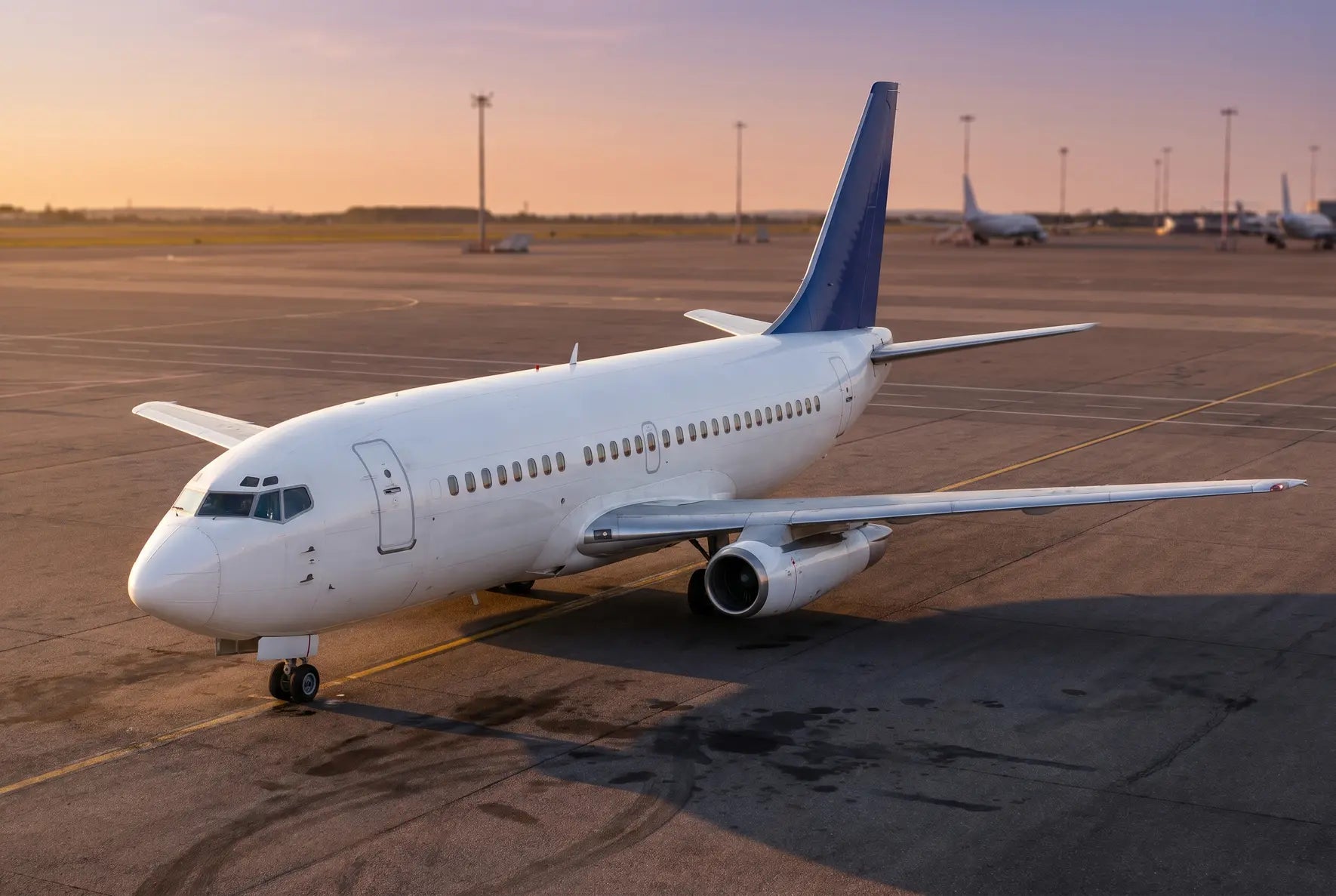
Preliminary design work for what would become the 737 started on May 11, 1964, under the direction of chief project engineer Jack Steiner and chief engineer Joe Sutter. Market research at the time pointed to strong demand for a 50 to 85 seat airliner capable of serving routes between 50 and 1,000 miles. The initial configuration mirrored the 727 with rear fuselage mounted engines, a T tail, and five abreast seating. However, launch customer Lufthansa demanded a wider fuselage to accommodate six abreast seating, matching the cross section of the Boeing 707. This requirement prompted Sutter's team to relocate the two Pratt & Whitney JT8D low bypass turbofan engines from the rear fuselage to underwing pods mounted directly to the wing underside without conventional pylons. The redesign lightened the airframe structure, allowed a conventional horizontal stabilizer instead of a T tail, and shortened the landing gear to keep the fuselage low enough for airstair boarding at airports without jetbridges.
On February 1, 1965, Boeing formally announced the 737 program launch. Lufthansa placed the launch order for 21 aircraft on February 19, 1965, becoming the first non American airline to launch a new Boeing commercial jet. Just weeks later, on April 5, 1965, United Airlines ordered 40 units but requested a larger variant, prompting the simultaneous development of the stretched 737-200.
The first 737-100 prototype, registered N73700, was rolled out on January 17, 1967, at Boeing's Renton plant. Its maiden flight took place on April 9, 1967, piloted by Brien Wygle and Lew Wallick from Boeing Field. The flight test program progressed rapidly, and the Federal Aviation Administration (FAA) issued Type Certificate A16WE on December 15, 1967. Notably, the Boeing 737-100 was the first commercial aircraft to receive Category II approach certification as part of its initial type approval, permitting precision instrument approaches with decision heights between 98 and 197 feet.
Lufthansa took delivery of its first aircraft on December 28, 1967, and inaugurated revenue service on February 10, 1968. However, airline interest in the short body variant remained limited. Only 30 Boeing 737-100 airframes were produced in total, delivered to Lufthansa (22 units), Malaysia Singapore Airlines (6 units), and Avianca (2 units). The last airworthy example was retired in 2005, and the type has since been removed from the ICAO Doc 8643 register as no operational aircraft remain.
What Distinguishes the Boeing 737-100 from Later 737 Variants
The Boeing 737-100 stands apart from every subsequent member of the 737 family through a combination of its compact fuselage, its powerplant installation, and its unique aerodynamic design. At just 28.65 metres (94 feet) in length, it was the shortest 737 ever built. Its two Pratt & Whitney JT8D-7 engines were mounted in slim, circular nacelles bolted directly beneath the wings with no pylons, a configuration made possible by the engine's narrow diameter. When Boeing later switched to the larger diameter CFM56 high bypass turbofans for the 737 Classic series in the 1980s, the low wing clearance forced engineers to adopt the characteristic flattened, non circular engine inlets that have defined every 737 generation since. The 737-100 also featured shorter landing gear than later models, reflecting its design priority of low sill height for simple ground operations at smaller airports.
Compared to the 737-200, which was developed simultaneously, the 737-100 had a fuselage 36 inches shorter forward of the wing and 40 inches shorter aft, limiting maximum seating to approximately 115 passengers versus 130 in the stretched variant. The 737-200's greater capacity and improved payload range economics quickly made it the preferred choice among airlines, ultimately reaching 1,114 units produced. For context on how regional jet programs later addressed similar short haul market needs with different design philosophies, the Bombardier CRJ1000 offers an interesting comparison.
Key variant identifiers that define the Boeing 737-100 include:
- Engines: Two Pratt & Whitney JT8D-7 turbofans, each rated at approximately 14,000 lbf (62.3 kN) of thrust
- Fuselage length: 28.65 m (94 ft), the shortest of any 737 variant
- Wingspan: 28.35 m (93 ft), shared with the 737-200
- Maximum takeoff weight (MTOW): Approximately 49,950 kg (110,000 lbs)
- Typical passenger capacity: 103 to 115 in a single class layout
- Nacelle design: Circular inlets mounted directly under the wing without pylons
- ICAO designator: B731
- Total production: 30 aircraft (1967 to 1969)

A South African Airlink Boeing 737-200 Advanced aircraft is shown in flight against a clear blue sky. The airplane's livery features the colors of the South African flag on the tail fin.
Boeing 737 100 Technical Specifications, Systems and Engine Overview
The Boeing 737 100 was the original member of the 737 family, designed in the mid 1960s as a short haul, high frequency narrowbody airliner for routes of roughly 1,500 nautical miles or less. Boeing optimized the airframe for quick turnarounds and short to medium length runways, accepting a modest range in exchange for lower operating costs and simplicity. The fuselage cross section was inherited from the Boeing 707 and 727, allowing six abreast seating in a 3+3 layout with a cabin width of 3.54 m, while the wing and empennage were entirely new designs sized for the aircraft's lighter weight class.
Only 30 units of the 737 100 were built between 1966 and 1969, making it one of the rarest variants in the 737 lineage. Lufthansa was the launch customer, placing the type into service in February 1968. Despite its brief production run, the 737 100 proved the fundamental design concept that would evolve through the 737 200, Classic, Next Generation and MAX families. Its systems philosophy, centered on hydro mechanical flight controls and dual hydraulic redundancy, set the template carried forward by every subsequent 737 variant.
- Overall length: 28.65 m (94.0 ft)
- Wingspan: 28.35 m (93.0 ft)
- Height: 11.23 m (36.8 ft)
- Typical seating: up to 111 passengers in a single class layout
- Maximum Takeoff Weight (MTOW): 49,940 kg (110,000 lb)
- Maximum Landing Weight (MLW): 44,906 kg (99,000 lb)
- Operating Empty Weight (OEW): approximately 28,150 kg (62,000 lb)
- Fuel capacity: approximately 17,860 litres (4,720 US gal)
- Range: approximately 1,540 to 1,720 NM (varies with payload and configuration)
- Cruise speed: Mach 0.73, approximately 780 km/h (420 kt TAS) at altitude
- Service ceiling: 37,000 ft
- Takeoff field length: approximately 1,800 m (5,900 ft) at MTOW, standard conditions
- Landing distance: approximately 1,400 m (4,600 ft)
- Engines: 2 x Pratt & Whitney JT8D 7 turbofans, each rated at 14,000 lbf (62.3 kN) takeoff thrust
Systems Architecture and Handling
The 737 100 employed a conventional hydro mechanical flight control system, with pilot inputs transmitted to hydraulic actuators through steel cables running along the fuselage and wings. Primary flight controls consisted of ailerons, elevators, a single rudder, and flight spoilers, all powered by two independent hydraulic systems (System A and System B). In the event of a dual hydraulic failure, the aircraft was designed to revert to manual reversion, where servo tabs on the ailerons and elevators allowed the pilot to maintain directional control using aerodynamic forces alone. This architecture, shared with the Boeing 707 and 727, prioritized mechanical simplicity and redundancy over electronic automation.
The avionics suite reflected 1960s era standards, built around ARINC 500 series equipment. There was no flight management system or autothrottle in the original configuration; the autopilot provided basic heading, altitude hold, and ILS approach coupling functions. Pilots preparing for technical interviews on legacy Boeing types will find that the 737 100's systems philosophy is an excellent foundation for understanding how Boeing's design DNA evolved across later generations.
Published performance figures for the 737 100 can vary depending on the source because of differences in operator configuration, cabin density, chosen engine variant, atmospheric assumptions (ISA versus hot and high conditions), and runway surface state. Boeing's airport planning documents specify values under standardized conditions, but real world takeoff distances, range, and payload capabilities are influenced by factors such as flap setting, bleed air configuration, and actual aircraft weight. Any comparison between variants should account for these variables, and published numbers are best treated as reference baselines rather than absolute limits.
Pratt & Whitney JT8D: The Engine Behind the Original 737
The Boeing 737 100 was exclusively powered by the Pratt & Whitney JT8D, a low bypass turbofan that became one of the most successful jet engines in commercial aviation history. The JT8D family was derived from the military J52 turbojet and first ran in the early 1960s, entering airline service in 1964 on the Boeing 727. The standard variant fitted to the 737 100 was the JT8D 7, producing 14,000 lbf (62.3 kN) of takeoff thrust, although the slightly more powerful JT8D 9, rated at 14,500 lbf (64.5 kN), was also certified for the type.
The JT8D is a dual spool, axial flow turbofan featuring a two stage fan, a six stage low pressure compressor, a seven stage high pressure compressor, nine can annular combustion chambers, and a four stage turbine section. It has a bypass ratio of approximately 1.0, making it a low bypass design by modern standards. Its fan tip diameter is approximately 39.9 inches (101 cm), with a flange to flange length of around 120 inches (305 cm) and a dry weight of roughly 3,155 lb (1,431 kg). Specific fuel consumption at takeoff is around 0.80 lb/(lbf·h).
Beyond the 737 100 and 737 200, the JT8D powered a wide range of aircraft including the Boeing 727 (all variants), the McDonnell Douglas DC 9 series, the Dassault Mercure, and the Sud Aviation Caravelle (later variants). The higher thrust JT8D 200 series, producing 18,500 to 21,700 lbf, was developed specifically for the McDonnell Douglas MD 80 family starting in 1980. Pratt & Whitney, now part of RTX Corporation, produced over 14,750 JT8D engines in total, accumulating more than 673 million flight hours. While no longer fitted to new production aircraft, the JT8D remains in service on freighter and legacy platforms around the world.
Boeing 737 Early and Classic Variants Comparison (737-100, -200, -300, -500)
Scroll horizontally to see more →
| Parameter | Boeing 737-100 | Boeing 737-200 | Boeing 737-300 | Boeing 737-500 |
|---|---|---|---|---|
| Entry into service | 1968 | 1968 | 1984 | 1988 |
| Engines | 2 × Pratt & Whitney JT8D-7 | 2 × Pratt & Whitney JT8D-15 | 2 × CFM56-3 | 2 × CFM56-3 |
| Length | 28.7 m | 30.5 m | 33.8 m | 31.0 m |
| Wingspan | 28.4 m | 28.4 m | 28.9 m | 28.9 m |
| Height | 11.2 m | 11.2 m | 11.1 m | 11.1 m |
| Typical seating and layout | 2-class: 100–115 passengers | 2-class: 115–130 passengers | 2-class: 130–150 passengers | 2-class: 110–132 passengers |
| MTOW | 50 t | 52 t | 63 t | 56 t |
| Range | 1,700 nm | 2,500 nm | 3,000 nm | 2,700 nm |
| Cruise speed | 0.74 Mach | 0.74 Mach | 0.78 Mach | 0.78 Mach |
| Service ceiling | 37,000 ft | 37,000 ft | 37,000 ft | 37,000 ft |
| Program note | Original short-fuselage 737, low production (30 units) | Slightly stretched version with higher weights and thrust | Classic series, first with high-bypass CFM56 engines | Short-fuselage Classic, positioned between -300 and originals |
Scroll horizontally to see more →
The table compares key specifications of the Boeing 737-100, -200, -300 and -500, showing how the family evolved from the short, low-production -100 to the larger and longer-range Classic models. The -300 is the longest and has the highest MTOW (63 t) and range (3,000 nm), while the -200 offers a big range jump over the -100. The -300/-500 switch to CFM56 engines and cruise faster at Mach 0.78 versus 0.74 for the JT8D-powered originals.
Boeing 737-100 Operations, Typical Routes and Airlines That Flew the Original 737
The Boeing 737-100 was designed from the outset as a short haul workhorse intended to replace ageing turboprops and smaller jets on high frequency domestic and regional routes. With a maximum range of approximately 1,720 nautical miles (about 3,185 km) at full payload and a cruise speed of Mach 0.73 (around 420 knots true airspeed), the aircraft was optimised for sectors typically lasting between one and three hours. According to SKYbrary, the type had a service ceiling of 35,000 feet and required roughly 6,700 feet of runway for takeoff under standard sea level conditions, making it compatible with a wide range of airports including secondary and regional fields.
In daily airline service during the late 1960s through the 1980s, operators typically scheduled the Boeing 737-100 for four to six sectors per day, achieving eight to twelve block hours of utilisation. This high cycle pattern suited hub and spoke networks as well as point to point shuttle services between close city pairs. The aircraft's compact dimensions, simple systems and twin Pratt & Whitney JT8D engines allowed rapid turnarounds of 30 to 45 minutes, a significant advantage on competitive short haul corridors. However, the very limited production run of only 30 airframes meant that economies of scale were never fully realised, and operators eventually transitioned to the longer fuselage Boeing 737-200, which offered more seats over essentially the same routes.
One of the main operational challenges for Boeing 737-100 operators was the relatively high fuel consumption of the JT8D low bypass turbofans compared with later high bypass engines. Noise regulations that tightened throughout the 1970s and 1980s also posed difficulties, particularly at European airports with strict curfews. These factors, combined with the small fleet size, contributed to the type's early retirement from passenger service by the mid 1990s.
Where the Boeing 737-100 Operated Around the World
Because only 30 Boeing 737-100 aircraft were ever built, the type's geographic footprint remained modest compared with later 737 variants. Operations were concentrated primarily in Europe and North America, with a small presence in Asia and South America. In Europe, Lufthansa used the aircraft on dense intra German and Western European routes. In North America, several carriers acquired second hand airframes for domestic shuttle and low cost services. In Southeast Asia, Malaysia Singapore Airlines briefly operated the type on short regional sectors. Africa did not see any documented Boeing 737-100 operations.
- Europe – Lufthansa was the launch customer and by far the largest operator, receiving 22 of the 30 airframes produced. The German flag carrier introduced the Boeing 737-100 in February 1968 on short haul European routes such as Frankfurt to Hamburg, Munich and other intra German city pairs, as well as services to neighbouring countries. Flights typically lasted under two hours. Lufthansa progressively retired its fleet during the 1970s as it transitioned to the more capable 737-200. Pilots and cabin crew working for European flag carriers during this era operated under conditions that shaped modern airline crew frameworks still referenced today.
- North & South America – Several United States carriers operated second hand Boeing 737-100 aircraft after Lufthansa began retiring them. People Express flew the type on high frequency, low fare East Coast routes during the early to mid 1980s. When Continental Airlines absorbed People Express in 1987, it inherited several airframes and continued to use them on short haul domestic sectors. Air California also operated the type on intrastate California routes, while Air Florida reportedly flew at least one example on East Coast services. In South America, Avianca of Colombia is listed in some production records as having received two aircraft for domestic routes, although detailed operational data remains scarce.
- Asia – Malaysia Singapore Airlines (MSA) received five Boeing 737-100 aircraft between 1969 and the early 1970s. MSA deployed them on short regional routes in Southeast Asia, including the Singapore to Kuala Lumpur corridor, before the airline split into Malaysia Airlines and Singapore Airlines in 1972. The aircraft were subsequently phased out in favour of newer equipment.
- Africa – No confirmed commercial operators of the Boeing 737-100 have been documented on the African continent. The limited number of airframes built and their concentration among European and American carriers meant the type never reached African markets.
Typical Cabin Layouts and Seating Configurations
The Boeing 737-100 featured a standard six abreast seating arrangement in a 3+3 configuration across a single aisle, consistent with the cabin cross section shared by all 737 variants. According to Boeing 737 documentation on Wikipedia, the first generation 737-100 and 737-200 offered seating for 85 to 130 passengers depending on cabin layout and seat pitch.
In practice, most operators configured the Boeing 737-100 as an all economy aircraft. A vintage 1987 seat map from Continental Airlines shows a single class, all coach layout with 118 seats, an arrangement inherited from People Express, which prioritised maximum capacity on its low fare routes. Lufthansa, as a full service flag carrier, may have offered a more spacious configuration with fewer seats and potentially a small premium cabin section, though specific seat maps from the airline's 737-100 era have not been widely published. Boeing's original 1965 marketing brochure promoted flexible interior options including four, five or six abreast seating, giving airlines the freedom to tailor the cabin to their market. Lower density layouts with around 85 to 100 seats would have been typical for carriers emphasising passenger comfort, while high density configurations pushed capacity closer to 118 to 130 seats. As detailed in Boeing's airport planning documentation, the cabin cross section supported hatrack type overhead stowage, a feature that became standard across the entire 737 family.
In this video, Noel Philips flies on the world’s oldest Boeing 737 and shares what happened along the journey. You will see the onboard experience and key observations from this unique flight.
Boeing 737-100 Safety Record: How Safe Was the Original 737?
With only 30 airframes built between 1967 and 1969, the Boeing 737-100 had one of the smallest production runs of any commercial jetliner. The type entered revenue service with Lufthansa in February 1968 and was gradually phased out over the following decades, with the last example retired around 2006. Over roughly four decades of operation, the Aviation Safety Network database lists approximately 14 occurrences involving the 737-100, the vast majority classified as minor or non-damage events. Only one hull loss is recorded for the type, and no passengers or crew members lost their lives in an operational accident aboard a Boeing 737-100. That single hull loss against 30 aircraft produced and decades of flying represents a remarkably low attrition rate for a first-generation narrowbody jet. When grouped with the closely related 737-200, the combined Original series shows a hull loss rate of around 1.8 per million flights, a figure that must be read in the context of 1960s and 1970s operational standards, navigation technology and airport infrastructure that were far less advanced than today.
Notable Incidents Involving the Boeing 737-100
Condor Flugdienst Flight 316 (20 July 1970) – A Boeing 737-130, registered D-ABEL, collided in mid-air with a Piper PA-28 Cherokee near Tarragona, Spain, while on approach to Reus Airport. The three occupants of the Piper were killed, making this the first fatal event connected to any Boeing 737, although no one aboard the 737 was harmed. The jetliner sustained only minor wing damage, landed safely and was subsequently repaired. The investigation pointed to an air traffic control error that placed both aircraft on a converging path, compounded by the Piper communicating in Spanish rather than the standard English, which the Condor crew could not understand. The accident underscored the need for standardised radiotelephony and improved radar separation procedures in European airspace, contributing to subsequent reforms in air traffic management across the region.
Lufthansa Flight 303 (17 December 1973) – During the 1973 Rome Fiumicino airport attacks, a Boeing 737-100 registered D-ABEY was hijacked by Palestinian militants after they had attacked a Pan Am Boeing 707 on the apron. The hijackers took hostages and forced the aircraft through multiple stops before surrendering in Kuwait. One passenger and one Italian border police officer were killed during the seizure. Although this was a criminal act rather than an operational failure, the event intensified international pressure for stronger terminal security, including mandatory passenger and hand luggage screening and the expansion of armed security at major European airports.
COPA Panama (19 November 1993) – A Boeing 737-112 registered HP-873CMP, operating a scheduled service from Miami, suffered a runway excursion on landing at Tocumen International Airport in Panama City during poor weather. The aircraft touched down approximately 750 metres past the threshold, veered off the runway and was damaged beyond economical repair. All 92 occupants survived. This remains the only hull loss attributed specifically to the 737-100 variant. The occurrence highlighted the importance of stabilised approach criteria and go-around decision making in adverse conditions, topics that have since become central to airline standard operating procedures worldwide.
How Safe Is the Boeing 737-100?
Judged purely on statistical grounds, the Boeing 737-100 compiled an enviable record: zero passenger fatalities from operational accidents across its entire service life. Its lone hull loss, with no injuries, compares favourably with many of its contemporaries. According to Airline Ratings, the combined 737-100/200 series achieved a hull loss rate of 1.8 per million flights, a figure that drops dramatically for later 737 generations thanks to advances in avionics, materials and crew training. The broader 737 family, across all variants and more than 238 million flights, records a hull loss rate of approximately 0.24 per million departures.
The 737-100 benefited from Boeing's conservative structural design philosophy, featuring fail-safe fuselage construction, dual hydraulic systems and reliable Pratt & Whitney JT8D engines. These fundamentals, combined with stringent FAA certification requirements and continuous airworthiness directives, helped keep the fleet flying safely well beyond its originally anticipated service horizon. Airlines that operated the type, from Lufthansa to short-haul carriers across the world, did so under evolving regulatory frameworks that progressively raised the bar for maintenance, crew qualification and operational standards.
Although the 737-100 has long since been retired and superseded by later generations, its operational history confirms a pattern consistent with the wider aviation industry: each generation of technology and regulation makes flying safer still. Data published by Boeing's Statistical Summary of Commercial Jet Airplane Accidents shows that the industry-wide fatal accident rate has declined by more than 65% over the past two decades alone. Commercial aviation remains, by a wide margin, one of the safest forms of mass transportation in existence.
01 What is the typical range and mission profile of the Boeing 737-100?
The Boeing 737-100 has a maximum range of about 1,720 nautical miles with typical passenger loads. It was designed primarily for short to medium-haul routes, such as intra-regional flights of 1,000 to 1,500 miles. Airlines used it for high-frequency shuttle services between major hubs and nearby cities.
02 How is the cabin laid out on the Boeing 737-100, and what is the passenger experience like?
The Boeing 737-100 typically seats 115 to 124 passengers in a single-class layout with narrow 3-3 abreast seating and a single aisle. The cabin feels compact by modern standards, with limited overhead space and higher noise levels from its older engines. Passengers often note a nostalgic, no-frills vibe suited for quick hops rather than long trips.
03 Which airlines operated the Boeing 737-100 and on what kinds of routes?
Launch customer Lufthansa introduced the Boeing 737-100 in 1968, followed by airlines like United Airlines, Southwest Airlines early on, and others such as TransAustralia Airlines. They flew it on short domestic routes, like U.S. coast-to-coast hops under 2 hours or European regional services. Most have since retired it in favor of newer variants.
04 How does the Boeing 737-100 perform compared to similar aircraft?
The Boeing 737-100 cruises at Mach 0.74 with JT8D engines, offering good short-field performance for smaller airports. It is less fuel-efficient than later 737 models or the DC-9 due to older technology, burning more per passenger on longer legs. Its role was as a workhorse for high-density, short routes before stretched variants took over.
05 What is the safety record of the Boeing 737-100?
The Boeing 737-100 has a solid safety record with few hull-loss accidents relative to its service life from 1968 to the 1990s. Key design features include reliable low-wing configuration and trailing-link landing gear for smooth landings. Like early jets, its incidents were often linked to operational factors rather than inherent flaws.
06 What should travelers know about seats and flying on a Boeing 737-100?
Opt for window seats in rows 1-5 or 20-25 for better views and less turbulence feel, as the wings are mid-fuselage. The narrow cabin means tighter legroom at about 31-32 inches pitch, and propwash from engines can make it noisier mid-cabin. It handles turbulence steadily due to its size but expect a bumpier ride on short runways.