


BAC One-Eleven 500: History, Development and What Set This Stretched Variant Apart
The BAC One-Eleven family traces its roots to the late 1950s, when Hunting Aircraft conceived the H.107, a compact 30-seat rear-engined airliner intended to bridge the gap between turboprop feeders and larger jets. When the British Aircraft Corporation (BAC) was formed on 23 February 1960 through a government-encouraged merger of English Electric, Vickers-Armstrongs, Bristol Aeroplane Company and Hunting Aircraft, the H.107 design was absorbed into the new organisation. BAC refined and enlarged the concept, ultimately launching the One-Eleven as a short-haul twinjet designed to replace the ageing Vickers Viscount on European and domestic routes. The programme advanced rapidly: the prototype (G-ASHG) completed its maiden flight on 20 August 1963, and the initial Series 200 entered airline service with British United Airways in April 1965.
Early development was not without setback. On 22 October 1963, the prototype crashed during stall testing near Chicklade, Wiltshire, killing all seven crew members. The investigation determined that the aircraft had entered a deep stall, a condition in which the T-tail was blanketed by the disturbed airflow from the wings and rear-mounted engines, rendering the elevators unable to push the nose down. This tragedy led directly to the adoption of stick-shakers and stick-pushers on the One-Eleven and influenced certification requirements for all subsequent T-tail aircraft worldwide.
Origins of the BAC One-Eleven 500
By the mid-1960s, airlines were seeking greater seating capacity and improved economics from the One-Eleven platform. British European Airways (BEA) was the driving force behind the stretched variant, which BAC designated the Series 500, often referred to as the Super One-Eleven. The prototype, converted from an earlier airframe, completed its first flight on 30 June 1967. The first new-build production aircraft (G-AVMH) followed on 7 February 1968. The Air Registration Board (ARB) granted certification on 15 August 1968, and BEA operated the type's first revenue service on 17 November 1968.
To accommodate up to 119 passengers, the Series 500 featured a fuselage stretched by approximately 4.0 m (13 ft 6 in) compared with the earlier Series 400, bringing total length to 32.61 m (107 ft 0 in). The wingspan grew from 26.97 m (88 ft 6 in) to 28.50 m (93 ft 6 in), with wing area increasing from 91.0 m² to 95.8 m². Powerplants were upgraded to two Rolls-Royce Spey Mk 512-14DW turbofans, each delivering 12,550 lbf (55.8 kN) of thrust, replacing the lower-rated Spey Mk 511 engines of the Series 400. Maximum take-off weight rose to 47,400 kg (104,500 lb).
BEA received a bespoke sub-variant, the Series 510ED, which featured a modified flight deck designed for crew commonality with its existing Hawker Siddeley Trident fleet. This cockpit arrangement required a separate type rating from all other Series 500 aircraft. Aside from BEA, the BAC One-Eleven 500 attracted orders from European charter and scheduled carriers as well as operators in Africa and the Middle East. A total of 86 Series 500 airframes were completed, contributing to overall One-Eleven production of 244 aircraft built between 1963 and 1982 in the United Kingdom, plus nine additional Rombac One-Elevens licence-built in Romania between 1982 and 1989. For those interested in careers tied to classic and modern aircraft operations, resources such as tips on writing a pilot's cover letter can help aspiring professionals get started.
What Differentiates the BAC One-Eleven 500 from Neighbouring Variants
The closest relatives of the Series 500 are the Series 400 and the Series 475. The Series 400, tailored for the North American market and ordered by American Airlines, retained the original shorter fuselage (28.50 m / 93 ft 6 in), the smaller 26.97 m wingspan and the less powerful Spey Mk 511 engines rated at 11,400 lbf. The Series 475, introduced in 1970, paired the Series 500's enlarged wing and uprated Spey 512 engines with the shorter Series 400 fuselage, creating a specialist variant optimised for hot-and-high airfields and low-strength runways, including unpaved strips. Only 10 Series 475 aircraft were built, three of which served with the Royal Air Force of Oman in a quick-change passenger/cargo role.
The following verified identifiers distinguish the BAC One-Eleven 500 from these sub-variants:
- Fuselage length: 32.61 m (107 ft 0 in), approximately 4.0 m longer than the Series 400/475
- Wingspan: 28.50 m (93 ft 6 in), shared with the Series 475 but wider than the Series 200/300/400
- Wing area: 95.8 m² (1,031 sq ft) versus 91.0 m² (980 sq ft) on earlier short-wing variants
- Engines: two Rolls-Royce Spey Mk 512-14DW turbofans, each producing 12,550 lbf (55.8 kN)
- Maximum take-off weight: 47,400 kg (104,500 lb), the highest of any One-Eleven variant
- Typical seating: up to 119 passengers in a single-class layout, versus 89 on the Series 400
- Maximum payload: 11,983 kg (26,418 lb)

A TAROM BAC 1-11 passenger aircraft is captured mid-flight against a clear blue sky. The airplane's markings and livery are prominently displayed, showcasing the design typical of its era.
BAC One-Eleven 500 Technical Specifications, Systems and Engine Overview
The BAC One-Eleven 500 was the stretched, definitive production variant of the One-Eleven family, engineered for short-haul airline operations with higher passenger capacity and improved field performance. Compared to the earlier Series 200/400, the 500 added a 4.06 m (13 ft 4 in) fuselage stretch and extended the wingspan by 1.52 m (5 ft) with distinctive swept wingtip extensions, increasing wing area to 95.8 m². These changes shifted the payload/range balance in favour of greater seat count (up to 119 in a single-class layout) while retaining acceptable runway performance for regional airports. The uprated Rolls-Royce Spey 512-14DW engines, each delivering 55.8 kN (12,550 lbf) of thrust, compensated for the higher operating weights.
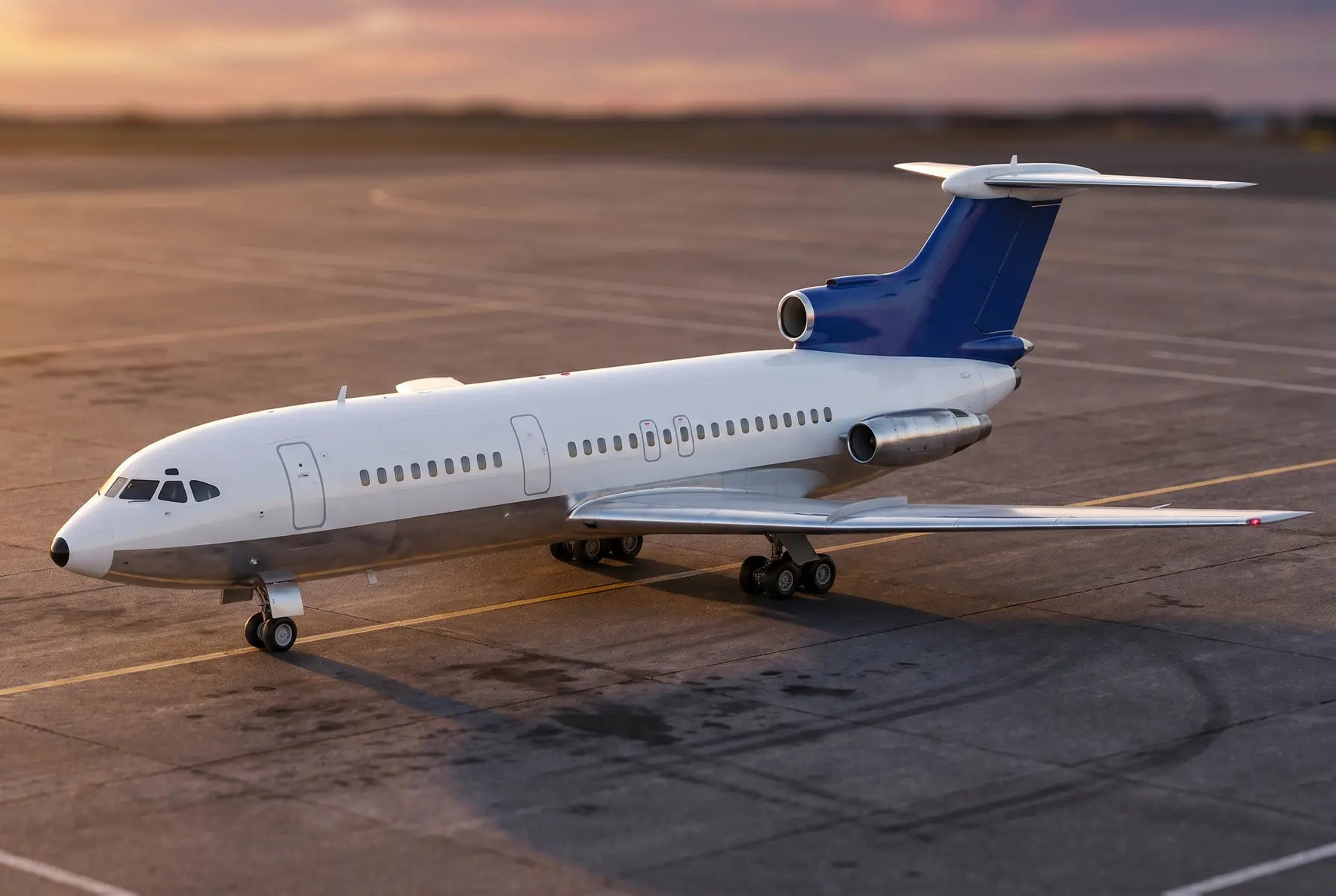
The Series 500 inherited the aft-mounted twin-engine configuration and T-tail arrangement common to the entire One-Eleven line. This layout kept the wing clean for efficient low-speed handling and simplified cabin noise management, but it required careful engineering to address the deep-stall risk identified during the prototype programme. A sub-variant designated 510ED was developed specifically for British European Airways, incorporating a more sophisticated autopilot with autoland capability and an autothrottle for fleet commonality with the Hawker Siddeley Trident. Several European carriers, including those serving regional networks in the Netherlands, operated the type on dense short-haul routes throughout the 1970s and 1980s.
- Overall length: 32.61 m (107 ft 0 in)
- Wingspan: 28.50 m (93 ft 6 in)
- Height: 7.47 m (24 ft 6 in)
- Wing area: 95.8 m²
- Typical seating: 99 to 119 passengers (single class)
- Maximum take-off weight (MTOW): 47,400 kg (104,500 lb)
- Maximum landing weight (MLW): 39,462 kg (87,000 lb)
- Maximum zero-fuel weight (MZFW): 36,740 kg (81,000 lb)
- Operating empty weight (OEW): approximately 24,780 kg
- Standard fuel capacity: 14,020 litres; integral wing tanks of 10,160 litres plus a centre tank of 3,864 litres
- Engines: 2 × Rolls-Royce Spey 512-14DW turbofans, each rated at 55.8 kN (12,550 lbf)
- Maximum cruise speed: 475 kts (882 km/h) at FL210
- Economical cruise speed: 440 kts (815 km/h) at FL250
- Service ceiling: 10,670 m (35,000 ft)
- Range with maximum payload: approximately 2,700 km (1,480 nm)
- Take-off field length: approximately 2,280 m (7,480 ft) at MTOW
- Landing field length: approximately 1,450 m (4,760 ft)
Systems and Handling Technology
The One-Eleven 500 relied on dual hydraulic flight control systems backed by AC electric pumps for redundancy. The elevators were hydraulically boosted rather than purely cable-operated, giving pilots greater authority during demanding phases of flight such as stall recovery. To mitigate the deep-stall risk inherent in T-tail designs, BAC fitted stick shakers and pneumatic stick pushers linked to dual angle-of-attack sensors on each side of the fuselage. If the angle of attack exceeded safe limits, the stick shaker alerted the crew; if corrective action was not taken, the stick pusher automatically applied nose-down input via a pneumatic ram. The wing leading edge was also redesigned to improve airflow characteristics at high angles of attack.
The 510ED sub-variant, ordered by BEA, added autoland capability certified for Category II conditions, an autothrottle, Doppler navigation equipment, and a Hakco moving-map display. These avionics upgrades represented a significant step up from the standard Series 500 panel and required a separate type rating. The airframe itself was recognised for exceptional structural strength, with documented cases of successful recovery from severe windshear and microburst encounters during operational service.
Published performance figures for the BAC One-Eleven 500 should always be interpreted in context. Actual take-off and landing distances depend on runway elevation, ambient temperature, wind component, surface condition, and the operator's specific weight configuration. Cabin density choices (from 99 seats in a generous layout to 119 in high-density) directly affect payload range. Ferry range (quoted at approximately 1,915 nm) assumes no payload and maximum fuel. Operators frequently applied weight restrictions at hot-and-high airfields, particularly in tropical and high-altitude destinations, reflecting the engine's sensitivity to density altitude at maximum gross weights.
Rolls-Royce Spey 512-14DW: The Engine Behind the One-Eleven 500
The Rolls-Royce Spey is a low-bypass turbofan designed in the late 1950s by a Rolls-Royce team under Frederick Morley. The Spey 512-14DW variant, fitted exclusively to the One-Eleven 500, is the most powerful civil mark of this engine family, rated at 55.8 kN (12,550 lbf) of static thrust at sea level. It is a twin-spool design with a five-stage low-pressure compressor, a twelve-stage high-pressure compressor, ten can-annular combustion chambers, and two-stage high-pressure and low-pressure turbines. The bypass ratio is 0.64:1, classifying it firmly in the low-bypass category.
First run in the early 1960s, the Spey entered airline service in 1964 and went on to power a remarkably diverse fleet. Civil variants propelled the Hawker Siddeley Trident, the Gulfstream II and III business jets, and the Fokker F28 Fellowship (via the smaller RB.183 Spey Junior derivative). Militarised versions equipped the Blackburn Buccaneer S.2, the British Phantom FG.1 and FGR.2, the Hawker Siddeley Nimrod maritime patrol family, and the AMX International AMX light attack aircraft (built under licence by Fiat Avio). China also produced the engine as the WS-9 for the Xian JH-7 fighter-bomber. Beyond aviation, the Spey was adapted into a marine gas turbine powering Royal Navy Type 23 frigates and other warship classes worldwide.
Although the Spey's low bypass ratio made it less fuel-efficient than the high-bypass turbofans that succeeded it, the engine earned a strong reputation for reliability and robustness in short-cycle operations. Accumulated flight hours across all Spey variants exceeded 50 million. Its core technology later evolved into the Rolls-Royce Tay, a higher-bypass development that replaced the Spey in the Fokker 70/100 family and the re-engined Gulfstream IV.
BAC One-Eleven Variants vs Douglas DC-9-30: Key Specifications Comparison
Scroll horizontally to see more →
| Parameter | BAC One-Eleven 500 | BAC One-Eleven 400 | BAC One-Eleven 200 | Douglas DC-9-30 |
|---|---|---|---|---|
| Entry into service | 1968 | 1965 | 1965 | 1967 |
| Engines | 2 × Rolls-Royce Spey 512-14DW | 2 × Rolls-Royce Spey 511-14 | 2 × Rolls-Royce Spey 511-14 | 2 × Pratt & Whitney JT8D-9/11 |
| Length | 32.6 m | 28.5 m | 28.5 m | 36.4 m |
| Wingspan | 28.5 m | 26.8 m | 26.8 m | 27.3 m |
| Height | 7.5 m | 7.6 m | 7.6 m | 8.4 m |
| Typical seating and layout (short description + approximate passengers) | 1-class: 99–119 passengers | 1-class: 89–99 passengers | 1-class: 79–89 passengers | 1–2-class: 115–125 passengers |
| MTOW | 45.2 t | 44.7 t | 35.8 t | 49.9 t |
| Range | 1,460 nm | 1,340 nm | 1,010 nm | 1,500 nm |
| Cruise speed | 0.80 Mach | 0.80 Mach | 0.80 Mach | 0.78 Mach |
| Service ceiling | 35,000 ft | 35,000 ft | 35,000 ft | 35,000 ft |
| Program note | Stretched, higher-capacity One-Eleven variant for dense short-haul routes, with more powerful Spey engines and longer wings. | Intermediate One-Eleven version offering modest stretch and payload increase over the original 200 while retaining common systems. | Baseline short-haul BAC One-Eleven model, optimized for regional jet services from shorter runways. | Competing short-haul twinjet of similar era and capacity, forming the core of many airlines’ 1960s–1970s regional jet fleets. |
Scroll horizontally to see more →
The table compares the BAC One-Eleven 500/400/200 with the Douglas DC-9-30 across entry into service, dimensions, engines, capacity, and performance. The One-Eleven 500 is the stretched Spey-powered variant (99–119 seats) with 1,460 nm range, while the 200 is smaller and shorter-range (1,010 nm). The DC-9-30 is longer, offers the highest MTOW, similar ceiling, slightly slower cruise, and the longest range at 1,500 nm.
BAC One-Eleven 500 Routes, Missions and Airlines Around the World
The BAC One-Eleven 500 was designed from the outset as a short to medium haul workhorse, replacing turboprop types on domestic and intra-regional routes. With a maximum range of approximately 1,480 nautical miles (2,744 km) and seating for up to 119 passengers, the Series 500 was well suited to sectors typically lasting between one and two and a half hours. Routes generally did not exceed 800 miles (1,290 km) in scheduled network use, though the aircraft could cover longer legs at reduced payload. Its Rolls-Royce Spey 512 engines, each producing 12,550 pounds-force of thrust, gave adequate climb and cruise performance for these missions.
The BAC One-Eleven 500 required approximately 2,000 m (6,500 ft) of runway for takeoff at maximum weight, and around 1,440 m (4,720 ft) for landing. This made it compatible with most major and secondary airports across Europe, though it was not ideally suited to very short strips or unprepared surfaces due to its relatively high wheel loading. Airlines typically scheduled the aircraft for multiple rotations per day on trunk domestic and intra-European services, with rapid turnaround times that helped maximise daily utilisation.
Operationally, the aircraft fitted both hub-and-spoke and point-to-point networks. In Europe, British European Airways (BEA) deployed it on scheduled routes radiating from London Heathrow and regional hubs such as Manchester and Birmingham, feeding traffic into larger long-haul networks. Charter and inclusive tour operators used it on point-to-point leisure routes from secondary airports across the United Kingdom and Europe to Mediterranean holiday destinations. In Africa and Central America, the type served thinner scheduled routes linking capitals and regional centres to international gateways such as Miami.
A notable challenge for operators was the aircraft's noise profile. The Spey engines, while reliable, classified the BAC One-Eleven 500 as an ICAO Chapter 2 aircraft. As airports across Europe and North America introduced increasingly strict noise restrictions from the late 1980s onward, many carriers found the type progressively excluded from key airports, accelerating its retirement in favour of quieter, more fuel-efficient replacements such as the Boeing 737-300 and Airbus A320. Rising fuel costs further eroded its economic viability. By the mid-1990s, most Western operators had phased the type out of frontline service.
Where the BAC One-Eleven 500 Operated
The Series 500 found its largest customer base in Europe, where it served both scheduled and charter markets for nearly three decades. British European Airways ordered 18 aircraft (designated the 510ED sub-variant) in 1967, which later passed to British Airways following the BEA/BOAC merger. Several UK charter and leisure carriers adopted former BA airframes, keeping the type active well into the 1990s. In the Americas, the aircraft operated scheduled services between Central America, the Caribbean and the United States, connecting smaller national carriers with major gateways. South America also saw scheduled use. In Africa, national carriers in countries such as Malawi and Zambia deployed the type on domestic trunk routes and regional connections. Asia saw limited Series 500 use, though earlier BAC One-Eleven variants served airlines in the Philippines and the broader region, performing domestic and short regional hops comparable to similar turboprop replacements such as the Fokker F27.
- Europe: British European Airways (BEA) and subsequently British Airways were the principal scheduled operators, deploying the BAC One-Eleven 500 on domestic UK routes and intra-European services from London, Manchester, and Birmingham. British Caledonian Airways operated 19 Series 500 aircraft on European scheduled routes before its 1988 merger. Dan Air flew 15 examples on both scheduled and charter services across Europe. Ryanair used ROMBAC-built and former BA examples on early low-fare services between Ireland and the UK from 1986. Cyprus Airways operated 6 Series 500 aircraft on scheduled routes, while Monarch Airlines used 4 on inclusive tour charters to Mediterranean resorts. Hapag-Lloyd Flug in Germany operated 7 and European Aviation Air Charter accumulated 19 airframes for leisure flying.
- North & South America: LACSA of Costa Rica operated 4 Series 500 aircraft on scheduled services to Miami. Bahamasair used the type between Nassau and Miami. Aviateca (Guatemala) and Belize Airways also flew the Series 500 into Miami and New Orleans. In South America, Transbrasil operated 9 Series 500 aircraft on domestic Brazilian routes.
- Asia: Direct Series 500 operations in Asia were limited. Philippine Airlines operated earlier BAC One-Eleven variants on domestic trunk routes such as Manila to Cebu and Davao. The ROMBAC-produced Series 560 found use with Aero Asia International in Pakistan during the 1990s on domestic services.
- Africa: Air Malawi operated 3 Series 500 aircraft on domestic and regional routes in southeastern Africa. Zambia Airways used 2 aircraft before selling them to Dan Air. In Nigeria, Chanchangi Airlines operated at least one Series 500 airframe on domestic services during the late 1990s. TAROM of Romania, although geographically European, used its ROMBAC-built fleet on services across Europe and to North Africa.
Typical Seating Configurations
The BAC One-Eleven 500 featured a fuselage cabin width of 3.20 m (10 ft 4 in), arranged in a standard five-abreast layout (3+2) with a single centre aisle. Seating capacity varied considerably depending on operator type and mission. Scheduled network carriers such as British Airways typically configured the aircraft with around 107 to 119 seats in a single-class economy layout at 33 to 34 inch seat pitch. A two-class arrangement offered 14 first-class seats at 38 inch pitch forward and 91 economy seats at 34 inch pitch in the rear cabin, as documented in BAE Systems Heritage records.
Charter and inclusive tour operators favoured higher-density configurations to reduce per-seat costs on leisure routes. Layouts of 129 seats at 30 inch pitch or up to 136 seats at 29 to 32 inch pitch were proposed and used by holiday carriers. The manufacturer even documented configurations reaching 144 seats at tight pitch, though these were rarely adopted in practice. According to AirVectors, a maximum of 122 seats was more commonly referenced as the practical upper limit in all-economy service, with 107 seats being a conventional standard that balanced comfort with commercial efficiency. The cabin measured approximately 21.44 m (70 ft 4 in) in length and included three galleys and three lavatories in most standard configurations.
In this video, discover the BAC 111, a short-range jet airliner developed by the British Aircraft Corporation in the early days of modern aviation, and learn why this aircraft helped shape regional jet travel.
BAC One-Eleven 500 Safety Record: Accidents, Incidents and How Safe Is It?
The BAC One-Eleven 500 entered airline service in the late 1960s as a stretched, higher capacity development of the original One-Eleven family. Approximately 86 Series 500 airframes were built in the United Kingdom, forming part of a total production run of 244 aircraft across all variants. Operators ranged from major European flag carriers such as British European Airways and British Airways to charter airlines and, later, secondary carriers in Africa and the Middle East. The type remained in commercial passenger service for roughly four decades before the last examples were retired in the mid 2000s, primarily due to noise regulations rather than structural concerns.
Across that long operational life, the BAC One-Eleven family accumulated millions of flight hours. The overall safety record of the type is broadly comparable to other first generation short haul jets of its era. Several serious accidents did occur, but the majority were attributed to human factors, maintenance lapses or operational shortcomings rather than systemic airframe design flaws. Understanding these events in context is essential for a balanced assessment of the aircraft's safety profile.
Notable Accidents and Incidents Involving the BAC One-Eleven 500
Three events stand out in the operational history of the Series 500 variant, each of which prompted meaningful improvements in aviation safety.
- Paninternational Flight 112 (6 September 1971, Hamburg, Germany) – A BAC One-Eleven 515FB suffered dual engine failure shortly after take off from Hamburg Fuhlsbüttel Airport. The cause was traced to a ground handling error: kerosene had been loaded into the water injection system instead of demineralised water. When the contaminated fluid was sprayed into the Rolls Royce Spey engines during the take off roll, both powerplants overheated and failed. The captain attempted an emergency landing on the A7 motorway, but the aircraft struck an overpass. Of the 121 people on board, 22 lost their lives. The accident underscored the critical importance of fluid handling protocols and independent verification checks during ground servicing. Two maintenance workers were later convicted for the error, as documented by the Aviation Safety Network.
- British Airways Flight 5390 (10 June 1990, near Didcot, United Kingdom) – A BAC One-Eleven 528FL, registration G-BJRT, experienced explosive decompression at 17,300 feet when the left cockpit windscreen detached. The captain was partially sucked out of the opening while cabin crew held him in place. The first officer made a successful emergency diversion to Southampton Airport with no fatalities. The UK Air Accidents Investigation Branch (AAIB) determined that 84 of the 90 windscreen bolts had been replaced with fasteners of incorrect diameter and six were too short, installed by a shift maintenance manager who worked alone, without consulting the Illustrated Parts Catalogue and without an independent inspection. The AAIB report led to tightened requirements for the mandatory use of approved maintenance data, dual independent inspections for safety critical tasks, improved stores control for parts and fasteners, and stronger human factors training across the UK maintenance sector.
- EAS Airlines Flight 4226 (4 May 2002, Kano, Nigeria) – A BAC One-Eleven 525FT overran the runway during take off from Mallam Aminu Kano International Airport. Dust ingested by the engines reduced thrust and the landing gear failed to retract. The aircraft could not gain altitude and crashed into a residential area. Of the 77 people on board, 73 perished, along with a significant number of casualties on the ground. Investigators pointed to crew unfamiliarity with the shorter runway and poor cockpit coordination. This remains the deadliest accident involving the BAC One-Eleven and highlighted ongoing concerns about regulatory oversight and operator standards in certain regions.
It is also worth noting that the entire One-Eleven programme benefited from a painful early lesson. In 1963, the prototype (a Series 200) was lost during stall testing near Chicklade, Wiltshire, when the aircraft entered an unrecoverable deep stall, a phenomenon where the T tail is blanketed by disturbed airflow from the wings. All seven crew members were killed. The accident led BAC to fit production aircraft with stick shakers and automatic stick pushers, devices that became standard on T tail jets worldwide and contributed directly to the safe service record of the Series 500 in later decades.
How Safe Is the BAC One-Eleven 500?
When evaluated against the volume of flights performed over nearly four decades, the accident rate of the BAC One-Eleven 500 is broadly in line with other regional jets of its generation. The airframe was designed to meet British Civil Airworthiness Requirements (BCAR) and was later validated under additional national standards as it entered service with operators around the world. Its Rolls Royce Spey engines were mature and well understood, and the type benefited from continuous airworthiness directives issued by the UK Civil Aviation Authority.
Most fatal accidents involving the One-Eleven 500 were rooted in operational and human factors, such as maintenance errors, incorrect ground servicing or crew performance, rather than inherent design weaknesses. This pattern is consistent with broader aviation safety data: according to Boeing's Statistical Summary of Commercial Jet Airplane Accidents, human and operational factors remain the leading contributors to hull loss events across all types. Airlines that maintained rigorous standard operating procedures (SOPs), adhered to manufacturer bulletins and operated under strict regulatory oversight, such as those governed by the UK CAA or equivalent authorities, flew the type with very few incidents.
For passengers and aviation enthusiasts assessing the legacy of the BAC One-Eleven 500, it is important to remember that commercial aviation, taken as a whole, remains one of the safest forms of transport. Lessons drawn from the One-Eleven's service life, from deep stall prevention to maintenance human factors, have been absorbed into modern airworthiness standards and continue to make flying safer for everyone.
01 What is the maximum range of the BAC One-Eleven 500?
The BAC One-Eleven 500 has a maximum range of approximately 2,700 kilometers (1,680 miles) with maximum payload, making it suitable for regional and medium-haul routes across Europe and North Africa. With ferry tanks and no payload, the aircraft can extend its range to around 2,240 nautical miles, allowing for longer positioning flights when necessary.
02 How many passengers can the BAC One-Eleven 500 typically carry?
The BAC One-Eleven 500 is configured for a maximum of 119 passengers in a high-density layout, though typical airline configurations often featured between 100 and 119 seats depending on comfort preferences. The extended fuselage length of 32.61 meters compared to earlier variants provided additional cabin space for increased seating capacity.
03 What was the cruising speed of the BAC One-Eleven 500?
The BAC One-Eleven 500 cruised at a maximum speed of 548 miles per hour (475 knots or 882 kilometers per hour) at 21,000 feet, with a fuel-efficient cruising speed of 507 miles per hour at 25,000 feet. The aircraft had a maximum operating altitude of 35,000 feet and could reach a maximum Mach number of 0.78.
04 How did the BAC One-Eleven 500 perform on short airfields?
The BAC One-Eleven 500 required a takeoff distance of 6,500 feet (2,000 meters) at maximum weight under standard conditions, demonstrating solid short-field performance for a jet airliner of its era. This capability made it attractive for regional operations at airports without long runways, contributing to its popularity on European trunk routes.
05 What engines powered the BAC One-Eleven 500 and how efficient were they?
The BAC One-Eleven 500 was equipped with two Rolls-Royce Spey 512-14DW turbofan engines, each producing 12,550 pounds of thrust, delivering a total combined thrust of approximately 55.8 kilonewtons. Fuel consumption at economical cruise speed was approximately 2,783 kilograms per hour, with a specific fuel consumption of 88.6 kilograms per kilonewton per hour, making it reasonably efficient for short to medium-range regional operations.
06 What made the BAC One-Eleven 500 different from earlier BAC One-Eleven variants?
The BAC One-Eleven 500 featured more powerful Spey 512 engines compared to the earlier Series 200 and 300 variants, which used less powerful Spey 506 and 511 engines, resulting in improved climb performance and payload capacity. The Series 500 also had an extended fuselage, longer wingspan, and increased maximum takeoff weight of 104,500 pounds, allowing for higher seating capacity and greater range with payload compared to its predecessors.